
能源

Search documents
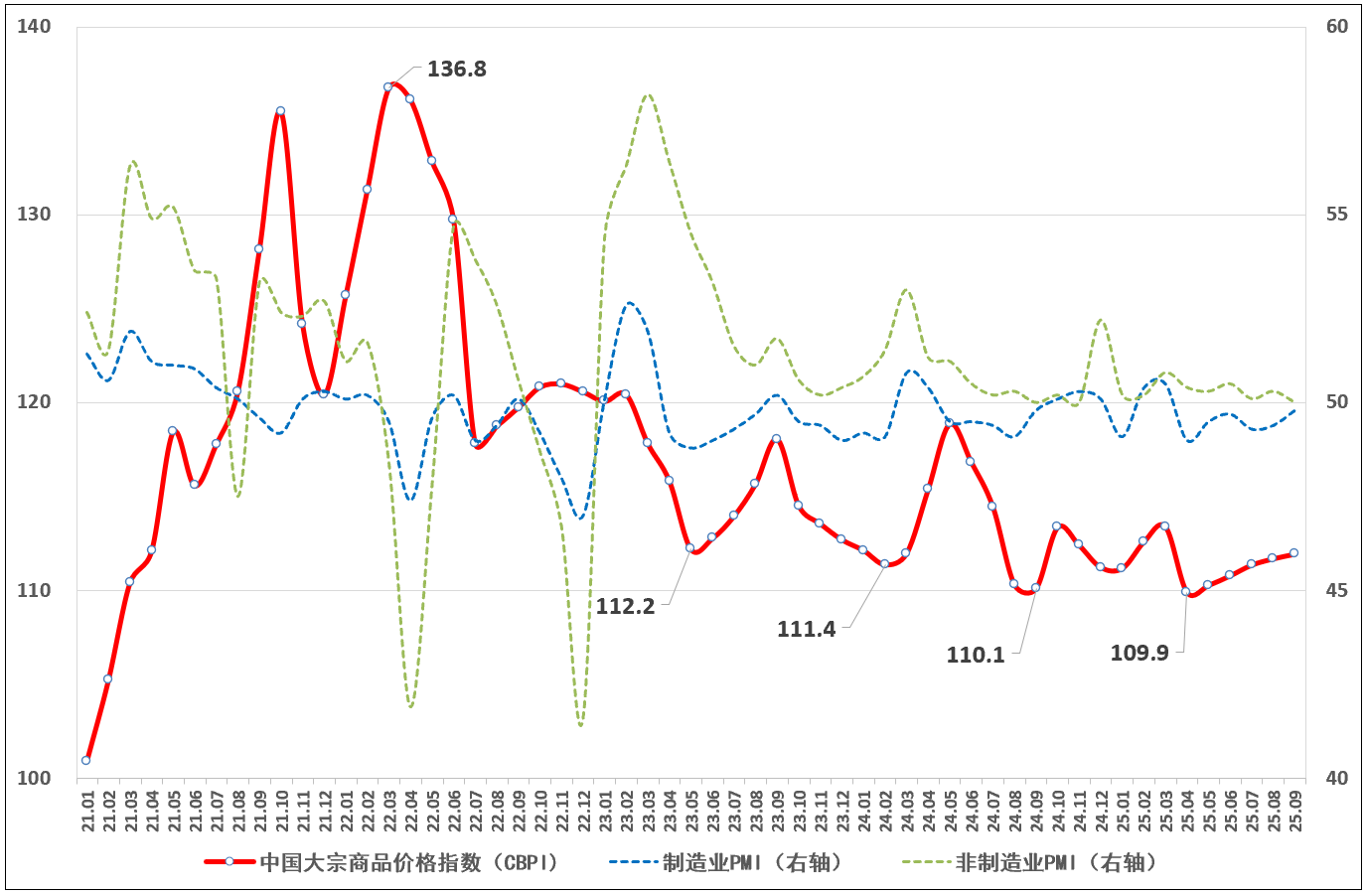
大宗商品价格指数连续5个月环比上升 有色价格指数继续走高
Xin Hua Cai Jing· 2025-10-05 02:04
Core Insights - The China Commodity Price Index (CBPI) for September 2025 is reported at 111.9 points, reflecting a month-on-month increase of 0.2% and a year-on-year increase of 1.7%, indicating a stable overall operation in the commodity market [1][7] Price Index Overview - The non-ferrous price index rose to 131.8 points, with a month-on-month increase of 1.1% and a year-on-year increase of 5.7% [3] - The black metal price index decreased to 79.0 points, showing a month-on-month decline of 0.8% and a year-on-year increase of 0.7% [3] Price Changes by Commodity - Among 50 monitored commodities, 18 saw price increases in September, with notable rises in corrugated paper (6%), caustic soda (2.5%), and electrolytic copper (2.3%) [6] - Conversely, carbon lithium, urea, and corn starch experienced the largest declines, with month-on-month decreases of 5.5%, 4.3%, and 3.3% respectively [6] Sector Analysis - The mineral price index showed low volatility at 70.4 points, with a month-on-month decrease of 0.1% and a year-on-year decrease of 11.4% [8] - The energy price index slightly declined to 98.0 points, reflecting a month-on-month decrease of 0.7% and a year-on-year decrease of 5.4% [8] - The chemical price index continued its downward trend at 100.0 points, with a month-on-month decrease of 1.9% and a year-on-year decrease of 9.1% [8] Market Dynamics - Analysts noted that the recovery in demand during the peak season was generally below expectations, contributing to the fluctuations in the mineral price index [9] - The energy price index's decline was attributed to reduced gasoline demand post-summer and adverse weather affecting construction projects [9] - The chemical sector faced pressure from weak market demand and the introduction of new production capacities [9]

伯克希尔,重要调整
Shang Hai Zheng Quan Bao· 2025-10-04 09:28
Core Points - Berkshire Hathaway has separated the roles of Chairman and CEO, with the board voting on September 30 to amend the company's bylaws, effective immediately [2][4] - Greg Abel, the current Vice Chairman, is set to become the CEO in early 2026, marking a significant leadership transition [6][7] - Berkshire announced a $9.7 billion acquisition of Occidental Petroleum's chemical business, OxyChem, which is the largest acquisition since 2022 and was orchestrated by Greg Abel [9][12] Company Governance - The amendment to the bylaws includes a new clause that separates the roles of Chairman and CEO, reflecting a shift in governance structure [4][6] - Warren Buffett, who has held both positions since 1965, will continue as Chairman while Greg Abel prepares to take over as CEO [6][8] Acquisition Details - The acquisition of OxyChem is a cash transaction valued at $9.7 billion, aimed at enhancing Berkshire's portfolio with a well-managed asset [9][11] - Occidental Petroleum's motivation for the sale is to alleviate debt, with plans to use $6.5 billion from the sale to reduce its debt load [11][12] - The deal is expected to close in Q4 2025, pending regulatory approval and other customary closing conditions [12]

帮主郑重:铜价飙出一年最大涨,金价七周连阳,这周大宗商品在闹啥?
Sou Hu Cai Jing· 2025-10-04 07:02
Group 1: Oil Market - Oil prices experienced a short-term spike due to geopolitical tensions, particularly Trump's ultimatum to Hamas, raising concerns about Middle Eastern oil supply disruptions [3] - Despite the spike, oil prices actually fell by 7.4% over the week, as market participants remain cautious about OPEC+'s upcoming discussions on production levels and the impact of U.S. government activities on Iraqi oil exports [3] - The overall sentiment in the oil market is mixed, with short-term volatility driven by news but long-term trends dependent on OPEC+ decisions and supply-demand dynamics [3] Group 2: Copper Market - Copper prices surged by 5.2% in a week, marking the largest weekly increase in a year, closing at $10,715 per ton, just under $400 from last year's historical high [4] - The rise in copper prices is attributed to supply chain issues and a weaker dollar, which enhances the attractiveness of dollar-denominated commodities [4] - Other base metals also saw significant increases, with zinc rising by 5% and tin by 8.6%, driven by supply concerns from Indonesia [4] Group 3: Gold Market - Gold prices have risen for seven consecutive weeks, currently standing above $3,885 per ounce, just $12 shy of the previous record high [5] - The increase in gold prices is primarily driven by uncertainty surrounding U.S. government operations and delayed economic data, leading investors to seek gold as a safe-haven asset [5] - There are indications of overbought conditions in the gold market, suggesting potential for a price correction despite the current upward trend [5] Group 4: Investment Strategy - Investors are advised to focus on the underlying "mainline logic" of commodity markets rather than short-term fluctuations, with oil influenced by supply-demand and geopolitical balance, copper by industrial demand and supply gaps, and gold by Federal Reserve policies and global uncertainties [5]

馬斯克免費送太陽能還倒貼錢?別傻了!揭秘背後3層算計#特斯拉 #Tesla #Powerwall #太陽能 #馬斯克 #ElonMusk #商業模式 #理財 #賺錢
大鱼聊电动· 2025-10-03 10:52
Business Strategy Analysis - Tesla's solar leasing program appears to offer free solar panels and monthly payments to customers [1] - The program leverages government subsidies, which primarily benefit Tesla [1] - After five years, customers are likely to either buy out or renew the lease, creating long-term dependency [1] - Tesla aims to build a loyal customer base for its energy empire over a 25-year period [1] Financial Implications - The solar leasing program is not philanthropic but a strategic business move [1] - Tesla profits by turning customers into long-term users of its energy products [1]


美国搞美元霸权收割,各国用人民币反击!美元垄断被打破
Sou Hu Cai Jing· 2025-10-03 04:39
Group 1 - The article discusses the emerging trend of countries moving away from the US dollar as the default currency for international trade, with nations like India, Australia, and Russia exploring alternative currencies for transactions [1][3][5] - Countries are seeking "dollar alternatives" due to a desire to maintain control over their financial systems and avoid reliance on the US, especially after incidents like the freezing of foreign reserves [3][11] - Australia has begun accepting payments in Chinese yuan for iron ore, indicating a shift towards prioritizing transaction convenience and security over the traditional use of the dollar [5][9] Group 2 - The decline in the dollar's appeal is attributed to the perception of "money insecurity," as countries fear their reserves could be frozen or restricted, leading to a loss of trust in the dollar [11][14] - The US's monetary policy, including frequent money printing and interest rate hikes, has contributed to inflation in other countries, prompting them to seek reduced dependence on the dollar [14][21] - Despite the trend towards de-dollarization, the dollar's dominance is expected to persist in the short term due to the US's comprehensive power in economic, military, and technological domains [16][19] Group 3 - The article suggests that while the dollar's hegemony is weakening, it is unlikely to collapse entirely, and a multi-currency system may emerge where different currencies play significant roles in various sectors [21][23] - The shift away from the dollar could impact everyday transactions, such as cross-border shopping, potentially allowing consumers to use their local currencies directly, thus reducing exchange rate risks [27]
港股集体回撤,公用、工商、科技、石油纷纷跳水
Ge Long Hui· 2025-10-02 12:44
Market Overview - The Hong Kong stock market continued its weak performance, with the Hang Seng Index closing down 1.67% after opening lower and maintaining a low-level consolidation throughout the day [1] - All sectors experienced declines of over 1%, with the Hang Seng Utilities Index showing the least decline, followed by the Hang Seng Industrial Index, Mainland Oil Index, and Hang Seng Technology Index [1] Sector Performance Utilities Sector - The Hang Seng Utilities Index opened lower and ended the day down 2.12%, with notable declines in stocks such as: - New Energy down 2.79% - Hong Kong and China Gas down 2.55% - CLP Holdings down 2.24% - Cheung Kong Infrastructure down 2.18% - Power Assets Holdings down 1.9% [1] Industrial Sector - The Hang Seng Industrial Index also opened lower and closed down 1.93%, with significant drops in: - Xinyi Solar down 5.41% - Sunny Optical Technology down 3.9% - Orient Overseas International down 3.85% - Geely Automobile down 3.47% - China Overseas Development down 3.35% - Zhongsheng Holdings down 3.19% [1] Mainland Oil Sector - The previously strong Mainland Oil sector saw a pullback, closing down 1.88%, with declines in: - CNOOC down 3.19% - Sinopec down 1.82% - PetroChina down 1.54% - China Oilfield Services down 0.65% [1] Technology Sector - The Hang Seng Technology Index opened lower and closed down 1.76%, with key stocks experiencing declines such as: - Meituan down 3.09% - Li Auto down 2.88% - SMIC down 2.72% - Dongfang Zhenxuan down 2.71% - NetEase down 2.64% - Other stocks like Tongcheng Travel, JD Group, and Ping An Good Doctor also saw declines exceeding 2% [2]
中国国际商会组织企业家代表团赴美出席“可持续市场倡议”2025年CEO秋季峰会
Huan Qiu Wang· 2025-10-02 11:14
Group 1 - The "Sustainable Market Initiative" is an important platform for the business community to participate in global sustainable development, initiated by King Charles III during his time as Prince of Wales [2] - The Chinese Council of the "Sustainable Market Initiative" was officially established in August 2022, under the personal attention and guidance of President Xi Jinping, serving as a significant cooperation platform for the Chinese business community [2] - As of now, the Chinese Council has 19 member units and has attracted over 30 foreign investment partners [2] Group 2 - A delegation from the China International Chamber of Commerce attended the "Sustainable Market Initiative" 2025 CEO Autumn Summit in New York, invited by the global council [1] - The summit featured discussions on topics such as nuclear fusion commercialization, global scaling of sustainable aviation fuels, grid interconnectivity, and blended finance [1] - Representatives from major Chinese banks and companies participated in the summit, promoting China's contributions to sustainable development [1]
“旧经济”,正在缓缓落幕
虎嗅APP· 2025-10-02 09:46
Core Viewpoint - The article discusses the transition from a traditional economy to a new economy driven by technology, particularly focusing on the performance of major tech companies and the implications for investment and society [4][8]. Group 1: Declining Traditional Economy - The traditional economy is defined as one built on physical entities, including manufacturing giants and energy companies, which are constrained by physical limitations and regulatory environments [10][12]. - Growth in traditional sectors has stagnated, with U.S. manufacturing worker productivity growing at only 2% annually since 2018, compared to 7% in the tech sector [13]. - In 2022, the digital economy's value added grew by 6.3%, contributing 35% to U.S. economic growth over the past decade [13]. Group 2: Rise of the New Economy - The new economy is characterized by exponential growth potential and a lack of physical constraints, driven by digital technologies and network effects [16][17]. - Companies like Google and Meta benefit from network effects, where increased user numbers enhance service value, creating a self-reinforcing cycle [17]. - AI and automation enable small teams to create significant value, with the potential for "one-person companies" to reach billion-dollar valuations [19][20]. - The cost of adding users in the digital realm is negligible, allowing for global scalability without physical limitations [21]. Group 3: Magnificent Seven as New Productivity Leaders - The "Magnificent Seven" (Apple, Microsoft, Alphabet, Amazon, Nvidia, Meta, and Tesla) now account for approximately 34% of the S&P 500 index, up from 12% in 2015 [25]. - In 2023, these companies achieved a collective return rate of 75.71%, significantly outperforming the S&P 500's 24.23% [26]. - The market growth is primarily driven by these tech giants, which have become infrastructure builders in the new economy [30]. Group 4: Implications for Capital Markets and Society - The transition from old to new economy is reshaping social structures and governance models, presenting both opportunities and risks for investors [31][33]. - The concentration of wealth in tech sectors raises concerns about inequality and the loss of traditional jobs [34]. - The emergence of "network states" is predicted, where communities based on shared values may replace traditional nation-states [36].





大摩:维持恒指“基本”情境至2026年6月目标24500点
智通财经网· 2025-10-02 08:17
Core Viewpoint - Morgan Stanley's report indicates that the covered markets are nearing their "bull case" target for June 2026, primarily due to valuation multiple expansion, but questions the sustainability of this trend without significant acceleration in global growth [1] Market Analysis - The analysis suggests that Asian and emerging market stock valuations are unlikely to sustain without a renewed acceleration in earnings growth, with optimism for a rebound in India's growth [1] - The report anticipates a potential further weakening of the US dollar, with the Bank of Japan having room for interest rate hikes, while the Federal Reserve is expected to implement significant rate cuts [1] Investment Strategy - Following increased holdings in China and South Korea this year, current portfolio risk is lower than in previous years, with "overweight" positions in Japan, Singapore, India, UAE, and Brazil, while "underweight" positions are taken in Indonesia and Saudi Arabia [1] - The industry strategy favors sectors including finance, domestic e-commerce/consumption, and industrials, while maintaining an "underweight" stance on energy and materials (excluding gold), and adopting a selective strategy in the information technology sector [1] Index Projections - Morgan Stanley maintains a "base case" target for the Hang Seng Index at 24,500 points by June 2026, corresponding to a forecasted P/E ratio of 10.6x; the "bull case" target is set at 28,000 points with a P/E ratio of 11.5x, while the "bear case" target is 18,300 points with a P/E ratio of 8.2x [1]
“零碳交通”应用“多点开花” 成本“拦路虎”仍待突破
Zhong Guo Neng Yuan Wang· 2025-10-02 07:23
Core Insights - The integration of transportation and energy sectors in China is undergoing significant transformation, moving from early electric vehicle trials to comprehensive exploration across commercial vehicles, shipping, aviation, and multimodal transport [1][2] - The Chinese Clean Transportation Partnership emphasizes that zero emissions encompass not only carbon emissions but also all forms of pollution, advocating for a collaborative governance approach [1] - The development of a green low-carbon industrial chain and supply chain is expected to stimulate investment growth in both transportation and energy sectors, fostering technological innovation and equipment development [1] Policy Framework - In March, the Ministry of Transport and ten other departments released guidelines to promote the integration of transportation and energy, marking a shift from concept to practice [2] - The guidelines include a dual mechanism of constraints and incentives, such as funding for phasing out old trucks and incentives for green travel, to enhance stakeholder engagement [2] - Local governments are responding with policies like V2G pricing and subsidies for charging infrastructure, establishing a solid policy foundation for integration [2] Practical Applications - The integration of transportation and energy is manifesting in various innovative scenarios across the country, such as transforming service areas into energy hubs and establishing virtual power plants at heavy truck battery swap stations [3] - Projects like the Zao-Hao Expressway's green energy integration have generated significant clean electricity and reduced carbon emissions, showcasing the potential for energy savings and cost reductions [3] - The "Hydrogen Corridor" project in the Western Land-Sea New Passage demonstrates the feasibility of cross-regional collaboration in expanding hydrogen energy applications [4] Challenges and Opportunities - Despite the progress, cost and business model challenges remain significant barriers to the large-scale promotion of transportation and energy integration [5][6] - The integration is expected to enhance energy security, stimulate domestic consumption, and create new economic growth points, with intelligent technologies playing a crucial role in improving efficiency [6] - Systemic issues such as cross-regional policy coordination and the adaptability of different technological routes need collaborative efforts from government, enterprises, and research institutions to overcome [7]