
多晶硅

Search documents
新特能源盘中跌近4% 多晶硅主力合约触及跌停 硅料累库趋势未改
Zhi Tong Cai Jing· 2026-01-08 07:03
新特能源(01799)盘中跌近4%,截至发稿,跌3.11%,报7.47港元,成交额609.38万港元。 消息面上,1月8日,多晶硅主力合约触及跌停,跌幅9%,报53610元/吨。据集邦光储观察,供给端, 当前硅料库存突破48万吨,累库趋势未改。尽管通威等头部厂商通过"低价老单搭配高价新单"的捆绑方 式实现少量出货,但整体供给压力仍大。预计后续在行业自律配额制约下,厂商将通过大幅减产来控制 供给。 华泰期货日前指出,多晶硅价格预计将维持5.4-6万元/吨区间震荡整理,广期所出台的上调保证金的风 控措施提高了交易持仓门槛,压制了市场情绪。库存积压及供应端的压力使得高价成交较少或是当日价 格下跌原因。短期内关注硅片新报价和1月排产计划:中长期则需观密收储政策落地情况和库存去化进 度。 ...
港股异动 | 新特能源(01799)盘中跌近4% 多晶硅主力合约触及跌停 硅料累库趋势未改
智通财经网· 2026-01-08 06:58
消息面上,1月8日,多晶硅主力合约触及跌停,跌幅9%,报53610元/吨。据集邦光储观察,供给端, 当前硅料库存突破48万吨,累库趋势未改。尽管通威等头部厂商通过"低价老单搭配高价新单"的捆绑方 式实现少量出货,但整体供给压力仍大。预计后续在行业自律配额制约下,厂商将通过大幅减产来控制 供给。 智通财经APP获悉,新特能源(01799)盘中跌近4%,截至发稿,跌3.11%,报7.47港元,成交额609.38万 港元。 华泰期货日前指出,多晶硅价格预计将维持5.4-6万元/吨区间震荡整理,广期所出台的上调保证金的风 控措施提高了交易持仓门槛,压制了市场情绪。库存积压及供应端的压力使得高价成交较少或是当日价 格下跌原因。短期内关注硅片新报价和1月排产计划:中长期则需观密收储政策落地情况和库存去化进 度。 ...
库存持续积压,多晶硅震荡下行
Hua Tai Qi Huo· 2026-01-08 03:14
1. Report Industry Investment Rating No relevant information provided. 2. Core Viewpoints of the Report - Industrial silicon prices are expected to maintain range - bound fluctuations. With both supply and demand decreasing, along with the upward price transmission effects of coking coal and the photovoltaic industry chain, price support is evident. The upside potential depends on downstream demand recovery and inventory reduction progress, while the downside is limited by cost support and production - cut expectations [1][3]. - Polysilicon prices are expected to oscillate within the range of 54,000 - 60,000 yuan per ton. The risk - control measure of raising the margin by the Guangzhou Futures Exchange has increased the trading threshold and dampened market sentiment. Inventory backlog and supply - side pressure may be the reasons for the high - price transactions being scarce and the price decline on that day [3][6]. 3. Summary by Related Catalogs Industrial Silicon Market Analysis - On January 7, 2026, the industrial silicon futures price fluctuated upward. The main contract 2605 opened at 9,050 yuan per ton and closed at 8,980 yuan per ton, a change of 95 yuan per ton (1.07%) from the previous settlement. As of the close, the position of the main contract 2605 was 244,734 lots, and the number of warehouse receipts on January 6, 2026, was 10,799 lots, a change of 112 lots from the previous day [1]. - Industrial silicon spot prices remained basically stable. According to SMM data, the price of oxygen - passing 553 silicon in East China was 9,200 - 9,300 yuan per ton; 421 silicon was 9,500 - 9,800 yuan per ton. The price of oxygen - passing 553 silicon in Xinjiang was 8,600 - 8,800 yuan per ton, and 99 silicon was 8,600 - 8,800 yuan per ton. Silicon prices in Kunming, Huangpu Port, Northwest, Tianjin, Xinjiang, Sichuan, and Shanghai remained flat, and the price of 97 silicon was stable [1]. - As of December 31, the total social inventory of industrial silicon in major regions was 557,000 tons, a change of 0.36% from the previous week [1]. Consumption End - The quoted price of organic silicon DMC was 13,500 - 13,700 yuan per ton. Recently, an orange pollution alert was issued in Shihezi, Xinjiang, and the expected supply contraction reduced short - term supply pressure and supported price increases. The weekly output of organic silicon enterprises changed little. Against the background of emission reduction and price support, organic silicon monomer enterprises began to gradually reduce production since early December. The operating rate of aluminum - silicon alloy enterprises remained stable. The secondary aluminum enterprises in Chongqing that reduced production due to air pollution last week maintained the production - cut state this week. The downstream demand for aluminum alloys showed marginal weakness, and the subsequent operating rate is expected to be stable with a slight decline [2]. Strategy - Industrial silicon prices are expected to maintain range - bound fluctuations. Short - term range operation is recommended for single - side trading. There are no strategies for inter - period, cross - variety, spot - futures, and options trading [3]. Polysilicon Market Analysis - On January 7, 2026, the main contract 2605 of polysilicon futures fluctuated downward, opening at 59,400 yuan per ton and closing at 58,300 yuan per ton, a change of - 2.13% from the previous trading day. The position of the main contract reached 67,800 lots (72,353 lots the previous day), and the trading volume on that day was 20,581 lots [3]. - Polysilicon spot prices strengthened slightly. According to SMM statistics, the price of N - type material was 50.00 - 57.00 yuan per kilogram, and N - type granular silicon was 50.00 - 51.00 yuan per kilogram. Polysilicon manufacturers' inventory and silicon wafer inventory increased. The latest polysilicon inventory was 30.60 (unit not specified), a change of 0.90% month - on - month, silicon wafer inventory was 23.19 GW, a change of 6.92% month - on - month. The weekly polysilicon output was 24,000 tons, a change of - 5.10% month - on - month, and the silicon wafer output was 10.18 GW, a change of - 1.45% month - on - month [3]. - In terms of silicon wafers, the price of domestic N - type 18Xmm silicon wafers was 1.38 yuan per piece, N - type 210mm was 1.68 yuan per piece, and N - type 210R silicon wafers were 1.48 yuan per piece [4]. - In terms of battery cells, the price of high - efficiency PERC182 battery cells was 0.27 yuan per watt; PERC210 battery cells were about 0.28 yuan per watt; Topcon M10 battery cells were about 0.39 yuan per watt; Topcon G12 battery cells were 0.39 yuan per watt; Topcon 210RN battery cells were 0.39 yuan per watt; HJT210 half - cell battery was 0.37 yuan per watt [4][5]. - For components, the mainstream transaction price of PERC182mm was 0.67 - 0.74 yuan per watt, PERC210mm was 0.69 - 0.73 yuan per watt, N - type 182mm was 0.69 - 0.70 yuan per watt, and N - type was 0.70 - 0.72 yuan per watt [5]. Strategy - Polysilicon prices are expected to oscillate within the range of 54,000 - 60,000 yuan per ton. Short - term range operation is recommended for single - side trading, and the main contract is expected to fluctuate within the range of 54,000 - 60,000 yuan per ton. There are no strategies for inter - period, cross - variety, spot - futures, and options trading [6].
多元布局服务实体经济发展
Jin Rong Shi Bao· 2026-01-08 02:25
Core Viewpoint - The company focuses on managing non-performing assets while supporting the real economy through financial innovation and strategic alignment with national policies [1] Group 1: Focus on Livelihood Security - The company has established a state-owned land asset revitalization fund in collaboration with Zhuhai Huafa, investing in a "non-residential to residential" rental housing project in Zhuhai, alleviating local housing supply and demand issues [2] - The company is actively involved in urban renewal projects, including the Wuxi Liangxi Science and Technology City, and is committed to enhancing affordable housing and industrial park sectors [2] - The company supports the capital economy by innovating financial revitalization solutions, exemplified by the successful implementation of the Shoufang City Development project, which enhances the delivery capacity of housing and aligns with the "guarantee delivery" policy [2] Group 2: Layout in New Energy - The company collaborates with Tongwei Co., a global leader in polysilicon, to strengthen its core subsidiary's capital and financial structure, enhancing competitiveness in the high-purity silicon industry [3] - In the new energy vehicle sector, the company partners with Seres Automotive to provide financial support for innovation and development, facilitating the green transformation and high-quality growth of the automotive industry [3] Group 3: Empowering Innovation through Technology Finance - The company has increased support for the technology sector, successfully launching the first batch of data center REITs, demonstrating its commitment to high-quality development of private listed companies [4] - The company tracks opportunities in technology-intensive industries such as integrated circuits and commercial aerospace, providing comprehensive financial services to help tech companies overcome technical bottlenecks [4] - The company collaborates with state-owned enterprises to stabilize the economy and improve efficiency, participating in restructuring efforts for companies like Galaxy Paper, aiding in asset integration and structural upgrades [4]
硅业分会:多晶硅市场价格涨势延续 供应宽松格局未改
智通财经网· 2026-01-07 09:10
Group 1 - The core viewpoint of the articles indicates that the domestic polysilicon market is experiencing a price increase, driven by several factors including reduced production rates and rising prices in downstream sectors [1][2]. - The average transaction price for n-type recycled polysilicon is reported at 59,200 yuan per ton, reflecting a week-on-week increase of 9.83% [1][3]. - The transaction price range for n-type granular silicon is between 50,000 to 64,000 yuan per ton, with an average price of 55,800 yuan per ton, marking a week-on-week increase of 10.5% [1][3]. Group 2 - In December 2025, the domestic polysilicon production was approximately 111,200 tons, a decrease of 3.2% month-on-month, and an annual decrease of 28.4% [2]. - The expected production for January 2026 is around 106,000 tons, indicating a month-on-month decline of about 5% [2]. - The market outlook suggests that the first quarter will continue to see weak demand, with existing orders providing limited support to market demand [2].

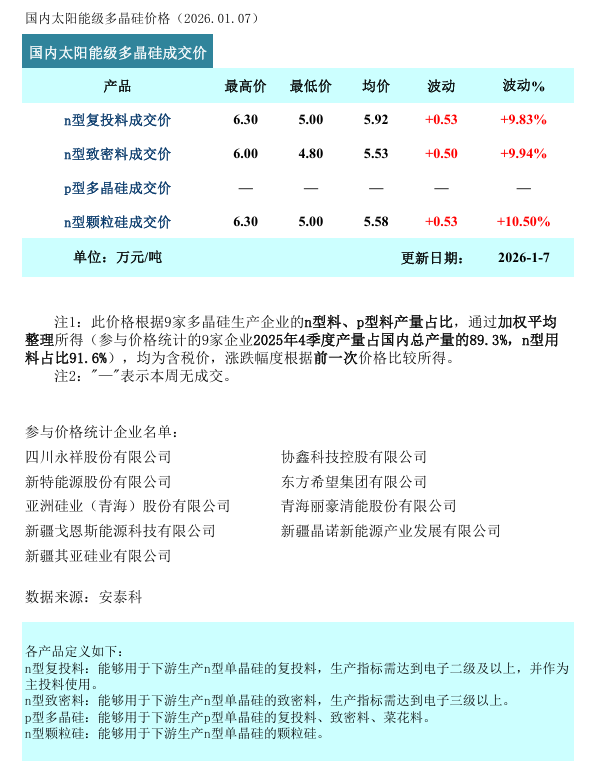
[安泰科]多晶硅周评-市场价格涨势延续 供应宽松格局未改(2026年1月7日)
中国有色金属工业协会硅业分会· 2026-01-07 08:56
Group 1 - The core viewpoint of the article highlights the continuous increase in the domestic polysilicon market prices, driven by multiple factors including rising production costs and increased acceptance of price hikes in downstream sectors [1][2]. - The transaction price range for n-type re-investment material is reported at 50,000 - 63,000 yuan/ton, with an average transaction price of 59,200 yuan/ton, reflecting a week-on-week increase of 9.83% [1][3]. - The n-type granular silicon has a transaction price range of 50,000 - 64,000 yuan/ton, with an average price of 55,800 yuan/ton, showing a week-on-week increase of 10.5% [1][3]. Group 2 - According to statistics, the domestic polysilicon production in December 2025 is estimated to be approximately 111,200 tons, a month-on-month decrease of 3.2%, with an annual production of about 1,319,000 tons, representing a year-on-year decrease of 28.4% [2]. - The forecast for January 2026 indicates a production of around 106,000 tons, a month-on-month decline of about 5%, suggesting a continued trend of inventory accumulation in the polysilicon market [2]. - The article anticipates that the market will maintain a stable operation in the short term, with a potential recovery in demand towards the end of the first quarter, which may provide more substantial support for the market [2].
供需宽松、成本定价
Ning Zheng Qi Huo· 2026-01-07 02:37
Report Industry Investment Rating No relevant content provided. Core Viewpoints of the Report - In 2026, the over - capacity of industrial silicon will not be fundamentally alleviated. High inventory will suppress prices, while the cost line will form a strong support. Supply - side policies are the biggest source of elasticity. The price range is expected to be 7500 - 9700 yuan/ton; under the scenario of strong policy stimulus, it will move up to 8500 - 10500 yuan/ton; under the scenario of unexpectedly weak demand, it will drop to 7000 - 7500 yuan/ton. The overall demand growth rate of industrial silicon will continue to slow down, but as the supply side also enters a contraction cycle, the overall supply - demand structure will become more balanced [3][40]. Summary by Directory Chapter 1: 2025 Industrial Silicon Market Trend Review - In 2025, the industrial silicon futures and spot markets showed a trend of "deep decline in the first half, hitting the bottom in June, and low - level volatile rebound from July to December". The average price of the futures main contract for the whole year was about 8800 yuan/ton, and the average comprehensive price of the spot was about 9200 yuan/ton. The futures and spot markets showed a pattern of spot premium for a long time. The spot market had multiple structural characteristics [9]. - In the first half of the year (January - June), the price dropped from a high level, and the supply - demand contradiction emerged. The average price of the 553 mainstream spot in January was about 9800 yuan/ton, falling below 9000 yuan/ton in March and reaching the annual low of 8600 - 8700 yuan/ton at the end of June. The 441 dropped from 11690 yuan/ton to 8620 yuan/ton, a decrease of 26.26%. The futures main contract SI2508/SI2510 started at about 10800 yuan/ton, fell below 10,000 yuan in March, and reached the lowest point of about 7015 yuan/ton on June 4, with a decline of about 36% in the first half of the year. The trading volume and open interest gradually shrank. The core driving factors were the natural decline in the off - season of downstream industries after the Spring Festival, the gradual release of new production capacity in 2024, and the lack of substantial production - capacity control policies [9][10]. - In the second half of the year (July - December), the price rebounded after hitting the bottom + low - level oscillation. The 553 mainstream spot price rebounded in July, rose to 9300 - 9500 yuan/ton from September to October, and stabilized at 9200 - 9300 yuan/ton (East China oxygen - blowing) in December. The futures main contract SI2601/SI2605 rebounded with cost repair and the expectation of production reduction in Southwest China from July, rose to 9000 - 9200 yuan/ton from September to October, and fell back to 8800 - 8900 yuan/ton in December. The trading volume and open interest increased. The core driving factors were the reduction in supply due to the rise in electricity prices during the dry season in Southwest China and the maintenance of some enterprises in Xinjiang, and the limited rebound amplitude due to high inventory [10]. Chapter 2: Analysis of the Supply - Demand Situation of Industrial Silicon in 2025/26 2.1 Supply Side: The Core Contradiction is Excess Supply, and Policy Regulation is the Catalyst - In November 2025, China's industrial silicon output was 401,700 tons, a year - on - year decrease of 11.2%. From January to November, the cumulative output reached 3.868 million tons, a cumulative year - on - year decrease of 14.7%. In the early stage of the year, the output was low. After April, Xinjiang made significant production cuts. In June, the output of most provinces decreased. After August, the supply in the main production areas increased. In the fourth quarter, the output in Xinjiang remained high, while that in Southwest China decreased slightly. In November, the output decreased to around 400,000 tons [14]. - From January to November 2025, Xinjiang's cumulative output was 1.9248 million tons, accounting for 52.03%. Inner Mongolia's output was 438,900 tons, accounting for 11.86%. Gansu's output was 329,700 tons, accounting for 8.91%. Yunnan's output was 300,800 tons, accounting for 8.13%. Sichuan's output was 323,500 tons, accounting for 8.74%. With the implementation of anti - involution policies, the release of new production capacity in the future will be extremely limited [15]. 2.2 Demand Side: The Establishment of a New Polysilicon Platform Company Marks the Entry of the Photovoltaic Industry's Anti - Involution Governance into a Critical Stage - From January to November 2024, China's polysilicon cumulative output was 1.206 million tons, a cumulative year - on - year decrease of 27.3%. In the first half of the year, the polysilicon price was low. After June, enterprises were determined to stabilize prices. By mid - December, the price of P - type dense materials soared to 49 - 51 yuan/kg, and the price of N - type silicon materials rose to 49.6 - 55 yuan/kg, a year - on - year increase of 26.5%. On December 12, 2025, the "polysilicon production - capacity integration and acquisition platform" was officially established, which has great strategic value for rectifying the industry's "involution" [29][31]. 2.2.1 Organic Silicon Production Cuts to Support Prices Yielded Results, and the Supply - Demand Will Enter a Sustainable New Ecosystem - From January to November 2025, China's organic silicon DMC cumulative output was 2.272 million tons, a year - on - year increase of 4.6%. In the first half of the year, the organic silicon industry faced over - capacity and weak terminal consumption. In the third quarter, the price rebounded slightly. In the fourth quarter, after the anti - involution industry meeting, enterprises reached a consensus on a 30% production cut and jointly supported prices. The DMC spot price rose from 11050 yuan/ton at the beginning of the fourth quarter to 13600 yuan/ton. It is expected that in 2026, the output will increase limitedly, and the supply - demand will enter a sustainable new ecosystem [33]. Chapter 3: Outlook for the Industrial Silicon Market in 2026 - In terms of supply, in 2026, the national industrial silicon planned new production capacity will be only 700,000 tons, and the production capacity will further shrink. In terms of demand, the overall demand growth rate of industrial silicon will continue to slow down, but the overall supply - demand structure will become more balanced [3][40]. - The over - capacity will not be fundamentally alleviated, high inventory will suppress prices, the cost line will form a strong support, and supply - side policies are the biggest source of elasticity. The price range is 7500 - 9700 yuan/ton; under the scenario of strong policy stimulus, it will move up to 8500 - 10500 yuan/ton; under the scenario of unexpectedly weak demand, it will drop to 7000 - 7500 yuan/ton. The price will be strong during the dry season and Spring Festival stocking, pressured during the wet season when supply increases and polysilicon demand slows down, and will stabilize and rebound with inventory reduction and cost support [3][40].
国泰君安期货所长早读-20260107
Guo Tai Jun An Qi Huo· 2026-01-07 01:30
Report Industry Investment Ratings Not provided in the content. Core Views of the Report - The 2026 China People's Bank Work Conference emphasized promoting high - quality economic development and reasonable price recovery, and planned to use various monetary policy tools such as reserve requirement ratio and interest rate cuts [8][22][28][30]. - Multiple factors drive the copper price to be strong. Supply - side concerns and long - term copper consumption recovery expectations, especially from emerging industries like AI computing centers,新能源 industries, and grid transformation, may lead to a continuous firm or rising copper price [9][10]. - For the Container Freight Index (European Line), the 2602 contract may make up the water price, and the far - month contracts should focus on the water - making up and the fermentation of geopolitical events [11][12][144]. - The silicon iron market is driven by emotions and medium - term expectations, and the price may rise, but the sustainability needs further confirmation [13]. Summary by Related Catalogs Metals Copper - **Supply - side**: Global geopolitical turmoil raises concerns about copper mine supply. The 2026 Chinese imported copper concentrate long - term TC is $0/ton, lower than in 2025. Some copper mines face potential labor disputes and production changes [9][24][26]. - **Demand - side**: Long - term copper consumption recovery expectations are strong. AI computing centers and other emerging industries, as well as the new energy industry and grid transformation, drive copper demand [9][10]. - **Price trend**: Based on the long - term positive fundamentals, the copper price may remain firm or rise [10]. Zinc - **Market performance**: The zinc price is running strongly. The prices of domestic and foreign zinc futures and spot have increased, and the trading volume and open interest have also changed [27]. - **News influence**: Policy changes and geopolitical events may affect the zinc market [28]. Lead - **Market situation**: The LME lead inventory decrease supports the lead price. The prices of domestic and foreign lead futures and spot have changed, and the trading volume and open interest have also shown corresponding trends [31]. - **News background**: Geopolitical events and corporate data influence the lead market [31]. Tin - **Market trend**: The tin price is in a range - bound oscillation. The prices of domestic and foreign tin futures and spot have increased, and the inventory has changed [34]. - **News impact**: Macroeconomic policies and corporate news affect the tin market [35]. Aluminum - **Market performance**: The aluminum price is oscillating strongly. The prices of domestic and foreign aluminum futures and spot, as well as the trading volume, open interest, and inventory, have all changed [37]. - **News influence**: Fed policy differences and geopolitical events affect the aluminum market [38]. Platinum and Palladium - **Market trend**: Platinum shows a recovery in sentiment and runs strongly, and palladium follows platinum. The prices of platinum and palladium futures and spot have increased, and the trading volume, open interest, and inventory have changed [39]. - **News background**: Geopolitical events and corporate news influence the market [42]. Nickel and Stainless Steel - **Market situation**: Nickel is in a wide - range oscillation, and stainless steel is affected by the fundamentals and Indonesian policies. The prices, trading volume, and open interest of nickel - related products have changed, and the Indonesian government has introduced relevant policies [43][44][46]. Carbonate Lithium - **Market performance**: The market sentiment of carbonate lithium is strong. The prices of carbonate lithium futures and spot have increased, and the trading volume and open interest have changed [47]. - **News influence**: The price negotiation of lithium iron phosphate and the release of new battery products affect the market [48][49]. Energy and Chemicals Industrial Silicon and Polysilicon - **Market trend**: Industrial silicon is affected by news and shows a strong performance, and polysilicon needs to pay attention to market news. The prices, trading volume, open interest, and inventory of industrial silicon and polysilicon have changed [50]. - **News background**: The proposed implementation of differential electricity prices in Shaanxi affects the industrial silicon market [51]. Iron Ore - **Market situation**: The iron ore price is fluctuating at a high level. The prices of iron ore futures and spot have changed, and the trading volume, open interest, and inventory have also shown corresponding trends [54][55]. Steel Products (Rebar and Hot - Rolled Coil) - **Market performance**: The prices of rebar and hot - rolled coil are affected by market sentiment and are in a wide - range oscillation. The prices, trading volume, open interest, and inventory of rebar and hot - rolled coil have changed, and relevant policies have been introduced [58][59][60]. Silicon Iron and Manganese Silicon - **Market trend**: The prices of silicon iron and manganese silicon are oscillating upwards. The prices of futures and spot, as well as the trading volume, open interest, and inventory, have changed. The market is affected by potential electricity price increases and other factors [63][64][65]. Coke and Coking Coal - **Market situation**: Coke and coking coal are in a wide - range oscillation with accumulating contradictions. The prices of futures and spot, as well as the trading volume, open interest, and inventory, have changed [67]. Logs - **Market performance**: The log price is oscillating at a low level. The prices, trading volume, open interest, and inventory of log futures and spot have changed [70][71][73]. p - Xylene, PTA, and MEG - **Market trend**: p - Xylene is in a short - term high - level oscillation, PTA is in a high - level oscillation, and MEG has limited upward space and medium - term pressure. The prices, trading volume, open interest, and inventory of relevant products have changed, and market news affects the market [74][75][76]. Rubber - **Market situation**: The rubber price is oscillating strongly. The prices, trading volume, open interest, and inventory of rubber futures and spot have changed, and the rubber cost support is strengthening [79][80][81]. Synthetic Rubber - **Market performance**: The short - term center of synthetic rubber moves upwards. The prices, trading volume, open interest, and inventory of synthetic rubber futures and spot have changed, and it is affected by the cost of butadiene [82][83][84]. LLDPE - **Market trend**: The LLDPE price is firm, and the standard product production decreases. The prices, trading volume, open interest, and inventory of LLDPE futures and spot have changed, and the market is affected by raw material prices and supply - demand relationships [85][86]. PP - **Market situation**: The PP price is weak. The prices, trading volume, open interest, and inventory of PP futures and spot have changed, and it is affected by cost and demand [88][89]. Caustic Soda - **Market performance**: Caustic soda is strong in the short - term and oscillating in the medium - term. The prices, trading volume, open interest, and inventory of caustic soda futures and spot have changed, and it is affected by factors such as delivery and supply - demand [90][91][92]. Pulp - **Market trend**: The pulp price is oscillating strongly. The prices, trading volume, open interest, and inventory of pulp futures and spot have changed, and the market is affected by raw material prices and demand [95][97][98]. Glass - **Market situation**: The glass price is stable. The prices, trading volume, open interest, and inventory of glass futures and spot have changed, and the market is affected by the holiday atmosphere and demand [100][101]. Methanol - **Market performance**: Methanol is strong in the short - term. The prices, trading volume, open interest, and inventory of methanol futures and spot have changed, and it is affected by geopolitical events and supply - demand expectations [103][104][106]. Urea - **Market situation**: The urea price center moves upwards. The prices, trading volume, open interest, and inventory of urea futures and spot have changed, and it is affected by factors such as demand expectations and inventory [108][109][110]. Styrene - **Market trend**: Styrene is in a short - term oscillation. The prices, trading volume, open interest, and inventory of styrene futures and spot have changed, and it is affected by factors such as valuation and supply - demand [113][114][115]. Soda Ash - **Market situation**: The soda ash market changes little. The prices, trading volume, open interest, and inventory of soda ash futures and spot have changed [117][119]. LPG and Propylene - **Market performance**: The LPG import cost is firm, and propylene demand is stable with a slight price increase. The prices, trading volume, open interest, and inventory of LPG and propylene futures and spot have changed, and relevant industry data have also been updated [121]. PVC - **Market trend**: PVC is strong in the short - term but has limited upward space. The prices, trading volume, open interest, and inventory of PVC futures and spot have changed, and it is affected by factors such as cost, supply - demand, and inventory [129][130][131]. Fuel Oil and Low - Sulfur Fuel Oil - **Market situation**: Fuel oil turns strong and is easy to rise and difficult to fall, and low - sulfur fuel oil follows the upward trend. The prices, trading volume, open interest, and inventory of fuel oil and low - sulfur fuel oil futures and spot have changed [134]. Container Freight Index (European Line) - **Market performance**: The 2602 contract may make up the water price, and the far - month contracts should focus on the water - making up and geopolitical events. The prices, trading volume, open interest, and inventory of relevant contracts have changed, and the shipping capacity and freight rates have also been affected [136][142][143]. Agricultural Products Short - Fiber and Bottle Chip - **Market situation**: Short - fiber and bottle chip are in a short - term oscillation. The prices, trading volume, open interest, and inventory of short - fiber and bottle - chip futures and spot have changed [146][147]. Offset Printing Paper - **Market performance**: It is advisable to wait and see for offset printing paper. The prices, trading volume, open interest, and inventory of offset printing paper futures and spot have changed, and the market demand is weak [149][150][152]. Pure Benzene - **Market situation**: Pure benzene is in a short - term oscillation. The prices, trading volume, open interest, and inventory of pure benzene futures and spot have changed, and the port inventory has increased [153][154]. Palm Oil, Soybean Oil, and Rapeseed Oil - **Market performance**: Palm oil is affected by macro - emotions, soybean oil is in a range - bound operation, and rapeseed oil shows corresponding price changes. The prices, trading volume, open interest, and inventory of relevant futures and spot have changed, and relevant industry data have also been updated [157][158][159]. Soybean Meal and Soybeans - **Market situation**: Soybean meal may oscillate, and soybeans are in an oscillation. The prices, trading volume, open interest, and inventory of soybean meal and soybean futures and spot have changed, and the market is affected by factors such as Chinese purchases and USDA reports [162][163][164]. Corn - **Market performance**: Attention should be paid to the corn spot. The prices, trading volume, open interest, and inventory of corn futures and spot have changed, and the market is affected by factors such as spot prices and import information [165][166][167]. Sugar - **Market situation**: Sugar is in a low - level consolidation. The prices, trading volume, open interest, and inventory of sugar futures and spot have changed, and the market is affected by factors such as production and import [169][170][171]. Cotton - **Market performance**: Cotton remains strong. The prices, trading volume, open interest, and inventory of cotton futures and spot have changed, and the market is affected by factors such as spot trading and textile enterprise operations [174][175]. Eggs - **Market situation**: The far - month sentiment of eggs weakens. The prices, trading volume, open interest, and inventory of egg futures and spot have changed, and relevant industry data have also been updated [178]. Hogs - **Market performance**: There is still inventory accumulation for hogs. The prices, trading volume, open interest, and inventory of hog futures and spot have changed, and relevant industry data have also been updated [181][183][184]. Peanuts - **Market situation**: Peanuts are in an oscillating operation. The prices, trading volume, open interest, and inventory of peanut futures and spot have changed, and the spot market price is relatively stable [187][188].
建信期货多晶硅日报-20260107
Jian Xin Qi Huo· 2026-01-07 01:08
多晶硅日报 油) 021-60635738 lijie@ccb.ccbfutures.com 期货从业资格号:F3031215 021-60635737 renjunchi@ccb.ccbfutures.com 期货从业资格号:F3037892 硅)028-8663 0631 penghaozhou@ccb.ccbfutures.com 期货从业资格号:F3065843 021-60635740 pengjinglin@ccb.ccbfutures.com 期货从业资格号:F3075681 021-60635570 liuyouran@ccb.ccbfutures.com 期货从业资格号:F03094925 研究员:冯泽仁(玻璃纯碱) 021-60635727 fengzeren@ccb.ccbfutures.com 期货从业资格号:F03134307 行业 日期 2026 年 01 月 07 日 能源化工研究团队 研究员:李捷,CFA(原油燃料 研究员:任俊弛(PTA/MEG) 研究员:彭浩洲(工业硅/多晶 研究员:彭婧霖(聚烯烃) 研究员:刘悠然(纸浆) 请阅读正文后的声明 每日报告 一、行情回顾与展望 ...
日度策略参考-20260106
Guo Mao Qi Huo· 2026-01-06 02:51
Report Industry Investment Rating No relevant information provided. Report Core Viewpoints - Short - term, the stock index may continue a relatively strong trend, but attention should be paid to the impact of overseas geopolitical events on market risk appetite. In the long - term, the stock index is expected to rise in 2026 based on 2025 [1]. - Asset shortage and weak economy are beneficial to bond futures, but the central bank has recently warned of interest - rate risks, and attention should be paid to the Bank of Japan's interest - rate decision [1]. - Different commodities have various trends, including price increases, oscillations, and potential reversals, with corresponding investment strategies recommended [1]. Summary by Related Catalogs Macro Finance - Short - term, the stock index may continue to be strong, and in the long - term (2026), it is expected to rise on the basis of 2025 due to factors like continuous policy efforts, inflation recovery, capital market reform, and the support of Central Huijin [1]. - Asset shortage and weak economy benefit bond futures, but the central bank warns of interest - rate risks, and the Bank of Japan's interest - rate decision should be watched [1]. Metals Non - ferrous Metals - Copper: The price has further increased due to weak industry fundamentals but positive macro sentiment and continuous premium. However, short - term adjustment risks should be guarded against, and the upward trend is expected to continue [1]. - Aluminum: Domestic electrolytic aluminum has accumulated inventory, but positive macro sentiment and the early fermentation of supply - tightness expectations are likely to keep the price strong [1]. - Alumina: The supply side has a large release space, and the weak industry fundamentals put pressure on the price. However, the current price is near the cost line, so it is expected to oscillate [1]. - Zinc: The fundamentals have improved, the cost center has moved up, recent negative factors have been mostly realized, and market sentiment is volatile, leading to price oscillations [1]. - Nickel: Positive macro sentiment, concerns about supply due to Indonesian events, slow inventory accumulation, and unconfirmed Indonesian policies are likely to keep the short - term price strong. It is recommended to go long at low prices and control risks [1]. - Stainless Steel: Positive macro sentiment, concerns about raw - material supply, a rebound in nickel - iron prices, a slight reduction in social inventory, and an increase in January production plans are likely to keep the short - term futures price strong. It is recommended to go long at low prices, and enterprises should wait for opportunities to sell and hedge [1]. - Tin: The industry association's initiative has put pressure on the price, but considering the tense situation in Congo - Kinshasa, the supply may still be affected. After a short - term decline, the downward space is limited, and low - long opportunities near the support level are recommended [1]. - Precious Metals: Geopolitical risks and international - order uncertainties have boosted the demand for hedging, making the price strong in the short - term. However, the high VIX of silver indicates potential risks. Platinum and palladium are expected to fluctuate widely in the short - term, and platinum can be bought at low prices or a [long - platinum short - palladium] arbitrage strategy can be adopted in the long - term [1]. Black Metals - Iron Ore: There is a combination of weak reality (weak direct demand, high supply, and inventory accumulation) and strong expectation (potential supply disturbances from energy - consumption control and anti - involution). The near - month contract is restricted by production cuts, while the far - month contract has upward potential [1]. - Steel (including Rebar): The valuation of the price is not high, and it is not recommended to short. Positions in cash - and - carry arbitrage can take rolling profits [1]. - Glass: Supply and demand are acceptable, and the valuation is low, so the downward space is limited, and it may be under pressure to oscillate [1]. - Soda Ash: It follows the trend of glass, with acceptable supply and demand, low valuation, and limited downward space, and may oscillate under pressure [1]. - Coking Coal: The fourth - round spot price cut has started. After the futures price dropped to the corresponding position and rebounded, attention should be paid to whether it can reach a new low during the implementation of the price cut. There is a high possibility of wide - range oscillations [1]. - Coke: The logic is the same as that of coking coal [1]. Energy and Chemicals - Crude Oil: OPEC + has suspended production increases until the end of 2026, the uncertainty of the Russia - Ukraine peace agreement, and US sanctions on Venezuelan oil exports have an impact on the price [1]. - Fuel Oil: The short - term supply - demand contradiction is not prominent, and it follows the trend of crude oil. The probability of the 14th Five - Year Plan's rush - work demand is falsified, the supply of Marey crude oil is sufficient, and the asphalt profit is high [1]. - Asphalt: The cost is strongly supported, the spot - futures price difference is low, and the mid - stream inventory may tend to accumulate [1]. - Rubber: For natural rubber, the mid - stream inventory may tend to accumulate, and the price oscillates. For BR rubber, the futures position has declined, the price increase has slowed down, the processing profit is gradually repaired, it maintains high - level operation in terms of production and inventory, and the spot trading is weak [1]. - PTA: The PX market has experienced a sharp increase, and the domestic PTA maintains high - level operation, benefiting from stable domestic demand and the recovery of exports to India since the end of November [1]. - MEG: Two sets of MEG devices in Taiwan, China, are planned to stop production due to efficiency reasons. The price has rebounded rapidly due to supply - side news, and the downstream polyester operating rate is over 90%, with better - than - expected demand [1]. - Short - fiber: The price continues to fluctuate closely following the cost [1]. - Styrene: The Asian styrene market is generally stable. Suppliers are reluctant to reduce prices due to continuous losses, while buyers keep pressing prices due to weak downstream demand and profit compression. The market is in a weak - balance state, and the short - term upward momentum depends on overseas market drive [1]. - Steam: The upward space is limited due to insufficient domestic demand, but there is support from anti - involution and the cost side [1]. - Propylene: The supply pressure is large, the downstream improvement is less than expected, the cost is strongly supported by high - level propylene monomers and rising crude - oil prices, and there is a risk of rising crude - oil prices due to intensified geopolitical conflicts [1]. - PVC: The global production in 2026 is expected to be low, but currently, new capacity is being released, the supply pressure is increasing, and the demand is weak [1]. - Chlorine: The inventory pressure in Shandong is large, the supply pressure is high due to high - level operation and few overhauls, the non - aluminum demand is in the off - season, and the cost support is weakened by the rising price of liquid chlorine [1]. - LPG: The January CP has risen unexpectedly, providing strong cost - end support. Geopolitical conflicts in the US, Venezuela, and the Middle East have increased the short - term risk premium. The EIA weekly C3 inventory is in an accumulation trend, with a temporary slowdown in overseas demand. The domestic PDH maintains high - level operation but is deeply in deficit, and the overseas olefin blending - oil demand is acceptable [1]. New Energy and Silicon Industry - Polysilicon: There is production increase in the northwest and decrease in the southwest. The December production plan has decreased. A capacity storage platform company has been established, with a long - term expectation of capacity reduction. The terminal installation in the fourth quarter has increased marginally. Large enterprises are willing to support the price but not to deliver. The short - term speculative sentiment is high [1]. - Lithium Carbonate: It is the traditional peak season for new - energy vehicles, the energy - storage demand is strong, the supply - side production resumption has increased, and the price has risen rapidly in the short - term [1]. Agricultural Products - Palm Oil: The MPOB December data is expected to be negative, but it may reverse under themes such as seasonal production reduction, the B50 policy, and US biodiesel. If the price gaps up due to geopolitical events, short - selling can be considered [1]. - Soybean Oil: It follows the trend of other oils in the short - term, and waiting for the January USDA report is recommended [1]. - Rapeseed Oil: News of blocked trader purchases and Australian seed imports has led to a large rebound in the single - side price and the 1 - 5 spread, but it is difficult to change the subsequent loosening of the fundamental situation. A decline in sentiment is expected, and short - selling on rebounds can be considered [1]. - Cotton: The domestic new - crop harvest is expected to be good, but the purchase price of seed cotton supports the cost of lint. The downstream operation rate remains low, but the yarn - mill inventory is not high, with rigid restocking demand. The cotton market is currently in a situation of "having support but no driver", and attention should be paid to factors such as the central government's No. 1 Document in the first quarter of next year, planting - area intentions, weather during the planting period, and peak - season demand [1]. - Sugar: There is a global surplus and a large supply of domestic new - crop sugar, with a strong consensus on short - selling. If the futures price continues to fall, the cost support is strong, but the short - term fundamentals lack continuous driving forces, and attention should be paid to changes in the capital side [1]. - Corn: The grass - roots grain - selling progress is relatively fast, the current port and downstream inventory levels are still low, and most traders have not started strategic inventory building. The spot price is expected to be strong in the short - term, and the futures price is expected to have limited decline and then maintain an oscillating and strengthening trend [1]. - Soybeans: Attention should be paid to the adjustment in the January USDA report and the impact of Brazilian harvest selling pressure on CNF premiums. The M05 contract is expected to be relatively weak, while the M03 - M05 spread is expected to be in a positive - arbitrage situation in the short - term, but caution should be exercised due to potential changes in customs policies, soybean auctions, and directional policies [1]. - Pulp: The 05 contract is expected to oscillate in the range of 5400 - 5700 yuan/ton due to the tug - of - war between "strong supply" and "weak demand" [1]. - Logs: The spot price has shown signs of bottom - rebounding, and the downward space of the futures price is limited. However, the January overseas quotation has slightly declined, and there is a lack of upward - driving factors in the spot - futures market. It is expected to oscillate in the range of 760 - 790 yuan/m³ [1]. Livestock - Hogs: The spot price has gradually stabilized recently, with demand support. The slaughter weight has not been fully cleared, and the production capacity still needs to be further released [1].