
建筑业

Search documents
阿尔及利亚经济多元化步伐加快三年来吸引近600亿美元投资
Shang Wu Bu Wang Zhan· 2026-01-16 03:12
Core Insights - Algeria has attracted nearly $60 billion in investments over the past three years, with a total of 18,712 registered investment projects, indicating a significant growth in investment scale [1] - The investment structure shows a dominance of local capital, with domestic investments accounting for 98.4% and foreign investments only 1.6%, highlighting the leading role of domestic capital in economic development [1] Industry Distribution - The manufacturing sector plays a central role, absorbing over half of the newly created jobs, while transportation, construction, and agriculture sectors are also developing concurrently [1] - The number of new and expansion projects is nearly equal, reflecting the ongoing expansion of existing industries [1] Regional Distribution - Investment distribution remains uneven across regions, with the southern areas showing untapped potential that needs further development [1] - Overall, the results indicate an ongoing improvement in Algeria's investment environment, an enhanced role of the private sector, and steady progress in economic diversification and regional coordination [1]
超预期三倍!英国GDP强势回暖,英镑为何迟迟不涨?
Sou Hu Cai Jing· 2026-01-15 10:49
尽管英国经济数据表现亮眼,英镑却未能延续上涨势头,核心原因在于外部美元的强势压制与内部隐忧 并存。近期美国公布的生产者物价指数、零售销售数据均超出预期,失业率维持低位,强化了市场对美 联储将在未来数月维持高利率的预期,美元凭借利差优势和避险属性保持强势,直接压制了英镑的上涨 空间。 英国经济自身也存在结构性隐忧,11月建筑活动环比下降1.3%,不仅弱于市场预期的持平水平,还较 10月的跌幅进一步扩大。建筑业走弱与融资成本高企、房地产需求降温以及企业资本开支趋于谨慎直接 相关,若该趋势持续,将削弱"全面复苏"的市场预期,让更多参与者将本次增长视为阶段性企稳而非趋 势性反转。 货币政策层面的差异也进一步限制了英镑的突破动能。英国央行当前核心关注点仍在通胀路径的稳定 性,本次GDP数据虽缓解了需求塌陷的担忧,但并未达到促使央行立即调整政策立场的程度,0.3%的 月度增长仅为决策层提供了观察通胀走势的窗口,政策大概率维持偏紧观望状态。而美联储因美国经济 基本面稳固,降息预期不断延后,美英利差格局未发生根本变化,使得英镑难以获得持续上行的支撑。 后续英镑能否突破震荡区间,将取决于两条主线:一是英国通胀、薪资等后续数据能 ...
2025 年 12 月美国非农数据点评:失业率回落:1月降息门槛仍高
Haitong Securities International· 2026-01-14 12:28
Employment Market Overview - The unemployment rate in the U.S. fell to 4.4% in December, better than the expected 4.5%[6] - The unemployment rate for November was revised down to 4.5%, interrupting the previous upward trend[6] - The U6 unemployment rate decreased by 0.3 percentage points to 8.4%, indicating reduced pressure on marginally employed groups[10] Job Creation and Market Conditions - Non-farm payrolls added only 50,000 jobs in December, falling short of the market expectation of 65,000[19] - Job additions for October and November were revised down by a total of 76,000, with October's figures adjusted from -105,000 to -173,000[19] - The average weekly hours worked decreased to 34.2 hours, while average hourly earnings increased by 0.3% month-over-month and 3.8% year-over-year, slightly above the expected 3.6%[13] Federal Reserve Outlook - The Federal Reserve has room to pause interest rate cuts in January, with a current market expectation of only a 5% probability for a rate cut[26] - The market anticipates two rate cuts in 2026, now pushed to June and September[26] Risks and Considerations - Political pressure from Trump could further threaten the independence of the Federal Reserve[27]
复刻2009年大牛市?PMI回升吹响春季行情进攻号角
Xin Lang Cai Jing· 2026-01-14 05:31
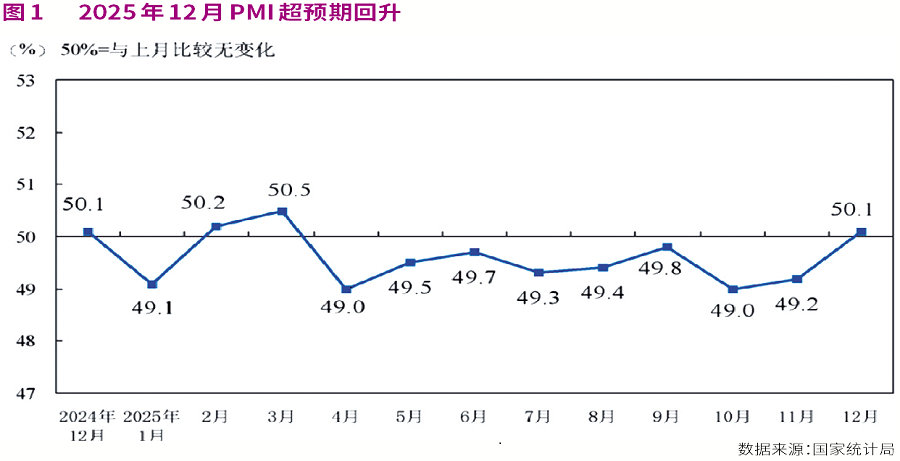
Core Viewpoint - The significant rebound in the Manufacturing Purchasing Managers' Index (PMI) for December 2025, which exceeded expectations, signals a potential bullish market trend for 2026, reminiscent of the 2008-2009 market recovery [1][6][26]. Economic Indicators - The December 2025 manufacturing PMI reached 50.1%, an increase of 0.9 percentage points from the previous month, marking a return to the expansion zone after eight months [5][16]. - The non-manufacturing PMI was 50.2%, up 0.7 percentage points, while the composite PMI rose to 50.7%, an increase of 1.0 percentage points [5][16]. - Historical trends show that PMIs typically experience seasonal declines at year-end, but the current data reflects a significant "reverse seasonal" increase, indicating stronger economic potential for Q1 2026 [5][16]. Sector Performance - The production index and new orders index for December were 51.7% and 50.8%, respectively, both showing substantial increases, particularly the new orders index, which rose above the critical point for the first time since the second half of 2025 [9][20]. - Industries such as food processing, textiles, and electronics showed production and new orders indices above 53.0%, indicating robust demand, while sectors like non-metallic minerals and black metal processing faced challenges with indices below the critical point [9][20]. Market Sentiment - The current economic environment is characterized by a strong willingness for production expansion, as indicated by rising PMI indices for production activities and procurement [17][20]. - The upcoming Spring Festival in 2026, occurring later than usual, has prompted companies to adjust production schedules to avoid disruptions, contributing to increased production activity [21]. Price Trends - The raw material purchase price index decreased by 0.5 percentage points, while the factory price index increased by 0.7 percentage points, suggesting improved pricing dynamics and potential profit margins for mid- and downstream industries [21]. - The new export orders index rose by 1.4 percentage points, reflecting enhanced resilience in Chinese exports and reduced dependency on specific markets [21]. Construction Sector - The construction business activity index surged to 52.8%, a significant increase of 3.2 percentage points, indicating a recovery in the construction sector after four months below the critical threshold [22][23]. - Factors contributing to this increase include favorable weather conditions in southern provinces and proactive measures by companies to accelerate construction progress [22][23]. Conclusion - The December 2025 PMI's unexpected rise suggests renewed policy momentum, with expectations for a strong economic start in Q1 2026, supporting a bullish outlook for the upcoming "spring market rally" [24][26].

“放管服”为建筑业企业松绑赋能
Xin Lang Cai Jing· 2026-01-13 19:50
Core Viewpoint - Qinghai province is implementing engineering guarantee insurance as a key measure to deepen the "streamlining administration and delegating power" reform during the 14th Five-Year Plan period, replacing traditional cash deposit methods to alleviate financial burdens on construction enterprises [1][2] Group 1: Policy Implementation - The new policy covers four types of guarantees: bidding, performance, quality, and payment of migrant workers' wages, addressing the long-standing issue of cash flow constraints in the construction industry [1] - All insurance institutions within the province are authorized to handle engineering guarantee insurance, providing efficient and low-cost options for enterprises [1] Group 2: Reform Outcomes - During the 14th Five-Year Plan, a total of 148,000 engineering guarantee insurance policies were completed, with enterprises paying a total premium of 195 million yuan, and releasing 21.37 billion yuan in various guarantees [1] - Compared to the 13th Five-Year Plan, the number of policies, premium scale, and released guarantee amounts increased by 13.6 times, 6.2 times, and 7.1 times respectively, indicating that engineering guarantee insurance has become the mainstream method for guarantee payments in the construction sector [1] Group 3: Market Impact - The reform significantly alleviates cash flow pressure on enterprises, enhances capital utilization efficiency, and stimulates market vitality, allowing small and medium-sized enterprises to invest more in technology upgrades, personnel training, and project quality management [2] - The professional risk control processes of insurance institutions create market constraints that effectively promote the construction of an industry integrity system [2] - The comprehensive implementation of engineering guarantee insurance injects strong momentum into optimizing the business environment and promoting high-quality development in the construction industry [2]
宏观经济周度高频前瞻报告:经济周周看:经济存在开门红特征-20260113
ZHESHANG SECURITIES· 2026-01-13 07:28
Economic Indicators - The GDP weekly high-frequency prosperity index as of January 10 is 5.9%, a significant increase from the revised value of 5.0% the previous week, indicating a positive economic outlook[1][7]. - The service sector is the main driver of this increase, attributed to enhanced contributions from the financial industry and active travel performance[1][7]. Production and Demand - High-frequency indicators for both the service and industrial sectors have improved compared to the previous week[1][10]. - External demand remains strong, while internal demand, particularly in infrastructure, shows better-than-seasonal performance[1][18]. - The construction sector's physical workload is exhibiting a trend of exceeding seasonal expectations, with a notable increase in the operational rates of asphalt and cement facilities compared to the previous year[1][29]. Real Estate Market - The real estate market shows a significant decline, with new home sales in 30 major cities dropping to 125.2 million square meters, a 49% decrease week-on-week and a 36% decrease year-on-year[1][45]. - Land transaction volumes have also decreased, with a year-on-year decline of 31.03% in land sales across 100 cities[1][45]. Price Trends - Consumer prices are fluctuating, with agricultural product prices showing a mixed trend; the wholesale price index for agricultural products decreased by 0.13% week-on-week[1][52]. - The average wholesale price of pork has increased by 1.45% week-on-week, while vegetable prices have continued to decline, with a 2.8% drop in the average price of 28 monitored vegetables[1][55][59].
中金缪延亮 | 消费如何破局:就业视角
中金点睛· 2026-01-13 00:33
Core Viewpoint - The main issue behind the recent slowdown in consumer spending in China is not a lack of willingness to consume, but rather a limitation in consumption capacity, primarily driven by slowing income growth and weakened income expectations [5][6][30]. Group 1: Consumer Spending Trends - From 2001 to 2023, consumer spending contributed an average of 53.1% to China's economic growth, but this is projected to drop to 44.5% in 2024 [4][10]. - The growth rate of social retail sales has decreased significantly, from over 8% before 2019 to less than 4% in 2024 [4][10]. - Service consumption recovery is lagging, with major sectors like dining, housing, education, and entertainment showing a general slowdown in growth [4][10]. Group 2: Income Growth and Consumer Capacity - The growth rate of per capita disposable income has slowed from 8.9% in 2019 to 5.3% in 2024, with wage income being the largest component facing pressure [6][30][32]. - The net transfer income growth has also decelerated, reflecting reduced fiscal space for local governments, which impacts social welfare spending [30][32]. Group 3: Employment Market Pressures - The employment market is facing three main pressures: a total demand gap, a structural gap, and an efficiency squeeze gap [8][49][50]. - The total demand gap is approximately 2.1%, driven by economic performance below potential levels [50][55]. - The structural gap, resulting from a divergence in recovery between manufacturing and service sectors, accounts for about 1.3% of the employment gap [50][56]. - The efficiency squeeze gap, due to technological advancements and extended working hours, is estimated at 2.2% [50][58]. Group 4: Policy Recommendations - To break the negative spiral of weak income, low confidence, and sluggish consumption, a coordinated approach involving fiscal, monetary, and structural reforms is necessary [9][67]. - Policies should focus on revitalizing local government and corporate balance sheets to stabilize credit expansion and investment expectations [67][69]. - Enhancing service sector capacity and quality is crucial, as it holds significant potential for consumer spending growth [70][72].

中经评论:莫让返乡变返贫
Jing Ji Ri Bao· 2026-01-13 00:22
Core Viewpoint - The article emphasizes the importance of stable employment for rural workers, particularly for those who have escaped poverty, and highlights the need for targeted support to prevent a return to poverty due to unemployment [1][2][3][4] Group 1: Employment and Income - Labor income is the largest source of income for farmers, and the central rural work conference has proposed measures to support migrant workers and promote stable employment [1] - During the "14th Five-Year Plan" period, the scale of employment for the poverty-stricken population has remained stable at over 30 million, ensuring that large-scale poverty does not occur [1] - The article notes that if one member of a three-person household can maintain stable employment, the family is less likely to fall back into poverty [1] Group 2: Challenges and Opportunities - There are successful cases of migrant workers and college students returning to their hometowns to start businesses, but the employment absorption capacity in poverty-stricken areas is limited compared to larger cities [2] - The article warns against the dilemma of returning workers facing unemployment in cities and a lack of jobs in rural areas, stressing the need for human capital investment to enhance skills among the poverty-stricken population [2] - The coexistence of labor shortages and job vacancies in certain skilled positions indicates a need for skill adaptation among migrant workers [2] Group 3: Employment Support Strategies - The article advocates for a dual approach to employment: promoting both external and local job opportunities, with targeted training programs to enhance skills in areas like home services and e-commerce [3] - Development of local industries is crucial for creating job opportunities, and there is a call for precise assistance to help returning farmers find direction and stability [3] - The article suggests leveraging labor brands and traditional craftsmanship to enhance employment and entrepreneurship among the rural population [3] Group 4: Rural Revitalization - A broader perspective on rural revitalization involves addressing the outflow of young populations and creating conditions for local employment and entrepreneurship [4] - The article emphasizes the need for rural industries to retain people and attract investment, ensuring that rural areas become viable places for living and working [4] - The focus for the new year should be on enhancing the internal development motivation of the poverty-stricken population, leading to improved living standards [4]
2025年12月德国申请破产企业数量同比增长15.2%
Xin Lang Cai Jing· 2026-01-12 16:56
Core Insights - The number of companies applying for standard bankruptcy procedures in Germany increased by 15.2% year-on-year as of December 2025, indicating heightened operational pressures on businesses towards the end of the year [1] Group 1: Bankruptcy Statistics - In October 2025, a total of 2,108 companies reported bankruptcy applications, reflecting a year-on-year increase of 4.8% [1] - The total debt owed by creditors amounted to approximately €2.6 billion, which is lower than the €3.8 billion reported in the same period of 2024 [1] - The transportation and warehousing sector experienced the highest frequency of bankruptcies, with 12.3 bankruptcies per 10,000 companies, followed by the accommodation and food services sector at 10.5, and the construction sector at 8.5 [1] Group 2: Expert Analysis - The chief analyst of the German Chamber of Commerce, Volker Treier, noted that the number of companies ceasing operations due to bankruptcy is at its highest level in nearly 11 years, with an expectation that the total number of bankruptcies for 2025 will exceed 23,000 [1] - Treier urged the government to implement effective measures to alleviate burdens related to taxes, energy prices, and administrative procedures, highlighting a gap between policy suggestions and actual implementation [1]
哈萨克斯坦2025年GDP同比增长6.5%
Zhong Guo Xin Wen Wang· 2026-01-12 11:57
Economic Growth - Kazakhstan's GDP is projected to grow by 6.5% year-on-year in 2025, driven by key sectors such as industry, transportation, construction, and trade [1] - The industrial production index is expected to increase by 7.4%, with manufacturing growing by 6.4% [1] - Notable growth is observed in specific sectors, including mechanical manufacturing, which is anticipated to rise by 12.9% [1] Transportation and Logistics - The transportation and logistics sector is expected to maintain a strong growth trajectory, with transportation and warehousing increasing by 20.4% year-on-year [1] - Rising freight volumes in rail and road transport are contributing to growth in related services such as freight forwarding and airport operations [1] Construction Sector - The construction industry is projected to grow by 15.9%, with new housing area reaching 20.1 million square meters, a 5.1% increase year-on-year [1] - Increased investment in education, healthcare, and infrastructure is effectively driving growth in the construction sector [1] Trade Performance - Total trade volume is expected to grow by 8.9%, continuing the previous growth trend, with wholesale trade showing significant increases [2] - Key commodities such as food, machinery, pharmaceuticals, automobiles, and dairy products are experiencing rapid sales growth, indicating sustained market demand [2] Agriculture and Communication - The agriculture, forestry, and fishing sectors are projected to grow by 5.9%, while the information and communication sector is expected to increase by 3.6% [3] - In 2024, Kazakhstan's GDP is anticipated to grow by 5% [3]