手机

Search documents
他设计的手机卖了1.5亿台|我们的四分之一世纪
经济观察报· 2025-12-19 11:16
Core Insights - The article highlights the journey of a prominent industrial designer, Shi Xiaoxi, who transitioned from designing mobile phones at Nokia to exploring broader design fields, emphasizing the importance of material and manufacturing processes in design [3][4][19]. Group 1: Background and Early Career - Shi Xiaoxi, at 44 years old, is recognized for his passion for design rather than electronic products, having been one of the youngest design experts at Nokia, where he led the design of the Nokia 1200, which sold over 150 million units globally [3][9]. - In 2006, Nokia was at its peak, with annual sales exceeding 400 million units and a market share of 40%, making it a dominant player in the mobile phone industry [8][16]. - The Nokia 1200 project was initially seen as a low-budget, low-resource endeavor, yet it became one of Nokia's most successful products, illustrating the significance of design choices in product success [9][10]. Group 2: Transition to Smart Devices - The launch of the iPhone in 2007 marked a pivotal shift in the mobile phone industry, but Nokia's management was overconfident in their existing capabilities, leading to missed opportunities in the smartphone market [13][15]. - Despite efforts to innovate, Nokia struggled with internal processes and decision-making, ultimately leading to a significant decline in market share and a loss of 5.2 billion euros in 2013 [16][17]. Group 3: Design Philosophy and Evolution - Shi Xiaoxi's design philosophy evolved to prioritize material-driven and manufacturing-first approaches, moving away from purely aesthetic considerations to focus on practical and feasible designs [21][22]. - His experience in various manufacturing environments reshaped his understanding of design, emphasizing the importance of collaboration with manufacturers to achieve innovative outcomes [21][22]. Group 4: Current Endeavors and Future Outlook - After leaving Nokia, Shi Xiaoxi continued to work in design, focusing on diverse projects, including a minimalist smart bracelet that won multiple design awards, showcasing his commitment to simplicity and functionality [19][20]. - He believes that the future of design lies in understanding manufacturing processes and trends, advocating for a broad perspective that incorporates insights from various fields [21][23].


手机厂商“杀入”短剧市场:小米砸钱囤片,华为试水变现,图的是啥?
3 6 Ke· 2025-12-19 04:23
Market Growth - The short drama industry in China has rapidly expanded from a market size of 370 million yuan to over 50 billion yuan in just three years, with projections to exceed 68 billion yuan by 2025 and surpass 100 billion yuan by 2027 [1] - As of June this year, the user base for micro short dramas reached 626 million, accounting for 55.8% of the total internet users, with average daily usage time increasing to 120.5 minutes by August [1] Company Strategies - Xiaomi has developed 1,000 S-level short dramas, with an average consumption time of 70 minutes per user, indicating a significant investment in high-quality content [1][3] - The company has launched an independent short drama app called "Weiguan Short Drama," which is currently only available on the Xiaomi app store, emphasizing features like "ad-free" and "completely free" [4][9] Competitive Landscape - The leading apps in the short drama sector are Hongguo Short Drama and Hemat Theater, with Hongguo Short Drama holding a significant market lead [9] - Xiaomi's "Weiguan Short Drama" app has faced challenges in content variety, with fewer than 30 categories compared to competitors like Hemat Theater, which boasts over 10,000 short drama works across more than 100 categories [9] Industry Trends - The short drama industry is undergoing a trend towards premiumization, with major platforms focusing on S-level and high-quality productions [3] - The market for short dramas is seen as a new opportunity for smartphone manufacturers, as it offers lower production costs and better monetization potential compared to traditional video formats [26] Future Outlook - The short drama market is expected to continue its explosive growth, with significant potential for smartphone manufacturers to leverage this content for user engagement and brand promotion [29][30] - The integration of AI technology in short drama production is anticipated to enhance the creative process, making it a key area for future development [30][33]

美俄联手让欧洲“变天”,全新的世界格局,将中国彻底排除在外?
Sou Hu Cai Jing· 2025-12-18 21:06
Group 1 - The notion of a "US-Russia alliance" is misleading, as the energy dynamics in Europe have shifted from a heavy reliance on Russian gas to a significant dependence on US liquefied natural gas (LNG), with US LNG now accounting for over half of Europe's supply [3][4] - The US is set to gain financially from this energy transition, with Europe expected to spend €100 billion on US gas over three years, while the price of US LNG is notably higher than other sources [4][6] - The relationship between the US and Russia in the context of the Ukraine conflict is characterized by a strategic maneuvering rather than a true alliance, with the US aiming to shift its focus from Europe to the Asia-Pacific region [3][9] Group 2 - The claim that China is being excluded from the new world order overlooks the reality of global interdependence, as China's exports to the EU grew by 8.9% in the first 11 months, and ASEAN has become China's largest trading partner [6][9] - Despite the US's attempts to isolate China, Russia's increasing cooperation with China in various sectors, including energy and technology, indicates a deepening partnership that counters US influence [6][9] - China's role in the global supply chain is significant, with its competitive edge in electric vehicles and lithium batteries showing robust growth, making it unlikely for any party to effectively exclude China from the global economy [7][9]
谨慎调仓?
第一财经· 2025-12-18 11:46
A股三大指数呈分化格局,与前一日普涨反弹形成明显反差,沪指低开高走,收带长上影阳线, 受阻于3880-3900点压力区;深成指与创业板指跌破短期均线,呈弱势探底格局。 2025.12. 18 234 家上涨 涨跌停比 个股呈涨多跌少. 但赚钱效应收敛,盘面上,大 消费走强,零售方向领涨;商业航天概念股反复 活跃,军工股午后局部发力,医药商业题材表现 强势,银行板块震荡拉升。光伏、锂电池、算力 硬件、Al手机等题材调整。 两市成交额 万亿元 ▼8.59% 两市成交额显著缩量,资金观望情绪升温,全 天呈现"早盘缩量、午后小幅放量回落"态势, 无明显资金进场承接信号,存量博弈特征显 著,资金集中流向防御性板块。 资金情绪 19 Last / Lanch and M 上 证 指 数 3876.37 0月10日 1月16日 6月19日 日16日 8月28日 9月11日 11月6日 1月20日 0月24日 11月7日 1月21日 1月2日 2月27日 3月13日 3月27日 5月8日 5月22日 6月5日 7月3日 9月25日 12月5日 12月19日 1月30日 2月13日 1月10日 4月24日 8月14日 10月9 ...

传音控股,增聘「摩根大通、中金公司、海通国际、德银」为香港上市整体协调人
Xin Lang Cai Jing· 2025-12-17 12:43
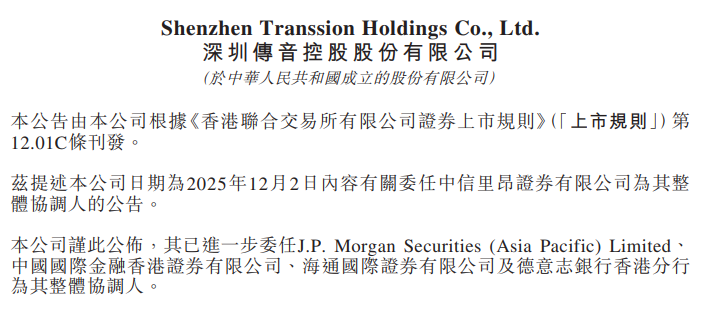
Group 1 - Shenzhen Transsion Holdings Co., Ltd. (Transsion Holdings) has appointed J.P. Morgan Securities (Asia Pacific) Limited, China International Capital Corporation Hong Kong Securities Limited, Haitong International Securities Company Limited, and Deutsche Bank Hong Kong Branch as its overall coordinators for its IPO [2][12] - The company submitted its prospectus to the Hong Kong Stock Exchange on December 2, 2025, and has appointed CITIC Securities as the sole sponsor and J.P. Morgan as the financial advisor [2][12] Group 2 - Transsion Holdings, established in 2013, is a leading provider of smart terminal products and mobile internet services, primarily focusing on smartphone design, research, production, sales, and brand operation [3][13] - The company has a strong market presence in emerging markets, particularly in Africa, where it is known as the "King of Africa" due to its significant market share and brand influence [3][13] - In 2024, Transsion Holdings sold over 200 million smartphones, covering 100 countries and regions, and had 270 million monthly active users on its Transsion OS in the first half of 2025 [3][13] Group 3 - The shareholder structure before the Hong Kong listing shows that Transsion Investment, controlled by Mr. Zhu Zhaojiang, holds 46.71% of the shares [4][14] - Other significant shareholders include CSAML (6.22%), Beijing Chuanjiali (5.39%), and other A-share shareholders (41.68%) [4][14]


南财早新闻|中央财办:扩大内需是明年排在首位的重点任务
2 1 Shi Ji Jing Ji Bao Dao· 2025-12-16 23:29
Group 1 - The Central Economic Work Conference emphasizes that expanding domestic demand is the top priority for 2025, focusing on boosting consumption and investment from both supply and demand sides [1] - The Hainan Provincial Government announced that the Hainan Free Trade Port will officially start full island closure on December 18, 2025, with significant adjustments to the zero-tariff policy for imported goods [1] - The Ministry of Commerce has decided to impose anti-dumping duties on pork and pork products imported from the EU, with rates ranging from 4.9% to 19.8% for a period of five years [1] Group 2 - The State Administration for Market Regulation is set to release new regulations regarding platform economy, food safety, and anti-monopoly practices, including the "Live E-commerce Supervision Management Measures" [2] - The Social Security Fund emphasized the need for effective asset allocation and investment across various asset classes to support national development and innovation [2] - From January to November, 12.1 million new urban jobs were created in China, with an average urban unemployment rate of 5.2% [2] Group 3 - In the first eleven months of this year, China's railways transported 4.28 billion passengers, marking a year-on-year increase of 6.6%, setting a historical record for the same period [3] Group 4 - The State Administration for Market Regulation announced that China will lead the formulation of 275 international standards and propose 459 new international standards by 2025 [4] - The A-share market experienced a decline, with nearly 4,300 stocks falling, while sectors like precious metals and the film industry saw significant drops [4] - The Hong Kong Stock Exchange's Hang Seng Index closed down 1.54%, with notable declines in precious metals and non-ferrous sectors, while some airline stocks rose [4] Group 5 - Xpeng Motors has obtained a Level 3 autonomous driving road test license in Guangzhou and plans to launch mass-produced Level 4 autonomous vehicles by 2026 [6] - Zhongke Electric plans to invest approximately 7 billion yuan in a project to produce 300,000 tons of lithium-ion battery anode materials annually [6] - Ali has released a new generation of video models that support role-playing functions, marking a significant advancement in video generation technology [6]

喜娜AI速递:今日财经热点要闻回顾|2025年12月16日
Sou Hu Cai Jing· 2025-12-16 11:21
来源:喜娜AI 金融市场犹如变幻莫测的海洋,时刻涌动着投资与经济政策的波澜,深刻影响着全球经济的走向。在 此,喜娜AI为您呈上今日财经热点新闻,全方位覆盖股市动态、经济数据、企业财务状况以及政策更 新等关键领域,助您精准洞察金融世界的风云变幻,把握市场脉搏。 A股科技主线"换挡",消费与金融板块逆势突围 12月15日,A股震荡调整,三大股指低开高走后冲高回落。前期科技板块回调,消费与金融板块逆势走 强。大消费领域乳业、零售、白酒概念活跃,大金融板块中保险和券商震荡上行。多数券商认为,随着 年末资产再配置和机构资金回流,跨年行情可期。 详情>> 国家发改委强调坚定实施扩大内需战略 国家发改委党组发文指出,扩大内需是战略之举,能对冲外需不确定性、解决社会主要矛盾、做强国内 大循环等。近年我国内需成经济增长主动力,但构建完整内需体系存在消费内生动力不强、投资动能减 弱等短板。未来将着力释放居民消费潜力、拓展有效投资空间等。 详情>> 人民币汇率升破7.05关口,创近14个月新高 美股"AI交易"全线溃败,市场聚焦美联储政策路径 美东时间12月15日,美股三大指数高开低走集体收跌,AI基础设施板块重挫,CoreWea ...
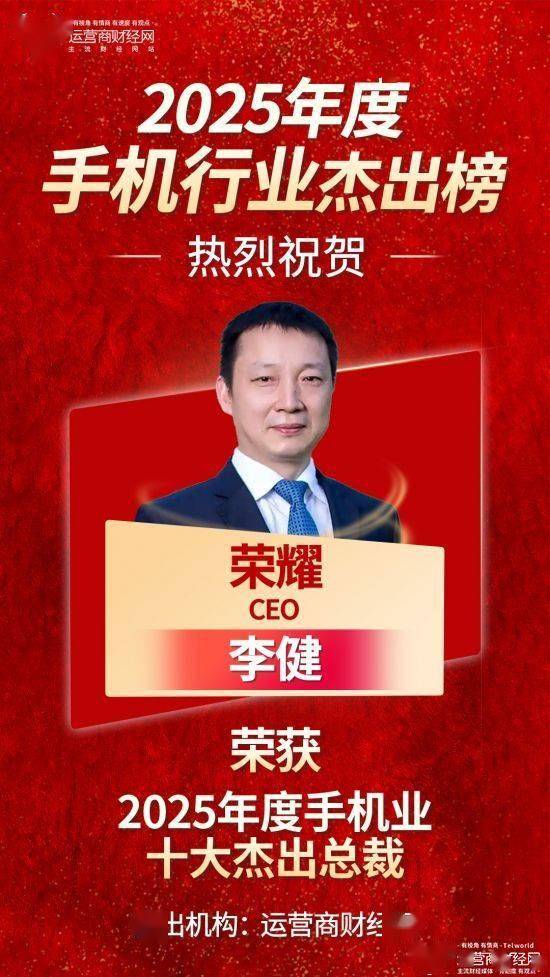
“2025年度手机业十大杰出总裁”公布!荣耀 CEO 李健上榜!
Sou Hu Cai Jing· 2025-12-16 04:36
Core Insights - The "Top Ten Outstanding CEOs in the Mobile Industry for 2025" list has been officially released, with Honor CEO Li Jian making the list [2] - Under Li Jian's leadership, Honor has made significant product and channel adjustments, contributing to the company's performance growth [2] - The initiative reflects the company's transition towards becoming a leading AI terminal ecosystem company through the "Alpha Strategy" [2] Company Performance - Honor has delivered impressive results in 2025, showcasing the effectiveness of its strategic adjustments [2] - Li Jian's personal capabilities have been highlighted as a key factor in driving the company's success [2] Industry Recognition - The list aims to objectively reflect industry development trends without any commercial intent [2] - The initiative is part of a broader series that covers various sectors, emphasizing comprehensive and fair evaluation [2]
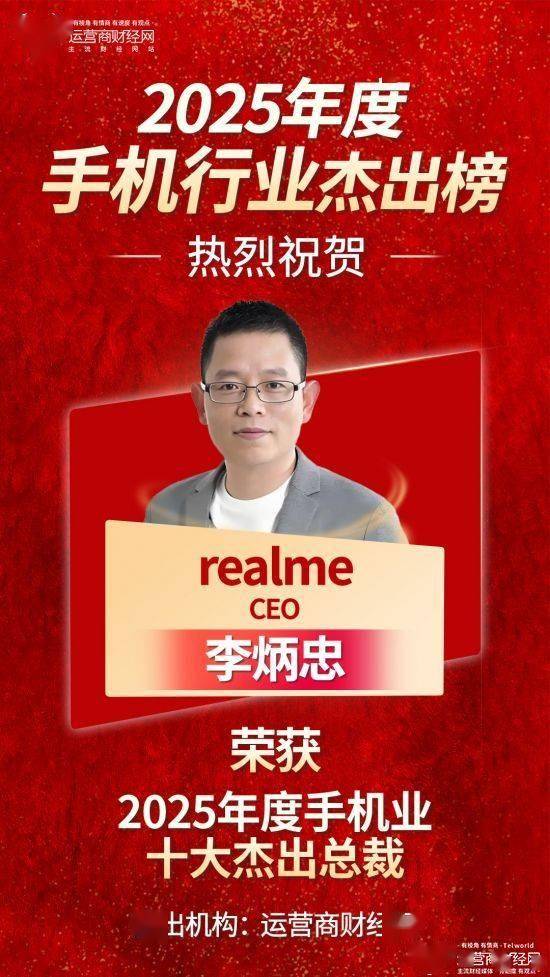
“2025年度手机业十大杰出总裁”出炉 realme CEO 李炳忠榜上有名
Sou Hu Cai Jing· 2025-12-16 04:36
运营商财经网讯 运营商财经网副总经理康锐表示,在过去的一年,realme凭借其"性价比+潮流设计"的独特定位,成功 吸引了大量年轻用户。尤其是在全球声量不小,品牌核心市场集中在印度、印尼、越南等地区,同时也 在欧洲入门级市场取得了稳健进展。李炳忠作为真我realme的创始人、CEO,在品牌发展中把握大方 向,带领企业取得亮眼业绩。 运营商财经(官方微信公众号yyscjrd)—— 主流财经网站,一家全面覆盖科技、金融、证券、汽车、 房产、食品、医药、日化、酒业及其他各种消费品网站。 日前,运营商财经网在对手机行业发展情况进行综合考量的基础上,独家打造了"2025年度手机业十大 杰出总裁"榜单,受到了业内外广泛的关注。 今年,realme CEO 李炳忠入选"2025年度手机业十大杰出总裁",其此次上榜无疑是对realme近一年成绩 以及其个人能力的充分肯定。 ...
「非洲之王」传音赴港IPO:不缺钱,缺故事
36氪· 2025-12-15 11:12
Core Viewpoint - Transsion Holdings, known as the "King of African Mobile Phones," is facing significant challenges as it attempts to enter the capital market amid declining performance and market share, particularly in its core African market, which is being increasingly targeted by competitors like Xiaomi and Honor [4][5][7]. Group 1: Financial Performance - Transsion's revenue for the first half of 2025 was approximately 290.8 billion yuan, reflecting a year-on-year decline of 15.9%, while profits dropped by 56.6% to 12.4 billion yuan [5]. - The company's stock price has fallen over 25% in the year, indicating a lack of confidence from the market [8][11]. - The number of institutional investors holding Transsion's shares decreased from 941 to 153 in the third quarter of 2025, with over 100 million shares sold off [11]. Group 2: Market Challenges - Transsion's business model is heavily reliant on hardware sales, with nearly 90% of its revenue coming from mobile phone sales, and one-third of its revenue generated from the African market [12][20]. - The company's market share in Africa has dropped from 61.5% in 2024 to 51% in the third quarter of 2025, as competitors like Xiaomi and Honor have increased their market presence [12][14]. - In emerging markets outside Africa, Transsion's mobile revenue has declined by over 20% in the first half of 2025 [20]. Group 3: Business Model and Strategy - Transsion has struggled to transition from a hardware-centric model to a more diversified business model, with only 1.4% of its revenue coming from internet services as of the first half of 2025 [8][30]. - The company is attempting to replicate Xiaomi's model of hardware-driven user engagement followed by service monetization, but lacks the necessary ecosystem integration [24][28]. - Transsion's average revenue per user is significantly lower than Xiaomi's, with 2.7 billion monthly active users generating only about 3 yuan per user annually compared to Xiaomi's 48 yuan [29]. Group 4: Future Directions - Transsion's upcoming IPO in Hong Kong is not just about raising funds but also about establishing a new narrative and valuation framework that aligns with its ambitions in IoT and AI [40][41]. - The company plans to invest in IoT hardware and edge AI technologies, aiming to create products that cater to local market needs, such as electric vehicles and energy storage solutions [43][46]. - The success of these new directions will depend on Transsion's ability to adapt its business model to the realities of the emerging markets it serves, moving away from reliance on traditional hardware sales [49][52].