
能源

Search documents
新华财经早报:9月23日
Zhong Guo Jin Rong Xin Xi Wang· 2025-09-22 23:58
Group 1: Financial Developments - As of the end of July, foreign institutions and individuals held over 10 trillion yuan in domestic stocks, bonds, and deposits in China, with stocks exceeding 3 trillion yuan, bonds around 4 trillion yuan, and deposits approximately 3 trillion yuan [1] - Since the beginning of the "14th Five-Year Plan," insurance funds have invested over 5.4 trillion yuan in stocks and equity funds, representing an 85% increase compared to the end of the "13th Five-Year Plan" [1] - Listed companies in China have distributed a total of 10.6 trillion yuan through dividends and buybacks over the past five years, which is more than 80% higher than during the "13th Five-Year Plan" and equivalent to 2.07 times the amount raised through IPOs and refinancing during the same period [1] Group 2: Steel Industry - A joint document from five departments outlines a plan to stabilize growth in the steel industry, setting an average annual growth target of around 4% for value added over the next two years, while implementing precise capacity and production controls and prohibiting new capacity [1] Group 3: Corporate Announcements - Tianqi Lithium announced a cooperation agreement with Ruipu Lanjun for the procurement of no less than 800,000 tons of electrolyte products by the end of 2030, with a monthly supply requirement of at least 20,000 tons [1][5] - Changchuan Technology expects a net profit of between 827 million yuan and 870 million yuan for the first three quarters, representing a year-on-year growth of 131.39% to 145.38% [5]


美股三大股指,齐创历史新高!牵手OpenAI,英伟达大涨近4%
Zhong Guo Zheng Quan Bao· 2025-09-22 23:15
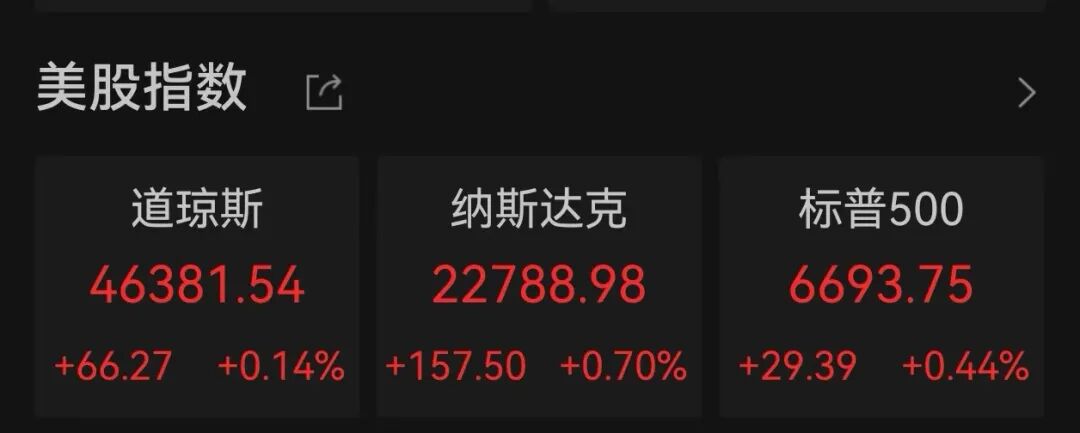
Group 1: Market Performance - On September 22, U.S. stock indices opened lower but closed higher, with all three major indices reaching new historical highs [2][4] - The Dow Jones, Nasdaq, and S&P 500 indices increased by 0.14%, 0.70%, and 0.44% respectively [2] - Nvidia's stock rose nearly 4%, closing at $183.61 per share, with a total market capitalization of $4.46 trillion [4] Group 2: Nvidia's Investment Plans - Nvidia plans to invest $100 billion in an artificial intelligence research center in collaboration with OpenAI, focusing on building large-scale data centers [1] Group 3: Commodity Market Trends - International gold prices surged, with COMEX gold futures and London spot gold prices increasing by 2.03% and 1.66% respectively [5] - The international oil prices experienced a slight decline, with light crude oil futures dropping to $62.64 per barrel, a decrease of 0.06% [7] - Analysts predict that the Federal Reserve's potential continued rate cuts may lead to increased gold ETF holdings globally [7]

大宗商品会有新一轮牛市吗?
对冲研投· 2025-09-22 13:53
Core Viewpoint - The article emphasizes the importance of understanding economic cycles as a comprehensive product of economic, technological, and social systems, rather than merely focusing on macroeconomic indicators [2]. Group 1: Commodity Market Dynamics - Following the pandemic, global fiscal stimulus, geopolitical tensions, and a surge in AI capital expenditures have led to a bullish trend in metals and various commodities [3]. - The article questions whether the current commodity bull market can sustain itself and what underlying bullish drivers remain unrecognized by investment banks and media [3]. - The series aims to provide insights and materials for readers to make informed judgments and decisions regarding the commodity market [3]. Group 2: Market Participation and Trading Behavior - The article discusses the role of top traders and their actions in influencing market prices, suggesting that asset price changes are a result of complex interactions within economic and social systems [4]. - It highlights the importance of understanding market rhythms and the process of trading rather than relying solely on predictive models [4][5]. - Historical cycles of economic prosperity and recession (Kondratiev waves) are presented, indicating that the current phase may be entering a recovery period with increased investment demand [6]. Group 3: Strategic Role of Commodities - Recent political developments have led investment banks to believe that commodities will play a more strategic role in investment portfolios, with even a small allocation being considered beneficial [7]. - Goldman Sachs outlines a four-step "control cycle" for commodities, emphasizing the need for supply chain security, market share expansion, concentration of supply, and leveraging geopolitical tools [8][9][10]. - The article suggests that as commodities become a necessary part of investment strategies, their market dynamics will change, potentially leading to increased price volatility and inflation risks [10]. Group 4: Gold as a Safe Haven - The World Gold Council is planning to introduce "digital gold" to innovate the gold trading and settlement process, which could significantly alter the existing gold market ecosystem [15]. - The rising price of gold, particularly since the election of Trump, signals a shift in the global macro environment, indicating a potential bull market for commodities [17]. - The influx of capital into gold futures is expected to have a spillover effect on other commodities, leading to a broad-based bull market [17].

美联储降息25BP:商品走势分化,后市交易逻辑待切换
Sou Hu Cai Jing· 2025-09-22 13:46
Core Viewpoint - The recent "Super Central Bank Week" concluded with the Federal Reserve lowering interest rates by 25 basis points, prompting other central banks to follow suit, leading to a recalibration of asset pricing and new trading logic in the market [1] Market Performance - Global stock markets exhibited mixed results, with U.S. stocks initially declining but later reaching new highs, while A-shares experienced a pullback after a rise [1] - The Baltic Dry Index (BDI) saw a slight increase, while the volatility index (VIX) rose, indicating market uncertainty [1] - U.S. Treasury yields and the dollar index initially fell but later rebounded, showcasing volatility in non-U.S. currencies [1] Commodity Market Trends - Commodity prices displayed divergence, with gold experiencing high volatility, copper prices dropping significantly, and oil prices remaining weak, leading to a weekly decline in the CRB index [1] - In the domestic market, a trend against "involution" boosted black commodities, particularly coking coal and coke, while glass and soda ash also saw gains [1] - The domestic bond market showed mixed results, with stock indices reflecting varied performances [1] Commodity Sector Analysis - The Wind Commodity Index reported a weekly change of -0.19%, with 4 out of 10 sectors gaining and 6 sectors declining, indicating a pattern of strength domestically but weakness externally [1] - Precious metals faced a correction, and the significant drop in non-ferrous metals negatively impacted overall commodity performance, while coal, steel, and non-metallic building materials sectors surged [1] - Agricultural products led the decline among commodity sectors [1] Future Outlook - The resumption of the interest rate cut process is expected to shift global macro trading logic, with the Fed's rate cut likely to influence commodity prices through various channels [1] - Generally, rate cuts enhance the attractiveness of gold and other commodities, as a weaker dollar supports commodity prices and liquidity injections boost expectations [1] - The phenomenon of "buying the expectation, selling the fact" is noted, with gold experiencing a rise followed by a pullback post-rate cut, suggesting that future commodity trends may diverge [1]
黄金股市齐创新高,本轮“泡沫”该如何交易?
Hua Er Jie Jian Wen· 2025-09-22 13:36
Core Viewpoint - The Federal Reserve is initiating interest rate cuts, leading to a surge in global asset prices and entering a bubble period driven by loose monetary policy [1] Group 1: Market Performance - As of September 22, gold has risen 35.4% year-to-date, Bitcoin is up 17.2%, and global stock markets have increased by 14.3%. High-yield bonds and investment-grade bonds have recorded returns of 8.5% and 8.3%, respectively [1] - In contrast, the US dollar index and oil prices have decreased by 9.3% and 11.4%, respectively [1] Group 2: Economic Environment - Michael Hartnett from Bank of America highlights that tariff cuts, tax reductions, and interest rate cuts create a "run-it-hot" policy environment, providing implicit "too big to fail" guarantees for the economy and stock market [1] - Despite evident bubble signs, Hartnett suggests that the market may not have peaked yet [1] Group 3: Trading Strategies - Hartnett proposes five trading strategies to navigate the current market conditions: 1. Go long on core bubble assets 2. Build a "barbell" portfolio with bubble assets on one end and cheap value stocks on the other 3. Short corporate bonds of bubble companies 4. Short US bonds 5. Go long on bond volatility and short stock volatility [1][6][11] Group 4: Historical Context - Historical analysis shows that from 1900, the average rise from market lows to peaks in 10 major bubbles was 244%, with an average peak dynamic P/E ratio of 58 times [4] - The "Magnificent Seven" tech stocks have risen 223% since their March 2023 lows, with a dynamic P/E ratio of 39 times, indicating potential for further upside [4] Group 5: Market Sentiment - Goldman Sachs trader Paolo Schiavone notes a prevailing market sentiment that favors consumption or investment over holding cash due to perceived currency devaluation, driving funds into risk assets [3] - Fund managers are compelled to chase high-risk, high-beta investments to keep up with market benchmarks as year-end bonuses approach [3] Group 6: Global Opportunities - The ongoing weakness of the US dollar presents opportunities in international markets, with a theme of "global rebalancing" emerging in the latter half of the 2020s [9] - A notable correlation between the Japanese yen and the Japanese stock market suggests a potential bull market in Japan, as both are moving in tandem [9]
光正眼科:控股股东光正投资累计质押约3492万股
Mei Ri Jing Ji Xin Wen· 2025-09-22 11:35
Group 1 - The core point of the article is that Guangzheng Eye Hospital has announced the pledge renewal and release of shares by its controlling shareholder, Guangzheng Investment, which has pledged approximately 34.92 million shares, accounting for 27.03% of its holdings [1] - As of the announcement date, Guangzheng Eye Hospital's market capitalization is 2.1 billion yuan [1] - For the first half of 2025, the revenue composition of Guangzheng Eye Hospital is as follows: 91.5% from the health industry, 5.46% from steel structure engineering, and 3.04% from the energy sector [1]

冠通期货宏观与大宗商品周报-20250922
Guan Tong Qi Huo· 2025-09-22 11:22
1. Report Industry Investment Rating No relevant content provided. 2. Core Views - After the super central bank week ended, the Fed cut interest rates by 25BP as expected, and many central banks followed suit. The trading logic of interest rate cuts was adjusted, and major assets corrected the over - priced loose expectations and brewed new trading logics [6][11]. - Global major stock markets showed mixed performance. The US stocks rebounded after an initial decline and reached a new all - time high, while the A - shares adjusted after a sharp rise. The BDI index rose slightly, the VIX volatility index increased significantly, the US Treasury yields and the US dollar index rebounded after hitting bottom, and non - US currencies performed differently [6][11]. - Commodity trends were divergent. Gold corrected after reaching a high and fluctuated, the sharp decline in copper prices dragged down the entire non - ferrous sector, and oil prices remained weak. The CRB index declined significantly on a weekly basis. In China, an article by senior officials was published in Qiushi Journal, triggering an anti - involution market and boosting the strong rise of the black series, with coking coal and coke leading the gains, followed by glass and soda ash [6][11]. - The domestic bond market showed mixed performance and was under pressure in the long - term. Stock indices were also divergent. The domestic commodity sectors showed mixed performance, with most closing down. The growth - style stocks were significantly more resilient, while value stocks tumbled [7]. - The domestic commodity sectors showed an internal - strong and external - weak style. The correction in precious metals and the sharp decline in non - ferrous metals dragged down the overall commodity performance. The coal, coking, steel, and mining sectors and the non - metallic building materials sector rose strongly due to the resurgence of the anti - involution market. The energy, oilseeds, and chemical sectors rose slightly. The agricultural products sector led the decline with a drop of - 4.33%, followed by the grain sector with a decline of over - 1% [7]. 3. Summary by Directory 3.1. Big - Class Assets - After the super central bank week, the Fed cut interest rates by 25BP, and many central banks followed. Global major stock markets, bond markets, currencies, and commodities showed mixed performance. In China, the anti - involution market pushed up the black series [6][11]. 3.2. Sector Express - The domestic bond market was mixed and under long - term pressure, stock indices were divergent, and most domestic commodity sectors closed down. The growth - style stocks were more resilient, and value stocks tumbled. The Wind Commodity Index declined by - 0.19% on a weekly basis, with 4 out of 10 commodity sub - indices rising and 6 falling. The internal - strong and external - weak style was evident, with precious metals' correction and non - ferrous metals' decline dragging down the overall performance [7][17]. 3.3. Fund Flows - Last week, funds in the commodity futures market flowed out slightly. The soft commodities, coal, coking, and steel sectors, and the agricultural products sector saw obvious fund inflows, while the non - ferrous metals and energy sectors saw significant outflows [20]. 3.4. Variety Performance - Most domestic major commodity futures closed down last week. The top - rising commodity futures were coking coal, coke, and industrial silicon, while the top - falling ones were live pigs, 20 - number rubber, and soybean meal [26]. 3.5. Volatility Characteristics - Last week, the volatility of the international CRB commodity index decreased significantly, the volatility of the domestic Wind Commodity Index increased, and the Nanhua Commodity Index declined significantly. Most commodity futures sectors saw a slight increase in volatility, with the energy and chemical sectors experiencing a significant decline, while the grain, coal, coking, steel, and mining sectors, and the non - metallic building materials sector saw a significant increase [31]. 3.6. Data Tracking - Internationally, most major commodities closed up, with the BDI rising, soybeans and corn increasing, copper and oil falling, and gold and silver almost flat. The gold - silver ratio was under pressure and the gold - oil ratio declined. Domestically, the asphalt operating rate rebounded rapidly, real estate sales continued to decline weakly, freight rates dropped rapidly, and short - term capital interest rates fluctuated and rebounded [34][55]. 3.7. Macro Logic - Stock indices adjusted after a sharp rise and were mixed. Valuations were under pressure, and the risk premium ERP rebounded after hitting bottom. Commodity price indices adjusted after a sharp rise, inflation expectations rebounded, and the divergence between expectations and reality converged [39][48]. - The US Treasury yields showed a divergent trend, with short - term yields weak and long - term yields strong. The term structure steepened, the term spread widened, the real interest rate rebounded, and the gold price was under pressure at a high level [62]. - The US high - frequency "recession indicator" weakened, the impact of tariffs on the economy became more obvious, and the 10Y - 3M US Treasury spread turned positive [72]. 3.8. Fed Interest Rate Cut Expectations - The Fed cut interest rates by 25BP in September as expected. The probability of another 25BP cut in October to 3.75% is 95.2%, and the probability of a further cut in December is high. It is expected to cut interest rates three times this year, a total of 75BP, and 1 - 2 times in 2026 to around 3% [78]. 3.9. China - US Madrid Economic and Trade Talks - From September 14th to 15th, China and the US reached a basic framework consensus on properly resolving the TikTok - related issues, reducing investment barriers, and promoting economic and trade cooperation. The market reacted positively after the results were announced [83][85]. 3.10. The Publication of an Article in Qiushi Journal - An article by General Secretary Xi Jinping was published in Qiushi Journal, emphasizing the construction of a national unified market. The anti - involution market restarted, which had strategic significance in multiple dimensions [88]. 3.11. September FOMC Meeting - The Fed cut interest rates by 25BP at the September FOMC meeting, which was called a "risk - control" interest rate cut. Most policymakers expect to cut interest rates two more times this year. The meeting also adjusted the statement on employment, highlighting the increased risk of employment decline [91]. - The market reaction to the meeting was mainly an adjustment due to over - pricing. Globally, it was a reaction to the fact that the actual result fell short of expectations after a major event. In China, it led to a triple - kill of stocks, bonds, and commodities, reflecting the disappointment of policy expectations [105]. 3.12. Global Central Bank Policies - After the Fed restarted interest rate cuts, many central banks around the world followed suit. The main theme of global central bank policies was easing, but the paces of different countries varied according to their own situations [112][113]. 3.13. Market Outlook after Interest Rate Cuts - After the interest rate cuts, the market macro - logic may switch from interest - rate - cut trading to recovery trading. The US dollar may rebound slightly after an initial weakness if the economic fundamentals improve. Gold may correct after over - pricing the interest rate cut expectations, but its long - term upward trend remains. The performance of commodities will be divergent, with silver and copper benefiting from the recovery trading, and coking coal and new - energy varieties being favored if the domestic economy weakens unexpectedly [117][131]. 3.14. This Week's Focus - A series of economic data releases and speeches by central bank officials from different countries are scheduled from September 22nd to 26th, including China's one - year LPR, Eurozone's consumer confidence index, and US GDP and inflation data [135].
推动全球科技开放合作迈出更大步伐——2025浦江创新论坛主论坛探讨如何应对全球性挑战
Ke Ji Ri Bao· 2025-09-22 09:26
Group 1 - The 2025 Pujiang Innovation Forum emphasized the importance of technological innovation as a key force for addressing global challenges and promoting development, with the Chinese government prioritizing strategies to enhance scientific and technological capabilities [1] - China aims to build a global scientific community through enhanced bilateral and multilateral cooperation, focusing on technology exchange and collaborative platforms such as joint laboratories and innovation cooperation zones [1] - The forum highlighted the significance of international scientific collaboration in addressing major global health challenges, exemplified by the development of a novel cell therapy for chronic hepatitis B involving teams from Germany, Singapore, and China [2] Group 2 - The successful development of the TCR-T cell therapy for chronic hepatitis B represents a milestone in treatment options, potentially offering a solution to the lifelong medication challenge faced by patients [2] - The forum underscored the necessity of diverse thinking in scientific research, advocating for the establishment of more international research platforms in China to facilitate long-term collaboration among scientists [3] - China is actively participating in major international scientific projects, such as the International Thermonuclear Experimental Reactor and the Square Kilometer Array, which are crucial for advancing knowledge and addressing significant scientific challenges [4]
7500亿购买美国产品!还要拿6000亿美元投资?欧盟不死也脱层皮
Sou Hu Cai Jing· 2025-09-22 07:39
Group 1 - The EU is responding to pressure from the US by deepening trade relations with India and other emerging markets, aiming to reduce reliance on the US market [1][3][4] - EU Commission President Ursula von der Leyen has committed to completing negotiations for a free trade agreement with India within this year, indicating a proactive approach to trade expansion [3][4] - The EU is currently negotiating with South Africa, Malaysia, and the UAE, and has already signed agreements with Mexico, Switzerland, and the Southern Common Market of South America, showcasing a strategic shift towards diversifying trade partnerships [3][4] Group 2 - The EU is facing significant challenges in the ongoing trade dispute with the US, having made concessions that include accepting higher tariffs and committing to substantial purchases of US energy products and AI chips [4][7] - European businesses are experiencing a survival crisis, prompting calls from major economic organizations for reforms to simplify administrative processes, control energy prices, and ease burdens on small and medium-sized enterprises [4][5][7] - The effectiveness of the EU's new trade agreements in addressing core issues such as energy and talent shortages remains to be seen, with the business community emphasizing the need for tangible results rather than mere discussions [7][9] Group 3 - India stands to benefit significantly from the EU's trade expansion, gaining access to new markets while reducing its dependence on the US, which may alter the balance of economic influence [3][9] - The current situation reflects a decline in US hegemony, as the Trump administration's aggressive policies have alienated traditional allies, leading to a collective pushback against US dominance [9]

能源化工期权策略早报:能源化工期权-20250922
Wu Kuang Qi Huo· 2025-09-22 03:46
1. Report Industry Investment Rating - Not available in the provided content 2. Core Viewpoints - Energy chemical options cover various categories including energy, polyolefins, polyesters, alkali chemicals, and others [3]. - The strategy suggests constructing option - combination strategies mainly as sellers, along with spot hedging or covered strategies to enhance returns [3]. 3. Summary by Related Catalogs 3.1. Futures Market Overview - Different energy - chemical option underlying futures have different price, trading volume, and open - interest changes. For example, crude oil (SC2511) closed at 484, down 8 (-1.55%), with a trading volume of 10.89 million lots and an open interest of 3.38 million lots [4]. 3.2. Option Factors - Volume and Open - Interest PCR - PCR indicators for different options vary. For instance, the volume PCR of crude oil options is 0.94, down 0.07, and the open - interest PCR is 1.03, down 0.13 [5]. 3.3. Option Factors - Pressure and Support Levels - Each option has its pressure and support levels. For example, the pressure level of crude oil options is 570, and the support level is 480 [6]. 3.4. Option Factors - Implied Volatility - Implied volatility of different options shows different trends. For example, the flat - strike implied volatility of crude oil options is 30.21%, and the weighted implied volatility is 32.98%, up 0.27% [7]. 3.5. Strategy and Recommendations 3.5.1. Energy - Class Options (Crude Oil) - Fundamental analysis: OPEC may discuss early release of 1.6 million barrels per day of production cuts, and Russia has its own production - cut plan [8]. - Market analysis: Crude oil has been in a weak and range - bound pattern since July, with short - term weakness in August and September [8]. - Option factor research: Implied volatility fluctuates around the mean, open - interest PCR is above 1.00, indicating a range - bound market, and the pressure and support levels are 570 and 480 respectively [8]. - Strategy recommendations: Directional strategy: None; Volatility strategy: Construct a short - biased call + put option combination strategy; Spot long - hedging strategy: Construct a long collar strategy [8]. 3.5.2. Energy - Class Options (LPG) - Fundamental analysis: PDH device maintenance is stable, but profit decline may lead to a decrease in capacity utilization [10]. - Market analysis: LPG has shown an oversold rebound pattern with pressure above [10]. - Option factor research: Implied volatility has dropped significantly to around the mean, open - interest PCR is around 0.80, indicating a range - bound market, and the pressure and support levels are 4800 and 4700 respectively [10]. - Strategy recommendations: Directional strategy: None; Volatility strategy: Construct a neutral - biased call + put option combination strategy; Spot long - hedging strategy: Construct a long collar strategy [10]. 3.5.3. Alcohol - Class Options (Methanol) - Fundamental analysis: Port inventory has reached a new high, and enterprise inventory and orders have changed [10]. - Market analysis: Methanol has shown a weak pattern with pressure above [10]. - Option factor research: Implied volatility has declined and fluctuates below the mean, open - interest PCR is around 0.80, indicating a weak - range - bound market, and the pressure and support levels are 2400 and 2250 respectively [10]. - Strategy recommendations: Directional strategy: Construct a bear - spread strategy with put options; Volatility strategy: Construct a short - biased call + put option combination strategy; Spot long - hedging strategy: Construct a long collar strategy [10]. 3.5.4. Alcohol - Class Options (Ethylene Glycol) - Fundamental analysis: Port inventory is expected to be in a low - level shock and then enter a stock - building cycle [11]. - Market analysis: Ethylene glycol has shown a weak pattern with pressure above [11]. - Option factor research: Implied volatility fluctuates below the mean, open - interest PCR is around 0.60, indicating strong short - side power, and the pressure and support levels are 4500 and 4250 respectively [11]. - Strategy recommendations: Directional strategy: Construct a bear - spread strategy with put options; Volatility strategy: Construct a short - volatility strategy; Spot long - hedging strategy: Hold spot long + buy put options + sell out - of - the - money call options [11]. 3.5.5. Polyolefin - Class Options - Fundamental analysis: Polyolefin inventory has different changes in production enterprises, traders, and ports, with PP having higher inventory pressure than PE [12]. - Market analysis: Polypropylene has shown a weak pattern with pressure above [12]. - Option factor research: Implied volatility has declined to below the mean, open - interest PCR is around 0.80, indicating a weak trend, and the pressure and support levels are 7400 and 6700 respectively [12]. - Strategy recommendations: Directional strategy: None; Volatility strategy: None; Spot long - hedging strategy: Hold spot long + buy at - the - money put options + sell out - of - the - money call options [12]. 3.5.6. Rubber Options - Fundamental analysis: Affected by the rubber - tapping season in Southeast Asia and increased overseas supply expectations, the global rubber futures market has declined [13]. - Market analysis: Rubber has shown a weak - range - bound pattern with support below and pressure above [13]. - Option factor research: Implied volatility has risen sharply and then dropped to around the mean, open - interest PCR is below 0.60, and the pressure and support levels are 17000 and 15750 respectively [13]. - Strategy recommendations: Directional strategy: None; Volatility strategy: Construct a neutral - biased call + put option combination strategy; Spot hedging strategy: None [13]. 3.5.7. Polyester - Class Options - Fundamental analysis: PTA inventory has increased slightly, but it is expected to maintain a de - stocking pattern due to high downstream load and more maintenance in September [14]. - Market analysis: PTA has shown a weak - bearish pattern with pressure above [14]. - Option factor research: Implied volatility fluctuates at a relatively high level, open - interest PCR is around 0.70, indicating a range - bound market, and the pressure and support levels are 5000 and 4400 respectively [14]. - Strategy recommendations: Directional strategy: None; Volatility strategy: Construct a short - biased call + put option combination strategy; Spot hedging strategy: None [14]. 3.5.8. Alkali - Class Options (Caustic Soda) - Fundamental analysis: Caustic soda factory inventory has increased [15]. - Market analysis: Caustic soda has shown a downward - trending pattern with pressure above [15]. - Option factor research: Implied volatility fluctuates at a high level, open - interest PCR is below 0.90, indicating a weak - range - bound market, and the pressure and support levels are 3000 and 2440 respectively [15]. - Strategy recommendations: Directional strategy: None; Volatility strategy: None; Spot collar hedging strategy: Hold spot long + buy put options + sell out - of - the - money call options [15]. 3.5.9. Alkali - Class Options (Soda Ash) - Fundamental analysis: Soda ash factory inventory has decreased [15]. - Market analysis: Soda ash has shown a low - level range - bound pattern with support below [15]. - Option factor research: Implied volatility fluctuates at a relatively high historical level, open - interest PCR is below 0.60, indicating strong short - side pressure, and the pressure and support levels are 1300 and 1200 respectively [15]. - Strategy recommendations: Directional strategy: Not specified; Volatility strategy: Construct a short - volatility combination strategy; Spot long - hedging strategy: Construct a long collar strategy [15]. 3.5.10. Urea Options - Fundamental analysis: Urea enterprise inventory has increased, and domestic demand is still weak [16]. - Market analysis: Urea has shown a low - level weak - range - bound pattern [16]. - Option factor research: Implied volatility fluctuates around the historical mean, open - interest PCR is below 0.60, indicating strong short - side pressure, and the pressure and support levels are 1800 and 1620 respectively [16]. - Strategy recommendations: Directional strategy: None; Volatility strategy: Construct a short - biased call + put option combination strategy; Spot hedging strategy: Hold spot long + buy at - the - money put options + sell out - of - the - money call options [16].