
地产

Search documents
国海富兰克林基金赵晓东:当下最显眼的机会在港股
Xin Lang Cai Jing· 2025-12-23 23:38
来源:智通财经 "港股最大的优势就是便宜。"近日,国海富兰克林基金权益投资总监赵晓东在接受智通财经采访时表 示,港股目前估值处于低位,且大部分大企业注重股东回报,在分红、回购方面更为积极,公司治理也 更为规范,"当下最显眼的机会在港股。" 从资金面看,赵晓东认为,南下资金持续流入成为港股重要支撑,尤其在境内低利率环境下,港股高分 红资产吸引力凸显。若美国降息周期开启或人民币进入升值通道,港股有望迎来进一步的估值修复动 力。 展望未来,赵晓东认为两大外部变量可能进一步提振港股:一是若美国开启降息周期,有望带动全球资 金回流港股市场;二是若人民币进入升值通道,则以人民币计价的资产吸引力将上升,尤其有利于现金 流稳定的高分红标的。 当前为地产行业逆向布局的窗口期 针对市场普遍谨慎的地产行业,赵晓东认为其虽仍面临基本面压力——房价下行、供给过剩及政策对二 手市场的冲击尚未完全消散,但行业已处于底部区域,反而提供了逆向布局的窗口。他预计,明年一季 度或将迎来稳定地产的政策,其目标在于稳住市场信心,而非助推房价上涨。 在具体配置方向上,赵晓东当前重点关注港股中的地产、银行及互联网板块。 他指出,地产行业目前已处于底部区域 ...
不出意外,A股跨年行情要重现了!
Sou Hu Cai Jing· 2025-12-23 14:11
Group 1 - The A-share market is expected to experience a year-end rally, with large funds prepared while retail investors are not yet ready [1][5] - The current market conditions, including index position, trading volume, and news sentiment, are favorable for a market uptrend [3] - The technology sector is likely to continue its bullish trend, with significant interest in biotechnology and new energy, despite the presence of bubbles in tech stocks [3][5] Group 2 - The cross-year market rally is anticipated to occur, as historical trends show that bull markets do not typically decline before the Spring Festival [5] - Consumer sectors such as liquor, real estate, and securities are also expected to rise, alongside technology stocks [5] - Current investment strategy suggests maintaining a high position in technology and securities while being cautious in a volatile market [7]


祥源系实控人俞发祥涉嫌犯罪被采取刑事强制措施,债务风波持续发酵
Xin Lang Cai Jing· 2025-12-23 00:16
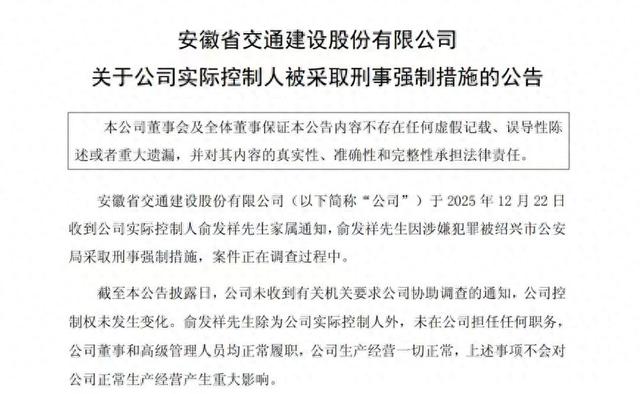
Core Viewpoint - Three listed companies, Xiangyuan Cultural Tourism, Jiaojian Co., and Haichang Ocean Park, announced that their actual controller, Yu Faxiang, has been taken into criminal custody by the Shaoxing Public Security Bureau due to suspected criminal activities, with investigations ongoing [1][3]. Group 1: Company Announcements - As of the announcement date, none of the three companies have received requests for assistance in the investigation, and their control has not changed, with normal production and operations continuing [3]. - The incident is a result of ongoing debt risks within the Xiangyuan Group, with financial products guaranteed by Xiangyuan Holdings and Yu Faxiang facing overdue payments totaling up to 20 billion yuan [3][5]. - On December 7, Xiangyuan Cultural Tourism and Jiaojian Co. issued statements clarifying that the overdue financial products are unrelated to the listed companies and that Yu Faxiang is responsible for the guarantees [3]. Group 2: Regulatory and Legal Actions - Following the debt crisis, regulatory authorities intervened, forming a working group to assist Xiangyuan Holdings and ensure normal operations while investigating the company's financial situation [5]. - The core equity of the Xiangyuan Group has been largely frozen, with Jiaojian Co. disclosing that shares held by its controlling shareholder and Yu Faxiang have been judicially frozen [6][8]. - Specific data shows that Xiangyuan Holdings holds 274.29 million shares of Jiaojian Co., accounting for 44.32% of the total share capital, with all shares frozen [7]. Group 3: Company Background and Current Status - Yu Faxiang, born in 1971, is the chairman of Xiangyuan Holdings, which controls three listed companies and has a net worth of 14.5 billion yuan, ranking 465th on the Hurun Rich List [8]. - Xiangyuan Holdings, founded in 1992, focuses on cultural tourism investment and operates over 50 projects, while also being involved in infrastructure and real estate [8]. - The three listed companies have emphasized their operational independence from the controlling shareholder, asserting no non-operational fund occupation or illegal guarantees exist [8].


沪指盘中站上3920点,“春季躁动”提前启动?机构分歧较大
Mei Ri Jing Ji Xin Wen· 2025-12-22 06:44
Group 1 - The A-share market experienced a significant increase, with the Shanghai Composite Index recovering the 3920-point mark, raising questions about the potential early start of the "spring market rally" [1] - Various research institutions have differing opinions on the spring market rally, with both Industrial Securities and Huatai Securities expressing optimism [1] - Industrial Securities highlighted potential signals for the rally, including the likelihood of interest rate cuts and improvements in key economic indicators such as PPI, PMI, M1, and social financing [1] Group 2 - Huatai Securities anticipates that the spring market rally is promising, although the current phase is characterized by uncertainties in fundamental expectations and policy data [1] - Shenwan Hongyuan maintains a cautious outlook, suggesting that the spring rally may initially manifest in non-mainstream sectors, focusing on industry and policy themes [1] - Huachuang Securities emphasizes that the timing of the spring rally's initiation is contingent on the strength and pace of real estate policies [2] Group 3 - The focus of Huachuang Securities is on how the low point before the spring rally is formed, with current market adjustments attributed to pressures in the real estate sector [2] - Guangfa Strategy's team views the probability of a spring rally in Hong Kong stocks during the Christmas to Spring Festival period as high, citing an 80% historical probability of the Hang Seng Index rising during this timeframe [2] - Relevant ETFs include the CSI 300 ETF, which is expected to face less resistance in the spring rally due to its balanced style and focus on large-cap, cyclical industries [2]
【十大券商一周策略】告别单一叙事!A股跨年行情+春季躁动或将拉开帷幕
Zheng Quan Shi Bao Wang· 2025-12-21 15:11
Group 1 - The core viewpoint is that a classic "cross-year-spring" market trend is brewing, with significant signals indicating its commencement [3] - Factors driving the appreciation of the RMB are increasing, and investors should adapt their asset allocation accordingly, focusing on industries that may benefit from this trend [1] - The market is expected to see a structural shift with a focus on cyclical sectors, particularly industrial metals, non-bank financials, and sectors related to domestic consumption [3][4] Group 2 - The investment strategy should consider three key clues: dividend value, layout of prosperous industries, and thematic hotspots [4] - The anticipated spring market in 2026 is expected to be driven by a combination of fundamental cyclical improvements and new technological trends [2] - The current market is characterized by a narrow range of fluctuations, influenced by external factors such as U.S. monetary policy and investor sentiment [4][6] Group 3 - The focus on AI and advanced manufacturing is expected to dominate the market, with a potential shift towards value and cyclical styles in the first half of 2026 [2] - The market is likely to experience a "value on stage, growth in action" dynamic, particularly as the Lunar New Year approaches [9] - There is a notable expectation for structural opportunities in sectors like AI, new energy, and controlled nuclear fusion, which are aligned with the "14th Five-Year Plan" [6][10]

这一轮牛市的下一步,2026年该怎么走?
雪球· 2025-12-21 11:25
Core Viewpoint - The Chinese market is expected to enter an extraordinary "bull market" in 2025, driven by industry trends, fundamental improvements, and external liquidity narratives, with significant attention on the subsequent direction of the "bull market" in 2026 [1] Group 1: Credit Expansion Direction - The global market in 2025 exhibited several counterintuitive characteristics, including diverse asset performance and significant asset rotation, particularly in the Hong Kong stock market, where different themes emerged each quarter [3] - Credit expansion is identified as the core explanatory logic for these phenomena, providing insights into the relative performance of tech stocks, dollar trends, and global asset flows [3] Group 2: U.S. Economic Recovery and Stock Market - The discussion on "de-dollarization" reveals that while it exists, it is not a universal trend, as some funds are increasing their holdings in U.S. Treasuries while others push gold prices to new highs, indicating a bifurcation in global asset allocation [5] - The U.S. economy and stock market are expected to recover, with a potential for overheating, particularly in the AI sector, which, while having high expectations, has not yet reached the exuberance seen during the 2000 internet bubble [5][6] - U.S. fiscal policy is projected to expand in 2026, with the "Great American Rescue Plan" potentially contributing an additional 1% to growth, and the real estate market may recover if the Federal Reserve lowers interest rates [6] Group 3: Chinese Market and Scarce Return Assets - The Chinese market in 2026 is characterized by excess liquidity chasing scarce return assets, with macro liquidity remaining ample despite insufficient effective demand [8][9] - The real estate sector is crucial for influencing household balance sheets and consumer expectations, which in turn affect market participation and wealth effects [9] - The effectiveness of macro policies in 2026 will depend on their ability to stimulate private sector leverage, focusing on matching costs and returns to sustain credit expansion [9] Group 4: Asset Allocation Recommendations - The asset allocation strategy for 2026 should focus on four key sectors: AI and dividend stocks, strong cyclical sectors like copper and aluminum, and selective new consumption stocks that may offer long-term value [10]

海南封关首日,网友热议:最大失意者或许不是李嘉诚,而是霍氏家族
Sou Hu Cai Jing· 2025-12-20 09:14
Core Viewpoint - The official launch of Hainan's zero-tariff policy on December 18 marks a significant shift in the regional economic landscape, positioning Hainan as a "super converter" for global market integration, which may adversely affect Hong Kong's retail sector and real estate values [1][11]. Group 1: Impact on Hong Kong - Hainan's zero-tariff policy directly threatens the foundation of Hong Kong's retail industry, which is crucial for sustaining high real estate rents [1]. - The potential decline in retail performance could lead to a decrease in property values, impacting major real estate investors like Li Ka-shing [1]. Group 2: The Case of Nansha and the Ho Family - The Ho family, who invested heavily in Nansha with the vision of creating a "Little Hong Kong," may face significant setbacks as Hainan's development overshadows their ambitions [3][19]. - The Ho family's early investments in Nansha, exceeding 8 billion RMB, were aimed at transforming the area into a thriving urban center, but the new national strategy for Nansha emphasizes a different direction focused on technology and livability [5][9]. Group 3: Strategic Shifts - The national plan for Nansha, which prioritizes innovation and modern living, diverges from the Ho family's original vision of a free trade hub, indicating a shift in regional development priorities [9][11]. - The emergence of Hainan as a free trade port diminishes the appeal of Nansha's previous aspirations, making it less competitive in attracting global business [11][19]. Group 4: Comparative Analysis of Investment Strategies - Li Ka-shing's global asset allocation strategy allows him to adapt to changing market conditions, potentially mitigating losses from Hong Kong's retail sector by investing in Hainan [15][17]. - In contrast, the Ho family's long-term commitment to Nansha reflects a deeper connection to regional development, but they risk missing out on immediate opportunities presented by Hainan's rise [17][19]. Group 5: Legacy and Future Prospects - Despite the challenges posed by Hainan's development, the Ho family's contributions to Nansha have laid a foundational role in the area's growth, ensuring their historical significance remains intact [19].

收评:沪指涨0.36%,地产、汽车等板块拉升,海南自贸概念爆发
Zheng Quan Shi Bao Wang· 2025-12-19 08:05
Market Performance - The stock indices in the two markets experienced fluctuations and rose, with the ChiNext Index increasing by over 1% at one point, and nearly 4,500 stocks in the A-share market showing gains [1] - By the end of trading, the Shanghai Composite Index rose by 0.36% to 3,890.45 points, the Shenzhen Component Index increased by 0.66%, the ChiNext Index rose by 0.49%, and the Northbound 50 Index increased by approximately 1% [1] - The total trading volume across the Shanghai, Shenzhen, and Northbound markets reached 1.7489 trillion yuan [1] Sector Performance - Key sectors that saw significant gains included real estate, food and beverage, textiles and apparel, automotive, steel, and pharmaceuticals [1] - The Hainan Free Trade Zone concept experienced a surge, while concepts related to controllable nuclear fusion, retail, and lithium mining were also active [1] Investment Insights - According to Hengsheng Qianhai Fund, recent trends indicate that several broad-based ETFs have seen substantial net inflows, but their structural characteristics are pronounced, making it difficult to support a comprehensive market reversal [1] - The current market is primarily driven by short-term liquidity and policy expectations, with a need to await macroeconomic data and corporate earnings for validation [1] - The overall outlook for A-shares suggests a high probability of a fluctuating upward trend, with Chinese assets undergoing a long-term revaluation process; short-term fluctuations do not alter the long-term positive trend [1] - The market is expected to continue a slow bull trend, with recommendations to focus on opportunities in technology, consumer goods, high-end manufacturing, and pharmaceuticals [1]
兴证策略:连续三年跑输大盘的行业,哪些有望反转?
Xin Lang Cai Jing· 2025-12-18 11:15
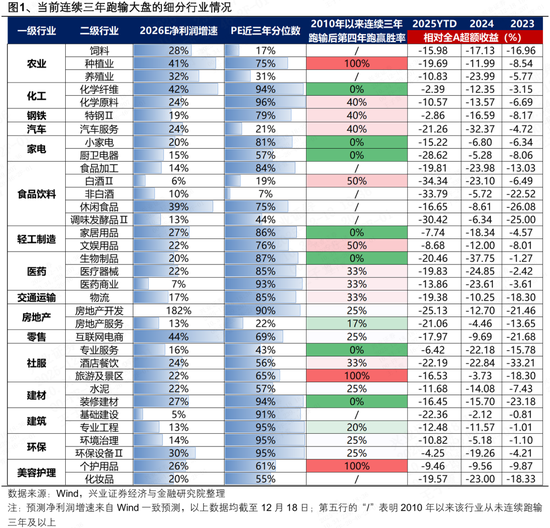
Core Insights - The article highlights that certain cyclical and consumer sectors have underperformed the market for three consecutive years, indicating potential investment opportunities in these areas [1][6]. Industry Analysis - The sectors with the highest expected net profit growth for next year include: - Agriculture (planting, breeding, feed) - Internet e-commerce - Leisure food - Beauty care (personal care products, cosmetics) - Light manufacturing (household goods, entertainment products) - Automotive services - Social services (hotel catering, tourist attractions) - Cement [1][6]. - Historical data since 2010 shows that industries that have underperformed for three consecutive years and then outperformed in the fourth year include: - Food and beverage (leisure food, food processing, seasoning and fermentation products, non-brewed beverages) - Agriculture (breeding, feed, planting) - Beauty care (cosmetics, personal care products) - Infrastructure - Tourist attractions [1][6]. Financial Metrics - Expected net profit growth rates for various sectors by 2026 are as follows: - Planting: 41% - Breeding: 32% - Chemical fiber: 42% - Chemical raw materials: 24% - Automotive services: 24% - Internet e-commerce: 44% - Cement: 22% [2][7]. - The PE (Price to Earnings) ratios over the past three years indicate reasonable valuation levels for several sectors, with notable figures such as: - Planting at 75% - Chemical fiber at 94% - Internet e-commerce at 69% [2][7].
香港第三季整体GDP同比实质上升3.8%
Zhi Tong Cai Jing· 2025-12-18 08:49
Group 1 - The overall local GDP of Hong Kong increased by 3.8% in Q3 2025 compared to the same period last year, up from a 3.1% increase in Q2 2025 [1] - The value added by all service activities rose by 3.1% in Q3 2025, compared to a 3.4% increase in Q2 2025 [1] - The value added by import and export trade, wholesale and retail industries increased by 5.1% in Q3 2025, down from a 6.1% increase in Q2 2025 [1] Group 2 - The accommodation and food services sector saw a decline in value added by 1.3% in Q3 2025, compared to a 0.6% decline in Q2 2025 [1] - The transportation, warehousing, postal, and courier services sector's value added increased by 2.3% in Q3 2025, down from a 5.5% increase in Q2 2025 [1] - The information and communications sector's value added remained relatively unchanged in Q3 2025, compared to a 0.4% increase in Q2 2025 [1] Group 3 - The financial and insurance sector's value added rose by 5.4% in Q3 2025, consistent with the increase in Q2 2025 [1] - The real estate, professional, and business services sector recorded a 0.4% increase in value added in Q3 2025, recovering from a 0.7% decline in Q2 2025 [2] - The public administration, social, and personal services sector's value added increased by 1.9% in Q3 2025, down from a 2.3% increase in Q2 2025 [2] Group 4 - The local manufacturing sector's value added increased by 5.4% in Q3 2025, compared to a 0.9% increase in Q2 2025 [2] - The electricity, gas, and water supply and waste management sector's value added decreased by 0.9% in Q3 2025, following a 0.4% increase in Q2 2025 [2] - The construction sector's value added declined by 7.0% in Q3 2025, following a 10.4% decline in Q2 2025 [3]