
化工

Search documents
鲁西化工2026年2月2日跌停分析
Xin Lang Cai Jing· 2026-02-02 03:37
Core Viewpoint - LUXI Chemical (SZ000830) experienced a limit down on February 2, 2026, with a closing price of 17.6 yuan, reflecting a decline of 9.97%, and a total market capitalization of 33.516 billion yuan [1] Group 1: Company Performance - The company's 2025 annual report forecast indicates a net profit attributable to shareholders of 850 million to 1.1 billion yuan, representing a year-on-year decline of 58.1% to 45.78%, highlighting significant operational challenges and a substantial decrease in profitability [2] - The decline in product prices outpaced the reduction in raw material costs, leading to a more pronounced drop in net profit excluding non-recurring items, which further pressures the stock price [2] Group 2: Industry and Market Context - The chemical industry is currently in a cyclical downturn, with product prices influenced by oil prices and the operating rates of peers, resulting in significant volatility [2] - The scale of related party transactions reached 9.37 billion yuan, raising concerns about the company's operational independence and impacting market perception and investor confidence [2] Group 3: Market Sentiment and Technical Analysis - The current market focus appears to be shifting towards technology and new energy sectors, leaving the chemical sector, including LUXI Chemical, underperforming [2] - The company's ESG rating dropped to C+ in January 2026, contributing to diminished investor confidence and potential capital outflows, while technical indicators such as MACD crossovers and BOLL channel breaches may exacerbate stock price declines [2]

格林大华期货早盘提示:尿素-20260202
Ge Lin Qi Huo· 2026-02-02 03:22
Morning session notice 更多精彩内容请关注格林大华期货官方微信 格林大华期货研究院 证监许可【2011】1288 号 2026 年 2 月 2 日星期一 重要事项: 本报告中的信息均源于公开资料,格林大华期货研究院对信息的准确性及完备性不作任何保 证,也不保证所包含的信息和建议不会发生任何变更。我们力求报告内容的客观、公正,但 文中的观点、结论和建议仅供参考,报告中的信息和意见并不构成所述期货合约的买卖出价 和征价,投资者据此作出的任何投资决策与本公司和作者无关,格林大华期货有限公司不承 担因根据本报告操作而导致的损失,敬请投资者注意可能存在的交易风险。本报告版权仅为 格林大华期货研究院所有 任何机构和个人不得以任何形式翻版 如引用、转载、刊发,须注明出处为格林大华期货有限公司。 联系方式:15000295386 | 板块 | 品种 | 多(空) | 推荐理由 【行情复盘】 周五尿素主力合约 2605 价格下跌 24 元至 1790 元/吨,华中主流地区现货价格 1770 元/吨。持仓方面,多头持仓减少 14423 手至 21.67 万手,空头持仓减少 25639 手至 24.19 万手 ...
甲醇周报:供需依旧偏弱,但甲醇或偏强运行-20260202
Hua Long Qi Huo· 2026-02-02 03:13
Group 1: Report Industry Investment Rating - Not provided Group 2: Core Viewpoints of the Report - Last week, methanol futures showed a relatively strong performance, with the methanol weighted closing at 2322 yuan/ton on Friday afternoon, up 1.04% from the previous week. The current supply - demand fundamentals of methanol remain weak, but it may be supported by the macro - level and geopolitical tensions. Future methanol trends need to closely follow the guidance of the macro - level, geopolitics, and crude oil. It is suggested to consider selling put options or using a bull spread strategy [6][9][10] Group 3: Summary by Relevant Catalogs 1. Methanol Trend Review - Futures: Last week, boosted by the relatively strong port methanol, methanol futures showed a relatively strong performance. The methanol weighted closed at 2322 yuan/ton on Friday afternoon, up 1.04% from the previous week. - Spot: Import apparent demand was weak last week. Port methanol inventory accumulated slightly at a high level, and the market tradable volume was high with an upper limit. Affected by the unstable international situation and positive macro - level, the market fluctuated and trended stronger. The price in Jiangsu ranged from 2240 - 2330 yuan/ton, and in Guangdong from 2220 - 2290 yuan/ton. Inland methanol prices continued to decline, with enterprises focusing on reducing inventory by lowering prices before the festival. The price in the Ordos northern line in the main production area ranged from 1785 - 1805 yuan/ton, and the receiving price in Dongying ranged from 2100 - 2130 yuan/ton [14] 2. Methanol Fundamental Analysis - Production: Last week (20260123 - 0129), China's methanol production was 2,037,735 tons, an increase of 28,820 tons from the previous week. The device capacity utilization rate was 91.21%, a month - on - month increase of 1.43% [15] - Downstream Demand: - Olefins: The average weekly operating rate of MTO devices in the Jiangsu and Zhejiang regions decreased to 30.48%, a decrease of 13.90 percentage points from the previous week. - Dimethyl Ether: The capacity utilization rate was 5.92%, a month - on - month increase of 12.76%. - Glacial Acetic Acid: The overall capacity utilization rate increased. - Chlorides: The operating rate of methane chlorides was 76.04%, with an increase in overall production and capacity utilization rate. - Formaldehyde: The operating rate was 33.32%, with a decrease in overall capacity utilization rate [18][20] - Inventory: - Sample enterprises: As of January 28, 2026, the inventory of Chinese methanol sample production enterprises was 424,100 tons, a decrease of 14,200 tons from the previous period, a month - on - month decrease of 3.24%. The order backlog of sample enterprises was 265,700 tons, an increase of 27,400 tons from the previous period, a month - on - month increase of 11.50%. - Ports: As of January 28, 2026, the inventory of Chinese methanol port samples was 1,472,100 tons, an increase of 14,600 tons from the previous period, a month - on - month increase of 1.00%. The inventory accumulation mainly occurred in the East China region [21][25] - Profit: Coal - to - methanol profit improved slightly but still showed an overall loss. The week - average profit of coal - to - methanol in Inner Mongolia in the northwest was - 266.10 yuan/ton, a month - on - month increase of 1.00%. The average profit of coal - to - methanol in Shandong was - 158.10 yuan/ton, a month - on - month increase of 10.58%. The average profit of coal - to - methanol in Shanxi was - 226.30 yuan/ton, a month - on - month decrease of 10.71%. The week - average profit of coke - oven gas - to - methanol in Hebei was 61.00 yuan/ton, a month - on - month decrease of 16.00%. The week - average profit of natural gas - to - methanol in the southwest was - 290.00 yuan/ton, a month - on - month decrease of 9.02% [27] 3. Methanol Trend Outlook - Supply: This week, the number of restarted domestic methanol devices may be more than that of overhauled ones. It is expected that China's methanol production will be about 2.0771 million tons, and the capacity utilization rate will be about 92.98%, an increase from last week. - Downstream Demand: - Olefins: The operating rate of the MTO industry will increase slightly. - Dimethyl Ether: The Xinxiang Xinlianxin device is expected to stop production, and the overall capacity utilization rate may decrease. - Glacial Acetic Acid: The capacity utilization rate is expected to increase slightly. - Formaldehyde: The capacity utilization rate is expected to decrease. - Chlorides: The domestic methane chloride capacity utilization rate may continue to rise. - Inventory: - Sample enterprises: The inventory of Chinese methanol sample production enterprises is expected to be 401,600 tons, continuing to decline. - Ports: The port methanol inventory is expected to decrease [30][31][33]
格林大华期货早盘提示:甲醇-20260202
Ge Lin Qi Huo· 2026-02-02 03:04
Report Industry Investment Rating - The investment rating for the methanol in the energy and chemical sector is "Oscillation" [2] Report's Core View - The uncertainty of the geopolitical situation in the Middle East is large, and crude oil fluctuates sharply. Last week, methanol at ports had a slight inventory build - up, and inventory decreased in production areas.提货 during the Spring Festival holiday may weaken, and the fundamentals lack continuous drivers. Methanol prices will continue to oscillate. Attention should be paid to the development of the Middle East situation, and high inventory may limit the upside. The reference range for the 05 contract is 2270 - 2380. The trading strategy is to wait and see [2] Summary by Relevant Catalog Market Review - On Friday night, the futures price of the main 2605 contract of methanol fell 15 yuan to 2341 yuan/ton, and the spot price of methanol in the mainstream East China region fell 12 yuan to 2270 yuan/ton. In terms of positions, long positions increased by 371 lots to 613,000 lots, and short positions increased by 44,528 lots to 739,000 lots [2] Important Information - Supply: The domestic methanol operating rate is 89.9%, a month - on - month decrease of 1.3%. The overseas methanol operating rate is 52.1%, a month - on - month decrease of 8.6% [2] - Inventory: The total inventory of methanol ports in China is 147.21 tons, an increase of 1.46 tons compared with the previous data. Among them, inventory in East China increased by 4.76 tons, and inventory in South China decreased by 3.3 tons. The inventory of Chinese methanol sample production enterprises is 42.41 tons, a decrease of 1.42 tons from the previous period, a month - on - month decrease of 3.24% [2] - Demand: The signed orders of northwest methanol enterprises are 11.31 tons, a month - on - month decrease of 5.04 tons. The pending orders of sample enterprises are 26.57 tons, an increase of 2.74 tons from the previous period, a month - on - month increase of 11.50%. The olefin operating rate is 85.1%, a month - on - month decrease of 1.7%; the methyl chloride operating rate is 74.8%, a month - on - month decrease of 4.5%; the acetic acid operating rate is 80.6%, a month - on - month increase of 2.2%; the formaldehyde operating rate is 34.5%, a month - on - month increase of 0.2%; the MTBE operating rate is 68.0%, a month - on - month increase of 0.4% [2] - Import: In December 2025, China's methanol import volume was 173.40 tons, a month - on - month increase of 24.56%, and the average import price was 240.61 US dollars/ton, a month - on - month decrease of 7.23%. Among them, the import volume from Saudi Arabia was the largest at 60.44 tons, and the average import price was 238.74 US dollars/ton. From January to December 2025, China's cumulative methanol import volume was 1440.54 tons, a year - on - year increase of 6.75% [2] - Oil Price: The US and Iran keep the option of dialogue and consultation, and the supply risk concerns caused by the tense geopolitical situation have been alleviated, and international oil prices have fallen. The NYMEX crude oil futures 03 contract is at 65.21, down 0.21 US dollars/barrel, a month - on - month decrease of 0.32%; the ICE Brent crude oil futures 03 contract is at 70.69, down 0.02 US dollars/barrel, a month - on - month decrease of 0.03%. The China INE crude oil futures 2603 contract rose 15.9 to 482.9 yuan/barrel and fell 12.9 to 470 yuan/barrel at night [2] Market Logic - The uncertainty of the geopolitical situation in the Middle East is large, and crude oil fluctuates sharply. Last week, methanol at ports had a slight inventory build - up, and inventory decreased in production areas.提货 during the Spring Festival holiday may weaken, and the fundamentals lack continuous drivers. Methanol prices will continue to oscillate. Attention should be paid to the development of the Middle East situation, and high inventory may limit the upside [2] Trading Strategy - The trading strategy is to wait and see [2]
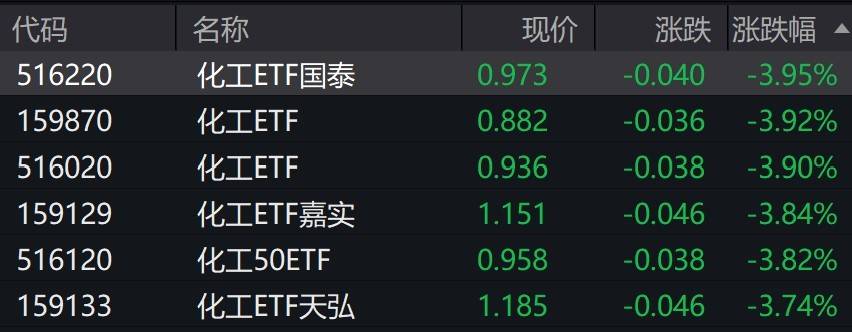
化工概念股走低,相关ETF跌近4%
Sou Hu Cai Jing· 2026-02-02 02:55
Group 1 - Chemical concept stocks declined, with Wanhua Chemical, Hengli Petrochemical, and Baofeng Energy dropping over 6%, while Hualu Hengsheng fell over 5% and Yuntianhua decreased over 4% [1] - Affected by the market, chemical-related ETFs fell nearly 4% [1] Group 2 - Various chemical ETFs reported declines, with the Guotai Chemical ETF at 0.973 (-3.95%), the Chemical ETF at 0.882 (-3.92%), and the Chemical 50 ETF at 0.958 (-3.82%) [2] - Analysts indicate that the chemical industry, being a typical cyclical sector, usually follows a five-year cycle consisting of "profit upturn - capacity expansion - profit bottoming - capacity clearance/demand expectation improvement" [2] - Current industry conditions are at the cycle bottom, with expectations for supply-demand dynamics to improve and accelerate the recovery of industry prosperity [2]



化工行业呈现“东升西落”,我国化工企业全球竞争力持续增强,石化ETF(159731)迎布局机遇
Mei Ri Jing Ji Xin Wen· 2026-02-02 02:48
Group 1 - The China Petroleum and Chemical Industry Index fell by 3.48% as of February 2, with nearly all constituent stocks declining, led by companies such as Luxi Chemical, Huafeng Chemical, and Yangnong Chemical [1] - The largest ETF tracking the index (159731) has seen a net inflow of funds for 18 consecutive trading days, totaling 1.351 billion yuan, with the latest share count reaching 1.594 billion and total assets at 1.661 billion yuan [1] - As of January 30, the US dollar index stood at 97.12, down 0.39 percentage points week-on-week [1] Group 2 - Brent crude oil futures settled at $70.69 per barrel, up 7.30% week-on-week, while WTI futures settled at $65.21 per barrel, up 6.78% [1] - NYMEX natural gas futures closed at $4.42 per million British thermal units, down 17.50% week-on-week, while Northeast Asia LNG prices were at $12.10 per million yen, up 6.86% [1] - Everbright Securities believes that the chemical industry is experiencing a recovery trend, supported by macro data and policy guidance, with leading companies gaining competitive advantages [1] Group 3 - The petrochemical ETF (159731) and its linked funds (017855/017856) closely track the China Petroleum and Chemical Industry Index, focusing on the "big energy" security logic [2] - The ETF not only benefits from the profit recovery of downstream chemical products but also locks in the value of upstream energy resources through a high allocation to major oil companies, providing stronger performance resilience during rising oil price cycles [2]
主题策略周报20260201:横盘震荡不变,关注转向农业
Orient Securities· 2026-02-02 02:30
Market Overview - The market is currently in a sideways trend, with the pre-holiday low likely established, indicating no need for panic[3] - Global financial markets remain volatile, with an upward trend in risk assessment, while China's risk evaluation remains stable[3] Industry Focus - Investment opportunities are shifting towards mid-cap blue-chip stocks, particularly in the chemical and agricultural sectors[4] - Previous recommendations in the cyclical sectors of chemicals and non-ferrous metals have met expectations, with a focus now on agriculture and chemicals[4] Thematic Investment - Agricultural price increases are anticipated, with the agricultural policy document expected to be released in February, potentially driving prices upward[5] - Key agricultural products like live pigs and rubber are at the beginning of a price uptrend due to supply adjustments, while major commodities like sugar and corn are in a tight supply-demand balance[5] Technology and Aerospace - Continued focus on AI technologies and applications, with significant market interest expected as major internet companies ramp up marketing efforts ahead of the Spring Festival[5] - The aerospace sector is experiencing a decline in market attention, but potential for a rebound exists due to ongoing developments from companies like SpaceX and NASA[6] Risk Factors - Market performance may fall short of expectations due to various economic and geopolitical risks[7] - Insufficient pricing of geopolitical risks could lead to sudden market shocks[7] - Potential underperformance in industry developments due to technological iterations and commercialization challenges[7]
化工ETF(159870)盘中净申购1.3亿份,制冷剂硫磺PVC等多个细分行业已有明确供给限制
Xin Lang Cai Jing· 2026-02-02 02:26
Group 1 - The chemical sector is experiencing fluctuations in line with the broader market and commodity prices, with a notable net subscription of 131 million units for the chemical ETF (159870) [1] - The chemical industry has historically shown strong cyclicality, with demand spanning various essential sectors, maintaining steady growth despite significant supply shocks [1] - Supply-side changes are significant, with the EU facing high energy costs leading to a continued exit from the market, while the U.S. is attempting to bring manufacturing back, albeit at high costs [1] Group 2 - The implementation of a dual control system for carbon emissions in 2024 will impose strict supply limitations on several industries, including refrigerants, chromium salts, sulfur, PVC, and high-energy-consuming sectors [1] - Specific industries facing clear supply restrictions include refrigerants due to the Montreal Protocol, chromium salts driven by increasing demand for high-temperature alloys, and sulfur as a byproduct of refining [1] - The chemical ETF (159870) closely tracks the CSI segmented chemical industry theme index, which consists of large-cap, liquid stocks from various sub-industries [2]
周期半月谈-短期调整之后-周期板块怎么看
2026-02-02 02:22
Summary of Key Points from Conference Call Records Industry Overview - **Industry Focus**: The records primarily discuss the cyclical sector, including commodities like precious metals, chemicals, oil shipping, and aviation [1][2][12]. Core Insights and Arguments Monetary Policy and Market Impact - **Federal Reserve's Stance**: Kevin Walsh's hawkish position as the new Fed Chair has temporarily alleviated concerns about the Fed's independence, but his proposed policies of balance sheet reduction and interest rate cuts may not effectively address issues like deficit monetization and government debt financing costs [1][27]. - **Liquidity Environment**: Both domestic and international liquidity conditions are currently loose, supporting price increases in precious and non-ferrous metals. Geopolitical instability and de-dollarization trends provide long-term support for these assets [1][4]. Commodity Performance - **Cyclical Sector Performance**: The cyclical sector in the A-share market has shown strong performance since early 2026, with significant gains in non-ferrous metals, particularly a 60% increase in precious metals in January [2][23]. - **Chemical Sector**: Despite recent price increases, the chemical sector is in a seasonal demand lull, and valuations are no longer attractive. The long-term outlook indicates a decrease in global chemical capacity growth due to reduced capital expenditure in China [5][6]. Oil Shipping Market - **High Demand and Pricing**: The oil shipping market is experiencing high demand due to OPEC+ production increases, with the VLOC freight index showing significant price increases. The market is characterized by limited supply and high demand, indicating a strong bullish outlook [1][13][14]. Aviation Sector - **Valuation and Recovery**: The aviation sector is currently facing short-term losses, but valuations have reached reasonable levels. Ticket prices are expected to recover and potentially exceed 2019 levels, with profit peaks possibly reaching 15 billion to 20 billion yuan [1][15][16]. Highway Sector - **Investment Attractiveness**: The highway sector has become more attractive relative to the broader market, with specific stocks like Sichuan Chengyu and Shenzhen International offering high dividend yields [1][17]. Additional Important Insights - **Geopolitical Factors**: The significant rise in non-ferrous metals prices in January 2026 was driven by geopolitical factors rather than traditional supply-demand dynamics, including U.S. interventions in various regions and military demand [23][25]. - **Future Trends in Chemical Industry**: The chemical industry is expected to face challenges due to stricter carbon emission regulations and reduced capital expenditure, leading to a decline in capacity growth [7][8][9]. - **Investment Opportunities**: Despite short-term price corrections, the long-term outlook for various commodities remains positive, with potential for price recovery as supply constraints and demand growth align [11][30][31]. Conclusion The cyclical sector is currently navigating a complex landscape influenced by monetary policy, geopolitical factors, and sector-specific dynamics. Investment opportunities exist, particularly in oil shipping, aviation, and select highway stocks, while caution is advised in the chemical sector due to valuation concerns and regulatory pressures.
廖市无双-风格切换成长轮休-该如何应对
2026-02-02 02:22
Summary of Conference Call Records Industry and Company Overview - The conference call discusses the current state of the market, focusing on various sectors including technology, resources, and financial services. The analysis highlights the performance of indices such as the CSI 500, CSI 1000, and the Shanghai Composite Index. Key Points and Arguments Market Conditions - The market is experiencing a weakening momentum, necessitating risk control and attention to the 20-day moving average and external factors affecting resource prices [1][3] - In January, the first three weeks saw strong performance from small-cap indices like CSI 500 and CSI 1000, but a cooling trend began in the third week, with large-cap indices like the Shanghai 50 and CSI 300 breaking below the 20-day moving average [2][4] Sector Performance - The non-ferrous metals sector is under pressure, with expectations of a prolonged adjustment phase, potentially lasting six months to a year. The previous year's surge of 97.5% in the non-ferrous index makes it unlikely to replicate such gains this year [5][6] - The technology growth sector is showing signs of weakness, with various industries including defense, electronics, and computing experiencing pullbacks [6][7] Investment Strategy - Investors are advised to maintain a balanced portfolio with a focus on sectors that are currently undervalued and have a high risk awareness. Caution is recommended for technology growth stocks due to potential short-term volatility [3][4] - Recommended sectors for investment include construction materials, electronics, and communication, which are considered to have a favorable risk-reward ratio [2][12] Market Trends and Predictions - The market is expected to enter a phase of strong oscillation leading up to the Spring Festival, with large-cap indices outperforming small-cap growth indices [8][11] - The brokerage sector is anticipated to enter a bullish cycle, with a potential for upward movement despite current low market sentiment [9][10] Risk Factors - The volatility in global resource prices, such as a 35% drop in silver prices, is impacting related assets and indices, particularly those with significant exposure to non-ferrous resources [4][5] - The potential for further declines in small-cap indices if they do not rebound quickly is a concern, indicating a need for careful monitoring of technical indicators [4][8] Future Outlook - The overall market is expected to remain in a state of fluctuation, with opportunities for growth anticipated towards the end of 2026. Investors are encouraged to adjust their portfolios accordingly and focus on sectors with solid fundamentals [11][18] Additional Important Content - The call emphasizes the importance of monitoring technical indicators such as the 20-day and 5-week moving averages to make timely adjustments to investment positions [4][11] - The discussion includes insights on the cyclical nature of certain sectors, particularly those related to commodities and technology, suggesting a strategic approach to investing in these areas [13][15]