
医药

Search documents
芯片股力撑纳指盘中新高,道指转跌,医药股回落,中概强势,阿里一度涨超5%
Hua Er Jie Jian Wen· 2025-10-02 14:33
Group 1 - The U.S. government shutdown is causing noticeable disruptions in economic data, leading to mixed performance in major U.S. stock indices [1] - Chip stocks are identified as a primary driver for the market's upward movement, while Chinese concept stocks are gaining strength [1] - The pharmaceutical sector, which had been a strong performer in the previous days, is experiencing a pullback [1] Group 2 - The release of key economic data, including weekly unemployment claims and August durable goods orders, has been delayed due to the government shutdown [1] - Major U.S. stock indices opened higher collectively, with the Nasdaq and S&P 500 reaching intraday record highs before diverging in performance [1] - The Nasdaq maintained its upward trend, while the S&P 500 retraced most of its gains and the Dow Jones turned negative [1]
一本股市老司机实战总结而成的投资宝典!从碎片化到体系化炒股,这个假期,一次学透!
雪球· 2025-10-02 13:00
Group 1: Macro Perspective on A-shares - The essence of A-shares is cyclical, driven by economic growth, valuation changes, and liquidity [3][6][13] - A-shares experience distinct bull and bear cycles, characterized by short bull markets and prolonged bear markets, necessitating timing strategies for investment [11][5] - Key indicators can help investors determine their current position within the cycle, as extreme market conditions are rare [8][7] Group 2: Industry Cycles - Industry cycles are influenced by supply-demand mismatches, with two main types: demand-driven cycles and supply-driven cycles [22][23] - The perception of stability in certain growth industries often proves misleading, as they too are subject to cyclical fluctuations [22][26] - Understanding the cyclical nature of industries is crucial for making informed investment decisions [24][28] Group 3: Individual Stock Analysis - Analyzing individual stocks involves understanding the company's fundamentals, including its business model, competitive advantages, growth potential, and financial health [45][52] - Different investment strategies apply to various types of companies, emphasizing the importance of aligning analysis with the company's lifecycle stage [46][47] - High-dividend strategies can provide stability in volatile markets, with a focus on companies with strong cash flow and consistent dividend history [56][57] Group 4: Trading Strategies and Tools - Various trading strategies exist, including value investing, growth investing, and high-dividend strategies, each suited to different investor profiles [63][65] - Tools like ETFs and convertible bonds offer unique advantages for investors, allowing for diversified exposure and risk management [66][68] - Understanding the mechanics of options trading can provide investors with leverage and risk management opportunities [70]


申万宏源:十五五产能优化与科技攻坚共振,AI应用蓄势待发(附十大行业前瞻)
Xin Lang Cai Jing· 2025-10-02 10:45
Group 1: 15th Five-Year Plan Outlook - The primary direction for industrial structure adjustment during the 15th Five-Year Plan is transformation and upgrading, with continued support for technological innovation [1] - The real estate sector is expected to stabilize, with new product development and pricing models emerging in core cities [1] - The home appliance industry will focus on smart, green, and globalized policies, aligning with future manufacturing directions [1] - The construction industry will emphasize overseas expansion and smart construction [1] - The importance of strategic resources will increase, benefiting the prices of non-ferrous metals [1] - Cement and glass industries will face strict capacity controls, focusing on profit recovery rather than just revenue [1] - The chemical industry will see a shift towards replacing outdated capacity, with a positive outlook for chemical exports [1] - The new energy sector is expected to experience favorable supply-demand dynamics, with significant growth in wind and solar power installations [1] - The coal industry will see increased resource scarcity and improved performance as prices rise [1] - The technology sector will benefit from government subsidies for AI capabilities and applications [1] - The cultural industry may see relaxed regulations for overseas expansion, positively impacting supply-side recovery [1] Group 2: AI and Computing Sector Insights - Breakthroughs in computing power and AI applications are expected to lead to a surge in the sector by 2026, with companies achieving over 10% revenue from AI [2] - Despite short-term pressures from subsidy reductions, long-term support for domestic semiconductor replacements remains strong [2] - The internet and cloud computing sectors are experiencing a positive cycle of investment and operational efficiency, with a focus on global entertainment and self-consumption [2] - The telecommunications sector is concentrating on 6G and satellite internet development, with opportunities in the IDC supply chain [2] - E-commerce is currently in a phase of competition for existing market share, but AI products are expected to offset negative impacts from subsidy reductions [2] Group 3: Q3 Earnings Outlook - The reduction in national subsidies is expected to pressure earnings in light industry, consumer electronics, and home appliances [3] - The non-ferrous metals sector is anticipated to see continued improvement in Q3 earnings due to rising domestic metal prices [3] - The pharmaceutical sector is not expected to face severe impacts from tariff policies, contrary to some investor fears [3] - The agricultural sector is projected to see weak growth, particularly in pig prices, through Q1 2026 [3] - The light industry is under pressure from both overseas demand and domestic subsidy reductions, leading to continued earnings challenges [3] - The consumer electronics sector may experience marginal declines in growth following subsidy cuts [3] - The chemical industry is expected to achieve stable growth, with a target of over 5% annual increase in value added by 2025-2026 [3] - The food and beverage sector is facing weak demand, but market expectations are low, which may provide some support [3] - The military industry is projected to see overall revenue and earnings growth, with ongoing attention to the 15th Five-Year Plan's impact [3]

港股10月“开门红”!科技股大涨,这一龙头股涨超9%
Zhong Guo Zheng Quan Bao - Zhong Zheng Wang· 2025-10-02 05:18
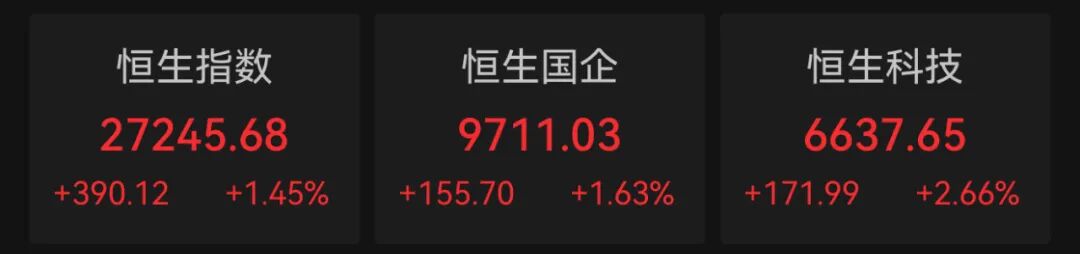
Group 1: Market Overview - On October 2, Hong Kong stocks experienced a strong opening, with all three major indices rising significantly. The Hang Seng Index increased by 1.45% to 27,245.68 points, the Hang Seng China Enterprises Index rose by 1.63% to 9,711.03 points, and the Hang Seng Tech Index surged by 2.66% to 6,637.65 points [2][3]. Group 2: Technology Sector Performance - The technology sector led the gains, with notable increases in several key stocks. Semiconductor company SMIC saw a rise of 9.30%, while Kuaishou-W increased by 6.56%. Other significant performers included Hua Hong Semiconductor and BYD Electronics, both rising over 5%, and NIO-SW and Baidu Group-SW, which rose over 4% [3][5]. Group 3: Gold Stocks Performance - Gold stocks continued their upward trend, with Tongguan Gold rising by 12.18% and Zijin Mining International increasing by 12.02%. Other gold stocks such as Lingbao Gold and Chifeng Jilong Gold also saw gains exceeding 6% [5][8]. Group 4: Semiconductor and Biopharmaceutical Sectors - The semiconductor and biopharmaceutical sectors showed strong performance, with the Wind Hong Kong Semiconductor Index and Wind Hong Kong Biopharmaceutical Index rising by 7.36% and 2.86%, respectively. Notable stocks included Shanghai Fudan and InnoCare Pharma, both rising over 4%, and Clover Biopharma-B, which surged by 22.03% [5][7]. Group 5: Economic Context - The recent Federal Reserve interest rate cuts have driven gold prices higher, with the U.S. government shutdown increasing demand for safe-haven assets. The shutdown has led to hundreds of thousands of federal employees being furloughed, impacting public services and economic data releases [8][9]. Group 6: Future Outlook - Analysts expect that the ongoing interest rate cuts by the Federal Reserve will continue to support gold prices in the medium term. There is a general market expectation for further rate cuts within the year, which will provide a solid foundation for gold's high performance [9].
2025年度中国消费名品征集工作启动
Xin Hua Wang· 2025-10-02 02:35
Core Viewpoint - The Ministry of Industry and Information Technology of China has initiated the 2025 Consumer Brand Collection, focusing on consumer goods sectors such as light industry, textiles, food, and pharmaceuticals, aiming to identify brands with strong market competitiveness, high product innovation, and significant brand recognition and cultural value [1] Group 1: Targeted Product Categories - The initiative emphasizes support for products catering to specific demographics, including products for the elderly, disabled, and maternal and child care [1] - Products for the elderly include clothing, daily assistive products, health foods, special medical formula foods, elderly care products, rehabilitation training aids, and improvements for elderly-friendly environments [1]
机构:四季度AI、创新药、机器人将继续冲锋
21世纪经济报道· 2025-10-02 00:43
Core Viewpoint - The A-share market is expected to continue its upward trend in Q4 2025, driven by "policy + liquidity," but volatility is anticipated [1][3]. Market Outlook - Most institutions maintain a bullish outlook for the A-share market in Q4, citing policy support, improved liquidity, and a rebound in A-share earnings as key drivers [3][5]. - Historical data indicates a strong profit-making effect in Q4, with a median increase of 1.96% in the first half of November, showing a 100% win rate [3]. Investment Strategy - The focus remains on technology growth, but investors are advised to adopt a "high-low switch" strategy, balancing offensive and defensive positions [2][10]. - Institutions suggest that the investment strategy should include both cyclical sectors and low-position technology stocks [11]. Sector Focus - Technology innovation is viewed as the clearest investment theme for Q4, with AI, innovative pharmaceuticals, and robotics expected to lead [7][8]. - Despite concerns about overheating in some tech sectors, the overall sentiment is that technology remains the market's main line [7][8]. High-Low Switching Strategy - The "high-low" strategy emphasizes finding undervalued segments within the technology sector and focusing on "anti-involution" opportunities [10][12]. - Specific areas of interest include storage chips, AI applications in healthcare, and intelligent driving technologies [11][12]. Anti-Involution Focus - The "anti-involution" strategy targets sectors with excess supply and low capacity utilization, such as industrial metals and renewable energy [12][13]. - Institutions highlight the potential for improvement in the competitive landscape of the renewable energy sector, particularly in solar, lithium battery, and wind power [12][13]. Balanced Market Style - The market style is expected to become more balanced in Q4, with a potential shift towards value stocks alongside growth [12][13]. - The dividend style is also noted for its attractiveness, with opportunities for positioning in this area during Q4 [13].

特朗普接连挥关税大棒,今日生效,辉瑞被豁免!美联储三把手发声
Sou Hu Cai Jing· 2025-10-01 02:52
Group 1: Tariff Policies - The recent tariff policies announced by Trump include a 25% tariff on heavy trucks, 50% on kitchen cabinets and bathroom sinks, 30% on imported furniture, and a 100% tariff on patented and branded drugs, with implementation occurring just four days after the announcement [3][5] - The 100% tariff on drugs significantly impacts India, which exports $27.85 billion worth of pharmaceuticals, with 31.35% going to the U.S., and 47% of U.S. generic drugs being imported from India [5] - On September 30, Trump granted Pfizer a three-year exemption from the 100% drug tariff, causing Pfizer's stock price to rise, highlighting a perceived double standard in tariff application [7] Group 2: Impact on Industries - The film industry is facing a proposed 100% tariff, which could complicate international distribution and negatively affect Hollywood, as over half of its revenue comes from overseas markets [9] - New tariffs on softwood lumber and wood products, including a 10% tariff on imported softwood and a 25% tariff on cabinets and bathroom vanities, will primarily affect Canadian suppliers and could lead to increased costs for U.S. consumers [10] - The overall tariff strategy appears to be broad, potentially affecting various industries, with concerns that domestic production may not meet demand, leading to price increases for consumers [12] Group 3: Federal Reserve Response - Following the Federal Reserve's interest rate cut on September 18, there has been internal disagreement, with some members advocating for a more significant cut to support the labor market [14][16] - The New York Fed President, Williams, indicated support for moderate rate cuts to protect employment and manage inflation, while acknowledging the limited impact of tariffs on inflation so far [16][18] - The Fed faces a balancing act between controlling inflation and supporting employment, with market expectations leaning towards another rate cut in October [18][20]


激活经济新动能 沈白高铁构建区域发展新格局
Ren Min Wang· 2025-10-01 01:46
Core Insights - The opening of the Shenyang-Baihe High-Speed Railway (Shenbai High-Speed Railway) marks a significant milestone in connecting Liaoning and Jilin provinces, completing the "O" shaped loop of the Northeast high-speed rail network, which is expected to boost economic development and improve transportation for residents [1][2]. Economic Activation - The Shenbai High-Speed Railway has doubled the daily train services from 14 to 28 pairs, enhancing connectivity to cities like Yanji and Qingdao, and significantly reducing travel times, with the fastest journey from Shenyang to Changbai Mountain taking only 1 hour and 53 minutes [2]. - The railway facilitates the movement of local products such as ginseng and wine, creating a more efficient market access and stimulating regional economic growth [2][3]. Urban Development - The arrival of high-speed rail is seen as a turning point for cities like Tonghua, which is now better connected to major urban centers, allowing for the development of a comprehensive tourism strategy and the growth of new industries [3]. - The Shenbai High-Speed Railway promotes the integration of the Harbin-Changchun urban agglomeration with the Liaozhongnan urban cluster, enhancing the flow of talent, resources, and technology across regions [3]. Cultural and Tourism Enhancement - The railway serves as a cultural and tourism connector, linking significant historical and scenic sites along its route, thus transforming travel experiences into cultural journeys [4]. - Tonghua's rich cultural heritage and tourism resources are revitalized through the railway, with local travel agencies developing diverse tourism products to attract visitors [4]. Improved Public Services - The upgraded facilities and innovative service models at Changbai Mountain Station enhance the travel experience for passengers, particularly for vulnerable groups such as the elderly and children [5][6]. - Initiatives like the "Changbai Qinyun Parent-Child Room" provide a supportive environment for families traveling with children, ensuring a comfortable and engaging experience [6]. Conclusion - The Shenbai High-Speed Railway is not just a transportation project; it is a new engine for the comprehensive revitalization of Northeast China, fostering economic growth, cultural exchange, and improved quality of life for residents [6].
950家公司公布最新股东户数
Zheng Quan Shi Bao Wang· 2025-09-30 10:52
Summary of Key Points Core Viewpoint - The recent data indicates a significant decline in the number of shareholders for many companies, with 480 out of 950 companies reporting a decrease in shareholder count as of September 20, 2023, compared to the previous period [1][3]. Company Performance - Among the companies with a decline in shareholder count, the most significant drop was observed in Kaichuang Electric, which saw a 27.34% decrease, bringing its total to 6,101 shareholders. This company has experienced a cumulative decline of 12.46% since the concentration of shares began [3][4]. - Xizhuang Co. reported a 24.94% decrease in shareholder count, totaling 8,398 shareholders, while its stock price increased by 44.56% during the same period [3][4]. - Other notable companies with significant shareholder count reductions include: - Dielian Technology: 23.68% decrease, 22,629 shareholders, 13.32% increase in stock price [4]. - Eurasia Group: 23.52% decrease, 26,911 shareholders, 10.11% decline in stock price [4]. Market Trends - The average performance of concentrated stocks from September 11 to the present shows a decline of 0.85%, contrasting with the Shanghai Composite Index, which increased by 0.64% during the same period. Notably, 30% of concentrated stocks outperformed the market [2][3]. - The sectors with the highest concentration of stocks include basic chemicals, machinery equipment, and pharmaceutical biology, with 57, 55, and 46 companies respectively [3]. Shareholder Information Access - Investors can access timely shareholder information through the stock exchange's interactive platform, which provides updates on shareholder counts on the 10th, 20th, and end of each month [1].



2025年9月PMI分析:生产带动PMI回升,供需缺口继续扩大
Yin He Zheng Quan· 2025-09-30 09:17
Group 1: PMI and Economic Indicators - In September 2025, the Manufacturing Purchasing Managers' Index (PMI) rose to 49.8%, an increase of 0.4 percentage points from the previous month, indicating an improvement in manufacturing sentiment[1] - The production index for September was reported at 51.9%, up from 50.8% in August, reflecting a significant rebound in production activity[2] - The supply-demand gap widened to 2.2 percentage points, indicating that production continues to outpace demand[2] Group 2: Price and Inventory Trends - The PMI for factory prices and raw material purchase prices decreased to 48.2% and 53.2%, respectively, with a notable drop in factory prices attributed to changes in consumer subsidy policies[3] - The average price of rebar, hot-rolled coils, and wire rods fell by 1.83%, 1.48%, and 4.1% month-on-month, reaching 3264 CNY/ton, 3406 CNY/ton, and 3205 CNY/ton respectively[3] - Finished goods inventory index increased by 1.4 percentage points to 48.2%, indicating a tight balance in inventory levels[4] Group 3: Business Performance by Size - Large enterprises saw an increase in their index by 0.5 percentage points to 50.8%, while small enterprises rose by 1.6 percentage points to 48.2%[4] - Medium-sized enterprises experienced a slight decline of 0.1 percentage points to 48.8%[4] - The construction sector's business activity index rose to 49.3%, but both housing and civil engineering indices remained below 50%, indicating ongoing challenges[4] Group 4: Future Outlook - The September PMI rebound and production expansion suggest economic resilience, but the continuous contraction in PMI over six months highlights underlying economic pressures[5] - The fluctuation in inventory indices indicates that the economy has not yet stabilized to provide firms with consistent expectations[5] - Future export pressures and the impact of subsidy policies on production and pricing remain critical factors for economic health[7]