医药

Search documents
财务老将曹冬"接棒"京东健康CEO
Mei Ri Jing Ji Xin Wen· 2025-09-30 07:59
Group 1 - The core point of the article is the appointment of Cao Dong as the new CEO of JD Health, following the resignation of Jin Enlin for family reasons [1] - Cao Dong has been with JD since January 2012 and has held various leadership roles within the financial system of JD Group, including CFO of JD Health from April 2019 to May 2023 [1] - The board of directors of JD Health will now include Cao Dong as the executive director, along with other members such as Liu Qiangdong and independent directors [1] Group 2 - JD Health reported a revenue of 35.29 billion RMB for the first half of 2025, representing a year-on-year increase of 24.5%, with a net profit of 3.57 billion RMB, up 35% [2] - For the full year of 2024, JD Health's revenue was 59.93 billion RMB, showing a year-on-year growth of 11.55%, while the net profit attributable to shareholders was 4.16 billion RMB, increasing by 94.31% [2] - As of the report date, JD Health's stock price rose by 1.63% to 65.55 HKD, with a total market capitalization of 209.86 billion HKD [2]

10月转债策略展望:震荡切换,攻守兼备
Yin He Zheng Quan· 2025-09-30 07:32
Group 1 - The convertible bond market experienced a slight increase of 0.6% in September, following a 2% rise in the stock market, with high valuations suppressing performance and significant outflows from ETFs [3][5][10] - The semiconductor, optical communication, humanoid robots, and lithium battery sectors showed rapid rotation, indicating a highly structural market [3][5][10] - The convertible bond ETF scale decreased by 6.2% to 70 billion, reflecting a net outflow trend throughout the month [3][8][10] Group 2 - The outlook for the convertible bond market suggests that high-priced varieties still have potential elasticity, although there are risks of correction [3][40] - The strategy for October emphasizes a balanced approach, focusing on mid-cap and large-cap growth stocks, with a preference for convertible bonds that are mid to high-priced [3][40][43] - Recommended convertible bond combinations for October include Hengyi Convertible Bond, Dazhong Convertible Bond, Hongfa Convertible Bond, and others [3][40] Group 3 - In September, the electronic and automotive sectors led the gains in convertible bonds, with increases of 6.5% and 6.4% respectively, while non-bank financials and banks saw declines [3][22][24] - The performance of high-priced convertible bonds was strong, with a year-to-date increase of 24.3%, while mid and low-priced bonds saw lower gains [3][31][32] - The convertible bond market showed a divergence in performance, with mid to low-rated bonds rising nearly 2%, while high-rated bonds fell by 2% [3][37]
午后持续拉升,药明康德大涨超8%,港股通医疗ETF涨近3%
Xin Lang Cai Jing· 2025-09-30 07:29
Core Viewpoint - The Hong Kong medical sector is experiencing significant gains, with companies like WuXi AppTec rising over 8%, indicating a strong market interest in AI healthcare and CXO services [1] Group 1: Market Performance - The Hong Kong medical sector saw a collective rise, with notable increases in stocks such as WuXi AppTec, Yaoshi Bang, Crystal Tech Holdings, Zai Lab, and MicroPort, reflecting a bullish sentiment in the market [1] - The Hong Kong Stock Connect medical ETF focusing on AI healthcare and CXO (520510) increased by nearly 3%, while the Hang Seng Medical ETF (159892) focusing on innovative drugs rose over 2% [1] Group 2: Industry Trends - Changjiang Securities reports that an increasing number of Chinese pharmaceutical companies are establishing original innovation capabilities and developing mature R&D technology platforms [1] - Chinese innovative pharmaceutical companies are targeting unmet clinical needs and continuously exploring new targets and mechanisms, leading to the emergence of a batch of innovative drugs with international competitiveness, including FIC (First-in-Class) and BIC (Best-in-Class) potential [1]

第八届虹桥论坛开启公开注册 八大亮点抢先看
Di Yi Cai Jing Zi Xun· 2025-09-30 05:15
Core Insights - The 8th Hongqiao International Economic Forum will be held from November 5 to 10, 2025, at the National Exhibition and Convention Center in Shanghai, focusing on global openness and economic governance [5][6] Group 1: Forum Theme and Objectives - The forum's theme is "Open Cooperation - Creating New Opportunities Together, Sharing a New Future," addressing global governance initiatives and the evolving global economic landscape [7] - The event coincides with the 80th anniversary of the United Nations, reflecting on the current state of global governance and trade order [7] Group 2: Agenda and Topics - The forum will feature 25 sub-forums covering topics such as multilateral cooperation, digital empowerment, sustainable development, and China's openness [8] - Key issues include trade security, supply chain resilience, and global south concerns, alongside discussions on artificial intelligence and digital economy [8] Group 3: Guest Speakers and Participation - Over 400 representatives from governments, international organizations, and top scholars are expected, with nearly 10,000 participants [9] - Notable speakers include Nobel laureates and executives from Fortune 500 companies, enhancing the forum's prestige [9] Group 4: Key Reports and Publications - The flagship report "World Open Report 2025" will be released, focusing on new trends and challenges in global openness [10][11] - Various authoritative research outcomes will be presented, including national standards in artificial intelligence and reports on trade security [11] Group 5: Communication and Interaction - The forum aims to enhance communication opportunities through various interactive formats, including pre-event networking and real-time engagement during sessions [12] - A dedicated app will facilitate participant interactions and information sharing [12] Group 6: Integration with Trade Events - The forum will leverage its concurrent scheduling with the China International Import Expo to enhance synergies between exhibitions and discussions [12] - Special activities will be organized to connect exhibitors with forum participants, fostering deeper dialogue [12] Group 7: Organizational Collaboration - The forum is co-hosted by multiple national ministries and international organizations, ensuring high-quality organization and diverse perspectives [13] - Collaboration with renowned think tanks and media outlets will support the forum's objectives [13] Group 8: Media Coverage and Promotion - Comprehensive media coverage will be implemented before, during, and after the forum to maximize outreach and engagement [14][15] - Continuous updates on guest participation and forum highlights will be shared through various media channels [15]

华安基金:锂电景气度高增,创业板50指数周涨2.50%
Xin Lang Ji Jin· 2025-09-30 02:50
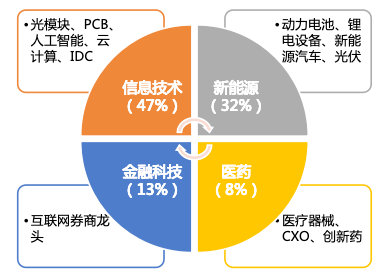
Market Overview - The A-share market showed an overall upward trend last week, with major indices rising: CSI 300 up 0.2%, CSI 500 up 1.1%, ChiNext 50 up 2.5%, and Sci-Tech 50 up 6.5% [1] - The average daily trading volume in the A-share market was around 2.3 trillion yuan, indicating sustained high market investment enthusiasm [1] - Market hotspots were mainly concentrated in the chip industry chain, robotics, AI applications, and energy storage, while consumer electronics and precious metals weakened after initial strength [1] Sector Focus - **Technology and AI**: The ChiNext 50 index covers 47% of the information technology sector, with 19% weight in optical modules. Key drivers include Nvidia's $100 billion investment in AI data centers and Alibaba's 380 billion yuan AI infrastructure plan, which are expected to accelerate demand for optical modules [5] - **Energy Storage and Lithium Batteries**: The energy storage and lithium battery sectors have seen a continuous increase in demand this year, driven by the expansion of renewable energy and new pricing policies. The core issue is whether sustained energy storage demand can maintain a projected 20% growth rate through 2026 [5] - **Pharmaceuticals and Biotech**: The pharmaceutical sector experienced an overall decline last week, with a cautious funding sentiment. Key drivers include new policies aimed at optimizing procurement rules and a recovery in medical device tenders, which are expected to accelerate revenue recognition [7] Investment Vehicle - The ChiNext 50 ETF (159949) focuses on leading companies in high-potential sectors such as new energy vehicles, biomedicine, electronics, photovoltaic, and internet finance. It reflects the performance of the top 50 companies in the ChiNext market, which are known for their liquidity and market capitalization [8] - The ChiNext 50 ETF had a recent valuation of 45.34 times, placing it in the 50.34% percentile over the past decade [4] Performance Metrics - The ChiNext 50 ETF had an average daily trading volume of 1.637 billion yuan over the past year, ranking it among the top ETFs on the Shenzhen Stock Exchange [8] - The top ten weighted stocks in the ChiNext 50 index showed varied performance, with Ningde Times (21.20% weight) increasing by 3.23%, while other stocks like Shenghong Technology (4.40% weight) decreased by 10.26% [9]


“药茅”片仔癀,又做LP了
投中网· 2025-09-30 02:00
Core Viewpoint - The article discusses the active participation of pharmaceutical companies, particularly Pianzaihuang, in the primary market as limited partners (LPs) in various investment funds, highlighting their strategies to seek new growth opportunities amid fluctuating performance [4][10][12]. Group 1: Pianzaihuang's Investment Activities - Pianzaihuang has committed to invest RMB 200 million as a limited partner in the CICC (Zhangzhou) Medical Industry Investment Partnership, representing 20% of the fund's target size of RMB 1 billion [4][6]. - This marks Pianzaihuang's third investment as an LP since 2025, following previous investments in the "Zhaoying Huikang Fund" and the "Gaoxin Runxin Fund," both with a scale of RMB 1 billion [4][11]. - The company has a strong cash reserve of nearly RMB 5 billion as of June 2025, allowing it to actively engage in investment activities despite recent declines in revenue and profit [12]. Group 2: Fund Details and Partners - The CICC Medical Fund aims to invest in sectors such as traditional Chinese medicine, biomedicine, medical devices, and health services, with a focus on projects related to Pianzaihuang's industry chain [6][8]. - The fund has seven limited partners, with several having connections to Pianzaihuang, indicating a strategic alignment within the investment ecosystem [8]. Group 3: Broader Industry Trends - Other pharmaceutical companies, such as Taige Pharmaceutical and Jiuzhoutong, are also becoming active LPs in the primary market, reflecting a trend among biopharmaceutical firms to diversify their investment portfolios [4][13]. - Companies like Hengrui Medicine and Kanglong Huacheng are also establishing significant investment funds, indicating a robust interest in the primary market driven by strong financial performance [14][16]. - The trend of pharmaceutical companies acting as LPs is seen as a positive signal for the venture capital and private equity landscape, providing much-needed capital to startups and investment firms [17].


光大证券晨会速递-20250930
EBSCN· 2025-09-30 01:00
Group 1: Market Overview - The domestic equity market indices generally rose, while the Hong Kong stock market experienced a pullback. The new fund market remains active with 61 new funds launched, totaling 36.607 billion shares issued [2] - In terms of thematic fund performance, new energy and TMT thematic funds showed superior net value growth, while pharmaceutical thematic funds continued to decline. The semiconductor thematic products performed notably well [2] Group 2: Construction and Building Materials - The Ministry of Industry and Information Technology issued the "Construction Materials Industry Steady Growth Work Plan (2025-2026)", focusing on coordinated efforts on both supply and demand sides. The report suggests attention to new materials and construction-related companies such as China Jushi, Guoen Co., Puyang Huachang, and others [3] - Key companies to watch include China Construction, Dongfang Yuhong, and Anhui Conch Cement, which are positioned well within the infrastructure and real estate supply chain [3] Group 3: Pharmaceutical Industry - Pfizer's acquisition of Metsera and its next-generation weight loss product portfolio marks a significant endorsement of the GLP-1 market potential, following similar moves by Eli Lilly and Novo Nordisk. This highlights the industry's urgent demand for next-generation therapies [4] - The global GLP-1 research competition has entered a critical phase, where depth of the supply chain, technological iteration capabilities, and cost control will be key to success. The report expresses strong optimism regarding the rise of China's weight loss drug supply chain [4] Group 4: Steel Industry - The asphalt operating rate is at its highest level in five years, with ductile iron pipe prices and processing fees at year-to-date highs. The steel sector's profitability is expected to recover to historical average levels, supported by government policies aimed at phasing out outdated capacity [5] - The report indicates that the steel sector's price-to-book ratio (PB) is likely to recover alongside profitability improvements [5]
定投基金3年还是亏?你可能犯了这2个致命错误!现在该还来得及
Sou Hu Cai Jing· 2025-09-30 00:56
Core Insights - The article highlights the significant disparity in investment outcomes among investors who employed a systematic investment strategy in index funds, with over 60% of investors in the CSI 300 index experiencing losses, averaging an 8.7% decline, while a different group achieved a 12% annualized return [1][3]. Group 1: Investment Strategy Errors - Investors commonly made two critical mistakes: selecting the wrong assets and mismanaging investment timing [1][3]. - Many investors fell into the "chasing hot spots" trap, investing in high-volatility sectors like renewable energy and semiconductors, which led to substantial losses [3][4]. - For instance, a renewable energy index fund saw its net value drop from 2.5 yuan in September 2022 to 1.8 yuan in August 2025, resulting in an 11% loss for consistent investors [3][4]. Group 2: Comparison of Investment Outcomes - Broad-based index funds, such as the CSI 300, emerged as the "winners" in systematic investment strategies, yielding a 5.2% annualized return despite market downturns [4][10]. - In contrast, thematic funds averaged a -3.8% return during the same period, underscoring the importance of asset selection [4][10]. Group 3: Valuation Considerations - A common error among investors was neglecting valuation, leading to blind investments without considering price rationality [6][7]. - The CSI 300 index experienced significant valuation fluctuations, with its price-to-earnings ratio ranging from 12 to 15 during the investment period, affecting returns based on timing of investments [6][7]. - An investor who adjusted their investment based on valuation metrics achieved a 14% profit, while another who did not lost 5% [6][10]. Group 4: Recommendations for Improvement - To enhance investment outcomes, investors should prioritize selecting "evergreen" assets and avoid sectors with high cyclicality or rapid technological changes [4][12]. - Implementing a dynamic investment strategy based on valuation metrics can significantly reduce average costs and improve returns [7][10]. - Investors are advised to regularly assess their investment choices and adjust their strategies according to market conditions and asset valuations [12].

麦科奥特向港交所提交上市申请书
Zheng Quan Shi Bao Wang· 2025-09-29 13:55
Group 1 - The core point of the article is that Shaanxi Micronaut Pharmaceutical Technology Co., Ltd. has submitted its listing application to the Hong Kong Stock Exchange [1] - The joint sponsors for the listing are Jianyin International and China Merchants Securities International [1]
美团:机会在下沉:2025中国企业差旅趋势洞察之住宿篇
Sou Hu Cai Jing· 2025-09-29 13:07
Core Insights - The report "Opportunities in Downstream: Insights on Corporate Travel Trends in China by 2025" highlights the trend of corporate travel shifting towards lower-tier cities, with a projected corporate travel expenditure of $373.1 billion by 2025, despite a slowdown in growth [1][30][42] - The report identifies three major trends in the travel market: deepening demand for lower-tier cities, a shift towards lean management practices, and a diversification of employee travel experiences [1][30][48] Group 1: Market Trends - Corporate travel demand is increasing, with over 60% of employees traveling to lower-tier cities, indicating a significant shift in travel patterns [1][30][49] - The corporate travel expenditure in China is expected to reach $373.1 billion by 2025, making it the second-largest globally, despite a growth rate slowdown to 2.2% in the current year [1][30][42] - The trend of businesses expanding into lower-tier cities is supported by government policies and market potential, leading to a higher growth rate in these areas compared to first-tier cities [1][35][42] Group 2: Challenges and Solutions - Companies face challenges in resource allocation and cost management as they expand into lower-tier markets, with a need for a more systematic approach to travel management [1][30][49] - The report suggests a shift from simple cost control to a more comprehensive lean management strategy, emphasizing the importance of balancing cost efficiency with employee travel experience [1][30][48] - Meituan's proposed solution includes a three-pronged approach: comprehensive coverage, precise matching of small scenarios, and intelligent efficiency improvements, aimed at optimizing travel management in the context of down-market expansion [1][14][42] Group 3: Case Studies - The report includes benchmark cases demonstrating successful cost reduction and efficiency improvements in corporate travel management, such as a well-known tea brand saving millions and a snack chain enhancing employee experience through innovative accommodations [1][14][42] - Specific examples highlight how companies have adapted to the challenges of down-market travel, such as implementing online processes and utilizing unique accommodation options to meet diverse employee needs [1][14][42]