
债券

Search documents
股市大涨,债市却“被错杀”!
Di Yi Cai Jing Zi Xun· 2025-08-18 14:25
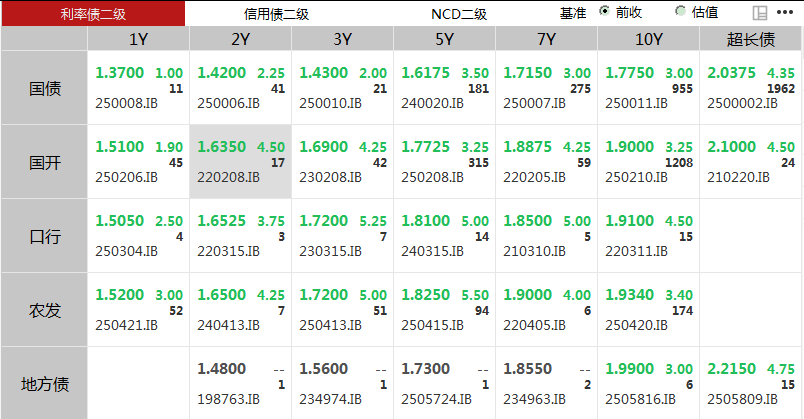
股债市场正上演"冰火两重天"。 8月18日,A股延续上行趋势,并在一片涨声中创出纪录——A股市值总和(A股最新价×A股总股本)首 次突破100万亿元大关。同日,债市则继续下跌,30年国债期货创5个多月以来最大跌幅,现券收益率时 隔4个月重回2%上方。 债市圈纷纷感慨:A股创历史,债市却崩了;股市强得可怕,债券跌得吓人……不过,对于债券后市走 势,综合考虑内外部因素,机构人士仍普遍持乐观态度。 股债跷跷板抢资金 周一,A股涨势如虹,创下多项纪录。截至收盘,上证指数收报3728点,创近十年新高,两市超4000只 个股飘红。 股市大涨,债市投资者则又经历了难熬的一天。国债期货收盘全线下跌,30年期主力合约跌1.33%报 116.09元,创3月17日以来最大跌幅,收盘价创3月24日以来新低;10年期主力合约跌0.29%报108.015 元,5年期、2年期主力合约分别跌0.21%、0.04%。 现券方面,银行间主要利率债收益率大幅上行。其中,30年期国债活跃券"25超长特别国债02"收益率一 度上行6.35BP报2.0575%;"25超长特别国债05"收益率一度上行6.75BP报2.1175%;50年期国债"25超长 ...
近期市场反馈及思考5:“资金分流+反内卷”下的债市主导逻辑变迁
Shenwan Hongyuan Securities· 2025-08-18 14:15
Group 1 - The dominant logic in the bond market since May 2025 is major asset allocation rather than "fundamentals + liquidity" [9][10][11] - The low interest rate environment has led to a significant change in residents' asset allocation behavior, with bonds being viewed as "low odds assets" compared to other higher value assets [10][11] - Key indicators to observe the intensity and sustainability of fund diversion include the scale of asset management products, the rate of new resident accounts, margin balances, and non-bank deposits [11][12] Group 2 - The "anti-involution" narrative has altered the macroeconomic discourse, shifting from "weak demand + falling prices" to a focus on improving corporate profitability and potential inflation [17][19] - The bond market's response to "anti-involution" should not be overestimated in the short term, but its long-term impact on price improvement and valuation reassessment is significant [19][20] Group 3 - The bond market should focus on three main expectation differences: external demand, liquidity expectations, and policy expectations, particularly on the demand side [21][22] - The risks in the bond market are gradually being released, with potential pressures from fund diversion and crowded trading structures expected in August to October 2025 [22][24] Group 4 - The expansion of credit bond ETFs presents both opportunities and risks, with potential for increased market volatility and the need for caution regarding component bonds [27][29] - Short-term strategies for credit bonds may involve exploring yield spreads, while caution is advised for long-duration credit bonds and ETFs as they approach profit-taking windows [30][32] Group 5 - The progress of the Southbound Bond Connect expansion offers investment opportunities, particularly in local government bonds and international agency bonds [33][34] - The performance of dim sum bonds is expected to remain strong, with a focus on short-duration sovereign bonds and high-quality local government bonds [34] Group 6 - The approach to low-volatility convertible bonds should shift towards trading rather than allocation, as their trading range narrows [36] - High-volatility convertible bonds should be viewed through a lens of allocation, especially if strong redemption announcements are made [37] Group 7 - The optimal fixed income combination should include short pure bonds as a base, supplemented by mid-to-low-rated convertible bonds and dividend stocks for a balanced portfolio [38]
A股上3700点创十年新高 资金跑步入场“股债跷跷板”再现
2 1 Shi Ji Jing Ji Bao Dao· 2025-08-18 13:27
Market Performance - On August 18, the A-share market's trading volume surged to 2.76 trillion yuan, with margin financing and securities lending (two融) balance exceeding 2 trillion yuan, marking the fourth consecutive trading day of both metrics surpassing 2 trillion yuan since August 13 [2] - The Shanghai Composite Index reached 3,700 points, achieving a nearly 10-year high, with a year-to-date increase of 11.23% [2] Investor Activity - In July, 1.9636 million new A-share accounts were opened, a month-on-month increase of 317,200 accounts, representing a nearly 20% growth compared to June [2] - As of July 31, the total number of new A-share accounts opened this year reached 14.5613 million, a year-on-year increase of 36.88% compared to 10.6379 million accounts opened in the first seven months of 2024 [2] Bond Market Reaction - On August 18, the bond market experienced a significant decline, with all government bond futures closing lower [2] - The 30-year main contract fell by 1.33%, closing at 116.090 yuan, marking the largest single-day drop since March 17, 2025, and the lowest closing price since March 24, 2025 [2] - The 10-year main contract decreased by 0.29% to 108.015 yuan, while the 5-year and 2-year contracts fell by 0.21% and 0.04%, closing at 105.455 yuan and 102.304 yuan respectively [2] - The 30-year government bond ETF dropped over 1%, closing down 1.26%, continuing a three-day decline [2]
200万新股民跑入A股,债市大跳水
21世纪经济报道· 2025-08-18 12:58
Core Viewpoint - The A-share market has shown significant upward momentum, with the Shanghai Composite Index breaking the 3700-point mark, while the bond market has experienced a sell-off, indicating a "stock-bond seesaw" effect [1][3][10]. Group 1: A-Share Market Performance - On August 18, the Shanghai Composite Index closed at 3728.03 points, marking a 0.85% increase and reaching a nearly 10-year high, with a year-to-date increase of 11.23% [1][10]. - The trading volume in the A-share market reached 2.76 trillion yuan, with margin financing balances exceeding 2 trillion yuan, indicating strong market participation [1][10]. - In July, 196.36 thousand new A-share accounts were opened, a 19% increase from June, contributing to a total of 1,456.13 thousand new accounts year-to-date, a 36.88% year-on-year increase [1][11]. Group 2: Bond Market Performance - On August 18, the bond market saw a significant decline, with the 30-year government bond futures dropping 1.33%, marking the largest decline since March 2025 [4][6]. - The yields on long-term government bonds have risen, with the 30-year bond yield increasing to 2.0450% and the 10-year bond yield expected to remain in the range of 1.65% to 1.75% [5][15]. - The Ministry of Finance announced measures to support the liquidity of government bonds in the secondary market, indicating a proactive approach to stabilize the bond market [7][8]. Group 3: Market Sentiment and Future Outlook - Analysts suggest that the current market conditions reflect a "healthy bull" phase, with significant inflows of new capital and a positive sentiment among investors [12][13]. - The stock market's upward trend is expected to continue, driven by economic stability and ongoing policy support, while the bond market may face challenges due to rising yields [16][17]. - Historical patterns indicate that the bond market may not sustain deep declines, as fundamental and policy factors are likely to stabilize yields in the long term [15].


债市情绪面周报(8月第2周):股市十年新高之际,债市情绪如何?-20250818
Huaan Securities· 2025-08-18 12:36
Report Summary 1. Report Industry Investment Rating The provided report does not mention the industry investment rating. 2. Core Viewpoints - **Hua'an Securities' View**: Amid the market style shift, there are still short - term long - trading opportunities in the bond market. Although the bond market has faced a style shift due to the strong performance of the stock and commodity markets, investors can still find long - trading opportunities such as taking advantage of the steeper curve and wider spreads, paying attention to the increased willingness of allocation investors to buy bonds when funds are loose, considering the possible short - covering of certain 30 - year Treasury bonds, and seizing the entry opportunity after the bond market correction. [2] - **Seller's View**: Only 30% of fixed - income sellers are bullish on the bond market, over 60% hold a neutral attitude, and the sentiment remains the same as last week. [3] - **Buyer's View**: The overall view of fixed - income buyers is neutral, and the sentiment index has declined. Over 80% of buyers hold a neutral view. [3] 3. Summary by Directory 3.1 Seller and Buyer Market - **Seller Market Sentiment Index and Interest - rate Bonds**: The weighted sentiment index this week is 0.21, up from last week, and the unweighted index is 0.26, unchanged from last week. 32% of institutions are bullish, 61% are neutral, and 6% are bearish. [11] - **Buyer Market Sentiment Index and Interest - rate Bonds**: The weighted sentiment index this week is 0.05, down 0.07 from last week, and the unweighted index is 0.06, down 0.097 from last week. 13% of institutions are bullish, 81% are neutral, and 6% are bearish. [12] - **Credit Bonds**: The market focuses on the "stock - bond seesaw" and "stable wealth - management scale". Due to the continuous rise of the equity market suppressing the bond market, it is recommended to shorten the duration. The wealth - management scale is stable, and the short - term liability pressure is controllable. [16] - **Convertible Bonds**: Institutions generally hold a neutral - to - bullish view this week. 77% of institutions are bullish, and 23% are neutral. [19] 3.2 Treasury Bond Futures Tracking - **Futures Trading**: As of August 15, the prices of TS/TF/T/TL Treasury bond futures contracts decreased compared to last Friday, the trading volume increased, the open interest decreased, and the trading - to - open - interest ratio increased. [24][25] - **Cash Bond Trading**: On August 15, the turnover rates of 30Y Treasury bonds, interest - rate bonds, and 10Y China Development Bank bonds all increased compared to last week. [32] - **Basis Trading**: Except for the TS contract, the basis of other main contracts narrowed. The net basis of TS/T/TL main contracts widened, and the IRR of main contracts generally increased. [44][45][47] - **Inter - period and Inter - variety Spreads**: The inter - period spreads of main contracts generally widened, and the inter - variety spreads showed mixed trends. [58][59]
债市突发大跌!30年期国债期货跌超1%
Zheng Quan Shi Bao Wang· 2025-08-18 10:51
曾经备受债市追捧的30年期国债期货,随着近期权益市场持续强势走高,热度呈现出持续下降趋势。 8月18日,30年期国债期货主力合约大跌超1%,创今年4月初以来新低。10年期国债期货、5年期国债期货、2年期 国债期货等均出现不同程度下跌。 对于当前的债市,业内认为,"反内卷"主线下的股市强势表现压制债市情绪,叠加机构赎回等行为,构成债市短 期风险点。不过,债市仍存在支撑因素,趋势性逆转的概率还不高。 30年期国债期货跌超1% 近期,股债"跷跷板"效应愈发明显。在基本面和资金面并无明显变化的情况下,债市近期出现接连调整走势,市 场关注焦点转向权益市场与商品市场。 8月18日,30年期、10年期、5年期、2年期国债期货均出现下跌。其中30年期国债期货的跌幅超过1%。截至收 盘,30年期国债期货主力合约跌1.33%,10年期国债期货主力合约跌0.29%,5年期国债期货主力合约跌0.21%,2年 期国债期货主力合约跌0.04%。 银行间主要利率债收益率快速上行。截至发稿,30年期国债活跃券的到期收益率上行4.35个基点,报2.0375%,重 返2%关口;10年期国债活跃券的到期收益率上行3个基点,报1.775%;5年期国 ...
流动性宽松与风险偏好共振,A股有望再创新高
Tong Guan Jin Yuan Qi Huo· 2025-08-18 10:49
Report Title - The report is titled "Macro and Major Asset Semi-Annual Report: Loose Liquidity and Risk Appetite Resonance, A-shares Expected to Reach New Highs" [1] Investment Rating - No investment rating for the industry is provided in the report Core Views - In the first half of 2025, under the impact of Trump's domestic and foreign policies, global major asset fluctuations intensified. Stocks performed the best, followed by bonds. Commodities were divided, with externally-driven varieties outperforming domestic-demand products. The currencies of the G2 countries were under pressure, with both the US dollar and the RMB weakening [2][3][8] - In the domestic market, equities (+5.83%) > bonds (+0.87%) > commodities (-2.09%) > RMB (-6.03%). A-shares' performance was centered around China's AI breakthroughs and Trump's tariff disruptions. AI利好 catalyzed the technology and growth sectors to lead in stages, boosting risk appetite. Tariff uncertainties dragged down the export chain, suppressing the valuation repair of the cyclical and manufacturing sectors. Bonds mainly fluctuated based on tight liquidity, tariff-induced risk aversion, and their gains significantly converged compared to 2024. The RMB appreciated against the US dollar and depreciated against non-US currencies. Commodities were divided, with precious metals shining and domestic-demand commodities such as black metals and industrial products remaining weak [3][8] - In the overseas market, bonds (+7.27%) > equities (+6.07%) > commodities (+5.96%) > US dollar (-10.79%). In the first half of the year, global risk appetite fluctuated significantly. Trump's tariff policies once triggered a sharp market shock, but the recession remained at the expected level. Global stock markets quickly recovered after a sharp decline, with the Hong Kong, German, and South Korean stock markets rising by over 20%. Global bonds generally rose, led by emerging markets and US bonds, while European bonds were weaker. Commodities generally rose slightly, led by livestock and oils, with metals and industrial raw materials having moderate increases. The US dollar index fell by over 10%, dragged down by cooling soft data, tariff impacts on credit, and doubts about the Fed's independence [3][8] - Looking ahead, A-shares are expected to reach new highs due to the continuation of loose global central bank liquidity and the approaching of the profit bottom. In the bond market, treasury bond yields may decline further but with weak odds. Gold prices are bullish in the medium to long term, supported by global loose liquidity, geopolitical risks, and anti-globalization. Copper prices are expected to rise as the global economy is expected to recover and the supply of concentrates is expected to tighten. Oil prices are expected to be weak in the second half of the year due to oversupply and weak demand [3] Summary by Directory 1. Major Asset Performance - In the first half of 2025, under the impact of Trump's domestic and foreign policies, global major asset fluctuations intensified. Stocks performed the best, followed by bonds. Commodities were divided, with externally-driven varieties outperforming domestic-demand products. The currencies of the G2 countries were under pressure, with both the US dollar and the RMB weakening [8] - In the domestic market, equities (+5.83%) > bonds (+0.87%) > commodities (-2.09%) > RMB (-6.03%). A-shares' performance was centered around China's AI breakthroughs and Trump's tariff disruptions. AI利好 catalyzed the technology and growth sectors to lead in stages, boosting risk appetite. Tariff uncertainties dragged down the export chain, suppressing the valuation repair of the cyclical and manufacturing sectors. Bonds mainly fluctuated based on tight liquidity, tariff-induced risk aversion, and their gains significantly converged compared to 2024. The RMB appreciated against the US dollar and depreciated against non-US currencies. Commodities were divided, with precious metals shining and domestic-demand commodities such as black metals and industrial products remaining weak [8] - In the overseas market, bonds (+7.27%) > equities (+6.07%) > commodities (+5.96%) > US dollar (-10.79%). In the first half of the year, global risk appetite fluctuated significantly. Trump's tariff policies once triggered a sharp market shock, but the recession remained at the expected level. Global stock markets quickly recovered after a sharp decline, with the Hong Kong, German, and South Korean stock markets rising by over 20%. Global bonds generally rose, led by emerging markets and US bonds, while European bonds were weaker. Commodities generally rose slightly, led by livestock and oils, with metals and industrial raw materials having moderate increases. The US dollar index fell by over 10%, dragged down by cooling soft data, tariff impacts on credit, and doubts about the Fed's independence [8] 2. Equity Market 2.1 A-shares - In the first half of 2025, A-shares performed well, with broad-based indices generally rising. The Beizheng 50, CSI 1000, and CSI 2000 led the gains, showing a significant structural market. The performance of large-cap blue-chip indices such as the SSE 50 and CSI 300 was relatively limited. Overall, the market fluctuated greatly in the first half of the year, and risk appetite fluctuated between "China's AI narrative" and "Trump's tariffs." The market generally trended upward, with a decent profit-making effect. The market can be roughly divided into four stages [13] - Stage 1 (January 1 - January 13): The market declined weakly due to a lack of economic data, weakening policy effects from the fourth quarter of 2024, and rising overseas uncertainties ahead of Trump's inauguration. During this period, most indices adjusted, with the ChiNext Index leading the decline and the growth sector performing weakly [16] - Stage 2 (January 14 - March 18): The market rose significantly as the strong expectations for China's AI industry outweighed the weak economic reality. The market's pessimistic sentiment was significantly repaired after the China-US presidential call in mid-January, and risk appetite recovered. The popularity of DeepSeek in late January triggered strong expectations for China's AI innovation, becoming the core driver of the market. The "strong expectations" for China's AI industry outweighed concerns about Trump's tariffs and the "weak reality" of economic data, driving the market's trading volume to an average of 1.8 trillion yuan and the margin trading balance to a 10-year high of 1.9 trillion yuan. During this period, most indices rose, with small-cap growth stocks such as the Beizheng 50 and CSI 2000 leading the gains [17] - Stage 3 (March 19 - April 7): Risk appetite declined as the market shifted from strong industry expectations to economic reality. The market's expectations for a Q1 reserve requirement ratio (RRR) cut and interest rate cut were disappointed, and the liquidity remained tight until the end of March. The 10-year treasury bond yield rose, and overseas liquidity tightened marginally, putting pressure on valuations. The market's trading volume declined. On April 7, Trump's announcement of "reciprocal tariffs" far exceeded market expectations, triggering a global risk-off sentiment. The A-share market tumbled after the Tomb-Sweeping Festival holiday, with the Shanghai Composite Index falling by more than 7% and thousands of stocks hitting the daily limit down [18][19] - Stage 4 (April 8 - June 30): The market gradually recovered as policy support and a stabilization of global risk appetite boosted investor confidence. Trump's decision to delay the implementation of reciprocal tariffs for 90 days helped to stabilize global risk appetite. In response to the US tariffs, the Chinese government quickly introduced a series of policies to support the economy and counter the US measures. The central bank injected liquidity through a stabilization fund, helping to restore market confidence. The market entered a structural recovery phase with strong support at the bottom [19] - Looking ahead to the second half of the year, A-shares still have upward momentum. On the earnings side, policy support is expected to improve the economic fundamentals, and the "earnings bottom" is approaching. On the valuation side, loose monetary policies at home and abroad are expected to continue, providing support for equity valuations. Policy support is expected to strengthen market expectations, and the A-share market is expected to reach new highs this year, breaking through the high set on September 24 last year. The market's performance will depend on the timing of the Fed's interest rate cuts and the recovery of domestic risk appetite [20][21][22] 3. Bond Market 3.1 Treasury Bonds - In the first half of 2025, the bond market entered an adjustment phase after a unilateral upward trend at the end of 2024. The market's pricing of the weak domestic economic momentum became more comprehensive, and tight liquidity, tariff policies, and the recovery of risk appetite became the core variables driving interest rate fluctuations. The bond market can be roughly divided into three stages [27] - Stage 1 (January 1 - March 19): Interest rates rose as the market's expectations for loose monetary policies were revised, liquidity tightened, and the stock market strengthened. In early 2025, the 10-year treasury bond yield quickly fell below 1.6% due to the continued impact of loose policy expectations at the end of 2024. Subsequently, tight liquidity, disappointed expectations for a Q1 RRR cut and interest rate cut, and the recovery of risk appetite driven by the revaluation of technology stocks led to a rebound in interest rates. The yield curve showed a "bear flattening" trend. By mid-March, the 10-year treasury bond yield approached 1.9%, reaching a new high for the year [30] - Stage 2 (March 20 - April 7): Interest rates declined as the central bank shifted its focus to supporting the economy, risk aversion increased due to Trump's tariff policies, and regulatory guidance was introduced. As economic data weakened and external risks increased, the central bank shifted its policy focus from "risk prevention" to "growth stabilization." The tight liquidity in the first quarter gradually eased, and the equity market entered an adjustment phase. The 10-year treasury bond yield declined to 1.8%. In early April, Trump's tariff policies far exceeded market expectations, triggering a global stock market crash. Risk aversion drove funds into the bond market, and the 10-year treasury bond yield dropped to 1.6% [30] - Stage 3 (April 8 - June 30): Interest rates fluctuated within a narrow range as the market balanced the recovery of risk appetite, the implementation of loose monetary policies, and the increase in bond supply. In the second quarter, the bond market generally fluctuated within a narrow range as the market weighed the recovery of risk appetite, RRR cuts and interest rate cuts, and the supply of government bonds. The market mainly focused on two factors: 1) The China-US trade talks in Geneva reached an unexpected consensus, boosting market sentiment. The resilience of exports in the second quarter also provided some support for the economy and put pressure on the bond market. 2) The central bank announced RRR cuts and interest rate cuts in early May, leading to a marginal easing of liquidity. Despite the large supply of government bonds, the central bank's open market operations showed a strong intention to support liquidity, providing some support for interest rates [31] - Looking ahead to the second half of the year, treasury bond yields may break through their previous lows, but the odds are weak. The economic fundamentals have not reversed, and the bond market is still likely to benefit from loose monetary policies. However, the recovery of risk appetite and the increasing attractiveness of risk assets may limit the downside potential of bond yields. The bond market may face some challenges in the second half of the year, including a potential increase in inflation expectations and the uncertainty of Trump's domestic and foreign policies [32][34][35] 4. Commodity Market 4.1 Gold - In the first half of 2025, the gold price continued its upward trend from last year, rising by more than 25%. The price increase was mainly driven by the risk aversion sentiment triggered by Trump's policies, increasing recession expectations, and doubts about the US dollar's credit. The gold market can be roughly divided into three stages [43] - Stage 1 (January 1 - April 2): The gold price rose as Trump's inauguration increased trade tensions, and weak US economic data and rising recession expectations drove investors to seek safe-haven assets. The US dollar index and the US treasury bond yield declined, and central banks around the world continued to increase their gold reserves, driving the gold price higher. During this period, the gold price trended upward [44][47] - Stage 2 (April 3 - April 21): The gold price reached a new high as Trump's tariff policies triggered a global risk-off sentiment and a crisis of confidence in the US dollar. The global market was shocked by Trump's announcement of "reciprocal tariffs," which far exceeded market expectations. The initial sell-off of gold due to liquidity shortages and panic was quickly reversed as investors sought the safe-haven properties of gold. The gold price reached a record high of over $3,500 per ounce on April 22 [47] - Stage 3 (April 22 - June 30): The gold price fluctuated within a narrow range as the market's risk appetite recovered, and geopolitical risks increased. The US government's decision to ease its tariff policies and the strong US economic data put pressure on the gold price. However, the escalating geopolitical tensions in the Middle East provided some support for the gold price. During this period, the gold price fluctuated between $3,175 and $3,450 per ounce [48] - Looking ahead to the second half of the year, the gold price is expected to continue its upward trend, supported by loose global liquidity, rising geopolitical risks, and the acceleration of anti-globalization. However, the narrowing of macro uncertainties and the increasing odds of a price correction may limit the upside potential of the gold price. The gold market may face some challenges in the second half of the year, including the implementation of Trump's tariff policies, the Fed's interest rate cuts, and the geopolitical situation in the Middle East [49] 4.2 Copper - In the first half of 2025, the copper price generally trended upward, with a brief correction in April due to Trump's tariff policies. The copper market can be roughly divided into three stages [51] - Stage 1 (January 1 - March 26): The copper price rose as the global manufacturing sector recovered, and the expectation of fiscal expansion in China and Europe supported the copper demand. The supply of copper concentrates tightened, and the spot treatment charge (TC) price reached a record low, putting upward pressure on the copper price. The expectation of copper tariffs and the US government's investigation into copper imports also contributed to the increase in the copper price [53] - Stage 2 (March 27 - April 9): The copper price declined as Trump's tariff policies triggered a global risk-off sentiment, and the demand for copper decreased. The copper price dropped by more than 20% in a short period, reaching its lowest level of the year [53] - Stage 3 (April 10 - June 30): The copper price recovered as the market's risk appetite improved, and the supply of copper concentrates continued to tighten. The decision to delay the implementation of reciprocal tariffs and the weakening of the US dollar supported the copper price. The supply-demand balance of the copper market remained tight, and the spot TC price continued to trade below $40 per ton, providing strong support for the copper price [54] - Looking ahead to the second half of the year, the copper price is expected to be supported by loose global monetary and fiscal policies and the tightening of the copper concentrate supply. The global central banks are still in the process of cutting interest rates, and the fiscal expansion plans of China, the US, and Europe are expected to boost the copper demand. The supply of copper concentrates is expected to remain tight, and the spot TC price is expected to stay at a low level, providing support for the copper price. Overall, the copper price is expected to trend upward in the second half of the year [54][55] 4.3 Crude Oil - In the first half of 2025, the crude oil price fluctuated significantly, mainly driven by geopolitical tensions and Trump's tariff policies. The supply-demand imbalance in the crude oil market put downward pressure on the oil price. The crude oil market can be roughly divided into five stages [59] - Stage 1 (January 1 - January 15): The oil price reached a new high for the year as the US government's sanctions on Russian oil and the tense situation in the Middle East increased the market's concerns about supply disruptions. The OPEC+ countries reaffirmed their commitment to the production cut agreement, and the cold weather in the US and Europe increased the demand for heating oil. The West Texas Intermediate (WTI) crude oil price approached $80 per barrel [61] - Stage 2 (January 16 - March 10): The oil price declined as the market's concerns about the supply-demand imbalance increased, and the weak US economic data and Trump's tariff policies put pressure on the oil price. The OPEC+ countries postponed their planned production increase until April, but the increasing production from non-OPEC countries such as the US, Brazil, and Canada deepened the oversupply situation. The demand for oil was also weak due to the weak global economic growth and the increasing trade tensions. The oil price dropped by 16% from its high to around $65 per barrel [61] - Stage 3 (March 11 - March 31): The oil price fluctuated within a narrow range as the market balanced the expectation of an increase in oil supply and the recovery of the oil demand in Asia. The OPEC+ countries confirmed their plan to gradually exit the production cut agreement in April, and the increasing US crude oil inventory put pressure on the oil price. However, the strong economic data from China and the expectation of policy stimulus increased the demand for oil in Asia, providing some support for the oil price [62] - Stage 4 (April 1 - May 5): The oil price dropped sharply as the market's concerns about the supply-demand imbalance increased, and the weak global economic data and Trump's tariff policies put pressure on the oil price. The OPEC+ countries prematurely lifted some of the voluntary production cuts, and the increasing production from non-OPEC
信用债ETF双周报(20250804-20250815):科创债ETF增速放缓,可转债ETF资金持续净流入-20250818
Hengtai Securities· 2025-08-18 10:37
1. Report Industry Investment Rating No information provided in the report. 2. Core Viewpoints of the Report - The convertible bond index led the market, while the sci - tech innovation bond index and the benchmark market - making credit bond index declined this period, with negative stage returns. Convertible bond - related ETFs led the gains, sci - tech innovation bond ETFs/benchmark market - making credit bond ETFs had negative current - period yields, and short - term financing ETFs had positive current - period returns [1]. - The scale of Convertible Bond ETF (511380.SH) exceeded 5 billion yuan, and the scale growth rate of sci - tech innovation bond - related ETFs slowed down. The benchmark market - making credit bond ETF still ranked first in terms of scale [1]. - The primary - market issuance of bond index sample bonds was differentiated. Short - term financing had the largest issuance volume and scale, and the coupon rates of bond index sample bonds were relatively low, with concentrated issuance terms [1]. - In the secondary market, convertible bond - related index component bonds had the largest trading volume, and the component bonds of the Shanghai Urban Investment Bond Index were traded at a discount. The credit spreads of the Shanghai Urban Investment Bond Index and the China Securities Short - Term Financing Index were relatively high but less than 40bp [1]. - In the past two weeks, the cancellation of bond issuance amounted to 1.745 billion yuan, and the Ministry of Finance and the State Taxation Administration issued an announcement on the VAT policy for the interest income of bonds such as treasury bonds [1]. - It is recommended to pay attention to Convertible Bond ETF (511380.SH) and China Securities Short - Term Financing (511360.SH) [1]. 3. Summaries According to Related Catalogs Market Conditions - **Bond Index Market Conditions**: The convertible bond index led the market. The Shanghai Investment - Grade Convertible Bond and Exchangeable Bond Index and the China Securities Convertible Bond and Exchangeable Bond Index had significant gains in the past two weeks, outperforming most pure - bond indexes. Affected by the bond market fluctuations and the stock - bond seesaw effect, the sci - tech innovation bond index and the benchmark market - making credit bond index declined. The China Securities Financial Bond Index and the Shanghai 10 - year Local Government Bond Index had the largest declines, while the Shanghai Urban Investment Bond Index, the China Securities Short - Term Financing Index, and the 0 - 4 - year Local Government Bond Index had positive stage returns due to their short durations [6]. - **Bond ETF Market Conditions**: Convertible bond - related ETFs led the gains, sci - tech innovation bond ETFs/benchmark market - making credit bond ETFs had negative current - period yields, and short - term financing ETFs had positive current - period returns [8]. - **Bond ETF Unit Net Value**: The unit net value performance of bond ETFs was differentiated. Convertible bond - related ETFs showed an upward - fluctuating trend in 2025, breaking through 13 yuan in the past two weeks. Sci - tech innovation bond - related ETFs had a downward - fluctuating net value after listing, with all net values falling below 100 yuan as of August 15, 2025. The short - term financing ETFs had a stable and rising unit net value, exceeding 112.2 yuan as of August 15, 2025 [12]. - **Bond ETF Fund Flows**: Convertible bond - related ETFs/short - term financing ETFs had continuous net inflows of funds, and local government bond - related ETFs were actively traded. The scale of Convertible Bond ETF (511380.SH) and Shanghai Convertible Bond ETF (511180.SH) increased by a total of 7.759 billion yuan in the past two weeks. The short - term financing ETF (511360.SH) had a subscription scale of 5.802 billion yuan in the past two weeks [25]. Credit Bond ETF Overview The scale of Convertible Bond ETF (511380.SH) exceeded 5 billion yuan, and the scale growth rate of sci - tech innovation bond - related ETFs slowed down. The benchmark market - making credit bond ETF still ranked first in terms of scale. The annualized yields of Convertible Bond ETF (511380.SH) and Shanghai Convertible Bond ETF (511180.SH) were 26.57% and 19.25% respectively. Among pure - bond ETFs, Credit Bond ETF Dacheng (159395.SZ) had the highest annualized yield of 2.25%. Nine sci - tech innovation bond - related ETF products had negative annualized yields after listing in July [30]. Primary Market - **Primary Issuance of Important Bond Index Sample Bonds**: The primary - market issuance of bond index sample bonds was differentiated. Short - term financing had the largest issuance volume and scale, convertible bond - related indexes had the smallest issuance scale, and the coupon rates of bond index sample bonds were relatively low. The issuance terms of bond index sample bonds were concentrated, with the weighted issuance term of China Securities Short - Term Financing sample bonds being 0.61 years and that of the Shanghai 10 - year Local Government Bond Index sample bonds being 9.18 years [33]. - **Primary Issuance of Important Bond Index Sample Bonds Since This Year**: The issuance of sci - tech innovation bond - related indexes and the Shanghai 10 - year Local Government Bond Index sample bonds accelerated in June and July. In early August, the issuance rates of most sample bonds increased, and the issuance terms of sci - tech innovation bond - related index sample bonds shortened [35]. Secondary Market - **Trading of Important Bond Index Component Bonds**: Convertible bond - related index component bonds had the largest trading volume, and the component bonds of the Shanghai Urban Investment Bond Index were traded at a discount. The trading volumes of the 0 - 4 - year Local Government Bond, Shanghai 5 - year Local Government Bond, and 5 - year Local Government Bond were less than 200 million yuan, with poor liquidity [40]. - **Spreads of Important Credit Bond Indexes**: The credit spreads of the Shanghai Urban Investment Bond Index and the China Securities Short - Term Financing Index were relatively high but less than 40bp. The yields of the Shanghai AAA Sci - tech Innovation Bond Index, Shenzhen AAA Sci - tech Innovation Bond Index, AAA Sci - tech Innovation Bond Index, Shanghai Urban Investment Bond Index, China Securities Short - Term Financing Index, and Shanghai Market - Making Corporate Bond Index all increased in the past two weeks [43]. Credit Events and Market News - **Deferred/Cancelled Bond Issuance**: The cancelled issuance amount in the past two weeks was 1.745 billion yuan. Due to large market interest - rate fluctuations in the past two weeks, 15 bonds were cancelled for issuance, with a planned issuance amount of 1.745 billion yuan [48]. - **Market News**: Since August 8, 2025, the VAT on the interest income of newly issued treasury bonds, local government bonds, and financial bonds (including those issued after August 8, 2025) has been restored. The interest income of treasury bonds, local government bonds, and financial bonds issued before this date (including the part issued after August 8, 2025) will continue to be exempt from VAT until the bonds mature [50]. Investment Recommendations The sentiment in the bond market was weak. Although the CPI increased by 0.4% month - on - month, the fundamentals still favored the bond market. The central bank's open - market operations maintained a net withdrawal in the past two weeks, the capital market was slightly tight, and bond valuation yields increased. It is recommended to pay attention to Convertible Bond ETF (511380.SH) and China Securities Short - Term Financing (511360.SH) [51].
债市,突发大跌!
证券时报· 2025-08-18 10:26
Core Viewpoint - The 30-year government bond futures, once favored in the bond market, are experiencing a decline in popularity as the equity market continues to perform strongly, leading to a bearish sentiment in the bond market [1][2]. Group 1: Market Performance - On August 18, the 30-year government bond futures fell over 1%, marking a new low since early April this year. Other maturities, including 10-year, 5-year, and 2-year government bond futures, also saw varying degrees of decline [2][4]. - The 30-year government bond futures closed down 1.33%, while the 10-year, 5-year, and 2-year futures fell by 0.29%, 0.21%, and 0.04%, respectively [4]. - The yields on major interbank government bonds have risen sharply, with the 30-year bond yield increasing by 4.35 basis points to 2.0375%, and the 10-year bond yield rising by 3 basis points to 1.775% [4]. Group 2: Market Sentiment and Dynamics - The bond market is currently under pressure due to the strong performance of the equity market, which is suppressing bond market sentiment. Additionally, institutional redemptions are contributing to short-term risks in the bond market [2][4]. - The prevailing sentiment in the bond market is one of weakness, as it has shown a muted response to positive economic data while being more sensitive to negative influences from the equity and commodity markets [5][6]. Group 3: Future Outlook - According to research from Everbright Securities, the banking system currently has ample liquidity, and despite upcoming tax periods and month-end factors, the average DR007 is expected to be the lowest of the year in late August, alleviating concerns over significant increases in bond yields [6]. - The bond market may either decouple from the equity market or continue to react to its movements. The likelihood of bond yields declining in the short term is greater than the chance of them rising [6]. Group 4: Redemption Risks - The ongoing adjustments in the bond market could trigger a wave of redemptions from bond funds, further increasing volatility. The research team at Huachuang Fixed Income suggests that while there may be minor redemption pressures, the overall risk remains manageable as long as yields stay below 1.9% [8]. - The Ministry of Finance has announced measures to support the liquidity of government bonds in the secondary market, which could help stabilize the market amid these adjustments [8][9].

资产配置全球跟踪2025年8月第3期:A股强势领涨,美元持续走弱
GUOTAI HAITONG SECURITIES· 2025-08-18 09:53
Group 1: Market Performance - A-shares and the ChiNext index led global gains with an increase of 8.6%[27] - The Hang Seng Index rose by 3.0% and the Nikkei 225 increased by 3.7%[27] - Emerging markets, particularly A-shares, outperformed developed markets, with the overall A-share market up by 3.0% last week[31] Group 2: Currency and Commodity Trends - The US dollar index fell by 0.4%, while the euro, pound, and yen appreciated by 0.5%, 0.8%, and 0.4% respectively[5] - Since the beginning of the year, the US dollar index has decreased by 9.8%, with the euro, pound, and yen rising by 13%, 8.3%, and 6.4% respectively[5] - Commodity prices saw a general increase, with the South China and CRB commodity indices both rising by 0.5%[71] Group 3: Bond Market Insights - The yield curve for Chinese bonds exhibited a "bear steepening" pattern, with the 10-year yield rising by 5.7 basis points to 1.75%[45] - The 10-year to 2-year yield spread for US bonds also expanded, indicating a "bear steepening" trend, with the 10-year yield increasing by 6 basis points to 4.33%[50] Group 4: Risk Premium Analysis - The risk premium for the CSI 300 relative to 10-year government bonds decreased to 5.7%, down by 0.14% from the previous value[19] - The risk premium for the S&P 500 relative to 10-year US Treasuries fell to -0.8%, a decrease of 0.10%[19]