公用事业

Search documents
银河证券晨会报告-20250416
Yin He Zheng Quan· 2025-04-16 08:11
Key Insights - The report highlights the strong growth in social financing and credit in March 2025, with new social financing reaching 5.89 trillion yuan, a year-on-year increase of 1.05 trillion yuan, indicating a positive trend in financial activity [2][3] - The government bonds continue to play a crucial role in supporting social financing growth, with new government bonds issued amounting to 1.48 trillion yuan, a year-on-year increase of 1.02 trillion yuan [3][6] - The banking sector is expected to benefit from a favorable environment with continued monetary policy easing and increased capital injections from major banks, maintaining a positive outlook for bank stocks [6] - The trust industry is undergoing significant regulatory changes aimed at refocusing on core responsibilities and enhancing risk management, which is expected to drive high-quality development in the sector [8][11] - The data center industry is projected to experience robust growth, with electricity consumption expected to grow at a CAGR of 16.1% from 2024 to 2030, driven by increasing demand for low-carbon electricity [14][15] - The report emphasizes the importance of integrating data centers with low-carbon power sources, particularly waste incineration and renewable energy, to meet the growing energy demands sustainably [16][17] - Hebei Steel Group is recognized for its leading profitability in the steel industry, maintaining positive net profits for nearly 20 years, with a sales gross margin of 8.53% in the first three quarters of 2024 [20][21] - Shennong Development has shown consistent growth, with a 14.72% increase in chicken sales in 2024, and is expected to continue its upward trajectory due to its integrated business model and product innovation [24][25]
港股增强含权债基:中低风险资金参与港股的投资工具
CMS· 2025-04-15 15:25
Group 1: Report Core View - The report focuses on the allocation value of Hong Kong stocks, the types of hybrid bond funds allocating Hong Kong stocks, a case study of fund managers with significant exposure to Hong Kong - enhanced hybrid bond funds, and concludes with investment suggestions [1][3][66] Group 2: Allocation Value of Hong Kong Stocks Sub - group 1: Positive Factors for Hong Kong Stocks - Southbound capital has been flowing into Hong Kong stocks, and the expectation of the Fed's interest rate cut is favorable for Hong Kong stocks [7][8][10] - Hong Kong stocks have high - quality and scarce underlying assets, including leading Internet companies, innovative biopharmaceutical enterprises, emerging consumer sectors, and high - dividend assets [16][17][23] - The cost - effectiveness of Hong Kong stocks has increased, and the proportion of Hong Kong stocks in hybrid bond funds has significantly risen [24][25][29] Sub - group 2: Screening of Hybrid Bond Funds Allocating Hong Kong Stocks - The screening criteria for Hong Kong - enhanced hybrid bond funds are hybrid bond funds with an average Hong Kong stock - to - equity ratio of over 20% in the past eight quarters and a consistent equity position of over 5% [30] - The Hong Kong - enhanced hybrid bond funds have shown good performance in the past two years, with average annualized returns in each equity position range exceeding 3% [32][33] - Most Hong Kong - enhanced hybrid bond funds have a large - cap or ultra - large - cap style, with a balanced or value style, and generally low exposure to growth [34][35][39] - Most fund managers have allocated Hong Kong - enhanced hybrid bond funds, with GF Fund, Huatai - PineBridge Fund, Fullgoal Fund, and Anxin Fund having larger management scales and more products [42][43][50] Sub - group 3: Case Study of GF Fund's Hong Kong - enhanced Hybrid Bond Funds - GF Fund's Hong Kong - enhanced hybrid bond funds have generally achieved positive returns in the past two years, with most annualized returns exceeding 3% [54] - The Hong Kong stock position of GF Fund's Hong Kong - enhanced hybrid bond funds is divided into stable and phased allocation types, with a central average Hong Kong stock - to - equity ratio of about 32% [51][57][58] - GF Fund's Hong Kong - enhanced hybrid bond funds show diverse styles, including balanced allocation, "core + satellite" configuration, and "dividend + Internet" dumbbell - shaped configuration [59][60][61] - The Hong Kong stock positions of GF Fund's Hong Kong - enhanced hybrid bond funds have contributed positive returns in the past two years, with some funds showing significant contributions [63][64] Group 3: Conclusion - Hong Kong - enhanced hybrid bond funds can be divided into stable and phased allocation types, suitable for investors with different investment preferences [66] - Most Hong Kong - enhanced hybrid bond funds have a large - cap or ultra - large - cap style, with a balanced or value style and low exposure to growth [66] - Dividend and Internet are the most popular sectors in Hong Kong stock positions, and balanced allocation is the most common strategy [66]
4月11日电力设备、汽车、计算机等行业融资净卖出额居前
Zheng Quan Shi Bao Wang· 2025-04-14 01:55
截至4月11日,市场最新融资余额为17982.81亿元,较上个交易日环比减少40.31亿元,分行业统计,申 万所属一级行业有10个行业融资余额增加,农林牧渔行业融资余额增加最多,较上一日增加3.94亿元; 融资余额增加居前的行业还有电子、公用事业、交通运输等,融资余额分别增加3.21亿元、1.41亿元、 7847.83万元;融资余额减少的行业有21个,电力设备、汽车、计算机等行业融资余额减少较多,分别 减少7.96亿元、6.54亿元、5.36亿元。 以幅度进行统计,农林牧渔行业融资余额增幅最高,最新融资余额为261.15亿元,环比增长1.53%,其 次是钢铁、公用事业、环保行业,环比增幅分别为0.44%、0.33%、0.31%;融资余额环比降幅居前的行 业有商贸零售、汽车、综合等,最新融资余额分别有219.48亿元、830.48亿元、29.48亿元,分别下降 0.80%、0.78%、0.73%。(数据宝) | 有色金属 | 775.23 | -2.17 | -0.28 | | --- | --- | --- | --- | | 医药生物 | 1211.29 | -3.95 | -0.33 | | 通信 | 6 ...
可以更加坚定地看好中国股市 | 资本市场
清华金融评论· 2025-04-12 10:30
Core Viewpoint - The article discusses the impact of Trump's tariff policy on global markets and China's response, highlighting the stabilization of the A-share market through various measures taken by the government and market participants [1][2][4]. Group 1: Impact of Tariff Policy - Trump's announcement of a minimum 10% tariff on global imports and specific rates on countries like China (34%) and the EU (20%) has led to significant declines in global asset prices, with the S&P 500 and Nasdaq dropping by 9.9% and 11.4% respectively [2][3]. - The A-share market experienced a sharp decline, with the Shanghai Composite Index falling by 7.3% on April 7, but showed signs of recovery with a 1.6% increase on April 8 due to intervention from various funds [2][3]. Group 2: Government and Institutional Response - The "national team" entered the market to stabilize it, with the Central Huijin announcing increased purchases of ETF funds, which saw a significant rise in trading volume, indicating strong demand [3][4]. - Regulatory bodies provided support by adjusting insurance fund investment ratios, allowing for greater equity asset allocation, which enhances market stability [3][4]. Group 3: Market Participants' Actions - Over 30 listed companies initiated stock buybacks, totaling over 15 billion yuan, reflecting confidence in their financial health and future prospects [4]. - The combination of government intervention, regulatory adjustments, and proactive measures from market participants demonstrates a collaborative effort to stabilize the market [4]. Group 4: Long-term Outlook - The article expresses a long-term positive outlook for the Chinese capital market, emphasizing that the current macroeconomic environment is more favorable compared to 2018, with a focus on internal demand and technological advancements [10][12]. - The diversification of export structures and the reduced reliance on the U.S. market (from 19.2% in 2018 to 14.7% in 2024) suggests that external shocks will have a limited impact on the overall economy [13]. Group 5: Investment Opportunities - Future investment opportunities may include sectors such as semiconductors and TMT (Technology, Media, and Telecommunications), which are expected to rebound due to domestic policy support and a focus on self-sufficiency [14]. - The food and beverage sector is likely to perform well due to low external dependency and increased domestic consumption support [15]. - Defensive sectors like banking and utilities are recommended for their high dividend yields and resilience during market downturns, with current yields around 6% compared to a 10-year government bond yield of 1.6% [15].

申万宏源关键假设表调整与交流精粹(2025年4月):AI产业链突破不止,关税冲击难挡前行
Shenwan Hongyuan Securities· 2025-04-11 06:41
Group 1: Macro and Strategy Insights - The manufacturing PMI recorded a slight increase to 50.5% in March, with production and new orders indices rising marginally [8] - The report emphasizes the importance of pricing long-term positive factors during market adjustments, suggesting that the market is transitioning to a more pragmatic stance [9] - The bond market is expected to perform well due to the unexpected tariffs, with a shift towards a steeper yield curve anticipated [16] Group 2: Financial and Real Estate Sector - The banking sector is expected to maintain stable performance with better-than-expected interest margins, focusing on high-dividend stocks [19] - The real estate sector is under pressure but is expected to show signs of bottoming out, with the importance of stabilizing the sector increasing amid trade tensions [23] - Construction investment is anticipated to recover, driven by improvements in manufacturing PMI and external shocks [25] Group 3: Materials and Energy Sector - Oil prices have declined due to OPEC's production increase and tariff impacts, but shale oil costs provide strong support for prices [26] - The chemical sector is responding to U.S. tariffs with a focus on self-sufficiency, highlighting the importance of domestic production trends [31] - The coal market is expected to stabilize as demand increases with the arrival of the peak season, supported by fiscal policies [36] Group 4: Consumer and Healthcare Sector - The pharmaceutical industry remains optimistic despite potential tariff impacts, particularly in the innovative drug supply chain [24] - The agricultural sector is under scrutiny due to unexpected tariff policies, with a focus on investment opportunities in various sub-sectors [11] Group 5: Technology and AI Sector - The AI industry is experiencing significant breakthroughs, with a focus on domestic computing power and the emergence of physical AI as a new frontier [4] - The report highlights the potential for AI applications in low-digital penetration sectors such as finance, education, and healthcare [4]
3月物价数据点评:警惕关税带来的价格压力
Soochow Securities· 2025-04-10 13:35
Price Data Overview - In March, CPI decreased by 0.4% month-on-month (previous value: -0.2%) and by 0.1% year-on-year (previous value: -0.7%), indicating a narrowing decline[2] - PPI also fell by 0.4% month-on-month (previous value: -0.1%) and by 2.5% year-on-year (previous value: -2.2%), showing an expanded decline[2] Key Influencing Factors - The decline in CPI was primarily driven by three factors: a 3.5% decrease in domestic gasoline prices due to falling international oil prices, which contributed approximately 0.12 percentage points to the CPI decline[2] - Food prices fell by 1.4% month-on-month, impacting CPI by about 0.24 percentage points, with significant drops in fresh vegetables (5.1%), pork (4.4%), and eggs (3.1%)[2] - Weak terminal consumption and industrial demand continued to exert downward pressure, with service prices slightly below historical levels[2] Future Price Trends - Moving forward, tariff impacts are expected to become a significant factor in price evolution, with supply and demand dynamics shifting[2] - The interplay between excess supply and weakening domestic demand will influence price stability, while tariff shocks may lead to lower prices through increased domestic supply[2] Policy Implications - Incremental policies to counter tariff impacts will be crucial, particularly in promoting consumption and stabilizing the real estate market[2] - The effectiveness of these policies will be key in determining future price trends[2] Risks and Challenges - Potential risks include a weakening real estate market, declining exports, and the possibility that incremental policies may not meet expectations[4] - The go-capacity policy may face tougher decisions, as the short-term pain from capacity reduction could be challenging for the domestic economy to absorb[2]
【9日资金路线图】两市主力资金净流入超30亿元 计算机等行业实现净流入
证券时报· 2025-04-09 11:41
Market Overview - The A-share market experienced an overall increase on April 9, with the Shanghai Composite Index closing at 3186.81 points, up 1.31%, the Shenzhen Component Index at 9539.89 points, up 1.22%, and the ChiNext Index at 1858.36 points, up 0.98% [1] - The total trading volume for both markets reached 16996.05 billion, an increase of 739.62 billion compared to the previous trading day [1] Capital Flow - The net inflow of main funds in the Shanghai and Shenzhen markets exceeded 30 billion, with a total net inflow of 34.23 billion for the day [2] - The main funds in the CSI 300 saw a net inflow of 72.47 billion, while the ChiNext recorded a net inflow of 26.11 billion [4] Sector Performance - The computer industry led with a net inflow of 85.24 billion, followed by electronics with 82.93 billion, and machinery equipment with 54.59 billion [6] - The defense and military industry also performed well, with a net inflow of 51.33 billion, while the food and beverage sector saw a net inflow of 47.70 billion [6] Individual Stock Performance - The top stocks with significant institutional net purchases included Unisplendour with a 10.00% increase and a net buy of 245.74 million, followed by Sunshine Dairy with a 1.84% increase and a net buy of 45.35 million [8] - Other notable stocks included Fuda Co. with a 10.04% increase and a net buy of 36.29 million, and New Yu Guo Ke with a 20.00% increase and a net buy of 26.19 million [8] Institutional Focus - Recent institutional attention has been directed towards stocks such as SAIC Motor, rated as a "Buy" with a target price of 25.5, indicating a potential upside of 67.76% from the latest closing price [10] - Other stocks receiving attention include Sichuan Road and Bridge, rated as a "Buy" with a target price of 11.03, suggesting a potential upside of 26.78% [10]

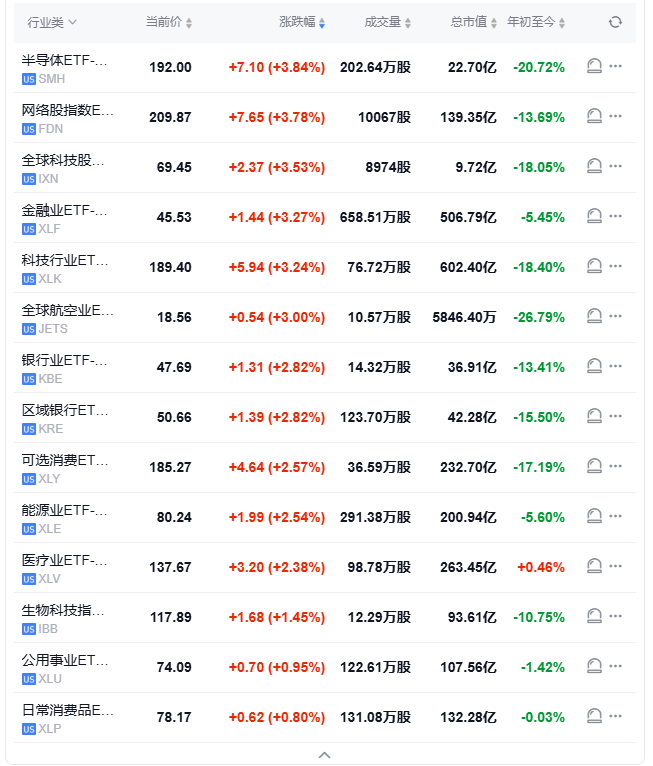
美股盘初,主要行业ETF普涨,半导体ETF、网络股指数ETF、全球科技股ETF涨近4%。
news flash· 2025-04-08 13:43
Core Viewpoint - Major industry ETFs in the US stock market experienced a significant increase, with semiconductor, internet stocks, and global technology stock ETFs rising nearly 4% [1] Industry Performance - Semiconductor ETF rose to $192.00, up by $7.10 (+3.84%), with a trading volume of 202.64 thousand shares and a year-to-date decline of 20.72% [2] - Internet stock index ETF increased to $209.87, gaining $7.65 (+3.78%), with a trading volume of 10,067 shares and a year-to-date decline of 13.69% [2] - Global technology stock ETF reached $69.45, up by $2.37 (+3.53%), with a trading volume of 8,974 shares and a year-to-date decline of 18.05% [2] - Financial sector ETF rose to $45.53, increasing by $1.44 (+3.27%), with a trading volume of 6.58 million shares and a year-to-date decline of 5.45% [2] - Technology sector ETF increased to $189.40, up by $5.94 (+3.24%), with a trading volume of 767.2 thousand shares and a year-to-date decline of 18.40% [2] - Global airline industry ETF rose to $18.56, gaining $0.54 (+3.00%), with a trading volume of 105.7 thousand shares and a year-to-date decline of 26.79% [2] - Banking sector ETF increased to $47.69, up by $1.31 (+2.82%), with a trading volume of 143.2 thousand shares and a year-to-date decline of 13.41% [2] - Regional bank ETF rose to $50.66, gaining $1.39 (+2.82%), with a trading volume of 1.24 million shares and a year-to-date decline of 15.50% [2] - Consumer discretionary ETF increased to $185.27, up by $4.64 (+2.57%), with a trading volume of 365.9 thousand shares and a year-to-date decline of 17.19% [2] - Energy sector ETF rose to $80.24, gaining $1.99 (+2.54%), with a trading volume of 2.91 million shares and a year-to-date decline of 5.60% [2] - Healthcare sector ETF increased to $137.67, up by $3.20 (+2.38%), with a trading volume of 987.8 thousand shares and a year-to-date increase of 0.46% [2] - Biotechnology index ETF rose to $117.89, gaining $1.68 (+1.45%), with a trading volume of 122.9 thousand shares and a year-to-date decline of 10.75% [2] - Utility sector ETF increased to $74.09, up by $0.70 (+0.95%), with a trading volume of 1.23 million shares and a year-to-date decline of 1.42% [2] - Consumer staples ETF rose to $78.17, gaining $0.62 (+0.80%), with a trading volume of 1.31 million shares and a year-to-date decline of 0.03% [2]
小摩:美国十年期国库券收益率达到约4% 建议在当前水平吸纳长江基建集团(01038)和电能实业(00006)
智通财经网· 2025-04-08 01:58
智通财经APP获悉,摩根大通发布研报称,随着美国十年期国库券收益率达到约4%,并且该行的美国 经济学家预计未来可能有150个基点的降息,该行建议在当前水平吸纳长江基建集团(01038)和电能实业 (00006)。该两股份本年至今表现较指数和同行分别落后28%和17%。该行认为,这种低迷表现可能在第 二季度逆转。 该行看到三个买入理由:(1)对关税和地缘政治紧张局势的担忧可能导致资金流向防守型股票,而长江 基建和电能实业是该行覆盖的香港公用事业股票中最便宜的,收益率约5.5%至5.9%,相较于同行的约 5%;(2)宏观环境利好这两家公司,美国10年期收益率年至今下降50个基点,美元(美汇指数本年至今累 跌5%),降息以及可能的监管重置利好。2024年下半年疲软的业绩部分由11月和12月的美元强势推动, 这种情况可能在2025年上半年逆转;(3)当前估值较该行的估计显示其监管资产价值(RAV)有约20%的折 让,比历史平均水平低约10个百分点。这与基本面不符,因为该行预测2022年至2026年间RAV将至少增 长25%,且下一次监管重置的回报率可能趋于上升。 该行的美国经济学家预测今年将降息150个基点,美国10 ...


A股资产具备反弹基础!十余家公募,火速解读
券商中国· 2025-04-07 14:21
Core Viewpoint - The article discusses the significant impact of the recent tariff increases announced by the U.S. on global financial markets, particularly the A-share market, which experienced substantial declines. Despite the short-term volatility, there is a belief in the resilience of the A-share market in the medium to long term due to supportive policies and domestic demand [1][2][10]. Impact of Tariffs - The tariff impact is primarily seen in three areas: 1. Export chain effects, with industries heavily reliant on exports to the U.S. facing order reductions and increased costs [3]. 2. Rising inflation risks in the U.S. due to increased tariffs, which may limit the Federal Reserve's ability to cut interest rates, thereby affecting global liquidity and high-valuation growth stocks [3]. 3. Supply chain restructuring pressures as the U.S. aims to bring manufacturing back, raising concerns about industry shifts and market risk appetite [3][10]. Market Reactions - Following the tariff announcements, the A-share market saw a significant drop, with the Shanghai Composite Index down 7.34%, the Shenzhen Component down 9.66%, and the ChiNext Index down 12.5% [1]. - Central Huijin Investment expressed confidence in the Chinese capital market, indicating plans to increase holdings in ETFs to stabilize the market [1]. Short-term Market Sentiment - Fund managers noted that the recent tariff increases have heightened market uncertainty, leading to a retreat in risk appetite. They expect that the market's excessive panic will be corrected as monetary policies such as interest rate cuts and consumption subsidies are anticipated [4][5][10]. - The market is currently in a performance verification phase, with expectations that domestic policies will be accelerated to counteract external uncertainties [7][10]. Long-term Outlook - Despite the immediate challenges posed by the tariffs, the Chinese stock market is viewed as having favorable conditions compared to previous years, with a focus on domestic demand and supportive macro policies [5][11]. - The article emphasizes that the A-share market has significant potential for recovery and growth in the medium to long term, driven by strong economic resilience and favorable policy adjustments [10][11]. Investment Strategies - In the short term, investors are advised to focus on defensive sectors such as domestic consumption, agriculture, and food and beverage, which have shown relative strength amid the market turmoil [7][8]. - The article suggests that high-dividend and value stocks may provide better stability during periods of increased market volatility [8][12]. Sector-Specific Insights - The technology sector is expected to experience volatility due to the tariff impacts, particularly on hardware products. However, the importance of self-sufficiency in technology is highlighted as a key focus area for future growth [13]. - The article also notes that the current market adjustment may present opportunities for investment in sectors supported by domestic policies and technological advancements [11][13].