
农林牧渔

Search documents
大消费行业主题报告
2025-12-17 15:50
Summary of Key Points from Conference Call Records Industry Overview - The conference call discusses the **large consumption sector**, highlighting the emergence of new consumer demands that drive growth in the sector through new products (personalized, green, low-carbon), new channels (snack chains, discount formats), and new business models (diverse consumption scenarios) supported by the "14th Five-Year Plan" [1][2]. Core Insights and Arguments - **Traditional Consumption Recovery**: The traditional consumption sector is expected to recover by 2026, driven by the release of residents' purchasing power and policy measures aimed at boosting employment and income stability. The food and beverage industry is stabilizing, with the liquor sector showing signs of fundamental stability and dairy products expected to recover quickly [1][5]. - **Commodity Market Trends**: The commodity market has shown a trend of high followed by low prices, with the government implementing various promotional policies to stimulate service consumption and domestic demand. The Ministry of Commerce has issued opinions to expand service consumption, aiming to enhance residents' quality of life and stimulate domestic demand potential [1][6][7]. - **Emerging Consumer Demands**: New consumer demands are impacting the large consumption sector through three main directions: the development of new products that meet diverse and personalized needs, the optimization of new channel structures, and the promotion of new business models that foster diverse consumption scenarios [2][4]. Important but Overlooked Content - **Social Services Sector Changes**: The social services sector is evolving to meet changing consumer demands, with slight increases in beauty care and retail sectors. Key areas of investment include outdoor sports, gold and jewelry, and cultural and trendy IPs, with recommendations for companies like Anta Sports and Lao Pu Gold [8][22]. - **Tourism Market Trends**: The tourism market is gradually recovering, with leading companies like Ctrip and Huazhu Group adapting through technological innovation and marketing to meet the new demands of both young and elderly consumers. China Duty Free's Hainan business has benefited significantly from new duty-free policies [9][10]. - **Food and Beverage Sector Stability**: The food and beverage sector is stabilizing, with the liquor market facing challenges but showing resilience in mass consumption. The snack sector is experiencing performance differentiation, while dairy product demand is steady and supply is gradually clearing [12][17]. - **Investment Opportunities in Agriculture**: The agriculture, forestry, animal husbandry, and fishery sectors present investment opportunities, particularly in pig farming and the pet industry, which is growing due to demographic changes and emotional needs [3][13][19]. - **Household Appliance Sector**: The household appliance industry is seeking structural highlights amid steady growth, with a focus on high-dividend white goods and improving profit margins in black goods. The market for robotic vacuum cleaners is also expected to grow due to technological advancements [20][21]. This summary encapsulates the key points discussed in the conference call, providing insights into the large consumption sector and its various components, along with potential investment opportunities and market trends.


【17日资金路线图】两市主力资金净流出超67亿元 电子等行业实现净流入
证券时报· 2025-12-17 12:07
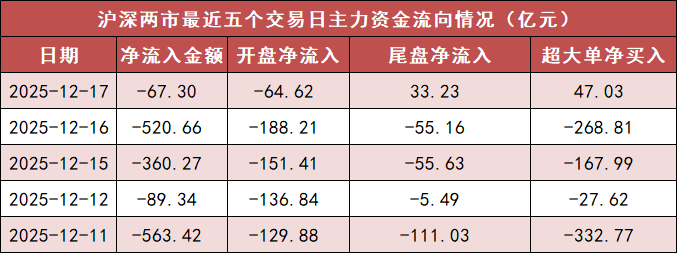
Market Overview - The A-share market experienced an overall increase on December 17, with the Shanghai Composite Index closing at 3870.28 points, up 1.19%, the Shenzhen Component Index at 13224.51 points, up 2.4%, and the ChiNext Index at 3175.91 points, up 3.39% [1]. Capital Flow - The net outflow of main funds in the Shanghai and Shenzhen markets exceeded 67 billion yuan, with an opening net outflow of 64.62 billion yuan and a closing net inflow of 33.23 billion yuan [2]. - Over the last five trading days, the main funds showed a consistent outflow trend, with December 16 recording a net outflow of 520.66 billion yuan [3]. - The CSI 300 index saw a net inflow of 51.45 billion yuan, while the ChiNext index had a net inflow of 40.67 billion yuan on the same day [4]. Sector Performance - The electronics sector achieved a net inflow of 209.83 billion yuan, with a growth of 2.88%, leading the capital inflow among industries [5][6]. - Other sectors with significant net inflows included telecommunications (138.36 billion yuan, up 1.71%) and non-ferrous metals (127.24 billion yuan, up 2.52%) [6]. Individual Stocks - The top stocks by institutional net buying included JuGuang Technology, which rose 17.34% with a net buy of 29,132.28 thousand yuan, and ShenNan Circuit, which increased by 10% with a net buy of 17,344.21 thousand yuan [7][9]. - Conversely, stocks like Guangxin Technology and Tianji Co. saw significant net selling, with net outflows of 12,413.62 thousand yuan and 10,667.31 thousand yuan, respectively [9]. Institutional Focus - Recent institutional ratings highlighted stocks such as Honglu Steel Structure with a target price of 25.27 yuan, indicating a potential upside of 56.76% from its latest closing price of 16.12 yuan [10].


【17日资金路线图】两市主力资金净流出超67亿元 电子等行业实现净流入
Zheng Quan Shi Bao· 2025-12-17 12:06
Market Overview - The A-share market experienced an overall increase on December 17, with the Shanghai Composite Index closing at 3870.28 points, up 1.19%, the Shenzhen Component Index at 13224.51 points, up 2.4%, and the ChiNext Index at 3175.91 points, up 3.39% [1] - The total trading volume for both markets reached 181.11 billion yuan, an increase of 8.70 billion yuan compared to the previous trading day [1] Capital Flow - The net outflow of main funds from the Shanghai and Shenzhen markets exceeded 6.73 billion yuan, with an opening net outflow of 6.46 billion yuan and a closing net inflow of 3.32 billion yuan [2] - Over the last five trading days, the main funds have shown a consistent outflow trend, with the highest outflow recorded on December 16 at 52.07 billion yuan [3] Sector Performance - The CSI 300 index saw a net inflow of 5.145 billion yuan, while the ChiNext index had a net inflow of 4.067 billion yuan on December 17 [4] - The electronics sector led the net inflow with 20.983 billion yuan, followed by the communication sector with 13.836 billion yuan and non-ferrous metals with 12.724 billion yuan [7] Institutional Activity - Notable institutional buying included stocks such as Juguang Technology with a 17.34% increase and a net institutional purchase of 291.32 million yuan, and Shennan Circuit with a 10.00% increase and a net purchase of 173.44 million yuan [11] - Conversely, stocks like Tongyu Communication and Huaren Health saw significant net outflows from institutions, with declines of 10.00% and 13.11%, respectively [11] Analyst Ratings - Analysts have recently rated several stocks positively, including Honglu Steel Structure with a target price indicating a potential upside of 56.76% and Anfu Technology with a potential upside of 26.56% [12]
数据复盘丨CPO、锂矿等概念走强 93股获主力资金净流入超1亿元
Zheng Quan Shi Bao Wang· 2025-12-17 11:47
Market Performance - The Shanghai Composite Index closed at 3870.28 points, up 1.19%, with a trading volume of 766.8 billion yuan [1] - The Shenzhen Component Index closed at 13224.51 points, up 2.4%, with a trading volume of 1044.325 billion yuan [1] - The ChiNext Index closed at 3175.91 points, up 3.39%, with a trading volume of 495.114 billion yuan [1] - The STAR Market 50 Index closed at 1325.33 points, up 2.47%, with a trading volume of 50.2 billion yuan [1] - The total trading volume of both markets reached 1811.125 billion yuan, an increase of 86.946 billion yuan compared to the previous trading day [1] Sector Performance - Strong performance was noted in sectors such as telecommunications, non-ferrous metals, insurance, precious metals, electronics, chemicals, power equipment, and media [2] - Concepts like CPO, lithium mining, optical communication modules, liquid cooling, copper cable high-speed connections, fluorine chemicals, PCB, and composite current collectors showed active trends [2] - The agriculture, defense, and liquor sectors experienced declines, with weaker trends in concepts like space stations, satellite internet, duty-free, rental sales, and grain [2] Fund Flow - The net outflow of main funds in the Shanghai and Shenzhen markets was 6.73 billion yuan [3] - The ChiNext saw a net outflow of 4.067 billion yuan, while the CSI 300 index experienced a net outflow of 5.145 billion yuan [4] - The telecommunications sector had the highest net inflow of main funds, amounting to 4.529 billion yuan, followed by non-ferrous metals, electronics, and power equipment [4] Individual Stock Performance - A total of 2117 stocks saw net inflows of main funds, with 93 stocks receiving over 100 million yuan in net inflows [5] - The stock with the highest net inflow was Zhongji Xuchuang, with 1.426 billion yuan, followed by Xinyi Sheng, Shenghong Technology, Tianfu Communication, and others [6] - Conversely, 3043 stocks experienced net outflows, with 75 stocks seeing over 100 million yuan in net outflows [7] - The stock with the highest net outflow was Pingtan Development, with 1.459 billion yuan, followed by Yonghui Supermarket, Aerospace Development, and others [8] Institutional Activity - Institutional seats had a net buy of approximately 471 million yuan, with 16 stocks being net bought and 11 stocks being net sold [9] - The stock with the highest net buy from institutions was Juguang Technology, with about 291 million yuan [10] - The stock with the highest net sell was Yingweike, with approximately 22 million yuan, followed by Xue Ren Group, Guangxun Technology, and others [11]




19.45亿元资金今日流出农林牧渔股
Zheng Quan Shi Bao Wang· 2025-12-17 09:48
Market Overview - The Shanghai Composite Index rose by 1.19% on December 17, with 28 out of 33 sectors experiencing gains, led by the communication and non-ferrous metals sectors, which increased by 5.07% and 3.03% respectively [1] - The agriculture, forestry, animal husbandry, and fishery sector had the largest decline, falling by 0.54% [1] Capital Flow Analysis - The net inflow of capital in the two markets was 9.51 billion yuan, with 16 sectors seeing net inflows [1] - The communication sector had the highest net inflow of 6.45 billion yuan, coinciding with its 5.07% increase [1] - The electronics sector also saw a significant net inflow of 6.34 billion yuan, with a daily increase of 2.48% [1] Agriculture, Forestry, Animal Husbandry, and Fishery Sector - This sector experienced a decline of 0.54%, with a net outflow of 1.94 billion yuan [2] - Out of 105 stocks in this sector, 60 rose, while 39 fell, including 3 that hit the daily limit down [2] - The top three stocks with the highest net inflow were COFCO Sugar Industry (35.26 million yuan), Beidahuang (33.62 million yuan), and Muyuan Foods (31.82 million yuan) [2] Capital Outflow in Agriculture, Forestry, Animal Husbandry, and Fishery Sector - The top three stocks with the highest net outflow were Pingtan Development (-1.28 billion yuan), Luoniushan (-264.82 million yuan), and Biological Shares (-142.17 million yuan) [4] - Pingtan Development saw a significant drop of 10.03%, while Luoniushan and Biological Shares fell by 9.19% and 10.01% respectively [4]


粤开市场日报-20251217
Yuekai Securities· 2025-12-17 07:52
Market Overview - The A-share market showed a general upward trend today, with the Shanghai Composite Index rising by 1.19% to close at 3870.28 points, the Shenzhen Component Index increasing by 2.4% to 13224.51 points, the ChiNext Index up by 3.39% to 3175.91 points, and the STAR 50 Index gaining 2.47% to 1325.33 points [1] - Overall, 3623 stocks rose while 1634 stocks fell, with 198 stocks remaining flat. The total trading volume in the Shanghai and Shenzhen markets reached 181.11 billion yuan, an increase of 87 billion yuan compared to the previous trading day [1] Industry Performance - Among the Shenwan first-level industries, the leading sectors included telecommunications, non-ferrous metals, electronics, basic chemicals, and power equipment, with respective gains of 5.07%, 3.03%, 2.48%, 2.15%, and 2.09%. The only sectors that experienced declines were agriculture, forestry, animal husbandry, and fishery, national defense and military industry, and coal, with losses of 0.54%, 0.20%, and 0.11% respectively [1] Concept Sector Performance - The top-performing concept sectors today included optical modules (CPO), lithium mining, lithium battery electrolytes, optical communication, liquid cooling servers, optical chips, lithium extraction from salt lakes, selected rare metals, copper-clad laminates, copper industry, high-speed copper connections, selected industrial metals, stock trading software, and circuit boards. In contrast, sectors such as Hainan Free Trade Port, cross-strait integration, satellite internet, commercial aerospace, and satellite navigation experienced pullbacks [2]
晨会聚焦:食饮、农业、传媒年度策略-20251216
ZHONGTAI SECURITIES· 2025-12-16 15:37
Group 1: Media and Internet Industry Strategy - The core viewpoint emphasizes the dual driving forces of AI and IP in the media sector, suggesting a focus on AI applications in various fields such as AI comics, games, marketing, education, and publishing [4][5] - AI comics are expected to enhance production efficiency by over 300% while reducing costs by more than 90%, supported by favorable platform policies [4] - The investment value of the IP industry is highlighted, with a shift from functional satisfaction to emotional resonance in consumer markets, indicating strong demand for domestic cultural products [5] Group 2: Beverage Industry Strategy - The energy drink market in China is projected to reach 62.785 billion yuan in 2025, with a year-on-year growth of 4.3%, driven by stable demand and competitive pricing strategies [14] - The industry is experiencing a shift towards health-oriented products, with 67.87% of consumers expressing a need for reduced sugar intake, prompting companies to innovate with sugar-free options [16] - The main raw materials, taurine and white sugar, are expected to maintain low prices due to oversupply and changing consumption patterns [15][16] Group 3: Agriculture and Fisheries Industry Strategy - The agricultural sector is facing challenges due to declining demand and efficiency improvements, with a lack of price imagination leading to a prolonged period of low prices [17] - The report suggests that the demand for agricultural products will gradually increase due to rising disposable incomes and government initiatives aimed at boosting consumption [18] - The pet industry is transitioning from high-speed growth to high-quality development, with increased competition and a focus on companies that excel in R&D and supply chain management [18]
长城基金汪立:布局春季行情,关注三大方向
Xin Lang Cai Jing· 2025-12-16 11:22
Group 1: Market Trends - The market continues to favor technology growth, while cyclical and consumer sectors are experiencing a pullback. AI-related optical modules and chips are gaining strength, alongside significant increases in controllable nuclear fusion and data center electricity, as well as heightened interest in smart grids and green energy consumption. Commercial aerospace remains highly active, while sectors like carbon black, phosphorus chemicals, methanol, real estate, and home textiles are lagging behind [1][6]. Group 2: Macroeconomic Analysis - The Central Economic Work Conference in China outlined five new understandings and eight key tasks to stabilize and promote economic growth. The focus is on a more proactive fiscal policy, leading investment recovery, and addressing real estate inventory issues. The conference emphasized the need for incremental policies based on changing circumstances [2][7]. - In November, China's core CPI rose to 0.7% year-on-year, while PPI fell to -2.2%. CPI was driven by food prices, consumer subsidies, and rising gold prices, while international oil price declines pressured PPI. The M1-M2 gap widened significantly, but M1 may stabilize marginally in the future. Exports in dollar terms grew by 5.9%, and imports increased by 1.9% [2][7]. Group 3: U.S. Federal Reserve Actions - The Federal Reserve announced a 25 basis point cut in the federal funds rate, bringing it to a target range of 3.50% to 3.75%. This decision aligns with expectations but reflects increasing internal divisions. The Fed's outlook on the U.S. economy and inflation has become more optimistic, and there may be further rate cuts anticipated due to a weakening labor market and upcoming leadership changes [3][8]. Group 4: Investment Strategy - A cross-year investment strategy is beginning, with expectations for policy adjustments to support market liquidity and activity. Historical patterns suggest that the spring market rally typically occurs from December to April, with large-cap stocks leading the way. Current market conditions may present a significant opportunity for positioning ahead of the spring rally [4][9]. - The investment outlook favors technology, financial services, and consumer sectors. Specific areas of interest include AI advancements, capital market reforms, and cyclical stocks that have seen valuation adjustments after three years of decline. Target sectors include internet, media, computing, and manufacturing with global competitive advantages, as well as low-priced consumer stocks and cyclical industries like non-ferrous metals and chemicals [5][10].
融资暴增260亿!融资暴增估值合理,杠杆资金杀疯,市场却亮红灯
Sou Hu Cai Jing· 2025-12-16 10:07
Group 1 - The A-share market is currently in a "data contradiction" phase, with valuation indicators showing a reasonable range while sentiment indicators signal caution [1] - The overall A-share market is in a medium valuation range according to the PE/PB valuation percentile rules over the past five years, with significant structural differentiation [2] - The Buffett indicator stands at 87%, indicating a reasonable range compared to the historical average, but still significantly lower than the US stock market's level [2] Group 2 - The stock-bond valuation ratio for the A-share index is 2.78%, close to the 10-year average of 2.56%, indicating attractiveness compared to historical levels [5] - There is notable structural differentiation, with the ChiNext index at a valuation percentile of only 28.98%, while the CSI 300 and CSI 500 indices exceed 70% [5] Group 3 - Recent trends show a recovery in leveraged funds, with financing balances increasing significantly, indicating renewed market enthusiasm [7] - The financing buy-in ratio accounts for 9.85% of A-share trading volume, suggesting that leverage levels are not in a high-risk zone [9] - There is a structural preference for cyclical sectors such as agriculture, retail, and real estate, while sectors like telecommunications and automotive are experiencing net selling [9] Group 4 - The total social financing increment exceeded 3.3 trillion yuan before November 2025, providing ample liquidity to support the market [11] - Market sentiment has entered a cautious zone, with the "Good Buy Temperature" index at 75.35°C, indicating a warning for investors against chasing high prices [13] - Policy measures are being implemented to support the market, including the issuance of long-term special government bonds and consumption-boosting policies [15][16]

浙商证券浙商早知道-20251215
ZHESHANG SECURITIES· 2025-12-15 14:49
Market Overview - On December 15, the Shanghai Composite Index fell by 0.55%, the CSI 300 decreased by 0.63%, the STAR 50 dropped by 2.22%, the CSI 1000 declined by 0.84%, the ChiNext Index fell by 1.77%, and the Hang Seng Index decreased by 1.34% [4] - The best-performing sectors on December 15 were non-bank financials (+1.59%), retail (+1.49%), agriculture, forestry, animal husbandry, and fishery (+1.24%), steel (+0.91%), and building materials (+0.91%). The worst-performing sectors included electronics (-2.42%), telecommunications (-1.89%), media (-1.63%), machinery and equipment (-1.36%), and computers (-1.27%) [4] - The total trading volume for the entire A-share market on December 15 was 1.7944 trillion yuan, with a net inflow of 3.654 billion Hong Kong dollars from southbound funds [4] Important Insights Bond Market Research - The report emphasizes the importance of the People's Bank of China's (PBOC) communication regarding the central economic work conference, which reflects the central bank's specific thoughts on monetary policy for 2026 [5] - The market is focused on changes in the description of monetary policy from the central economic work conference [5] - The report indicates a more gradual approach to easing monetary policy [5] Strategy Report - The report systematically reviews the calendar effects in the A-share market from 2010 to 2025, analyzing excess returns of major indices around key dates [6] - It highlights that the overall market tends to experience a spring rally at the beginning of the year, cautious trading mid-year, and a warm winter close at year-end [6] - The report identifies that Q4 has the highest win rate and return for the Wande All A Index, with a win rate of 66.7% and a median return of 2.9% [7] Industry Insights Machinery Equipment Sector - The report notes that the demand for satellite applications is expected to surge, with a potential breakthrough in rocket supply [8] - It highlights that China's satellite constellation construction is significantly lagging, entering a peak launch period [8] - Investment opportunities are identified in the rocket sector, driven by explosive demand and a shift towards high-frequency, low-cost commercial operations [8]