
预制菜

Search documents
汇通便利道 赋能实业兴 兴业银行厦门分行精准落地外汇便利化政策,助力高质量发展
Sou Hu Cai Jing· 2025-12-30 01:05
Core Viewpoint - The current financial work emphasizes deepening cross-border investment and financing foreign exchange management reforms to support high-quality development of the real economy [1] Group 1: Cross-Border Financing and Support for Enterprises - Xiamen branch of Industrial Bank actively responds to the call for high-level opening-up, utilizing foreign exchange reform to convert policy benefits into practical services for enterprises [1] - A private food company in Xiamen, referred to as Company A, utilizes an order-based agricultural model to drive local agricultural development but faces challenges such as high financing costs [2] - The bank customizes cross-border financing solutions for Company A, helping to expand foreign debt financing limits and streamline processes, completing over 600 million Japanese yen foreign debt registration in just one working day [2][3] Group 2: Risk Management and Business Expansion - The bank offers foreign exchange derivative products to convert floating-rate foreign debt into fixed rates, mitigating interest rate and exchange rate risks for enterprises [3] - With the financial support, Company A expands its procurement scale, enhances its industry cooperation model, and increases R&D investment to launch products suitable for rural markets [3] Group 3: Comprehensive Service System for Enterprises and Individuals - The case of Company A exemplifies the bank's implementation of foreign exchange facilitation policies, creating a comprehensive service system for cross-border business [4] - The bank's digital transformation enhances efficiency in foreign exchange services, allowing enterprises to complete transactions online, significantly reducing processing time [4] - The bank also introduces specialized services for cross-border salary payments, addressing the needs of foreign employees and improving the service experience for companies [4] Group 4: Future Directions - The bank plans to continue its commitment to serving the real economy, ensuring more quality enterprises and livelihood scenarios benefit from policy advantages, thereby contributing to high-quality development of foreign trade in Xiamen [5]

预制菜国标将至,餐饮透明化时代加速到来!
Zhong Guo Shi Pin Wang· 2025-12-29 05:44
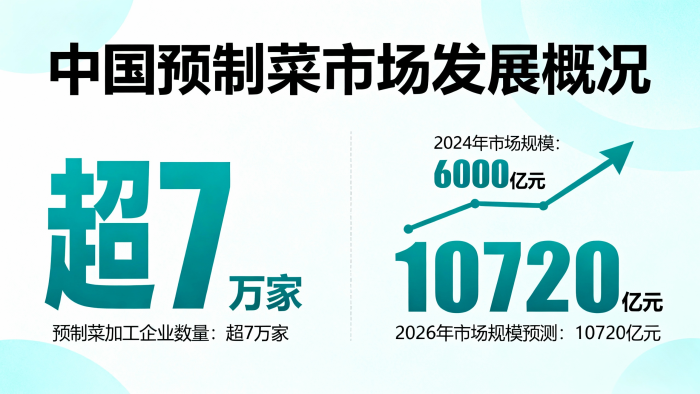
Core Insights - The pre-prepared food industry in China is rapidly growing, with over 70,000 processing companies and a projected market size exceeding 600 billion yuan in 2024, reaching 1,072 billion yuan by 2026 [1][3] Industry Overview - The demand for quick service and diverse menu options in the food and beverage sector is driving the industrialization of catering, leading to increased efficiency in kitchen operations through semi-finished products [3] - However, the industry faces challenges due to a lack of standards, resulting in food safety and quality concerns, as well as issues with ingredient freshness and production practices [3] Regulatory Developments - In response to industry issues, the government is actively working on establishing national standards for pre-prepared foods, with a significant notification issued in March 2024 to clarify definitions and promote safety [3] - The draft of the national food safety standard for pre-prepared foods has passed review and is set to be publicly consulted, addressing classification, raw materials, processing methods, storage, transportation, and inspection [3] Food Safety Standards - A new version of the national food safety standard for food additives will be implemented starting February 8, 2025, providing clear guidelines for the use of preservatives and other additives in pre-prepared foods [4] Industry Best Practices - Leading companies in the pre-prepared food sector are adopting high standards, such as the brand "Yisambao," which emphasizes no preservatives and utilizes modern food processing technology to ensure product quality [6] - Regions like Guangdong, Shanghai, and Hunan are exploring initiatives to clearly label pre-prepared foods, enhancing consumer trust and operational efficiency for restaurants [6] Future Market Outlook - The future of the dining market should not see pre-prepared foods and freshly made dishes as oppositional but rather as complementary, meeting diverse consumer needs [8] - With the implementation of national standards, consumers will be better equipped to identify quality pre-prepared food options, fostering a balance between convenience and safety in modern dining [8]

4家消费公司拿到新钱;奥乐齐中国门店数将达100家;西贝贾国龙“认错”|创投大视野
36氪未来消费· 2025-12-27 11:04
Investment Opportunities - FenYinTa Technology has completed nearly 100 million RMB in Series A financing, focusing on AI applications in elder care and health [3] - Obita has raised nearly 30 million USD in Pre-A financing, developing a blockchain-based payment network for enterprises [4] - YiSu Innovation has secured 100 million RMB in Pre-A financing, specializing in desktop laser processing equipment [5] - Kepler Project has completed 45 million RMB in angel financing, aiming to launch its RV products in the North American market by Q3 2026 [6] Market Expansion - Aldi plans to increase its store count in China to 100 by Q1 2026, with a focus on the East China market and a significant number of new openings in 2025 [8] - Grupo Bimbo has seen significant growth in its e-commerce and O2O channels in China, with a total investment of 72 million USD from 2023 to 2024 [13] Consumer Trends - A report by McKinsey indicates a cautious consumer sentiment in China, with a projected consumption growth rate of 2.3% for 2025, similar to the previous year's 2.4% [14] - Urban affluent elderly consumers have seen a 20% decline in confidence due to asset depreciation, while younger consumers in third-tier cities remain optimistic despite economic challenges [14] Product Innovations - MoLi NaiBai's Christmas strawberry series sold over 360,000 cups on its first day, leveraging social media and limited edition products to engage young consumers [11] - QiMengDao has opened its first flagship store, focusing on immersive experiences and exclusive products to attract fans [12] Brand Responses - BaWang Tea Ji has addressed consumer concerns regarding caffeine content in its products, emphasizing the balance of active ingredients in tea [9] - XiBei's founder has publicly acknowledged mistakes related to the pre-prepared food controversy, implementing price reductions to regain customer trust [10]

十分钟再谈预制菜之六:“广东年菜入沪”的思考
2 1 Shi Ji Jing Ji Bao Dao· 2025-12-26 05:33
Core Insights - The evolution of the New Year's Eve dinner reflects the changing dynamics of Chinese society, where smaller family structures and faster lifestyles call for a modern solution that balances tradition and efficiency [2] - Guangdong's prepared dishes are being introduced to Shanghai as part of a deeper exploration into the modernization of traditional holiday consumption, aiming to create a reliable bridge between efficiency and emotional warmth [2] Group 1: New Demand and Supply Dynamics - The average household size in China has decreased to 2.62 people, with over 100 million individuals living alone, leading to new demands for New Year's Eve dinners from dual-income families and less experienced cooks [3] - Prepared dishes are a proactive response to these changes, utilizing modern food technology and logistics to deliver restaurant-quality meals directly to homes, thereby empowering families to maintain emotional rituals [3][4] Group 2: Strategic Importance of Shanghai - Shanghai serves as a quality certification center and trendsetter for consumer standards, making it a strategic target for Guangdong's prepared dishes [5] - The city leads in retail sales and has discerning consumers who expect high-quality, restaurant-level meals, making success in Shanghai a significant endorsement for brands [5][6] - Shanghai's market demands drive industry innovation, pushing companies to enhance their production processes and adapt to local tastes, thus promoting a shift from mass production to high-quality manufacturing [6] Group 3: Market Entry Strategies - A focused strategy is essential for introducing prepared dishes in Shanghai, emphasizing high-recognition products and engaging local food influencers for blind taste tests to build credibility [7][8] - The marketing approach should create a closed-loop experience by integrating online promotion with offline tasting events, allowing consumers to experience the products in family settings [8] - Emotional storytelling is crucial, positioning prepared dishes as supportive rather than substitutive, enhancing family gatherings without replacing traditional cooking [8] Group 4: National and Global Expansion - Successful expansion in Shanghai could lead to a replicable model for other major cities, establishing prepared dishes as a reliable holiday solution [9] - Shanghai's international status positions it as a key hub for exporting Chinese New Year food culture, potentially making traditional dishes recognizable symbols of Eastern celebrations worldwide [9] Group 5: Balancing Tradition and Modernity - The introduction of Guangdong's prepared dishes in Shanghai represents a profound practice of balancing tradition with innovation, addressing the emotional needs of families during the holiday season [10] - The evolution of the New Year's Eve dinner is shifting from a fixed ritual to a more flexible and creative process, with prepared dishes acting as facilitators of connection and togetherness [10][11]
8点1氪|贾国龙首次回应西贝预制菜风波;京东发布年终奖计划:采销平均25薪,上不封顶;王思聪名下资产被法拍
3 6 Ke· 2025-12-26 00:00
Group 1 - JD.com announced its 2025 year-end bonus plan, with average bonuses reaching 25 times the monthly salary, with no upper limit [2] - Employees with an A+ performance rating will receive a year-end bonus equivalent to 10 times their monthly salary, totaling 22 times their salary [2] - The sales of duty-free shops in Sanya surged to 535 million yuan from December 18 to 22, marking a 50.3% year-on-year increase [3] Group 2 - ByteDance reported internal violations, resulting in the dismissal of 120 employees, with 28 being publicly named for serious offenses [7] - BYD won a court case against several accounts that spread false information, resulting in a compensation of 2 million yuan [7] - The Chinese government expressed strong opposition to the US imposing additional tariffs on semiconductor products, emphasizing the negative impact on global supply chains [5] Group 3 - The Chinese Ministry of Commerce stated that it hopes for a balanced solution regarding TikTok's establishment of a joint venture in the US, aligning with Chinese laws [6] - Reports indicate that Brazil is considering implementing visa exemptions for Chinese tourists, aiming to strengthen trade relations [6] - The housing market in major cities like Shenzhen and Shanghai may see relaxed purchase restrictions, following similar policies in Beijing [5] Group 4 - Toyota's global sales and production both declined in November, with sales down 1.9% to 965,919 vehicles and production down 3.4% to 934,001 vehicles [13] - Major silicon wafer manufacturers have raised prices significantly, with average increases of 12% due to rising raw material costs [14] - Silver futures prices reached a new high, closing at $71.685 per ounce, driven by increased industrial and investment demand [14] Group 5 - OpenAI is reportedly considering integrating advertisements into ChatGPT responses, aiming to prioritize promotional content in user queries [14] - The Chinese government plans to integrate artificial intelligence deeply into various sectors by 2035, enhancing economic development [20] - Major pharmaceutical e-commerce platforms are expected to benefit from the growing demand for AI medical applications [21] Group 6 - Xiaomi announced the pricing for its new Xiaomi 17 Ultra model, starting at 6,999 yuan, with pre-sales already underway [24] - "FenYinTa Technology" secured nearly 100 million yuan in Series A funding, focusing on AI applications in elder care [25] - "YunShenChu Technology" completed a Pre-IPO round of financing amounting to several hundred million yuan, led by the National AI Industry Fund [26]
退股,肉制品巨头的扩张梦碎了?
3 6 Ke· 2025-12-25 01:49
Core Viewpoint - The article discusses the transformation journey of the meat product giant Delisi (002330.SZ), highlighting its recent exit from the joint venture with Ding Delisi Sauce Industry, which reflects the company's strategic reassessment in the pre-made food sector [2][10]. Group 1: Company Actions and Changes - Delisi exited its approximately three-year investment in the joint venture Ding Delisi Sauce Industry on the same day the company removed "pre-made food" from its name, indicating a potential shift in strategy [2][10]. - Delisi initially invested 2.5 million yuan for a 25% stake in Ding Delisi Sauce Industry in September 2022, aiming to expand its market presence in the southwest and enhance its competitiveness in pre-made food [3][5]. - The company reported that the investment in Ding Delisi Sauce Industry did not positively impact its operating profits, with losses recorded under equity method accounting [7][9]. Group 2: Financial Performance - Delisi has faced financial difficulties, reporting net losses of 33.997 million yuan and 33.672 million yuan for 2023 and 2024, respectively, with a consistent loss of around 34 million yuan [8]. - Despite a 14.95% year-on-year revenue growth, the net profit for the first three quarters of the year was only 5.4038 million yuan, reflecting an 18.50% decline compared to the previous year [8]. - The company's core business of chilled and frozen meat saw a revenue decline of 1.25% in the first half of the year, with a significant drop of 10.51% in the previous year [15]. Group 3: Strategic Initiatives - Delisi has been exploring various strategies to address its profitability challenges, including partnerships with other companies for product supply and market expansion [16]. - The company announced plans to transfer 11% of its subsidiary's equity to introduce external shareholders, aiming to leverage the capabilities of its new partner in the high-end beef processing and pre-made food sectors [17][18]. - Delisi has also appointed a new vice president with extensive experience in the fast-moving consumer goods and food industries to bring fresh perspectives to its operations [18].


锅圈(02517):标准店和乡镇店战略打法逐步成型,小炒业态蓄势待发
HUAXI Securities· 2025-12-21 13:28
Investment Rating - The report assigns a "Buy" rating to the company [4] Core Insights - The company is positioned as a leading player in the "at-home dining" sector, with over 10,000 stores and is entering a new phase of expansion after a period of consolidation [4][14] - The company has strengthened its supply chain through self-production and cold chain acquisitions, enhancing its operational efficiency and cost control [2][3] - The company is exploring various store formats, including standard stores, town stores, and new business models like "锅圈小炒," which are expected to drive future growth [3][4] Company Overview - The company has developed a diverse business structure focused on the "at-home dining" market, with a total of over 10,000 stores as of June 2025 [14] - The company has undergone strategic upgrades to meet the growing demand for home dining, expanding its product offerings beyond hot pot ingredients to include a variety of meal solutions [14][39] Financial Performance - The company forecasts revenues of 76.46 billion, 90.83 billion, and 108.20 billion yuan for 2025, 2026, and 2027, respectively, with year-on-year growth rates of 18.18%, 18.79%, and 19.13% [7] - The projected net profit for the same years is 4.37 billion, 5.33 billion, and 6.64 billion yuan, reflecting significant growth rates of 89.65%, 21.84%, and 24.68% [7] - The company maintains a strong gross margin, with expectations for continued improvement in profitability due to enhanced supply chain management and product offerings [21][54] Competitive Landscape - The "at-home dining" market has seen significant growth, with the company leading in retail sales, achieving a market share of 3.0% in 2022 [39][46] - The market for at-home dining products is expected to continue expanding, driven by changing consumer habits and preferences for home-cooked meals [39][40]
锅圈回购44.60万股股票,共耗资约149.78万港元,本年累计回购7325.32万股
Jin Rong Jie· 2025-12-18 10:54
锅圈成立于2017年,是中国领先的居家餐饮解决方案品牌,主要通过"锅圈食汇"连锁门店及线上平台销 售火锅、烧烤等食材及设备。公司以"社区中央厨房"为定位,截至2023年末全国门店数超万家。2023年 11月在香港上市后,锅圈加速布局预制菜和冷链物流,但受消费降级影响,2023年净利润同比下滑约 30%。最新财报显示,其核心优势在于供应链整合能力,SKU超700种,自有品牌占比达60%。当前市 值约80亿港元,动态市盈率处于行业较低水平。 本文源自:市场资讯 作者:公告君 12月18日,锅圈回购44.60万股股票,每股回购均价3.36港元,共耗资约149.78万港元,本年累计回购 7325.32万股,占总股本2.77%。 截至当日港股收盘,锅圈下跌0.88%,报3.37港元/股。 锅圈近期回购情况 回购日期回购均价回购股数回购金额本年累计回购股数2025-12-183.35844.60万149.78万7325.32万2025- 12-173.39458.80万199.56万7280.72万2025-12-153.46657.68万199.93万7221.92万2025-12-123.43958.12万 199. ...
预制菜风波的下半场,商场该“动手”了
3 6 Ke· 2025-12-18 02:46
从罗永浩微博怒怼西贝,到事件发酵网友群情激奋;从贾国龙道歉整改,到华与华再次挑起争端;每当我们以为这场旷日持久的预制菜之争终于要落下帷 幕的时候,总有"抓马"续集再次上演。 这两天,老罗放出了与华杉的对话录音——的文件名:damocles071125463681。虽未透露何时公布细节,但这文件名却耐人寻味。 效率的共谋: 商场为何成为预制菜的温床 某种程度上说,预制菜能走进大众餐桌,离不开商场的推波助澜,但如今这份效率共谋正在变成反噬自身的生存陷阱。 面对激烈的市场竞争,商场不断抬高餐饮业态占比,频繁更换餐饮品牌已拉动客流。而要在短期内完成招商,能够标准化复制、快速落地的连锁餐饮品 牌,自然成为了更稳妥的选择。 damocles意思是达摩克里斯,寓意是权力与幸福背后,往往潜藏着与之相伴的风险与危机。那么这把达摩克里斯之剑,这次又是指向谁? 如果观察从9月开始的舆论风波,你会发现——品牌方反应果断:有些选择正面回应,坦诚成本结构与经营现实;有些趁势营销现炒优势,主打身正不怕 影子斜;还有些连夜改了招牌,怕自己成为下一个舆论焦点。 消费者更是踊跃参与:评论、转发、站队,个人情绪与用餐体验不断被放大,让预制菜从一个 ...
农村居民人均可支配收入超4.3万元!佛山城乡共富迈出坚实步伐
Nan Fang Nong Cun Bao· 2025-12-17 08:05
Core Viewpoint - The report highlights the significant economic and social achievements of Foshan during the "14th Five-Year Plan" period, emphasizing the city's commitment to high-quality development and common prosperity, with rural residents' per capita disposable income exceeding 43,000 yuan [1][45]. Economic Development - Foshan's economic total is projected to reach 1.33 trillion yuan by 2024, having crossed three trillion yuan thresholds in the past five years [7][8]. - The city has established ten industrial clusters with a scale of over 100 billion yuan, and the number of industrial enterprises above designated size has surpassed 10,000 [12]. - Advanced manufacturing's contribution to the industrial added value has increased to 54.8% [13]. Technological Innovation - Foshan has invested nearly 400 billion yuan in technological transformation, with 78.7% of industrial enterprises implementing digital transformation [14]. - The city has been recognized as a national new-type industrialization demonstration base and a pilot city for the digital transformation of small and medium-sized enterprises [16]. Investment and Infrastructure - Foshan has established a 20 billion yuan new momentum industry fund, attracting over 3,000 projects with a total investment of 1.8 trillion yuan [17][18]. - The city has become the largest industrial robot production base in the country, with the pharmaceutical health industry revenue exceeding 100 billion yuan [19]. Urban and Rural Development - The per capita disposable income of rural residents has increased by 33% compared to 2020, with 87 rural communities achieving "billion-yuan village" status [45][46]. - The urban-rural income ratio has improved to 1.6:1, better than the national and provincial averages [46]. Social Services and Quality of Life - Foshan has created 53,700 new jobs and has been recognized as a national pilot city for enhancing public employment service capabilities [65]. - The city has continuously improved public services, with significant increases in educational resources and healthcare facilities [66][67].
