通信

Search documents
渤海证券:政策基调初步明晰 A股市场延续震荡特征
Xin Lang Cai Jing· 2025-12-14 06:58
Market Review - Major indices showed mixed performance in the past five trading days (December 5 - December 11), with the Shanghai Composite Index slightly down by 0.06% and the ChiNext Index up by 3.14% [1][5] - The CSI 300 Index rose by 0.12%, while the CSI 500 Index increased by 1.00% [1][5] - Trading volume increased, with a total of 9.30 trillion yuan traded, averaging 1.86 trillion yuan per day, an increase of 205.98 billion yuan compared to the previous five trading days [1][5] - Among the Shenwan first-level industries, telecommunications, comprehensive, and defense industries saw the highest gains, while coal, oil and petrochemicals, and steel industries experienced the largest declines [1][5] Economic Data - November exports increased by 5.9% year-on-year, significantly rebounding from October, influenced by multiple factors including a lower base, stable external demand, and the end of holiday disruptions [1][5] - Exports to the US saw a larger year-on-year decline, while exports to Japan, South Korea, and the EU experienced substantial rebounds, indicating a continued optimization of export structure [1][5] - The Consumer Price Index (CPI) rose by 0.7% year-on-year and fell by 0.1% month-on-month, primarily driven by food prices, particularly fresh vegetables, due to a lower base and supply-side disruptions [1][5] - The Producer Price Index (PPI) decreased by 2.2% year-on-year and increased by 0.1% month-on-month, with the year-on-year decline mainly influenced by a higher base [1][5] Policy Outlook - The Central Political Bureau of the Communist Party held a meeting to analyze and study economic work for 2026, maintaining a tone of "more proactive and effective" macro policies as emphasized in the 2024 Central Economic Work Conference [2][6] - Fiscal and monetary policies will continue to emphasize "more proactive" and "moderately loose" measures, with a focus on integrating existing and new policies [2][6] - The economic work for 2026 will focus on building a strong domestic market and cultivating new growth drivers among eight key areas, with more detailed plans to be revealed in the Central Economic Work Conference [2][6] Investment Strategy - The A-share market continues to exhibit a volatile characteristic, with positive signals from the Political Bureau meeting and confirmation of overseas liquidity easing due to the Federal Reserve's interest rate cuts [3][7] - The market is expected to regain strength driven by policy support and liquidity expectations, although some funds may delay allocation as the year-end approaches [3][7] - Investors are advised to remain patient and refine their strategies around policy and technology themes while waiting for sentiment to improve [3][7] - Investment opportunities are identified in the following sectors: 1. TMT sector and robotics, driven by ongoing capital expansion from domestic and international cloud vendors, accelerated domestic substitution of computing power, and potential application-driven growth [3][7] 2. Power equipment and non-ferrous metals sectors, benefiting from high global demand for energy storage and ongoing solid-state battery industrialization [3][7] 3. Social services and resource products, with policy focus on structural adjustments and "anti-involution" creating competitive opportunities [3][7] - Additionally, the banking sector presents allocation opportunities due to a low interest rate environment and a shift in public fund holdings towards performance benchmarks [3][7]
中国银河策略:如何看待政策对A股跨年行情的牵引?
Xin Lang Cai Jing· 2025-12-14 06:53
Market Overview - The A-share market experienced a fluctuating and differentiated trend from December 8 to December 12, with the overall index rising by 0.26% [1][31] - The North Star 50 and ChiNext indices led the gains, increasing by 2.79% and 2.74% respectively, while the Shanghai Composite Index, Shanghai 50, and CSI 300 saw slight declines [1][31] - Small-cap stocks outperformed, with the CSI 1000 index rising by 0.39%, compared to a decline of 0.08% for the CSI 300 [1][31] - Among sectors, telecommunications, defense, and electronics were the top gainers, with increases of 6.27%, 2.80%, and 2.63% respectively, while coal, oil and petrochemicals, and steel faced significant declines [1][31][39] Fund Flow - The trading activity in the A-share market showed signs of recovery, with an average daily turnover of 19,530 billion yuan, up by 2,568.66 billion yuan from the previous week [2][32] - Northbound capital saw an average daily turnover of 2,324.71 billion yuan, an increase of 397.27 billion yuan compared to the previous week [2][32] - The total margin trading balance reached 25,079.69 billion yuan, up by 263.01 billion yuan from the previous week [2][32] - A total of 23 new funds were established this week, with a total issuance of 18.218 billion units, of which equity funds accounted for 13, with an issuance of 6.690 billion units, a decrease of 4.526 billion units from the previous week [2][32][47] Valuation Changes - As of December 12, the PE (TTM) ratio for the overall A-share index decreased by 0.24% to 21.73 times, placing it at the 85.10 percentile since 2010 [2][23] - The PB (LF) ratio fell by 0.1% to 1.79 times, situated at the 47.62 percentile since 2010 [2][23] - The bond yield spread for the A-shares was 2.7613%, near the three-year rolling average of 3.3405% and at the 52.16 percentile since 2010 [2][23][51] Investment Outlook - Recent significant events include the Federal Reserve's decision to cut interest rates by 25 basis points, aligning with market expectations, although internal divisions have widened [3][33] - The Central Political Bureau and Central Economic Work Conference held this week provided direction for economic work in 2026, emphasizing "seeking progress while maintaining stability and improving quality and efficiency" [3][33] - The focus on domestic demand as a primary task reflects the urgent need to address "insufficient effective demand," highlighting the importance of technological innovation under the drive for innovation [3][33] - The capital market's role is expected to be further strengthened, with a clear commitment to "continuously deepen the comprehensive reform of capital market investment and financing" [3][33] Configuration Opportunities - Main Line 1: The unprecedented global changes are accelerating, with a shift in domestic economic logic towards new productive forces, highlighting key areas such as artificial intelligence, embodied intelligence, new energy, controllable nuclear fusion, quantum technology, and aerospace [4][34] - Main Line 2: The moderate advancement of anti-involution policies, combined with supply-demand structure optimization and price recovery expectations, indicates a clear path for profit recovery in manufacturing and resource sectors [4][34] - Auxiliary Line 1: The policy direction to expand domestic demand presents a window for investment in the consumer sector [4][34] - Auxiliary Line 2: The trend of going global is expected to further open up profit space for enterprises [4][34]


主动量化周报:12月下旬:科技切周期趋势仍将持续-20251214
ZHESHANG SECURITIES· 2025-12-14 06:29
- The report discusses the **ETF Risk Appetite Index**, which has been declining since September 19, indicating a contraction in market risk appetite. This is evidenced by the outperformance of low-valuation stocks over high-valuation stocks and a gradual decline in trading volume. However, the **Active Capital Indicator** shows that speculative funds remain active, particularly in technology-related ETFs like cloud computing, military, and science innovation, while defensive ETFs like dividend and consumption are underperforming. This suggests a fragile market balance where risk appetite is declining, but active funds are narrowing their focus within the technology sector[1][11] - The report highlights the **High-Frequency Trading Regulation Impact**, which aims to level the playing field by increasing transaction delays and removing exclusive equipment. The regulation primarily targets microsecond-level ultra-high-frequency trading strategies, which are mostly proprietary or market-making strategies. These strategies have minimal impact on the overall market due to their small scale, typically under 100 million RMB per product. The report concludes that the regulation has limited influence on the profitability of quantitative strategies, as their excess returns are driven by asset pricing rather than trading speed. The report also notes that market volatility recovery could further enhance quantitative excess returns[2][12] - The report analyzes the **Micro-Cap Stock Trends**, noting that short-term fluctuations are influenced by hedging products, while medium-term trends are supported by incremental funds from quantitative products. Since December, the issuance of quantitative products has remained robust, though the proportion of "air index enhancement" (quantitative stock selection) has decreased by 12%, while "1000 index enhancement" and other index enhancements have increased. This shift has slightly reduced the allocation to micro-cap stocks. Additionally, as market risk appetite declines, funds are concentrating on high-growth sectors, strengthening mid-cap stocks like CSI 500 and CSI 1000. Despite short-term adjustments, the report remains optimistic about medium-term inflows into micro-cap stocks[3][13]
广发策略26年策略展望:挣脱牢笼,打破历史经验的桎梏
Sou Hu Cai Jing· 2025-12-14 05:55
Core Viewpoint - The article discusses the emergence of a new bull market in Chinese equity assets, driven by a decline in systemic risks in the Chinese economy and the global AI industry trend, suggesting that historical patterns may be broken in this new market phase [1][2]. Group 1: Market Trends - The A-share market is experiencing a bull market that aligns with global equity trends, characterized by a focus on technology and resources, with valuation-driven growth and increasing market concentration [2][4]. - Historical patterns, such as the tendency for industries to not lead for more than three consecutive years, may be challenged, particularly in the technology and communication sectors [7][9]. Group 2: Profitability and Valuation - A significant adjustment in the profitability assessment framework is necessary, as A-share non-financial companies have stabilized their return on equity (ROE) for three consecutive quarters despite traditional economic sectors showing no significant improvement [6][20]. - The current market conditions suggest that A-shares may break the historical trend of not achieving valuation increases for more than two consecutive years, with expectations for continued moderate valuation growth [26][30]. Group 3: Sector Performance - The technology sector has seen a historic increase in institutional holdings, surpassing the previous threshold of 20% that was thought to indicate a market peak, reflecting a shift in market dynamics [12][14]. - The contribution to profit improvement in the first three quarters of the year has been predominantly from technology-related sectors, indicating a shift in the economic drivers towards technology and global demand [20][78]. Group 4: Economic Transformation - The transformation of the Chinese economy is reflected in the changing profit structure of A-share companies, moving away from traditional sectors like real estate and infrastructure towards technology-driven productivity and global market integration [19][30]. - The current economic environment is characterized by a high-quality development narrative, with companies demonstrating resilience in profitability that exceeds macroeconomic data [20][78]. Group 5: Global Market Context - The global equity market is experiencing a bull market with distinct characteristics of differentiation, synchronization, and concentration, with A-shares showing a relatively lower proportion of declining stocks compared to other markets [41][45]. - The article highlights the importance of understanding the evolving global economic landscape, particularly in relation to the AI-driven technological revolution and its impact on market dynamics [29][51].
中银量化多策略行业轮动周报-20251214
Bank of China Securities· 2025-12-14 05:49
Core Insights - The report indicates that the current allocation of the Bank of China multi-strategy industry configuration system is as follows: Communication (9.6%), Banking (9.5%), Transportation (9.1%), Non-Bank Financials (8.0%), Food and Beverage (7.7%), Power Equipment and New Energy (7.2%), Steel (6.7%), Machinery (6.2%), Basic Chemicals (4.7%), Oil and Petrochemicals (4.7%), Home Appliances (4.4%), Comprehensive (3.5%), Agriculture, Forestry, Animal Husbandry, and Fishery (3.5%), Comprehensive Finance (3.5%), Nonferrous Metals (3.5%), Building Materials (3.4%), Electronics (2.4%), Power and Utilities (1.2%), and Construction (1.2%) [1] Market Performance Review - The average weekly return of the CITIC primary industries is 0.0%, with a one-month average return of -4.1%. The top three performing industries this week are Communication (6.4%), Defense and Military (4.6%), and Non-Bank Financials (3.3%). The worst-performing industries are Coal (-3.6%), Oil and Petrochemicals (-2.7%), and Steel (-2.4%) [3][10] - The composite industry rotation strategy achieved a cumulative return of 0.3% this week, with an excess return of 5.2% year-to-date compared to the CITIC primary industry equal-weight benchmark [3][10] Industry Valuation Risk Warning - The report employs a valuation warning system based on the PB ratio over the past six years, excluding extreme values. Industries with a PB ratio above the 95th percentile are flagged for high valuation risk. Currently, the industries under warning include Computer, Retail, Media, Nonferrous Metals, Oil and Petrochemicals, and Defense and Military [12][13] Single Strategy Performance - The top three industries based on the S1 high prosperity industry rotation strategy are Machinery, Communication, and Power Equipment and New Energy [15][16] - The S2 implied sentiment momentum strategy ranks the top three industries as Communication, Machinery, and Electronics [20] - The S3 macro style rotation strategy identifies the top six industries as Banking, Home Appliances, Power and Utilities, Oil and Petrochemicals, Transportation, and Construction [23] Strategy Adjustments - The composite strategy has increased positions in TMT, midstream cyclical, and midstream non-cyclical sectors while reducing positions in consumer, financial, and upstream cyclical sectors [3][10]
高息扩表,美联储开了个很不好的头!
鲁明量化全视角· 2025-12-14 04:28
Group 1 - The core viewpoint of the article highlights concerns over the Federal Reserve's recent decision to initiate high-interest balance sheet expansion, which may lead to significant volatility in global asset classes [4] - The domestic market is experiencing a narrow fluctuation, with the Shanghai Composite Index and CSI 300 showing slight declines, while the CSI 500 index has a modest increase, indicating ongoing market risks [3] - The Federal Reserve's unexpected move to expand its balance sheet shortly after ending its previous contraction raises questions about the underlying economic conditions in the U.S., particularly in light of recent fiscal stimulus measures [4] Group 2 - The article notes that domestic incremental capital has not sustained momentum, with institutional and speculative funds remaining cautious, contributing to a continued mid-term consolidation trend in the market [5] - The recommendation for the A-share market is to maintain a low position due to the interplay of domestic and international factors, with a focus on avoiding volatility [5] - The article suggests that the small and medium-sized market segments are more sensitive to liquidity conditions, advising a similar low position strategy as the main board [5]

小心!这种心理正在让你亏钱
Sou Hu Cai Jing· 2025-12-14 02:51
Market Overview - Global markets showed divergence this week with a cooling risk appetite; the Dow Jones increased by 1.05% while the Nasdaq fell by 1.62%, indicating a shift of funds away from overvalued growth stocks [1] - European stocks remained weak, while Asian markets, particularly in China, Japan, and South Korea, saw gains; Hong Kong stocks slightly declined by 0.42% [1] - In the commodity sector, oil prices decreased, while gold and copper prices strengthened [1] A-Share Market Dynamics - The A-share market exhibited structural fluctuations, with the ChiNext Index rising by 2.74% and the Sci-Tech 50 Index increasing by 1.72%, showcasing resilience in the technology growth sector; however, the CSI 300 and Shanghai Composite Index experienced slight declines [1] - Market turnover shrank, leading to a focus on small and mid-cap growth sectors amid a stock game [1] Sector Performance - Industry performance showed increasing divergence, with sectors such as telecommunications, military, and electronics leading gains driven by policy support; the telecommunications sector saw a rise of 6.27% [1] - Conversely, cyclical sectors like coal, oil and petrochemicals, and real estate experienced notable pullbacks [1] Policy Environment - The Central Economic Work Conference set the tone for "seeking progress while maintaining stability, improving quality and efficiency," emphasizing support for technological innovation and new productive forces, and mentioned the flexible use of interest rate cuts [1] - The expectation of interest rate cuts by the Federal Reserve also reinforced global liquidity easing [1] Outlook - Looking ahead to next week, the structural market trend in A-shares is expected to continue, supported by internal policy expectations and external liquidity conditions; the technology growth theme is likely to remain dominant, with continued attention on telecommunications, electronics, semiconductors, and military sectors [1] - Hong Kong stocks may benefit from improved liquidity and valuation advantages, with a potential recovery in technology and financial sectors [1] Investment Strategy - It is recommended to focus on sectors with clear industrial trends and strong policy support, such as AI computing power, domestic substitution, and high-end manufacturing, while avoiding chasing high valuations and emphasizing strategic positioning during pullbacks [1]
一周个股动向:创业板指涨近3% 最牛股周涨近120%
Di Yi Cai Jing· 2025-12-13 23:16
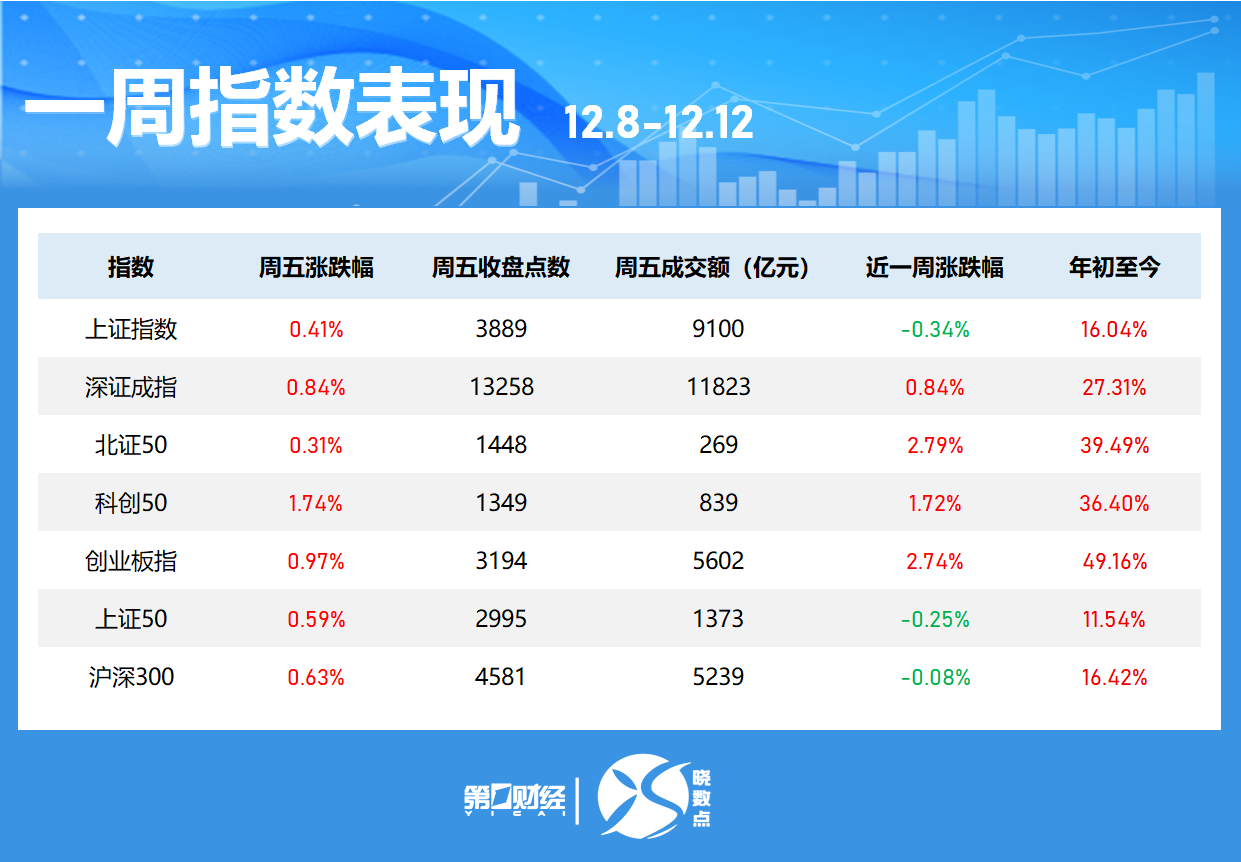
Market Performance - The A-share market showed mixed performance from December 8 to December 12, with the Shanghai Composite Index declining by 0.34%, while the Shenzhen Component Index increased by 0.84%, and the ChiNext Index rose by 2.74% [1] - The Shanghai Composite Index closed at 3889 points with a trading volume of 91 billion yuan, while the Shenzhen Component Index closed at 13258 points with a trading volume of 118.23 billion yuan [2] Stock Performance - Tianli Composite had the highest weekly gain of 117.21%, followed by Zaiseng Technology at 61.19% and Bona Film Group at 51.70% [3][4] - On the downside, Guangdao Tui saw a significant drop of 77.21%, with other notable declines including Tuisu Wu at 66.94% and Jiaohua Technology at 23.71% [3][4] Trading Activity - A total of 82 stocks had a turnover rate exceeding 100%, with Dapeng Industrial leading at 266.61%, followed by Moer Thread-U at 211.32% and Hai Xin Food at 210.52% [5] - The sectors with high turnover rates included electronics, computers, and defense industries [5] Fund Flows - The banking and steel sectors attracted significant net inflows, with the banking sector receiving a net inflow of 1.547 billion yuan [7] - The electronics sector faced substantial outflows, with nearly 18 billion yuan sold off [7][8] Individual Stock Inflows - Dongshan Precision received the highest net inflow of 1.508 billion yuan, with a weekly increase of 21.02% [8][9] - Other stocks with notable inflows included Shenghong Technology and BYD, with net inflows of 1.379 billion yuan and 1.217 billion yuan, respectively [8][9] Margin Trading - Shenghong Technology led in margin trading with a net buy of 2.387 billion yuan and a weekly increase of 11.20% [10][11] - Other stocks with significant net buys included Xin Yiseng and Industrial Fulian, while stocks like Hanwujing-U and Tianfu Communication faced notable sell-offs [10][11] Institutional Research - A total of 195 companies were researched by institutions, with Zhongke Shuguang and Haiguang Information receiving the most attention from 341 institutions each [12][13] - The focus of institutional research was primarily on industrial machinery, electronic components, and electrical equipment sectors [12] New Institutional Interests - Institutions showed first-time interest in 54 stocks, with notable ratings including Jiuzhou Pharmaceutical receiving a "Buy" rating from Tianfeng Securities with a target price of 24.50 yuan [14][15] - Other stocks receiving initial attention included Yilian Network and New Dairy, with target prices set above their latest closing prices [14][15]

一周主力丨银行、钢铁等行业获资金青睐 中兴通讯遭抛售居首
Di Yi Cai Jing· 2025-12-13 15:58
Group 1 - The banking, steel, transportation, and real estate industries received significant attention from major funds, with the banking sector seeing a net inflow of 1.547 billion yuan [1] - The electronics, computer, communication, pharmaceutical, and defense industries experienced substantial net outflows, with the electronics sector facing nearly 18 billion yuan in sell-offs [1] Group 2 - Among individual stocks, Dongshan Precision received the highest net inflow of 1.508 billion yuan, with a weekly increase of 21.02% [1] - Shenghong Technology and BYD also saw notable net inflows of 1.379 billion yuan and 1.217 billion yuan, respectively [1] - In contrast, ZTE, Sungrow Power, and Tianfu Communication faced significant sell-offs, with net outflows of 5.317 billion yuan, 4.721 billion yuan, and 3.843 billion yuan, respectively [1]

源达信息宏观策略周报:中央经济工作会议定调明年经济工作,美联储降息25bp
Xin Lang Cai Jing· 2025-12-13 14:06
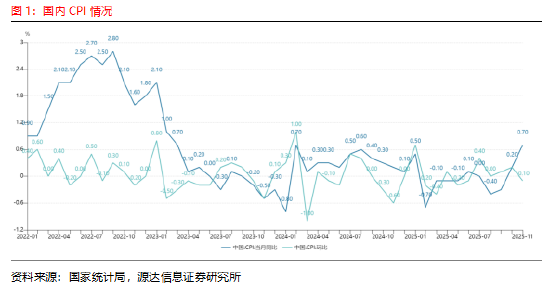
Group 1: Economic Policy and Outlook - The Central Economic Work Conference held on December 10-11 emphasized the continuation of a more proactive fiscal policy, maintaining necessary fiscal deficits, total debt scale, and expenditure levels, while addressing local fiscal difficulties [1][7][10] - The conference outlined key tasks for the upcoming year, focusing on expanding domestic demand, fostering new productive forces, and enhancing the quality of economic growth [10][12][13] - The meeting highlighted the need for a flexible and effective monetary policy, with an emphasis on supporting economic stability and reasonable price recovery [11][58] Group 2: Trade and Economic Data - In the first eleven months of 2025, China's total goods trade value reached 41.21 trillion yuan, a year-on-year increase of 3.6%, with exports growing by 6.2% and imports by 0.2% [2][18] - The trade data indicated strong performance from private enterprises and mechanical and electrical products, with significant contributions to export growth [19] - Consumer Price Index (CPI) showed a year-on-year increase of 0.7%, while the core CPI rose by 1.2%, indicating a recovery in consumer spending [3][20][21] Group 3: Market Performance and Investment Opportunities - The domestic securities market showed a mixed performance, with the ChiNext Index experiencing the highest increase of 2.74%, driven by a rise in risk appetite and a focus on technology and policy-driven themes [2][48] - Investment recommendations include sectors such as technology, non-bank financials, and metals, with a particular focus on AI, semiconductors, and renewable energy [49][40][41] - The outlook for the market remains positive, supported by domestic policy initiatives and the potential for improved global liquidity following the Federal Reserve's interest rate cuts [2][27][28]