
有色金属

Search documents
市值冲至全球矿业第二,紫金矿业开启万亿时代
2 1 Shi Ji Jing Ji Bao Dao· 2026-01-06 11:40
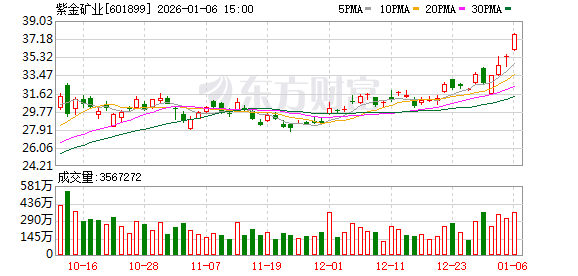
1月6日早盘,紫金矿业涨幅达到6.5%,总市值首破1万亿元。A股市值排名升至13位的同时,也超越了力拓(1月5日美股收盘市值9499.2亿元左右),成 为全球市值第二大的矿业公司。 在此之前,紫金矿业2025年股价已经取得了133%的上涨,这是公司自2008年上市以来涨幅最大的一年。 10024亿元,A股再增万亿市值龙头。 时来天地皆同力。当主观意愿与客观上涨的金价重合时,紫金矿业的市值管理取得了明显成效。 而以上二级市场的突出表现,又受到来自行业、企业等多方面的利好驱动。 首先,紫金矿业的铜、金两大主营矿种连续三年上涨,尤其是伦敦金以64.56%的涨幅成为2025年表现最好的大宗商品之一,带动全球黄金行业上市公司 股价大涨。 Wind数据显示,截至2025年末,市值超过1000亿元的有色行业上市公司涨幅中位数在88%左右,同期全球前十大的黄金企业涨幅中位数则达到172.82%, 领跑有色行业大盘。 其次,是紫金矿业一直强调的"成长性"。2023年以来,公司矿产金迅速放量,由67.7吨增加至2025年的90吨,产量增速明显高于铜产品,并在2025年成为 公司利润第一大来源。 量、价双重驱动下,体量可观的紫金矿 ...


今日财经要闻TOP10|2026年1月6日
Xin Lang Cai Jing· 2026-01-06 11:39
Group 1: Export Control Measures - The Ministry of Commerce of China has announced a ban on the export of all dual-use items to military users in Japan, as well as any other end-users that may enhance Japan's military capabilities, in accordance with the Export Control Law of the People's Republic of China [1] Group 2: Stock Market Performance - On January 6, the Shanghai Composite Index achieved a record of 13 consecutive days of gains, marking the longest streak in its history [2][9] - The index rose by 1.50% on January 6, with over 4,100 stocks increasing in value and a trading volume exceeding 2.8 trillion yuan [14] Group 3: Monetary Policy - The People's Bank of China emphasized the continuation of a moderately loose monetary policy during its work meeting held on January 5-6, aiming to enhance financial services for high-quality economic development and stabilize market expectations [4][11] Group 4: Market Sector Analysis - The brain-computer interface sector has seen significant growth, with multiple stocks reaching their daily limit up, including Sanbo Brain Science and Weisi Medical [14] - The non-ferrous metals and chemical sectors also performed strongly, with Zijin Mining's A-share market capitalization surpassing 100 billion yuan, achieving a historical high [14]
沪指再创本轮牛市新高
第一财经· 2026-01-06 11:34
Core Viewpoint - The current bull market in the A-share market is characterized by a prolonged and structural nature, driven by factors such as sustained liquidity, low domestic interest rates, and a focus on technological innovation, distinguishing it from previous bull markets that were primarily liquidity-driven [3][10][11]. Market Performance - On January 6, the Shanghai Composite Index rose by 1.5% to close at 4083 points, marking a new high in the current bull market after 13 consecutive trading days of increases [3]. - The total trading volume across Shanghai, Shenzhen, and Beijing reached 2.83 trillion yuan [3]. Historical Context - Since 2008, the A-share market has experienced four bull markets, each lasting between 23.5 to 25.5 months, with the current market having run for approximately 23 months since its low point in February 2024 [6][10]. - The previous bull markets were driven by different sectors, including financials, leverage, and new energy, while the current market is led by artificial intelligence and non-ferrous metals [5][6]. Structural Characteristics - The current bull market is marked by a structural shift, with funds concentrated in sectors aligned with national strategies and global technological trends, such as AI, semiconductors, and new energy [8][10]. - The balance of margin trading as of January 5 was 2.56 trillion yuan, slightly above the level seen in June 2015, indicating that leverage has not significantly expanded [10]. Long-term Investment Trends - Long-term funds, including insurance and pension funds, are entering the market, contributing to a more institutionalized and stable market environment, which supports the "slow bull" foundation [10][11]. - The market is expected to transition from a valuation recovery phase to a profit-driven phase, with a focus on sectors like AI, semiconductor localization, and innovative pharmaceuticals [10]. Future Outlook - Analysts predict that the current bull market may extend beyond historical time limits, evolving into a higher quality "long bull" and "slow bull" due to supportive policies and structural economic changes [11]. - The emphasis on technology stocks is expected to continue, with potential for market differentiation as investors seek opportunities in the commercialization of AI and domestic replacements [11].

100只股收盘价创历史新高
Zheng Quan Shi Bao Wang· 2026-01-06 11:28
创新高的能力是衡量股价强弱的指标之一,今日收盘创历史新高个股中,有些个股股价呈不断突破新高 的走势,从近一个月创新高次数看,西部材料近一个月收盘有13次创新高,航天电子、藏格矿业、上海 瀚讯近一个月分别有12次、11次、11次创新高。(数据宝) 今日收盘价创历史新高股一览 沪指今日上涨1.50%,100股收盘价创历史新高。 今日可交易A股中,股价上涨的有4108只,占比75.25%,下跌的有1222只,占比22.39%,其中,涨停的 有144只,跌停的有2只。 证券时报·数据宝统计显示,不含近一年上市的次新股,今日共有100股收盘价创历史新高,按所属板块 看,主板有54只,创业板有23只,科创板有20只。从行业属性来看,电子、有色金属、机械设备行业创 新高的个股较为集中,分别有17只、16只、11只个股出现在名单中。 从股价表现看,收盘价创历史新高股中,今日股价平均上涨6.36%,涨停的有天力复合、倍益康、雷尔 伟等,涨幅居前的有华测导航、珂玛科技、燕东微等。股价方面,创新高股平均股价73.37元,其中, 股价超百元的有21只,50元~100元的有28只,收盘股价最高的是北方华创,今日收盘价为485.97元, ...
每日核心期货品种分析-20260106
Guan Tong Qi Huo· 2026-01-06 11:25
Report Overview - The report is a daily analysis of core futures varieties, released on January 6, 2025, covering various commodities in the domestic futures market [3]. Market Performance Futures Market Summary - As of the close on January 6, domestic futures main contracts mostly rose. Lithium carbonate hit the daily limit, silver futures rose over 7%, platinum over 6%, palladium over 5%, and tin, copper, international copper, and nickel futures rose over 4%. PVC, aluminum, methanol, and apple futures rose over 3%. In terms of declines, plywood fell over 1%, and coke and logs declined slightly. Stock index futures generally rose, while treasury bond futures mostly fell. In terms of capital flow, silver 2604, CSI 2603, and SSE 50 2603 had capital inflows, while gold 2602, apple 2605, and crude oil 2602 had outflows [6][7]. Commodity Analysis Copper - A strike at a Canadian copper mine in Chile is expected to cut production by 70%. In 2026, copper smelters face profit challenges in long - term contracts, with by - products like sulfuric acid and gold becoming key profit sources. China's electrolytic copper production in 2024 increased both monthly and annually. Demand from downstream copper products is mixed, with the copper foil market being strong. Geopolitical factors and supply - demand dynamics support copper prices in the long - term, but short - term corrections are possible [9]. Lithium Carbonate - Lithium carbonate rose sharply and hit the limit due to positive news, including price increases by two phosphate - iron - lithium companies. However, the supply - demand structure remains unchanged, with production increasing in December 2025 and downstream demand contracting. The market is in a stage of strong expectations but weak reality, so a price drop should be guarded against [11]. Crude Oil - OPEC+ decided to maintain the output plan in February and March 2026. The US crude oil inventory decreased more than expected, but refined oil inventory increased. The US production is at a high level. Geopolitical factors, such as the US - Venezuela conflict and the EU's sanctions on Russia, bring uncertainties. The market is in a supply - surplus situation, but geopolitical events may stimulate price hikes [12][13]. Asphalt - The asphalt production rate declined last week, and the January 2026 production plan is lower than the previous month and the same period last year. The downstream demand is affected by funds and weather. The US military action in Venezuela may affect the supply of heavy oil for domestic refineries. The price is expected to be volatile, and it is recommended to wait and see [14][16]. PP - The downstream PP operating rate is at a low level, and the enterprise operating rate and the production ratio of standard products have decreased. The inventory is at a neutral level. With an oversupply of crude oil and weak prices, the new production capacity and declining downstream orders limit the upward space of PP prices. The L - PP spread is expected to narrow [17]. Plastic - The plastic operating rate decreased on January 6. The downstream PE operating rate is low, with the agricultural film season ending. The inventory is at a neutral level. New production capacity has been put into operation, and the weak demand limits the upward space of plastic prices. The L - PP spread is expected to fall [18][19]. PVC - The PVC operating rate increased, but the downstream operating rate decreased. The export price declined, and the social inventory is high. The real estate market is still in adjustment. New production capacity has been added, and it is recommended to wait and see during the traditional demand off - season [20]. Coking Coal - Coking coal prices fell on the day. The coking coal options will be listed on January 16, 2026. The supply may decrease as some mines approach the end - of - year production target, and the Mongolian coal imports will slow down. The downstream demand is weak, and the overall supply - demand is weak. Attention should be paid to the linkage effect of the black series [22]. Urea - Urea prices rose and then fell. The upstream factories raised prices due to positive market sentiment. The supply is abundant, with production resuming. The agricultural demand is in the off - season, and the industrial demand is limited by environmental protection. The inventory is decreasing, but the market may be over - rising, so a correction should be guarded against [23][25].
又一家万亿市值巨头诞生!
格隆汇APP· 2026-01-06 11:23
Core Viewpoint - The non-ferrous metal sector has shown remarkable performance, with significant price increases and a strong bullish trend expected to continue into 2026, driven by macroeconomic factors and supply-demand dynamics [2][10][30]. Group 1: Market Performance - As of January 6, 2026, various futures contracts in the non-ferrous metal market have surged, with lithium carbonate futures rising by 8.99% to 137,940 yuan per ton, more than doubling since mid-2025 [4]. - Major contracts for silver, platinum, and palladium have also seen substantial gains, with silver futures up 7.06%, platinum 6.02%, and palladium 5.16% [7]. - Zijin Mining, a leading player in the sector, saw its stock price increase by 6.5%, pushing its market capitalization above 1 trillion yuan, making it the only non-ferrous company in A-shares to reach this milestone [7]. Group 2: Catalysts for Price Increases - The strong price increases in non-ferrous metals are characterized by a notable trend of interlinked price movements, particularly driven by the surge in lithium-related sectors [12][13]. - The recent spike in silver prices was catalyzed by geopolitical events, specifically a U.S. military operation in Venezuela, which heightened market demand for safe-haven assets [16]. - Supply constraints in the copper market, exacerbated by mining accidents and declining ore grades, have contributed to a bullish outlook for copper prices [17]. Group 3: Supply and Demand Dynamics - The aluminum market is experiencing upward pressure due to limited new production capacity and strong demand, with prices nearing historical highs [18]. - Nickel prices are expected to rebound as Indonesia reduces its mining quotas, while rare earth prices are supported by new regulations in Vietnam that restrict exports [18][19]. - Analysts predict that as rare earth prices approach 600,000 yuan per ton, the strength of orders and company performance will validate current valuations [19]. Group 4: Macro and Policy Influences - Historical data indicates that periods of U.S. dollar weakness and low real interest rates typically lead to price increases in precious metals and copper, suggesting a favorable environment for non-ferrous metals [21][23]. - The current liquidity conditions, driven by a shift towards monetary easing and the growth of new technology sectors, are fundamental factors propelling demand for non-ferrous metals [23][24]. - The Chinese market has seen a significant increase in the valuation of quality assets, with long-term capital inflows into the non-ferrous sector, particularly benefiting companies with strong profit growth and integrated supply chains [26][27]. Group 5: Future Outlook - The non-ferrous metal sector is expected to continue its bullish trend into 2026, supported by strong demand from new technologies and supply constraints [28]. - Analysts from various firms express confidence in the ongoing bull market for non-ferrous metals, particularly copper and lithium, as supply-demand gaps widen [28][29]. - The transition of electrolytic aluminum into a high-quality, scarce asset is anticipated to stabilize prices and maintain high profit margins over the long term [29].

有色金属行业2026年度信用风险展望(2025年12月)
Lian He Zi Xin· 2026-01-06 11:15
Investment Rating - The report indicates that the credit risk outlook for the non-ferrous metals industry is expected to remain stable overall, but with notable structural pressures [4][44]. Core Insights - The non-ferrous metals industry is significantly influenced by macroeconomic demand, serving as a foundational material for industrial manufacturing, infrastructure, real estate, and emerging industries [5][6]. - The global economic environment has been characterized by "weak growth, high volatility, and multiple risks," impacting the performance of major commodities differently [4][6]. - In 2025, the asset scale of non-ferrous metal enterprises expanded, driven by strategic resource development and sustained demand from emerging industries [4][15]. - The profitability and cash flow metrics of sample enterprises in the non-ferrous metals sector have shown significant variability, with median profit totals and operating cash flow below average levels [20][19]. - The industry has seen an increase in bond financing, with a concentration of issuers rated AAA and AA+, primarily consisting of state-owned and strong private enterprises [34][32]. Industry Fundamentals - The non-ferrous metals sector's development is closely tied to macroeconomic demand, with the global economy exhibiting complex dynamics that affect trade and pricing [5][6]. - The industry has experienced structural differentiation, with resource-based and processing enterprises facing distinct opportunities and challenges [5][6]. Industry Performance - Since 2025, the non-ferrous metals industry has faced a "high-low, fluctuating downward" trend due to external shocks such as tariffs and domestic real estate sector challenges [7][8]. - The prices of major metals have shown divergence, with gold and copper prices supported by safe-haven demand and emerging market needs, while aluminum prices have remained stable [8][7]. Financial Status - As of November 2025, the non-ferrous metals industry had 53 active entities, with 44 selected as sample enterprises for analysis [11][13]. - The total asset value of sample enterprises increased by 9.40% to 87,939.47 billion yuan by the end of September 2025, driven by rising metal prices and expanding business scales [15][14]. - Profitability indicators have fluctuated, with average profit totals and operating cash flow metrics showing significant growth in 2025, despite challenges in processing fees [19][20]. Leverage Levels - The overall leverage level in the non-ferrous metals industry is moderate, but some enterprises have seen rapid increases in debt due to aggressive expansion [24][25]. - By the end of September 2025, the average debt-to-asset ratio for sample enterprises was 60.22%, with some companies exceeding 70% [25][24]. Debt Servicing Capacity - The industry has shown good performance in debt servicing indicators, although cash-to-short-term debt ratios have declined significantly [27][28]. - The average cash-to-short-term debt ratio fell to 0.26 by September 2025, indicating reduced cash reserves among enterprises [30][28]. Bond Market Performance - The non-ferrous metals industry has seen active bond issuance in 2025, with no significant defaults reported, although some credit ratings have been downgraded [32][33]. - A total of 43 enterprises issued bonds amounting to 1,939.26 billion yuan, with AAA-rated issuers dominating the market [35][34].
主力资金动向 69.61亿元潜入非银金融业
Zheng Quan Shi Bao Wang· 2026-01-06 11:14
Core Insights - The non-banking financial sector experienced the highest net inflow of funds today, amounting to 6.961 billion yuan, with a price change of 3.73% and a turnover rate of 2.12% [1][2] - The communication sector faced the largest net outflow of funds, totaling -10.507 billion yuan, with a price change of -0.77% and a turnover rate of 2.47% [1][2] Industry Summary - **Non-banking Financial**: - Trading volume: 8.892 billion shares - Change in trading volume: +80.24% - Price change: +3.73% - Net inflow: 6.961 billion yuan [1] - **Communication**: - Trading volume: 4.331 billion shares - Change in trading volume: +13.24% - Price change: -0.77% - Net outflow: -10.507 billion yuan [2] - **Other Notable Sectors**: - **Non-ferrous Metals**: - Net inflow: 5.885 billion yuan, price change: +4.26% [1] - **Automobile**: - Net inflow: 2.469 billion yuan, price change: +1.43% [1] - **Computer**: - Net inflow: 1.971 billion yuan, price change: +2.19% [1] - **Petroleum and Chemical**: - Net inflow: 1.111 billion yuan, price change: +2.82% [1] - **Pharmaceuticals**: - Net outflow: -6.276 billion yuan, price change: -22.60% [2] - **Machinery**: - Net outflow: -11.764 billion yuan, price change: -35.65% [2]
利好!多家上市公司,密集发布!
Zheng Quan Shi Bao· 2026-01-06 11:10
Group 1: Overall Market Performance - As of January 5, 2026, over 280 Hong Kong-listed companies have released annual performance forecasts for the fiscal year ending December 31, 2025, with more than 10 companies providing specific earnings outlooks [1] - The precious metals prices have been rising, leading to generally positive performance in the non-ferrous metals industry, while innovative pharmaceutical companies have also seen significant growth due to increased demand in biopharmaceutical research [1] Group 2: Non-Ferrous Metals Industry - The non-ferrous metals industry is expected to be a major contributor to profits in the Hong Kong market for 2025, benefiting from rising global commodity prices and optimized production capacity [2] - Zijin Mining Group forecasts a net profit of 51 billion to 52 billion yuan for 2025, representing a year-on-year increase of approximately 59% to 62%, with a non-recurring net profit of 47.5 billion to 48.5 billion yuan, up about 50% to 53% [2] - Zijin Mining anticipates production of approximately 90 tons of gold, 1.09 million tons of copper, and 437 tons of silver in 2025, with significant increases in sales prices for these minerals [2] Group 3: Other Non-Ferrous Metals Companies - Zijin Gold International expects a net profit of approximately 1.5 billion to 1.6 billion USD for 2025, an increase of about 212% to 233% compared to the previous year, driven by increased gold production and favorable market conditions [3] - Chifeng Jilong Gold Mining anticipates a net profit of 3 billion to 3.2 billion yuan for 2025, reflecting a year-on-year increase of approximately 70% to 81%, attributed to higher gold production and sales prices [3] Group 4: Innovative Pharmaceuticals and Smart Driving - Innovative pharmaceutical company Baiaosaitu expects a net profit of 135 million yuan for 2025, a year-on-year increase of 303.57%, driven by successful overseas market expansion and growing domestic biopharmaceutical research demand [4][5] - Hesai Technology projects revenue of 3 billion to 3.5 billion yuan for 2025, with GAAP profits of 200 million to 350 million yuan, and Non-GAAP profits expected to rise to 350 million to 500 million yuan, alongside a significant increase in lidar shipments [5] Group 5: Traditional Industries Facing Challenges - Citic Resources anticipates a net profit of approximately 170 million to 230 million HKD for 2025, representing a decline of 60% to 70% year-on-year, primarily due to a significant drop in average selling prices of crude oil and rising raw material costs [6] - New Iron Ore Resources expects a net loss of approximately 2.2 million USD for 2025, attributed to decreased iron ore supply from major suppliers and weakened demand [7]

兴业银锡:公司将持续关注套期保值业务的市场变化
Zheng Quan Ri Bao Wang· 2026-01-06 11:09
证券日报网讯1月6日,兴业银锡(000426)在互动平台回答投资者提问时表示,公司将持续关注套期保 值业务的市场变化,严格把控交易风险,审慎开展相关操作,并按照法律法规及监管要求及时履行信息 披露义务。 ...
