
能源

Search documents
国泰海通海外:港股迎来增配时机 下半年有望跑赢A股
智通财经网· 2025-07-20 02:37
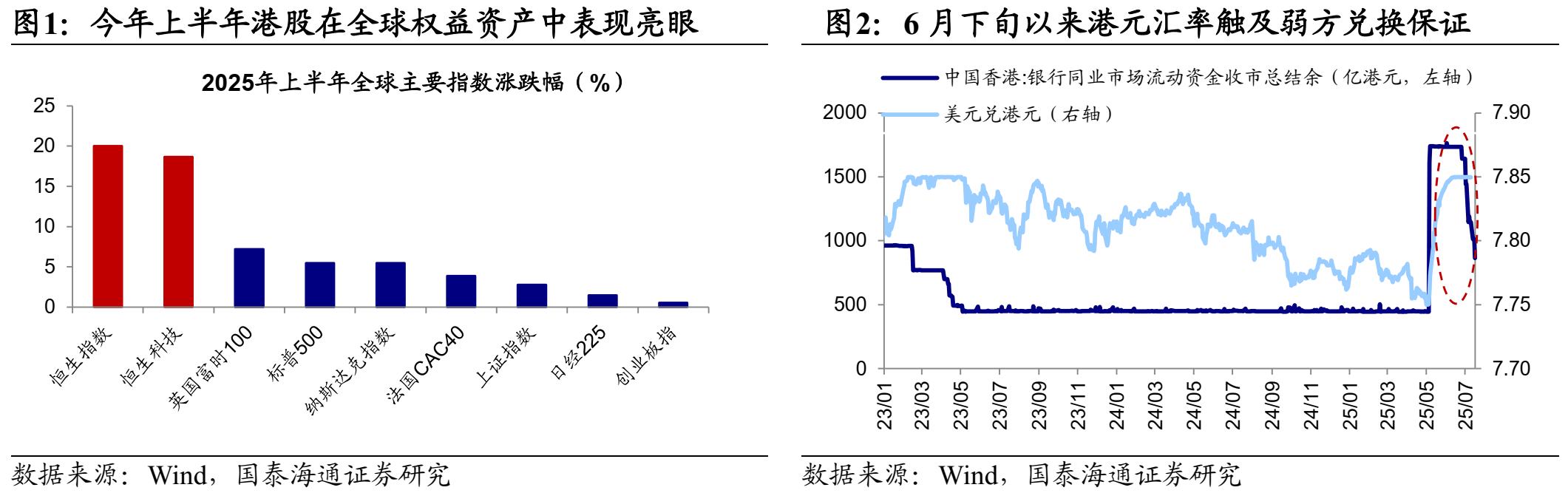
Core Viewpoint - The Hong Kong stock market has experienced fluctuations since the end of June due to tariffs and exchange rate impacts, but is expected to outperform the A-share market in the second half of the year as positive factors accumulate [1][3][13]. Market Performance - Since the end of June, the Hong Kong stock market has shown weaker performance compared to the A-share market, primarily influenced by U.S. tariff policies and the Hong Kong dollar's exchange rate [4][7]. - The Hang Seng Index rose by 20% in the first half of the year, outperforming major global indices, including the S&P 500 (5.5%) and the Shanghai Composite Index (2.8%) [3][4]. Sector Analysis - The technology and dividend sectors in Hong Kong are currently less active compared to A-shares, with the overall market heat slightly below historical averages [7][8]. - The healthcare and consumer sectors in Hong Kong show higher activity levels compared to A-shares, with the healthcare sector's heat at 91%, significantly above A-shares' 77% [9][8]. Investment Opportunities - The easing of U.S. chip export restrictions and the acceleration of AI applications are expected to benefit the Hong Kong technology sector, which is well-positioned to capitalize on the AI industry transformation [17]. - The dividend sector in Hong Kong, despite lower heat compared to A-shares, still holds value due to high dividend yields relative to risk-free rates, making it an attractive option for long-term investors [18]. Future Outlook - The Hong Kong stock market is entering a favorable allocation period, with expectations of continued upward movement in the second half of the year driven by supportive policies and improved capital inflows [13][14]. - The anticipated increase in capital expenditure by Hong Kong internet giants in AI infrastructure is expected to enhance the performance of the technology sector [17].


和美国谈判失败后,卡尼转头向中国示好,但中方已将它送出去了
Sou Hu Cai Jing· 2025-07-19 15:05
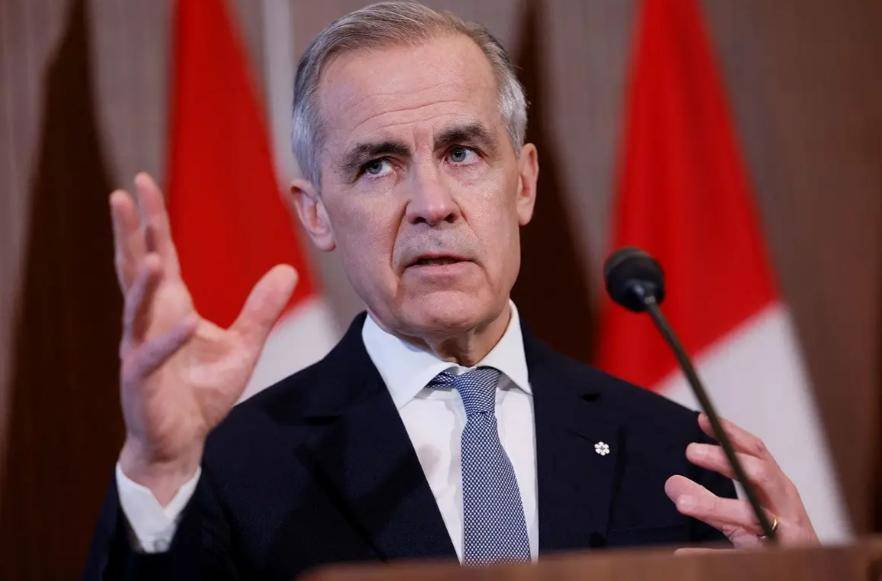
Group 1 - The Canadian government's imposition of a 25% steel tariff on China is seen as a strategic move to counterbalance U.S. pressure, but it has backfired significantly [1][5][10] - The Australian canola market is benefiting from a shift in orders, with a 150,000-ton agreement and a total of 3 million tons over three years, as Canada loses its previously dominant position [2][8] - Canadian farmers are facing severe financial losses, with reports of up to 15 billion Canadian dollars in losses due to the abrupt changes in trade dynamics [2][5] Group 2 - The Canadian government's reliance on the U.S. market is highlighted, with 75% of its exports going to the U.S., making it vulnerable to U.S. trade policies [7][8] - The response from Canadian officials to the steel tariff has been criticized as ineffective, with calls for better relations with China while simultaneously imposing tariffs [5][9] - The strategic missteps of the Canadian government are leading to a loss of credibility and market share, particularly in the agricultural sector, as provinces seek alternative markets [8][10]
全球市场导读刊物
2025-08-18 01:00
Summary of Key Points from Conference Call Industry Overview - **Industry**: Chinese Macro Economy and Real Estate Market - **Company**: Goldman Sachs (GS) Core Insights and Arguments 1. **Mixed Economic Data for May**: - Fixed asset investment growth was only 3.7%, below the expected 4.0% - Industrial value-added growth was 5.8%, slightly below the expected 6.0% - Retail sales of consumer goods grew strongly by 6.4%, exceeding the market expectation of 4.9% [2][3] 2. **Decline in Urban Housing Demand**: - GS revised the forecast for urban housing demand, estimating it will remain below 5 million units annually, a 75% decrease from the peak of 20 million units in 2017 - Current housing prices are still declining, indicating the real estate market has not yet bottomed out [3][4] 3. **Limited Impact of Export Front-Loading**: - Anticipated "reciprocal" tariffs led to front-loading of exports, with an estimated 5% increase in overall exports in March - The impact on exports for the second half of the year is expected to be limited to 1 percentage point, suggesting that trade surpluses will remain strong [5][4] 4. **Fiscal Policy and Economic Growth**: - May saw a slowdown in fiscal operations, with budgetary income growth at only 0.1%, significantly lower than April's 1.9% - Fiscal expenditure growth decreased from 5.8% in April to 2.6%, indicating that fiscal stimulus has not significantly strengthened [11][12] 5. **Real Estate Revenue Weakness**: - Land transfer revenue fell by 14.2% year-on-year, a stark contrast to April's growth of 3.9% - Budgetary real estate-related tax revenue decreased by 8.6%, reflecting ongoing weakness in the real estate market [11][12] 6. **Geopolitical Tensions and Energy Prices**: - Brent crude oil prices rose to nearly $80 per barrel due to escalating tensions in Iran, with a geopolitical risk premium of about $12 - Two scenarios for oil price increases were outlined, with potential peaks of $90 and $110 per barrel under different supply disruption scenarios [26][28] 7. **Copper Demand Driven by AI**: - AI-driven data center expansion is expected to become a new growth driver for copper demand, particularly in power distribution and cooling systems - Strong capital expenditure expectations for AI-related investments are anticipated to sustain demand for copper-intensive components [32][34] 8. **Modern Dairy Industry Forecast**: - Modern Dairy, a joint venture of Mengniu, expects a net loss of RMB 800-1,000 million in the first half of 2025, significantly higher than last year's loss of RMB 207 million - The core operations remain resilient, with EBITDA expected to remain stable due to lower raw milk sales costs [38][39] Other Important but Possibly Overlooked Content - **Fiscal Space for Expansion**: Despite current economic growth exceeding expectations, GS anticipates further fiscal expansion in the second half of the year to counter deflationary pressures and boost confidence [16][18] - **Market Sentiment and Currency Dynamics**: The report highlights a divergence in safe-haven currencies, with the dollar and Swiss franc performing strongly while Asian low-yield currencies face pressure [16][18] - **Potential for Future Trade Weakness**: High-frequency transport data indicates a potential weakening of Chinese exports to the U.S., particularly in container traffic, which may reflect the impact of new tariffs [35][37]
高频跟踪周报20250719:反内卷预期继续推升钢价-20250719
Tianfeng Securities· 2025-07-19 11:12
1. Report Industry Investment Rating No relevant content provided. 2. Core Viewpoints - The real - estate market shows weak supply and demand, and policies are expected to be more aggressive in the second half of the year. Steel prices are rising due to policy and cost factors. Industrial production is stable, and infrastructure construction starts are relatively strong. There are mixed trends in consumption, trade, prices, and the issuance of interest - rate bonds is progressing steadily [1][2][4] 3. Summary by Directory 3.1 Demand - New home sales decreased both on a week - on - week and year - on - year basis. As of the week of July 18, the transaction area of 20 - city commercial housing was 1.471 million square meters, down 22% week - on - week and 25% year - on - year. Second - hand home sales also declined. Automobile consumption improved marginally, with the average daily retail sales of passenger cars up 19.9% week - on - week and 9.7% year - on - year [12][38] 3.2 Production - In the mid - upstream, the blast furnace operating rate in Tangshan increased to 80.4%, while the rebar operating rate decreased to 43.0%. The PTA operating rate rose to 80.8%, and the operating rate of polyester filament in the Jiangsu and Zhejiang regions increased to 92.9%. In the downstream, the operating rates of all - steel and semi - steel tires in the automotive industry continued to improve, with the semi - steel tire operating rate at a seasonal high [44] 3.3 Investment - The apparent consumption of rebar declined, but its price increased by 1.0% week - on - week to 3,293 yuan/ton. The asphalt price rose by 0.8% to 3,630.8 yuan/ton. The cement price decreased by 1.7% to 108.0 points, while the cement shipping rate increased and the cement inventory ratio decreased [60] 3.4 Trade - In exports, port container throughput decreased by 0.9% week - on - week, and the CCFI composite index dropped by 0.8%. In imports, the CICFI composite index rose by 0.3% week - on - week [71] 3.5 Prices - The agricultural product wholesale price 200 index increased by 0.2% week - on - week, with pork prices rising by 0.2%. International crude oil prices generally declined, with Brent crude oil spot prices down 1.2% week - on - week. Gold prices rose slightly [77][82] 3.6 Interest - rate Bond Tracking - From July 21 to 25, the planned issuance of interest - rate bonds is 786.8 billion yuan, with a net financing of 56.2 billion yuan. As of July 18, the cumulative issuance progress of replacement bonds exceeded 90%, reaching 91.8%. The cumulative issuance progress of new general bonds was 61.8%, and that of new special bonds was 54.3% [93][95] 3.7 Policy Week Observation - The central bank conducted a 1.4 - trillion - yuan repurchase operation. The central city work conference set seven key tasks for urban work. The State Council studied measures to strengthen the domestic cycle. The central bank solicited opinions on canceling the freezing of collateral for bond repurchases. Local policies included allowing the use of housing provident funds for down payments in Shenzhen and implementing "trade - in" housing subsidies in Changsha [103][106][108]
国内商品期市夜盘收盘多数上涨 非金属建材涨幅居前
news flash· 2025-07-18 15:04
Group 1 - The domestic commodity futures market closed mostly higher during the night session, with non-metallic building materials leading the gains [1] - Glass prices increased by 4.93%, while PVC rose by 2.32% [1] - The black series commodities generally saw increases, with coking coal up by 3.38%, coke by 2.26%, hot-rolled coil by 1.75%, rebar by 1.30%, and iron ore by 0.95% [1] Group 2 - Energy products performed strongly, with fuel oil rising by 2.01% and low-sulfur fuel oil by 1.03% [1] - Most chemical products also saw gains, including styrene up by 2.20%, butadiene rubber by 1.32%, polypropylene by 0.83%, asphalt by 0.77%, plastic by 0.75%, ethylene glycol by 0.64%, and rubber by 0.27% [1] - Oilseeds and oils showed mixed results, with palm oil up by 1.69%, soybean meal by 0.79%, soybean two by 0.62%, and soybean oil by 0.39%, while soybean one fell by 0.52% [1] Group 3 - Agricultural and sideline products experienced slight fluctuations, with pulp up by 0.64%, corn starch by 0.64%, and corn by 0.61% [1]
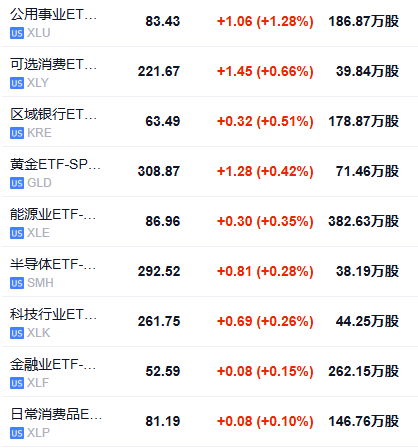
美股盘初,主要行业ETF多数走高,公用事业ETF涨超1%,可选消费ETF涨幅居前。
news flash· 2025-07-18 13:54
Group 1 - The major industry ETFs in the US stock market are mostly rising, with the utilities ETF increasing by over 1% and the consumer discretionary ETF showing the highest gains [1] - The utilities ETF (US XLU) is priced at 83.43, up by 1.06 (+1.28%) with a trading volume of 1.8687 million shares [2] - The consumer discretionary ETF (US XLY) is priced at 221.67, up by 1.45 (+0.66%) with a trading volume of 398,400 shares [2] Group 2 - The regional banks ETF (US KRE) is priced at 63.49, up by 0.32 (+0.51%) with a trading volume of 1.7887 million shares [2] - The gold ETF (US GLD) is priced at 308.87, up by 1.28 (+0.42%) with a trading volume of 714,600 shares [2] - The energy sector ETF (US XLE) is priced at 86.96, up by 0.30 (+0.35%) with a trading volume of 3.8263 million shares [2] Group 3 - The semiconductor ETF (US SMH) is priced at 292.52, up by 0.81 (+0.28%) with a trading volume of 381,900 shares [2] - The technology sector ETF (US XLK) is priced at 261.75, up by 0.69 (+0.26%) with a trading volume of 442,500 shares [2] - The financial sector ETF (US XLF) is priced at 52.59, up by 0.08 (+0.15%) with a trading volume of 2.6215 million shares [2] Group 4 - The consumer staples ETF (US XLP) is priced at 81.19, up by 0.08 (+0.10%) with a trading volume of 1.4676 million shares [2]


ATFX本周回顾:黄金震荡、美元震荡、原油V型走势
Sou Hu Cai Jing· 2025-07-18 10:18
周三能够实现剧烈波动,主要受到CPI数据和特朗普政策的影响。据美国劳工部劳动统计局数据,美国6月未季调核心CPI年率为2.9%,高于前值2.8%,低于 预期值3%;美国6月未季调CPI年率为2.7%,高于前值2.4%。美国通胀率数据表现坚挺,意味着美国的商品需求依旧旺盛,美联储没必要急于降息。 黄金: 本周五个交易日,黄金三阴K两阳K,最高触及3377美元,最低触及3309美元,差值68美元。68美元的周度波动幅度极低,因为在高波动时期,一个交易日 的波动幅度可能都会突破100美元。 本周关于黄金的消息非常少,只有一条印度进口数据。知情人士称,印度6月黄金进口量降40%至21吨创两年新低,白银进口量从109吨升至197吨。能够驱 动黄金实现高波动率的因素,主要是各国中央银行的储备性购金。印度黄金进口量大降,意味着印度央行的购金动作减缓,利空金价。 美元: 美元的震荡性没有黄金那么强烈。本周一和周二,美元指数连续收阳线,且周二的阳线幅度远大于周一,似乎具有较强动能。然而,周三行情剧烈波动,最 低点击穿了本周的开盘价,最高点超过本周一和周二的最高点。周四和周五两个交易日的K线,最低点处于周三K线内部,最高点仅小幅 ...

浙江国企首批26个“人工智能+”开放场景发布
Zhong Guo Xin Wen Wang· 2025-07-18 07:49
Core Viewpoint - Zhejiang State-owned Assets Supervision and Administration Commission has released the first batch of 26 "Artificial Intelligence +" scenario lists, covering eight key areas including transportation, manufacturing, services, energy, construction, finance, new materials, and environmental protection, aimed at promoting high-quality development of artificial intelligence in the region [1][2]. Group 1 - The "Artificial Intelligence +" initiative is a special action implemented by the Zhejiang State-owned Assets Supervision and Administration Commission to leverage the advantages of state-owned enterprises in terms of large demand, comprehensive industrial support, and diverse application scenarios [1]. - The released scenarios focus on high-value applications that have strong strategic significance, high economic returns, and close ties to people's livelihoods, aiming to accelerate the application of cutting-edge artificial intelligence technologies [1][2]. - Four cooperation models have been established for scenario collaboration: procurement of applications, joint innovation, solution provision, and scenario verification [1][2]. Group 2 - To ensure effective connection with social innovation forces, three open paths and docking methods have been set up: online platform publication and regular collection, offline matching events, and the establishment of a cooperation ecosystem library [2]. - The Zhejiang Transportation Group has chosen the scenario verification cooperation model, focusing on the "Smart Traffic Testing and Verification Platform" to address issues in the highway sector [2]. - The release of these open scenarios aims to create an efficient cooperation platform for private enterprises and research institutions to collaborate with state-owned enterprises, thereby stimulating innovation in artificial intelligence technology [2].
经济与市场“背离”:全球资产配置的变局与应对
Guo Ji Jin Rong Bao· 2025-07-18 07:44
Economic Outlook - The market anticipates that tariffs will lead to economic growth slowdown and rising inflation in the coming months, but significant opportunities for long or short positions in overall duration have not been identified yet [1] - Federal Reserve Chairman Powell advocates for patience regarding interest rates, suggesting that the Fed may prioritize employment goals and consider rate cuts later in the year as inflation is expected to decline [1] - Global central banks are adopting different policies in response to regional dynamics, leading to a general divergence between the economy and the markets [1] Government Bonds - In the Eurozone, the market expects the European Central Bank to further cut rates after a 175 basis point reduction, with long-term yields facing upward risks due to signs of demand recovery and low inflation expectations [3] - Japan is experiencing inflation pressure, with nominal GDP growth exceeding 5% year-on-year, but concerns over tariffs may hinder GDP growth and market confidence [3] - Investment opportunities may arise in UK government bonds as fears of fiscal irresponsibility lead to increased term premiums, despite signs of a weakening job market [3] Equities - The company maintains a moderate overweight in global equities, expecting positive earnings growth across major regions, although valuation remains a concern due to low risk premiums indicating market over-optimism [5] - Japanese equities are favored over U.S. equities due to valuation differences and ongoing corporate governance reforms, although potential policy headwinds may limit further overweighting [5] - U.S. equities are underweighted due to high valuations and market over-reliance on a few large companies for performance, with expectations for broad earnings growth being delayed [5][6] Credit Markets - Credit spreads have tightened back to historical lows after an initial widening, with a moderate overweight in credit spreads deemed acceptable in a non-recession scenario [8] - U.S. high-yield bonds have a total return of 6%-7%, attracting investors seeking arbitrage opportunities, supported by improved credit quality and low default rates [8] Commodities - The company holds a neutral view on commodities, with gold benefiting from structural factors and geopolitical concerns, although a cautious approach to new positions is advised [10] - Oil allocation has been slightly reduced due to expectations of oversupply by year-end, presenting a potential shorting opportunity, with risks associated with significant negative spreads [10]