
公用事业

Search documents
2026信用月报之四:4月信用,布局凸点增厚收益-20260330
HUAXI Securities· 2026-03-30 15:01
1. Report Industry Investment Rating No relevant content provided. 2. Core Viewpoints of the Report - In April, the buying power of credit bonds may increase, and it is advisable to attack appropriately. One can layout curve convex points, dig into the spreads of perpetual bonds to increase returns, and pay attention to the relatively high cost - performance of 2Y and 4Y secondary perpetual bonds while being aware of the large - scale redemption risk of fixed - income plus products [1][4]. - The yields of urban investment bonds generally declined, with short - duration and medium - low - rated bonds performing better [42]. - The supply of industrial bonds increased, and the proportion of medium - and long - term issuances rose [56]. - The net financing of bank secondary perpetual bonds was negative, and most spreads widened passively [64]. 3. Summary by Directory 3.1 4月信用债买盘力量或上升,适当进攻 3.1.1 布局凸点、挖掘永续品种利差增厚收益 - In March, the bond market showed a structural market of "narrow - range fluctuations in long - term interest rates, short - term strength and long - term weakness, and a steeper curve". The yields of credit bonds generally declined, and the credit spreads of most within - 5 - year bonds widened passively, while those of 7 - year and 10 - year bonds narrowed [9]. - The incremental demand for credit bond allocation in March mainly came from funds and other products, with the duration concentrated within 3 years [10]. - As of March 27, the yields and credit spreads of credit bonds were generally low, and the carry - trade space of medium - and short - duration credit bonds was significantly compressed [11]. - In April, the bond market may remain volatile. The increase in the scale of wealth management products may drive up the demand for credit bond allocation. One can layout curve convex points to increase returns through riding and dig into the spreads of perpetual bonds [15]. - For medium - and short - duration bonds, urban investment bonds with AA rating for 2 - year and 4 - year terms and AA(2) rating for 2 - 3 - year terms have relatively high cost - performance. High - rated 6 - 7Y bonds are convex points, and one can play with small positions in 5 - 7 - year bonds with an implied rating of AA+ and above [18][21]. - As of March 27, the outstanding scale of public perpetual bonds was 3.53 trillion yuan, and there is still room to dig into the spreads of perpetual bonds. One can actively dig into the spreads of perpetual bonds and wait for the spread compression market [23]. 3.1.2 二永债2Y和4Y性价比较高,关注固收+大额赎回风险 - In March, the yields of secondary perpetual bonds generally declined, and the credit spreads mostly widened passively. The 2 - 3 - year bonds performed weaker. The cost - performance of 2Y and 4Y secondary perpetual bonds has recovered [27]. - The divergence in institutional behavior has increased. Funds "chased up and sold down". The demand for secondary perpetual bonds from wealth management products was relatively stable, and insurance and other institutions have been net buyers in the secondary market in recent weeks [28]. - In April, the buying power of credit bonds is strong, and high - coupon assets may be favored. The 2Y and 4Y secondary perpetual bonds have relatively high cost - performance. However, one needs to be vigilant against the risk of secondary perpetual bond adjustment caused by the redemption of fixed - income plus products [32][35]. 3.2 城投债:收益率普遍下行,短久期、中低评级表现更好 - In March, the net financing of urban investment bonds was positive and increased year - on - year. The proportion of medium - and long - term issuances increased, and the weighted average issuance interest rates generally declined [42]. - The net financing performance of urban investment bonds varied by province, with about two - thirds of the provinces having positive net financing [44]. - In March, the yields of urban investment bonds generally declined, with short - duration and medium - low - rated bonds performing better. The credit spreads showed differentiation [46]. - The buying sentiment of urban investment bonds continued to pick up in March. The proportion of TKN and low - valuation transactions increased slightly compared with February. The trading activity of medium - and long - term bonds and medium - and low - grade bonds increased [53]. 3.3 产业债:供给放量,中长久期发行占比增加 - In March, the issuance and net financing scale of industrial bonds increased significantly year - on - year. The proportion of medium - and long - term issuances increased, and the issuance interest rates of medium - and short - duration bonds declined [56]. - In March, the yields of industrial bonds declined across the board, with medium - and short - duration and low - grade bonds performing better. The credit spreads showed differentiation [58]. - The yields of public bonds in various industries declined by 7 - 17bp. The 2 - year - and - within bonds and 2 - 3 - year AA bonds performed better [61]. 3.4 银行二永债:净融资为负,利差大多被动走扩 - Since 2026, there has been no new issuance of secondary perpetual bonds. In March, the secondary capital bonds and perpetual bonds were redeemed by 284 billion yuan and 397 billion yuan respectively, with a total net financing of - 681 billion yuan, a year - on - year decrease of 727 billion yuan [64]. - In March, the yields of bank secondary perpetual bonds generally declined, with short - duration and low - rated bonds performing better. Most credit spreads widened passively, and some bonds outperformed or underperformed general credit bonds [66]. - From the perspective of broker transactions, in March, the proportion of TKN transactions in secondary capital bonds and perpetual bonds remained basically the same, and the proportion of low - valuation transactions slightly decreased. The trading of large - bank secondary capital bonds extended the duration, while that of large - bank perpetual bonds shortened the duration. The trading sentiment of city - commercial bank secondary perpetual bonds improved [71].
粤开市场日报-20260330-20260330
Yuekai Securities· 2026-03-30 09:22
Market Overview - The A-share market showed mixed performance today, with the Shanghai Composite Index rising by 0.24% to close at 3923.29 points, while the Shenzhen Component Index fell by 0.25% to 13726.19 points. The ChiNext Index decreased by 0.68% to 3273.36 points [1][10] - Overall, 2865 stocks rose and 2461 stocks fell, with a total trading volume of 19159 billion yuan, an increase of 626 billion yuan compared to the previous trading day [1] Industry Performance - Among the Shenwan first-level industries, the top gainers included non-ferrous metals (up 1.84%), building materials (up 1.67%), telecommunications (up 1.31%), and national defense and military industry (up 1.25%). The sectors that experienced declines were utilities (down 2.97%), household appliances (down 1.49%), and electric equipment (down 1.25%) [1][10] Concept Sector Performance - The leading concept sectors today included aluminum industry, cross-strait integration, fiberglass, industrial metals selection, optical communication, commercial aerospace, semiconductor equipment, gold and jewelry, anti-tariff, cement manufacturing selection, SPD, human resources, satellite internet, large aircraft, and antibiotics [2]
认识“下一位巴菲特”:格雷格·阿贝尔︱重阳荐文
重阳投资· 2026-03-30 07:32
Core Viewpoint - The article discusses the transition of leadership at Berkshire Hathaway to Greg Abel, highlighting his background, management style, and the challenges he faces as the new CEO [7][10][13]. Group 1: Background of Greg Abel - Greg Abel, the new CEO of Berkshire Hathaway, comes from a working-class family in Canada and has a strong background in accounting and regulated industries, particularly in energy and utilities [2][10]. - Abel has been with Berkshire Hathaway since 2000 and has played a significant role in managing its non-insurance businesses, which contribute two-thirds of the company's non-investment income [10][11]. Group 2: Leadership Transition - The announcement of Abel as the successor to Warren Buffett ended years of speculation about who would take over the company [7][10]. - Abel's leadership style is characterized by a focus on building trust, risk management, and operational excellence, which aligns with Buffett's philosophy [11][12]. Group 3: Performance and Challenges - Berkshire Hathaway's annualized return has declined in recent years, with a return of 11.6% over the past decade, lagging behind the S&P 500's 13.2% [11][12]. - The company faces challenges with some of its subsidiaries, such as Geico and BNSF, which have underperformed compared to historical standards [30][31]. Group 4: Management Style and Strategies - Abel is known for his hands-on management approach, focusing on details and setting performance targets for subsidiary CEOs, which contrasts with Buffett's more hands-off style [28][30]. - He plans to implement strategies that include setting profit targets, establishing group leaders for different business segments, and promoting operational efficiencies through shared practices [31][32][33]. Group 5: Personal Attributes and Relationships - Abel is described as approachable and personable, with a strong ability to build relationships, which is seen as a key asset in his leadership role [15][17]. - His commitment to community service and mentorship reflects his values and enhances his reputation as a leader [18][19].


廖市无双-系统性慢牛-如何演绎下去
2026-03-30 05:15
Summary of Conference Call Records Industry Overview - The market focus has shifted downwards, with the Shanghai Composite Index's fluctuation range moving from 4,000-4,200 points to 3,700-3,800 points, indicating that 80% of the shares are currently in a locked state [1][4][7] - The second quarter allocation strategy suggests focusing on "new and old energy + cyclical consumption," with attention on collaborative electricity, power equipment, dividend assets (banks/transportation), and agricultural pharmaceuticals [1][11] Key Market Insights - The market is expected to stabilize around the W bottom or complex bottom by mid to late April, initiating a weekly-level rebound, although the probability of a B-wave rebound is higher than reaching new highs due to liquidity and external shocks [1][10] - The current market adjustment may not be over, with ongoing geopolitical tensions in the Middle East contributing to continued volatility in global capital markets [6][10] Sector Performance - Only the utilities and power equipment sectors have maintained upward momentum, while TMT and non-bank sectors have seen significant declines, reflecting a notable decrease in market risk appetite [1][5][11] - The A-share market has shown structural characteristics, with 9 sectors rising and 22 falling, indicating a defensive market environment [5][11] Support and Resistance Levels - The key support level is identified at 3,755 points (0.382 retracement level), with the core defensive range between 3,700-3,800 points, and significant resistance above 4,040 points [1][9][10] - Approximately 40% of shares are distributed above 4,000 points, and another 40% between 3,800 and 4,000 points, leading to about 80% of shares being locked when the index falls to 3,800 points [7][10] Investment Strategy - The strategy emphasizes timing over stock selection, recommending to buy on dips within the 3,700-3,800 point range and sell near 4,000 points to reduce costs [1][10] - Investors are advised to remain patient during the market bottoming process and consider increasing positions once the market stabilizes in mid-April [10][11] Future Market Trends - The market may experience a second bottoming phase, with the potential for a rebound if it can break through the 3,955 point gap [9][10] - The market's future trajectory will depend on fundamental, policy, and liquidity conditions, particularly the performance of major financial sectors [10][11] Sector Focus for Q2 2026 - Key sectors to watch include coal, pharmaceuticals, new energy, agriculture, transportation, and communication, reflecting a blend of growth and stability in the current market environment [11][12] - The market style is characterized by a combination of large-cap growth and stable sectors, indicating a pursuit of certainty amid volatility [12][13]
本周热度变化最大行业为公用事业、房地产:市场情绪监控周报(20260323-20260327)
Huachuang Securities· 2026-03-30 01:00
Investment Rating - The report does not explicitly provide an investment rating for the industry Core Insights - The most significant changes in market sentiment this week were observed in the utilities and real estate sectors, with utilities showing a positive change rate of 37.8% and real estate also performing well [2][27] - The broad market indices, including CSI 300, CSI 500, and CSI 1000, are currently at high historical valuation percentiles, with values of 82%, 97%, and 94% respectively [3][42] - The report highlights that industries with valuations above the 80th percentile include power equipment, retail, light industry manufacturing, and coal, while those below the 20th percentile include home appliances and non-bank financials [3][43] Market Sentiment Monitoring - The broad market sentiment tracked this week showed the largest increase in CSI 2000, which rose by 5.63%, while CSI 500 decreased by 5.89% [2][16] - The top five industries with positive sentiment changes were utilities, real estate, non-bank financials, light industry manufacturing, and coal [2][27] - The report also identifies the top five concepts with the highest sentiment changes, including military restructuring, supply cooperatives, and tobacco [2][28] Market Valuation Monitoring - The report indicates that the current valuations of major indices are significantly high, with the CSI 300 at 82%, indicating a potential overvaluation [3][42] - Among the first-level industries, those with valuations above the 80th percentile include power equipment, retail, and coal, while home appliances and non-bank financials are below the 20th percentile [3][43][45] - The second-level industries with high valuations include wind power equipment, aerospace equipment, and bioproducts, indicating strong investment potential in these areas [3][45] Event Tracking - This week, there were 23 stock incentive events, with significant participation from various sectors including healthcare and technology [46] - A total of 22 significant shareholder changes were reported, with 17 reductions and 5 increases, indicating a cautious sentiment among major stakeholders [50] - The report tracked 13 private placement events, highlighting ongoing capital raising activities in the market [52] Analyst Coverage - Analysts initiated coverage on 32 stocks this week, indicating a growing interest in various sectors including healthcare and technology [54] - Six stocks received upgraded ratings from analysts, reflecting positive sentiment and potential growth in those companies [56] - The report also lists the top 20 stocks with the most institutional research, indicating strong interest from institutional investors [58]
国泰海通|金工:量化择时和拥挤度预警周报(20260327)——目前资金分歧较大,处于存量博弈状态
国泰海通证券研究· 2026-03-29 15:17
Market Overview - The market is currently in a state of stock game with significant funding divergence, as indicated by the liquidity shock index for the CSI 300, which was -0.49 last Friday, lower than the previous week at 0.49, suggesting current market liquidity is above the average level of the past year by -0.49 standard deviations [1] - The PUT-CALL ratio for the SSE 50 ETF options has been rising, reaching 0.83 last Friday, up from 0.67 the previous week, indicating increased caution among investors regarding the short-term performance of the SSE 50 ETF [1] - The average turnover rates for the SSE Composite Index and Wind All A-shares were 1.38% and 1.94%, respectively, indicating a decrease in trading activity, positioned at the 78.04% and 81.46% percentile since 2005 [1] Macro Factors - The RMB exchange rate fluctuated last week, with onshore and offshore rates showing weekly declines of -0.42% and -0.2%, respectively [1] - The U.S. stock market experienced a downward trend, with the Dow Jones Industrial Average, S&P 500, and Nasdaq indices reporting weekly returns of -0.9%, -2.12%, and -3.23% [1] - The National Bureau of Statistics reported that profits of large-scale industrial enterprises in China reached 1.02 trillion yuan in January-February 2026, a year-on-year increase of 15.2%, accelerating by 14.6 percentage points compared to the previous year [1] Market Sentiment - The A-share market experienced some fluctuations and divergence last week, with heightened risk aversion due to ongoing geopolitical tensions, which have suppressed short-term risk appetite [1] - Technical analysis indicates multiple intraday reversals in the A-share market, suggesting significant funding divergence and a stock game state, leading to a low probability of upward trends in the short term [1] Factor Analysis - The overall market PE (TTM) stands at 22.5 times, positioned at the 77.5% percentile since 2005 [2] - The small-cap factor's congestion level has decreased to -0.11, while the low valuation factor's congestion level is at -0.54, indicating a shift in market dynamics [2] - Industry congestion levels are relatively high in sectors such as comprehensive, communication, non-ferrous metals, basic chemicals, and oil & petrochemicals, with the latter two sectors showing a significant increase in congestion [2]

金融工程:AI识图关注银行、金融、公用事业、红利低波
GF SECURITIES· 2026-03-29 14:08
- The report utilizes Convolutional Neural Networks (CNN) to model price-volume data and future prices, mapping learned features to industry theme sectors[1][75] - The latest configuration themes include banking, finance, utilities, and low volatility dividends, specifically covering indices such as the CSI Bank Index, CSI 800 Bank Index, SSE 180 Financial Stock Index, CSI All Share Utilities Index, and CSI Dividend Low Volatility Index[1][75][77] - The report provides detailed configuration information for the CNN industry themes, including specific dates and index codes[76] **Quantitative Models and Construction Methods** 1. Model Name: Convolutional Neural Network (CNN) - Construction Idea: Use CNN to model price-volume data and future prices, mapping learned features to industry theme sectors[1][75] - Detailed Construction Process: - Standardize price-volume data into charts for each stock within a window period - Apply CNN to these charts to learn features - Map the learned features to industry theme sectors - Evaluation: The model effectively identifies and maps features to relevant industry themes, providing actionable insights for sector allocation[1][75] **Model Backtesting Results** 1. CNN Model, Banking Theme, CSI Bank Index[76] 2. CNN Model, Banking Theme, CSI 800 Bank Index[76] 3. CNN Model, Financial Theme, SSE 180 Financial Stock Index[76] 4. CNN Model, Utilities Theme, CSI All Share Utilities Index[76] 5. CNN Model, Low Volatility Dividends Theme, CSI Dividend Low Volatility Index[76]
晓数点丨一周个股动向:最牛股周涨超50% 赣锋锂业获主力加仓居首
Di Yi Cai Jing· 2026-03-29 13:55
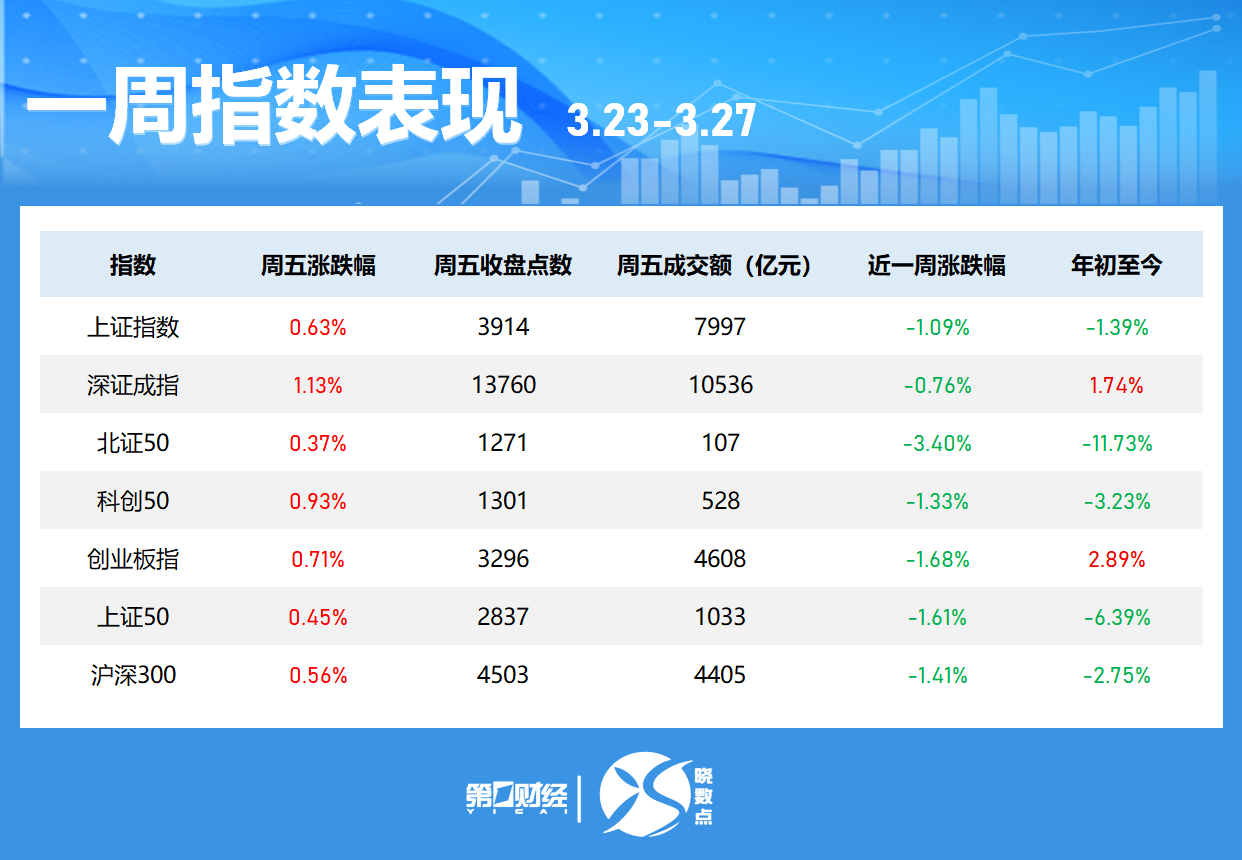
Market Overview - The A-share indices collectively declined during the week from March 23 to March 27, with the Shanghai Composite Index down by 1.09%, the Shenzhen Component Index down by 0.76%, the ChiNext Index down by 1.68%, and the Sci-Tech Innovation Index down by 0.43% [1][2]. Stock Performance - A total of 7 stocks saw gains exceeding 40%, with Haike Xinyuan leading at a weekly increase of 51.02%. Other notable gainers included Lianxiang Co. (48.26%), Rongjie Co. (46.95%), and Huadian Liaoning Energy (43.61%) [3][4]. - Conversely, 30 stocks experienced declines over 20%, with Huada Technology leading the drop at 32.34%, followed by Zhonghuan Hailu (29.59%) and Shenhua Fa A (28.03%) [3][4]. Trading Activity - 47 stocks had a turnover rate exceeding 100%, with Shouhang New Energy at the top with a turnover rate of 236.08%, followed by Nabichuan (199.27%) and Jiuzhou Group (177.88%) [5][6]. - The majority of stocks with high turnover rates were from the electric equipment, public utilities, and basic chemicals sectors [5]. Capital Flow - The sectors that attracted significant capital inflow included non-ferrous metals, basic chemicals, and building materials, while the electronics sector faced a net outflow exceeding 250 billion yuan [8]. - Ganfeng Lithium received the highest net inflow of 27.20 billion yuan, with a weekly increase of 18.15%. Other stocks with notable inflows included Demingli (15.88 billion yuan) and Yunnan Zhiye (14.20 billion yuan) [8][9]. Margin Trading - A total of 1399 stocks received net margin purchases, with 582 stocks having net purchases exceeding 10 million yuan. Luxshare Precision topped the list with a net purchase of 10.94 billion yuan, while NIO and Zijin Mining faced significant net sell-offs [10][11]. Institutional Research - During the week, 163 listed companies were researched by institutions, with Sanhua Intelligent Control receiving the most attention from 284 institutions. Other companies like Yuanjie Technology and Yuntianhua also attracted significant institutional interest [12][14]. Analyst Ratings - Several companies received new ratings from analysts, including Kaige Precision Machinery with a "Buy" rating and a target price of 207.84 yuan, and Daqin Railway with an "Overweight" rating and a target price of 5.95 yuan [15][16].



本周热度变化最大行业为公用事业、房地产:市场情绪监控周报(20260323-20260327)-20260329
Huachuang Securities· 2026-03-29 09:10
- The report discusses the construction of a "Total Heat Index" for monitoring market sentiment, which aggregates the total heat index of individual stocks within broad-based indices, industries, and concepts[7] - The Total Heat Index is defined as the sum of the browsing, self-selection, and click counts of a stock, normalized by its market share on the same day, and then multiplied by 10,000, with a value range of [0,10000][7] - The report constructs a simple rotation strategy based on the weekly heat change rate (MA2) of broad-based indices, buying the index with the highest heat change rate at the end of each week, and staying out of the market if the "other" group has the highest change rate[13][15] - The rotation strategy based on the heat change rate (MA2) has an annualized return of 8.74% since 2017, with a maximum drawdown of 23.5%, and a return of 0% in 2026[16] - The report also constructs two simple portfolios based on concept heat: a "TOP" portfolio consisting of the top 10 stocks with the highest total heat in the hottest concepts, and a "BOTTOM" portfolio consisting of the bottom 10 stocks with the lowest total heat in the hottest concepts[32][33] - The "BOTTOM" portfolio historically achieved an annualized return of 15.71% with a maximum drawdown of 28.89%, and a return of -7.6% in 2026[34] - The Total Heat Index for broad-based indices shows that the CSI 2000 had the highest heat change rate this week, increasing by 5.63%, while the CSI 500 had the lowest, decreasing by 5.89%[2][16] - The Total Heat Index for industries shows that the utility industry had the highest positive heat change rate (MA2) this week, increasing by 37.8%, while the comprehensive industry had the highest negative heat change rate, decreasing by 24.1%[2][27] - The Total Heat Index for concepts shows that the top 5 concepts with the highest heat change rates this week are the military reorganization concept, supply and marketing cooperatives, tobacco, medical waste treatment, and the Heilongjiang Free Trade Zone[2][28]
3月27日A股市场点评:市场温和修复
Zhongshan Securities· 2026-03-27 12:48
Market Performance - The Shanghai Composite Index increased by 0.63%[3] - The Shenzhen Component Index rose by 1.13%[3] - The CSI 300 Index saw a gain of 0.56%[3] - The ChiNext 50 Index grew by 0.93%[3] Sector Performance - The pharmaceutical and biotechnology sector led with a gain of 3.70%[3] - The non-ferrous metals sector increased by 2.88%[3] - The basic chemicals sector rose by 2.55%[3] - The utilities sector declined by 0.78%[3] - The banking sector fell by 0.50%[3] Concept Indices - The lithium mining index surged by 7.42%[3] - The lithium battery electrolyte index increased by 6.18%[3] - The innovative drug index rose by 5.42%[3] - The high送转 index decreased by 2.80%[3] Market Outlook - The market is expected to continue fluctuating, influenced by geopolitical tensions in the Middle East and oil prices[7] - The resilience of the market is supported by recent policy interventions from the central bank and the securities regulatory commission[7] - Attention should be paid to the latest developments in the Middle East over the weekend[7]