
电子等

Search documents
全球股市立体投资策略周报1月第2期:跨年行情在途,亚洲继续领涨-20260114
GUOTAI HAITONG SECURITIES· 2026-01-14 02:50
Market Performance - Emerging markets continued to lead, with MSCI Global up by 1.5%, MSCI Developed Markets up by 1.1%, and MSCI Emerging Markets up by 4.2% [8][12] - In the developed markets, the South Korean Composite Index showed the strongest performance with an increase of 11.1%, while the Australian S&P 200 was the weakest, declining by 0.5% [8][12] - In the emerging markets, the Shanghai Composite Index performed best with a rise of 4.0%, while the Indian Sensex30 was the weakest, falling by 1.7% [8][12] Trading Sentiment - The volatility of major stock indices continued to rise, with trading volumes in various markets increasing significantly [25] - In Hong Kong, the short-selling ratio decreased to 14.7%, indicating a high investor sentiment, while North American sentiment remained at a historical high with the NAAIM manager exposure index rising to 97.7% [25][28] Earnings Expectations - The overall earnings expectations for Hong Kong stocks were revised downwards, with the Hang Seng Index's 2025 EPS forecast adjusted from 2072 to 2071 [71] - In contrast, Japanese stocks saw an upward revision in earnings expectations, with the Nikkei 225's 2025 EPS forecast increased from 2447 to 2451 [71][72] - The earnings expectations for the S&P 500 remained stable at 273, while the Eurozone STOXX50's forecast was revised down from 332 to 331 [71][72] Economic Expectations - Economic indicators showed a slight decline in the US and China, with the Citigroup Economic Surprise Index for the US decreasing due to mixed non-farm data and political uncertainties [8][71] - The Eurozone's Economic Surprise Index saw a slight increase, influenced by easing geopolitical tensions and changes in trade policies [8][71] Fund Flows - The probability of a Federal Reserve rate cut in January was significantly reduced, with market expectations for 2.1 rate cuts in 2026, a slight decrease from the previous week [58][59] - Global liquidity showed signs of tightening, with significant inflows into Hong Kong stocks, amounting to 167 billion HKD, despite some outflows from stable foreign capital [68][70]
A股市场大势研判:三大指数集体调整
Dongguan Securities· 2026-01-14 01:49
Market Overview - The three major indices in the A-share market experienced collective adjustments, with the Shanghai Composite Index closing at 4138.76, down 0.64% [2] - The Shenzhen Component Index fell by 1.37% to 14169.40, while the CSI 300 Index decreased by 0.60% to 4761.03 [2] - The ChiNext Index and the STAR 50 Index saw declines of 1.96% and 2.80%, respectively [2] Sector Performance - The top-performing sectors included Oil & Petrochemicals (1.62%), Pharmaceuticals & Biotechnology (1.21%), and Nonferrous Metals (0.91%) [3] - Conversely, the worst-performing sectors were Defense & Military (−5.50%), Electronics (−3.30%), and Communications (−2.88%) [3] - Concept sectors that performed well included CRO Concept (3.56%) and Cell Immunotherapy (2.92%), while the Commercial Aerospace sector saw a decline of 5.04% [3] Future Outlook - The market is currently experiencing a period of adjustment after a strong start to the year, with the Shanghai Composite Index having previously broken through the 4000 and 4100 points [4][6] - A-shares have seen trading volumes exceeding 30 trillion yuan for three consecutive days, indicating active market participation [4] - Despite the recent adjustments, the report suggests that a phase of consolidation may benefit the underlying fundamentals and attract incremental capital inflows, supporting a continued upward trend in A-shares [6] Policy Insights - The Ministry of Industry and Information Technology (MIIT) has announced initiatives for the 14th Five-Year Plan, focusing on revitalizing traditional industries and promoting emerging sectors [5] - Emphasis is placed on enhancing core competitiveness through innovation and improving the quality of products and services to gain a competitive edge in both domestic and international markets [5]
粤开市场日报-20260113-20260113
Yuekai Securities· 2026-01-13 09:28
Market Overview - The A-share market saw a majority of indices decline today, with the Shanghai Composite Index down by 0.64% closing at 4138.76 points, the Shenzhen Component down by 1.37% at 14169.40 points, the Sci-Tech 50 down by 2.80% at 1469.57 points, and the ChiNext Index down by 1.96% at 3321.89 points [1] - Overall, there were 1619 stocks that rose and 3726 stocks that fell, with a total market turnover of 36510 billion yuan, an increase of 496 billion yuan compared to the previous trading day [1] Industry Performance - Among the Shenwan first-level industries, the leading sectors included Oil & Petrochemicals, Pharmaceuticals & Biotechnology, Nonferrous Metals, Media, and Banking, with respective gains of 1.62%, 1.21%, 0.91%, 0.67%, and 0.65% [1] - Conversely, sectors such as Defense & Military, Electronics, Telecommunications, Computers, and Building Materials experienced declines, with losses of 5.50%, 3.30%, 2.88%, 1.92%, and 1.87% respectively [1] Sector Highlights - The top-performing concept sectors today included CRO, Selected Medical Services, Weight Loss Drugs, SPD, Lithium Extraction from Salt Lakes, Genetic Testing, Lithium Mining, Pharmaceutical Digitalization, Selected Insurance, Stem Cells, Synthetic Biology, Influenza, Gold & Jewelry, and Biotechnology [2]
两市主力资金净流出274.68亿元 电力设备行业净流出居首
Zheng Quan Shi Bao Wang· 2026-01-12 09:27
1月12日,沪指上涨1.09%,深成指上涨1.75%,创业板指上涨1.82%,沪深300指数上涨0.65%。可交易 A股中,上涨的有4144只,占比75.91%,下跌的1182只。 资金面上,今日主力资金全天净流出274.68亿元,已连续5个交易日资金呈净流出状态。其中,创业板 主力资金净流出10.48亿元;科创板主力资金净流出69.33亿元;沪深300成份股主力资金净流出126.47亿 元。 分行业来看,申万所属的一级行业中,今日上涨的有28个,涨幅居前的行业为传媒、计算机,涨幅为 7.80%、7.26%。跌幅居前的行业为石油石化、煤炭、房地产,跌幅为1.00%、0.47%、0.29%。 行业资金流向方面,今日有11个行业主力资金净流入,计算机行业主力资金净流入规模居首,该行业今 日上涨7.26%,全天净流入资金157.74亿元,其次是传媒行业,日涨幅为7.80%,净流入资金为53.91亿 元。 今日各行业资金流向 | 行业 | 日涨跌幅(%) | 资金流向(亿元) | 行业 | 日涨跌幅(%) | 资金流向(亿元) | | --- | --- | --- | --- | --- | --- | | 计算机 ...
安徽国企改革板块1月6日涨1.28%,华安证券领涨,主力资金净流出3308.37万元
Sou Hu Cai Jing· 2026-01-06 09:13
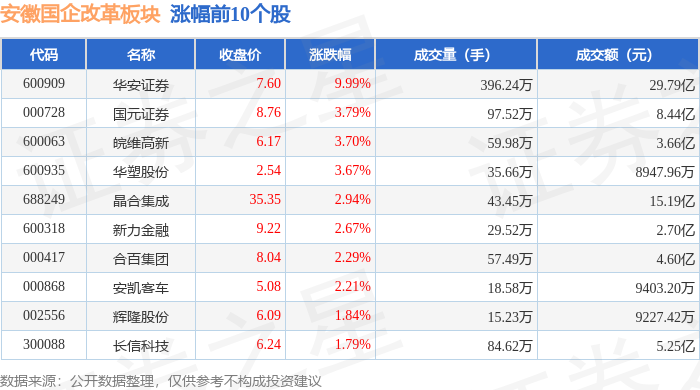
Market Performance - The Anhui state-owned enterprise reform sector rose by 1.28% compared to the previous trading day, with Huazhong Securities leading the gains [1] - The Shanghai Composite Index closed at 4083.67, up by 1.5%, while the Shenzhen Component Index closed at 14022.55, up by 1.4% [1] Stock Performance - Huazhong Securities (600909) closed at 7.60, with a significant increase of 9.99% and a trading volume of 3.96 million shares, amounting to a transaction value of 2.979 billion [1] - Guoyuan Securities (000728) and Anhui High-tech (600063) also saw increases of 3.79% and 3.70%, respectively [1] - Other notable stocks included Baosujiao Supply (600935) and Jinghe Integrated (688249), which rose by 3.67% and 2.94% respectively [1] Capital Flow - The Anhui state-owned enterprise reform sector experienced a net outflow of 33.08 million yuan from institutional investors, while retail investors saw a net inflow of 22.86 million yuan [2] - The overall capital flow indicates a mixed sentiment, with institutional investors withdrawing funds while retail investors increased their positions [2] Individual Stock Capital Flow - Huazhong Securities had a net inflow of 533 million yuan from institutional investors, but a net outflow of 212 million yuan from speculative funds [3] - Guoyuan Securities experienced a net inflow of 102 million yuan from institutional investors, but a significant outflow from speculative and retail investors [3] - Jinghe Integrated saw a net inflow of 58.68 million yuan from institutional investors, indicating strong interest in the stock [3]


中泰时钟资产配置月报(2601):PPI筑底,布局景气修复-20260105
ZHONGTAI SECURITIES· 2026-01-05 13:38
Group 1: Core Insights - The report predicts that the Producer Price Index (PPI) will slowly rebound to near zero in the first half of 2026, with the AR-gap and Phillips curve models indicating a mild recovery in PPI year-on-year, although the support from macro variables is weaker than the momentum of inflation itself [7][19]. - Beneficiary sectors during the historical periods when PPI rises from negative to positive include non-ferrous metals, real estate, building materials, machinery, electricity, home appliances, agriculture, coal, electronics, food and beverage, and pharmaceuticals [7][21]. - The liquidity-sensitive mode of major assets indicates that market sentiment has reached the upper range of historical thresholds, leading to a decrease in the explanatory power of sentiment on equity asset gains, suggesting a potential decline in momentum driven by sentiment [7][39]. Group 2: Inflation and Beneficiary Sectors - The report highlights that the "anti-involution" policy has led to market expectations of "price recovery," which helps to change the deflationary mindset, although the upward space for inflation is constrained by demand [19]. - Historical analysis shows that during periods when PPI rises from the bottom to near zero, sectors such as non-ferrous metals, real estate, building materials, machinery, steel, electricity, and public utilities exhibit significant positive marginal impacts on overall equity markets [21][27]. - The report identifies that the structural opportunities in the consumer sector are present, while the dividend sector faces both profit and valuation pressures [7][27]. Group 3: Macro and Funding Perspectives - The macro liquidity environment is characterized by a "price soft and volume stable" pattern, with marginal recovery in base currency issuance but still relying on rapid declines in interest rates to improve the overall funding situation [46]. - Global macro liquidity is also showing marginal recovery, primarily driven by strong expectations of interest rate cuts by the Federal Reserve, leading to significant capital inflows into the Hong Kong stock market [46][48]. - The report notes that the recent surge in new applications for equity funds indicates a warming market sentiment, with expectations that major funds will concentrate their investments around the end of the first quarter of 2026 [53][60]. Group 4: Style Allocation - The report indicates that the information ratio for dividend and consumer sectors continues to decline, with no reversal signals currently, while the information ratio for cyclical sectors is rapidly strengthening, suggesting a shift in focus towards growth sectors to capture momentum gains [74]. - The growth sector's net value is approaching previous highs, but there is still significant room for the information ratio to rise, indicating a potential for better performance in this area [74].
转债市场日度跟踪20251231:债券日报-20260104
Huachuang Securities· 2026-01-04 14:45
Report Industry Investment Rating No relevant content provided. Core Viewpoints On December 31, more than half of the convertible bond industries rose, and the valuation increased month - on - month. The convertible bond market trading sentiment weakened, and the median price of convertible bonds increased. Different industries in the A - share and convertible bond markets showed different trends in terms of rise and fall [1]. Summary by Related Catalogs Market Overview - **Index Performance**: The CSI Convertible Bond Index rose 0.02% month - on - month, the Shanghai Composite Index rose 0.09%, the Shenzhen Component Index fell 0.58%, the ChiNext Index fell 1.23%, the SSE 50 Index fell 0.18%, and the CSI 1000 Index fell 0.03% [1]. - **Market Style**: Mid - cap value was relatively dominant. Large - cap growth fell 0.82%, large - cap value fell 0.13%, mid - cap growth fell 0.42%, mid - cap value rose 0.45%, small - cap growth rose 0.14%, and small - cap value fell 0.17% [1]. - **Fund Performance**: The trading sentiment in the convertible bond market weakened. The trading volume of the convertible bond market was 74.68 billion yuan, a 0.50% month - on - month decrease; the total trading volume of the Wind All - A was 2.065788 trillion yuan, a 4.43% month - on - month decrease; the net outflow of the main funds in the Shanghai and Shenzhen stock markets was 23.828 billion yuan, and the yield of the 10 - year treasury bond decreased 1.09bp to 1.85% [1]. Convertible Bond Price - The weighted average closing price of convertible bonds was 134.60 yuan, a 0.07% month - on - month increase. Among them, the closing price of equity - biased convertible bonds was 196.81 yuan, a 2.93% month - on - month decrease; the closing price of bond - biased convertible bonds was 119.10 yuan, a 0.21% month - on - month increase; the closing price of balanced convertible bonds was 130.12 yuan, a 0.32% month - on - month increase [2]. - The proportion of high - price bonds above 130 yuan was 60.57%, a 0.63pct month - on - month increase. The interval with the largest change in proportion was 110 - 120 (including 120), with a proportion of 8.36%, a 1.07pct month - on - month decrease. There were 0 bonds with a closing price below 100 yuan. The median price was 133.05 yuan, a 0.34% month - on - month increase [2]. Convertible Bond Valuation - The fitted conversion premium rate of 100 - yuan parity was 34.04%, a 0.50pct month - on - month increase; the overall weighted parity was 101.47 yuan, a 0.36% month - on - month decrease [2]. - The premium rate of equity - biased convertible bonds was 16.20%, a 2.18pct month - on - month decrease; the premium rate of bond - biased convertible bonds was 86.36%, a 0.42pct month - on - month decrease; the premium rate of balanced convertible bonds was 26.25%, a 1.08pct month - on - month increase [2]. Industry Performance - **A - share Market**: Among the 31 sectors, 15 industries rose. The top three industries in terms of increase were national defense and military industry (+2.13%), media (+1.54%), and real estate (+1.13%); the top three industries in terms of decline were communication (-1.35%), agriculture, forestry, animal husbandry and fishery (-1.10%), and electronics (-1.02%) [3]. - **Convertible Bond Market**: A total of 17 industries rose. The top three industries in terms of increase were beauty care (+2.81%), national defense and military industry (+2.50%), and building materials (+1.45%); the top three industries in terms of decline were non - bank finance (-1.43%), light industry manufacturing (-1.32%), and steel (-0.69%) [3]. - **Comprehensive Indicators**: - Closing price: Large - cycle increased 0.18%, manufacturing decreased 0.02%, technology increased 0.86%, large - consumption increased 0.49%, and large - finance decreased 0.76% [3]. - Conversion premium rate: Large - cycle increased 0.45pct, manufacturing increased 0.9pct, technology decreased 0.7pct, large - consumption increased 0.15pct, and large - finance increased 0.22pct [3]. - Conversion value: Large - cycle decreased 0.20%, manufacturing decreased 0.16%, technology increased 1.36%, large - consumption increased 0.55%, and large - finance decreased 1.23% [3]. - Pure bond premium rate: Large - cycle increased 0.27pct, manufacturing increased 0.041pct, technology increased 1.5pct, large - consumption increased 0.59pct, and large - finance decreased 0.94pct [4]. Industry Rotation The national defense and military industry, media, and real estate led the rise. The national defense and military industry had a daily increase of 2.13% in the A - share market and 2.50% in the convertible bond market; the media had a daily increase of 1.54% in the A - share market and 0.75% in the convertible bond market; the real estate had a daily increase of 1.13% in the A - share market [57].
越南自2026年1月起生效的重要经济政策
Shang Wu Bu Wang Zhan· 2026-01-01 16:46
Group 1: New Economic Policies in Vietnam - From January 2026, several important new economic policies will take effect in Vietnam, including the Special Consumption Tax Law, Advertising Law, land use fee reductions, minimum wage increases, and a technology transfer mechanism for railway projects [1] Group 2: Special Consumption Tax Law - The new Special Consumption Tax Law, passed on June 14, 2025, aims to increase fiscal budget revenue, adjust consumption behavior, and guide the market towards sustainable development [2] Group 3: Advertising Law Adjustments - The amended Advertising Law, passed on June 16, 2025, focuses on administrative reform, reducing compliance costs for businesses, and enhancing the efficiency of advertising activities in a digital economy context [3] Group 4: International Financial Center Court Law - The National Assembly has passed the International Financial Center Court Law, establishing the court's functions, structure, and procedures, which is a significant legislative achievement [4] Group 5: ODA and Foreign Loan Regulations - New regulations on Official Development Assistance (ODA) and foreign loan transfer mechanisms have been introduced to enhance flexibility and expand access to preferential funding, supporting development investments [5] Group 6: Price Management Mechanism - The amended Price Law focuses on expanding regulatory scope, protecting consumers, and improving market transparency, which is essential for macroeconomic stability [6] Group 7: Macro-Economic Stability and Sustainable Development - The National Budget Law emphasizes maintaining macroeconomic stability and sustainable development, incorporating transparency and social oversight into the fiscal budget framework [7] Group 8: Railway Investment Prioritization - The Railway Law designates railways as a priority investment area, introducing mechanisms to encourage private sector participation in railway infrastructure development [8] Group 9: Statistical Law Adjustments - The amended Statistical Law aims to improve economic and social governance by reducing compliance costs and enhancing data transparency [10] Group 10: Land Use Fee Reductions - A resolution allows for reduced land use fees when converting agricultural land to residential use, aimed at alleviating financial burdens on families and meeting housing demands [11] Group 11: Agricultural Land Tax Policy - A new policy extends the tax exemption period for agricultural land use, encouraging production scale expansion and enhancing agricultural competitiveness [12] Group 12: Minimum Wage Increase - The minimum wage has been set between 3.7 million and 5.31 million VND per month, aimed at ensuring worker income and purchasing power [12] Group 13: Railway Technology Transfer Mechanism - A new decree establishes a special mechanism for technology development and transfer in the railway sector, promoting local capabilities and reducing reliance on foreign technology [13] Group 14: New Accounting Standards - The new accounting standards issued by the Ministry of Finance aim to align with international standards, enhancing financial transparency and financing capabilities for businesses [14] Group 15: Corporate Tax Incentives for Electronics Manufacturing - New standards for corporate tax incentives for electronics manufacturing companies have been introduced, aimed at reducing costs and encouraging investment in high-tech sectors [15]
资金周报:本周主力资金连续净流出
Zheng Quan Shi Bao Wang· 2025-12-31 11:04
沪指本周上涨0.13%,深成指下跌0.58%,创业板指下跌1.25%,沪深300指数下跌0.59%。可交易A股 中,上涨的有2000只,占比36.62%,下跌的3398只。 资金面上,本周主力资金合计净流出1212.93亿元,各交易日资金均为净流出状态。其中,创业板主力 资金净流出331.98亿元;科创板主力资金净流出92.33亿元;沪深300成份股主力资金净流出390.53亿 元。 本周主力资金流向概况(单位:亿元) | 日期 | 深沪两市 | 创业板 | 科创板 | 沪深300 | | --- | --- | --- | --- | --- | | 一周合计 | -1212.93 | -331.98 | -92.33 | -390.53 | | 12月31日 | -322.70 | -102.21 | -35.54 | -191.76 | | 12月30日 | -282.29 | -65.22 | -19.12 | 6.22 | | 12月29日 | -607.95 | -164.55 | -37.67 | -204.99 | 行业来看,申万所属的一级行业中,本周上涨的有12个,涨幅居前的行业为石油石化、 ...
财政工作会议召开,积极财政政策继续加码,500质量成长ETF(560500)获资金青睐
Sou Hu Cai Jing· 2025-12-29 02:50
Core Insights - The China Securities 500 Quality Growth Index (930939) has shown a decline of 0.26% as of December 29, 2025, with silver and non-ferrous metals leading the gains at 8.52% [1] - The index is characterized by a mid-cap growth style, particularly benefiting from sectors like advanced manufacturing and artificial intelligence, which are aligned with long-term investment preferences [2] Group 1: Index Performance and Composition - The top ten weighted stocks in the China Securities 500 Quality Growth Index account for 21.53% of the index, with notable companies including Huagong Technology and Kaiying Network [3] - The 500 Quality Growth ETF (560500) has a recent scale of 481 million yuan and has attracted a total of 27.74 million yuan in inflows over the last ten trading days [1][2] Group 2: Market and Policy Context - The national fiscal work conference held on December 28 emphasized the continuation of a more proactive fiscal policy into 2026, focusing on expanding fiscal spending and optimizing government bond tools [1] - The index's configuration value is enhanced by its alignment with policy directions, particularly in emerging sectors, which is expected to attract further capital inflows [2]