货币金融服务

Search documents
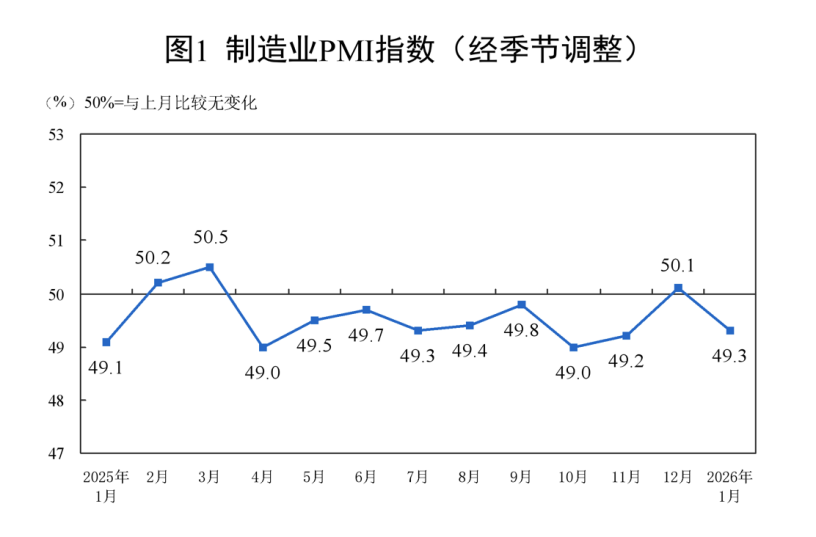
1月份制造业PMI为49.3%
Ren Min Ri Bao Hai Wai Ban· 2026-02-02 01:48
Group 1 - The manufacturing Purchasing Managers' Index (PMI) for January is 49.3%, a decrease of 0.8 percentage points from the previous month, indicating a decline in manufacturing activity due to seasonal factors and insufficient market demand [2] - The production index stands at 50.6%, indicating continued expansion in manufacturing production, while the new orders index is at 49.2%, reflecting a drop in market demand [2] - Certain industries such as agricultural processing and aerospace have production and new orders indices above 56.0%, indicating strong demand, while sectors like petroleum and automotive show indices below the critical point, suggesting a slowdown in market demand [2] Group 2 - The main raw materials purchasing price index and the factory price index are at 56.1% and 50.6%, respectively, both showing increases from the previous month, with the factory price index rising above the critical point for the first time in nearly 20 months [3] - Large enterprises maintain a PMI of 50.3%, indicating continued expansion, while medium and small enterprises show PMIs of 48.7% and 47.4%, reflecting a decline in their economic performance [3] - High-tech manufacturing leads with a PMI of 52.0%, remaining above 52.0% for two consecutive months, while consumer goods and high-energy industries show lower PMIs of 48.3% and 47.9%, indicating a decrease in their economic conditions [3] Group 3 - The production and business activity expectation index is at 52.6%, indicating optimism among enterprises, particularly in agricultural processing and food industries, which have indices above 56.0% [4] - The non-manufacturing business activity index for January is 49.4%, a decrease of 0.8 percentage points from the previous month, indicating a decline in overall non-manufacturing activity [4] - The service industry business activity index is at 49.5%, down 0.2 percentage points, with sectors like financial services showing high activity indices above 65.0%, while the real estate sector drops below 40.0%, indicating weak performance [4]

1月份中国采购经理指数有所回落
Guo Jia Tong Ji Ju· 2026-02-02 01:05
Group 1: Manufacturing Sector - The manufacturing Purchasing Managers' Index (PMI) decreased to 49.3% in January, indicating a decline in economic sentiment compared to the previous month [1][2] - The production index remained above the critical point at 50.6%, suggesting continued expansion in manufacturing production, while the new orders index fell to 49.2%, indicating a drop in market demand [2] - Large enterprises maintained a PMI of 50.3%, indicating ongoing expansion, while small and medium-sized enterprises saw declines in their PMIs to 48.7% and 47.4%, respectively [3] - High-tech manufacturing continued to lead with a PMI of 52.0%, reflecting a positive development trend in this sector [3] - The price indices for major raw materials and factory prices rose to 56.1% and 50.6%, respectively, indicating an overall improvement in market price levels [2] Group 2: Non-Manufacturing Sector - The non-manufacturing business activity index fell to 49.4%, reflecting a decrease in overall economic sentiment in this sector [1][4] - The service industry business activity index was at 49.5%, with significant activity in financial services, while the real estate sector's index dropped below 40.0%, indicating weak sentiment [4] - The construction industry experienced a notable decline, with its business activity index at 48.8%, influenced by adverse weather and the upcoming holiday [4] - Despite the decline in current activity, the service industry business activity expectation index rose to 57.1%, indicating increased confidence among service sector enterprises [4] Group 3: Composite PMI - The composite PMI output index was recorded at 49.8%, showing a slight decrease from the previous month, indicating a general slowdown in production and business activities [1][5] - The manufacturing production index and non-manufacturing business activity index were 50.6% and 49.4%, respectively, contributing to the overall composite PMI output index [5]
1月制造业生产保持扩张 金融市场活跃度较高
Zhong Guo Zheng Quan Bao· 2026-02-01 20:53
● 本报记者 连润 国家统计局1月31日发布的数据显示,1月份,制造业采购经理指数(PMI)为49.3%,比上月下降0.8个 百分点,其中,生产指数为50.6%,高于临界点,制造业生产保持扩张。非制造业商务活动指数为 49.4%,从行业看,货币金融服务、资本市场服务、保险等行业商务活动指数均高于65.0%,金融市场 活跃度较高。 出厂价格指数升至临界点以上 "1月份,部分制造业行业进入传统淡季,加之市场有效需求仍显不足,制造业PMI为49.3%,景气水平 较上月下降。"国家统计局服务业调查中心首席统计师霍丽慧表示。 从分项指数看,价格指数双双回升。霍丽慧分析,1月份,受近期部分大宗商品价格上涨等因素影响, 主要原材料购进价格指数和出厂价格指数分别为56.1%和50.6%,比上月上升3.0个和1.7个百分点,其中 出厂价格指数近20个月来首次升至临界点以上,制造业市场价格总体水平改善。 从非制造业看,霍丽慧表示,1月份,受建筑业等行业景气度下降等因素影响,非制造业商务活动指数 为49.4%,比上月下降0.8个百分点,非制造业总体景气水平有所回落。(下转A02版) 高技术制造业持续领跑。1月份,高技术制造业PMI ...
1月制造业PMI为49.3% 高技术制造业发展态势持续向好
Shang Hai Zheng Quan Bao· 2026-02-01 18:14
□ 1月生产指数为50.6%,高于临界点,制造业生产保持扩张 □ 1月高技术制造业PMI为52.0%,连续2个月位于52.0%及以上较高水平,行业发展态势持续向好。装备 制造业PMI为50.1%,保持在扩张区间 □ 1月主要原材料购进价格指数和出厂价格指数分别为56.1%和50.6%,分别比2025年12月上升3.0个百分 点和1.7个百分点。其中,原材料购进价格指数创2024年6月以来新高,出厂价格指数是近20个月来首次 升至临界点以上 □ 1月制造业企业生产经营活动预期指数为52.6%,继续高于临界点 □ 1月服务业业务活动预期指数为57.1%,比2025年12月上升0.7个百分点,连续2个月环比上升,表明服 务业企业对近期市场发展信心有所增强 ◎记者 陈芳 从制造业PMI的分项指标看,企业生产增势有所放缓,但整体仍保持扩张态势,市场需求承压运行,新 订单指数和新出口订单指数均回落。 数据显示:1月生产指数为50.6%,高于临界点,制造业生产保持扩张;新订单指数为49.2%,较2025年 12月下降1.6个百分点;新出口订单指数为47.8%,较2025年12月下降1.2个百分点。 对于需求回落的原因,中国 ...
1月制造业PMI为49.3% 出厂价格指数近20个月来首次升至临界点以上
Xin Lang Cai Jing· 2026-02-01 13:07
Group 1 - In January, the manufacturing Purchasing Managers' Index (PMI) decreased to 49.3%, indicating a decline in economic sentiment [1] - The non-manufacturing business activity index fell to 49.4%, reflecting a decrease in overall economic activity [1] - The comprehensive PMI output index also dropped to 49.8%, showing a general downturn in economic conditions [1] Group 2 - The decline in manufacturing PMI is attributed to seasonal factors, as many industries enter a traditional off-peak period in January [2] - The PMI index is affected by a high base effect from December 2025, which saw a significant increase, thus impacting January's figures [2] - Weak internal investment and consumption demand, along with high external uncertainties, are major factors dragging down the manufacturing sector [2] Group 3 - The raw material purchase price index rose to 56.1%, while the factory price index increased to 50.6%, marking the first time in nearly 20 months that the factory price index exceeded the critical point [3] - The difference between the raw material purchase price index and the factory price index indicates a transfer of profits upstream [3] - Recent structural policies aimed at supporting small and medium enterprises and technology firms are expected to take time to positively impact the manufacturing sector [3] Group 4 - The non-manufacturing business activity index's decline is influenced by the downturn in industries such as construction, with the index falling to 49.4% [4] - The real estate sector's business activity index dropped below 40.0%, indicating a weak overall sentiment in that industry [4] - Financial services and capital market services showed higher activity levels, with indices above 65.0%, reflecting a more active market [4] Group 5 - The overall macroeconomic sentiment is declining due to seasonal fluctuations, high previous month bases, and insufficient effective demand from the real estate market [5] - The manufacturing production index is expected to decline significantly in February due to the extended Spring Festival holiday [5] - Future manufacturing sentiment will be influenced by export growth, real estate market trends, and the timing and intensity of growth-stimulating policies [5]
价格继续抑制需求
CAITONG SECURITIES· 2026-02-01 06:45
Group 1: Economic Indicators - The manufacturing Purchasing Managers' Index (PMI) for January is 49.3%, down 0.8 percentage points from the previous month, indicating a return below the growth threshold[3][7]. - The new export orders index and new orders index for January are 47.8% and 49.2%, respectively, down 1.2 and 1.6 percentage points from last month, both remaining below the growth threshold[5][13]. - The production expansion speed has slowed, with the manufacturing PMI at 50.6%, down 1.1 percentage points from the previous month, still above the growth threshold[16]. Group 2: Inventory and Pricing Dynamics - The finished goods inventory index for January is 48.6%, up 0.4 percentage points from last month, slightly above seasonal levels; the raw materials inventory index is 47.4%, down 0.4 percentage points, below seasonal levels[17][21]. - The price scissors difference between raw material purchase prices and factory prices is 5.5%, up 1.3 percentage points from last month, indicating further compression of profit margins for enterprises[20][23]. - The main raw material purchase price index is 56.1%, up 3.0 percentage points from last month, reflecting significant price increases in the commodity market[20]. Group 3: Demand Weakness and Risks - External demand is weakening due to changes in trade policies and a decline in the U.S. consumer confidence index, which fell from 94.2% to 84.5%, the lowest since May 2014[15]. - Internal demand is also showing signs of weakness, with the difference between new orders and new export orders dropping from 1.8% in December 2025 to 1.4% in January 2026[15]. - Risks include potential underperformance of domestic policy measures, unexpected changes in international geopolitical situations, and measurement errors in PMI indicators related to anti-involution industries[40].
PMI意外回落,什么信号
HUAXI Securities· 2026-01-31 13:25
证券研究报告|宏观点评报告 [Table_Date] 2026 年 01 月 31 日 [Table_Title] PMI 意外回落,什么信号 1 月 31 日, 统计局发布 1 月 PMI。制造业 PMI 49.3%,前值 50.1%。非制造业 PMI 49.4%,前值 50.2%。重点关注以下四个方面: 第一,制造业 PMI 回落,生产和订单是主要拖累。1 月制造业 PMI 回落 0.8 个百分点至 49.3%,与去年 11 月的 49.2%接近,表现显著弱于市场预期(彭博预期 50.1%)。组成制造业 PMI的五个分项中,主要是生产、新 订单明显回落,生产回落 1.1 个百分点至 50.6%,新订单回落 1.6 个百分点至 49.2%,两者分别拖累 PMI 0.3、 0.5 个百分点。 制造业回落幅度超出季节性。PMI 已通过季调方式部分剔除季节性规律,不过春节早晚对 12 月、1 月到 3 月 PMI 仍会有一定程度影响,难以完全剔除。我们参考春节类似日期的年份,2015(2 月 19 日)、2018(2 月 16 日)、2021(2 月 12 日),制造业生产分项 1 月相对前一年 12 月回落 0 ...
年初产需降温——1月PMI数据解读【陈兴团队·华福宏观】
陈兴宏观研究· 2026-01-31 10:27
Group 1 - The manufacturing PMI in January recorded a decline to 49.3%, which is 0.8 percentage points lower than the previous month and below the median level of the past five years [4][3] - Key sub-indices such as new orders, production, raw material inventory, and employment all showed a decrease, indicating a cooling in both supply and demand [4][2] - The new orders index fell to 49.2%, down 1.6 percentage points from the previous month, while the production index decreased to 50.6%, down 1.1 percentage points [6][4] Group 2 - The price index has risen significantly due to recent increases in commodity prices, with the raw material purchase price index at 56.1%, down 3.0 percentage points, and the factory price index at 50.6%, up 1.7 percentage points [8][3] - The construction industry has seen a notable decline, with the new orders index dropping significantly, leading to a business activity index of 48.8%, the lowest since April 2020 [9][3] - The non-manufacturing business activity index fell to 49.4%, with the service sector also experiencing a slight decline, indicating overall weak economic conditions [9][12]

1月份制造业采购经理指数有所回落
Xin Hua Cai Jing· 2026-01-31 06:59
Group 1: Manufacturing Sector - The manufacturing Purchasing Managers' Index (PMI) for January is 49.3%, indicating a decline from the previous month [1][2] - The production index remains above the critical point at 50.6%, showing continued expansion in manufacturing production [2] - New orders index is at 49.2%, reflecting a decrease in market demand [2] - Certain industries, such as agricultural processing and aerospace, show strong production and new orders indices above 56.0%, while sectors like automotive and fuel processing are below the critical point [2] - Price indices for raw materials and factory output have risen, with the raw material purchase price index at 56.1% and the factory price index at 50.6%, marking an improvement in overall market prices [2] Group 2: Large vs. Small Enterprises - Large enterprises have a PMI of 50.3%, indicating continued expansion, while medium and small enterprises have PMIs of 48.7% and 47.4%, respectively, showing a decline [3] - High-tech manufacturing leads with a PMI of 52.0%, indicating a positive development trend [3] - Consumer goods and high-energy industries show lower PMIs of 48.3% and 47.9%, respectively, indicating a downturn in these sectors [3] Group 3: Non-Manufacturing Sector - The non-manufacturing business activity index is at 49.4%, reflecting a decrease from the previous month [4] - The service sector's business activity index is at 49.5%, with financial services showing high activity levels above 65.0%, while the real estate sector is below 40.0% [4] - The construction sector's business activity index has dropped to 48.8%, indicating a significant decline in activity due to seasonal factors [4] Group 4: Composite PMI - The composite PMI output index is at 49.8%, indicating a slowdown in overall business activities compared to the previous month [5] - The manufacturing production index is at 50.6%, while the non-manufacturing business activity index is at 49.4%, contributing to the composite index's decline [5]
资本市场服务等行业市场活跃度较高!国家统计局最新发布
Xin Lang Cai Jing· 2026-01-31 05:00
国家统计局1月31日发布数据显示,1月份,制造业采购经理指数(PMI)、非制造业商务活动指数和综合PMI产出指数分别为49.3%、49.4%和49.8%,比 上月下降0.8个、0.8个和0.9个百分点,经济景气水平有所回落。 从行业看,货币金融服务、资本市场服务、保险等行业商务活动指数均高于65.0%,市场活跃度较高。 出厂价格指数近20个月来首次升至临界点以上 "1月份,部分制造业行业进入传统淡季,加之市场有效需求仍显不足,制造业PMI为49.3%,景气水平较上月下降。"国家统计局服务业调查中心首席统计 师霍丽慧表示。 高技术制造业持续领跑。1月份,高技术制造业PMI为52.0%,连续两个月位于52.0%及以上较高水平,相关行业发展态势持续向好。装备制造业PMI为 50.1%,保持在扩张区间。消费品行业和高耗能行业PMI分别为48.3%和47.9%,景气水平有所回落。 企业预期保持乐观。1月份,生产经营活动预期指数为52.6%,继续高于临界点。从行业看,农副食品加工、食品及酒饮料精制茶等行业生产经营活动预 期指数连续两个月位于56.0%以上较高景气区间,相关企业对近期行业发展信心较强。 "1月份,受季节性因 ...