
石化化工

Search documents
石化化工行业迎利好!7部门联合发布重磅文件 “反内卷”有序推进
Hua Xia Shi Bao· 2025-10-03 00:30
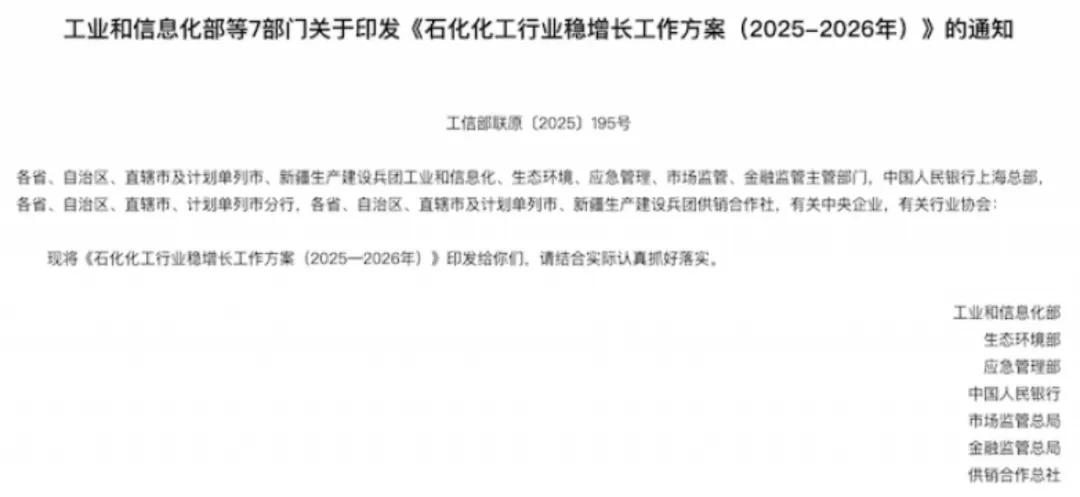
Core Viewpoint - The recently released "Petrochemical Industry Stabilization Growth Work Plan (2025-2026)" aims to address the challenges of overcapacity in refining and insufficient supply in high-end materials, targeting an average annual growth of over 5% in the industry's added value during this period [2][4]. Group 1: Industry Challenges - The petrochemical industry is currently facing intensified competition in the basic organic raw materials market, slowing domestic demand growth, and increasing external uncertainties [4]. - In 2024, domestic refined oil demand is expected to peak and decline, leading to overcapacity in refining, with national refining capacity reaching 955 million tons per year [4]. - The government aims to control crude oil processing capacity within 1 billion tons by 2025 as part of the "14th Five-Year" modern energy system planning [4]. Group 2: Policy Measures - The plan emphasizes strict control over new refining capacity and the scientific regulation of new capacity for ethylene and paraxylene, while supporting the renovation of outdated petrochemical facilities and the demonstration of new technologies [4][5]. - By the end of 2025, the plan aims to complete the relocation and transformation of hazardous chemical production enterprises in densely populated urban areas [4]. Group 3: High-End Supply Enhancement - The plan identifies key areas such as electronic chemicals, high-end polyolefins, and specialty rubbers to enhance supply capabilities and promote domestic production of critical materials [6]. - The demand for new materials in emerging industries like new energy, low-altitude economy, and humanoid robots is expected to create new growth opportunities for the industry [7]. Group 4: Market Dynamics - The "anti-involution" policy aims to prevent vicious competition within the industry, with recent actions indicating a shift towards optimizing the supply-demand structure [9]. - For instance, a recent announcement from Xinxiang Chemical Fiber to suspend production of 31,200 tons of viscose filament yarn for 90 days will impact approximately 13% of the industry supply [9]. Group 5: Investment Outlook - The release of the plan has renewed market expectations for the petrochemical sector, with analysts noting that the industry is likely to transition from a focus on scale expansion to optimizing existing capacity and pursuing high-quality growth [11]. - Future investment opportunities are anticipated in both price recovery cycles and the development of high-end new materials [11].

申万宏源:十五五产能优化与科技攻坚共振,AI应用蓄势待发(附十大行业前瞻)
Xin Lang Cai Jing· 2025-10-02 10:45
Group 1: 15th Five-Year Plan Outlook - The primary direction for industrial structure adjustment during the 15th Five-Year Plan is transformation and upgrading, with continued support for technological innovation [1] - The real estate sector is expected to stabilize, with new product development and pricing models emerging in core cities [1] - The home appliance industry will focus on smart, green, and globalized policies, aligning with future manufacturing directions [1] - The construction industry will emphasize overseas expansion and smart construction [1] - The importance of strategic resources will increase, benefiting the prices of non-ferrous metals [1] - Cement and glass industries will face strict capacity controls, focusing on profit recovery rather than just revenue [1] - The chemical industry will see a shift towards replacing outdated capacity, with a positive outlook for chemical exports [1] - The new energy sector is expected to experience favorable supply-demand dynamics, with significant growth in wind and solar power installations [1] - The coal industry will see increased resource scarcity and improved performance as prices rise [1] - The technology sector will benefit from government subsidies for AI capabilities and applications [1] - The cultural industry may see relaxed regulations for overseas expansion, positively impacting supply-side recovery [1] Group 2: AI and Computing Sector Insights - Breakthroughs in computing power and AI applications are expected to lead to a surge in the sector by 2026, with companies achieving over 10% revenue from AI [2] - Despite short-term pressures from subsidy reductions, long-term support for domestic semiconductor replacements remains strong [2] - The internet and cloud computing sectors are experiencing a positive cycle of investment and operational efficiency, with a focus on global entertainment and self-consumption [2] - The telecommunications sector is concentrating on 6G and satellite internet development, with opportunities in the IDC supply chain [2] - E-commerce is currently in a phase of competition for existing market share, but AI products are expected to offset negative impacts from subsidy reductions [2] Group 3: Q3 Earnings Outlook - The reduction in national subsidies is expected to pressure earnings in light industry, consumer electronics, and home appliances [3] - The non-ferrous metals sector is anticipated to see continued improvement in Q3 earnings due to rising domestic metal prices [3] - The pharmaceutical sector is not expected to face severe impacts from tariff policies, contrary to some investor fears [3] - The agricultural sector is projected to see weak growth, particularly in pig prices, through Q1 2026 [3] - The light industry is under pressure from both overseas demand and domestic subsidy reductions, leading to continued earnings challenges [3] - The consumer electronics sector may experience marginal declines in growth following subsidy cuts [3] - The chemical industry is expected to achieve stable growth, with a target of over 5% annual increase in value added by 2025-2026 [3] - The food and beverage sector is facing weak demand, but market expectations are low, which may provide some support [3] - The military industry is projected to see overall revenue and earnings growth, with ongoing attention to the 15th Five-Year Plan's impact [3]

石化化工行业迎利好!7部门联合发布重磅文件,“反内卷”有序推进
Hua Xia Shi Bao· 2025-10-01 07:44
Core Viewpoint - The petrochemical industry in China is set to experience an average annual growth of over 5% in value added from 2025 to 2026, as outlined in the recently released "Petrochemical Industry Stabilization Growth Work Plan (2025-2026)" by multiple government departments [2][3]. Group 1: Industry Challenges and Responses - The petrochemical industry faces intensified competition in the basic organic raw materials market, slowing domestic demand growth, and increased external uncertainties [3]. - The plan emphasizes strict control over new refining capacity and aims to manage the pace of new capacity for ethylene and paraxylene, while supporting the renovation of outdated facilities and the "reduce oil and increase chemicals" initiative [3][4]. Group 2: Focus on High-End Supply - There is a notable shortage in high-end chemical new materials and fine chemicals, necessitating improvements in the supply of key products and raw materials [4][5]. - The plan identifies electronic chemicals, high-end polyolefins, and specialty rubbers as key areas for technological innovation and effective supply enhancement [5]. Group 3: Emerging Market Opportunities - The demand for materials in emerging fields is robust, with applications in sectors such as electric vehicle battery materials, carbon fiber composites, and specialty engineering plastics [5][6]. - PEEK, a high-performance polymer, is highlighted for its potential to replace metals in various applications, including humanoid robots, due to its superior strength-to-weight ratio and durability [6]. Group 4: Industry Structural Optimization - Recent high-level meetings have focused on preventing "involution" or excessive competition within the industry, leading to a more optimized supply-demand structure [7][8]. - The chemical industry is witnessing a shift from a focus on expansion to optimizing existing capacities and pursuing high-quality growth, which is expected to create better investment opportunities [9].
华泰证券今日早参-20250930
HTSC· 2025-09-30 01:22
Group 1: Securities Industry - The report highlights a favorable configuration opportunity in the securities sector, driven by multiple factors including policy support for capital market development, increased market participation from institutions and residents, and a recovery in brokerage business lines [2][4]. - The current valuation and positioning of the brokerage sector are at mid-low levels since 2014, suggesting a high cost-performance investment opportunity [2][4]. Group 2: Nonferrous Metals Industry - The Ministry of Industry and Information Technology and other departments released a "Stabilization Growth Work Plan for the Nonferrous Metals Industry (2025-2026)", aiming to address resource security and demand issues, promoting stable operation and transformation of the industry [2][3]. - Short-term investment opportunities are expected in the recycling metals and copper smelting sectors, while long-term benefits are anticipated for domestic copper, aluminum, and lithium resource mining companies [2][3]. - Companies with extensive experience in copper, aluminum, and magnesium alloy processing are likely to benefit from the upgrading of materials in automotive and electronics sectors, leading to increased processing fees and profits [2][3]. Group 3: Banking Sector - The report indicates an improvement in the cost-performance ratio for quality banks, with some banks' dividend yields exceeding 5% [4]. - The banking sector is expected to see a recovery in core business profitability and asset quality, driven by policy focus on stabilizing interest margins and preventing tail risks [4]. - Recommended stocks include quality regional banks and those with stable dividends, such as Shanghai Pudong Development Bank and Industrial and Commercial Bank of China [4]. Group 4: Power Equipment and New Energy - The lithium battery industry is experiencing a significant increase in production, with a projected output of 135.8 GWh in October, reflecting a 7.9% month-on-month increase [5]. - The demand for energy storage is expected to exceed expectations, driven by the domestic market and the electrification of commercial vehicles [5]. Group 5: Petrochemical Industry - The "Stabilization Growth Work Plan for the Petrochemical Industry (2025-2026)" aims to enhance high-end supply and regulate major project construction, which is expected to optimize supply in various sub-sectors [9]. - The report recommends companies such as Hengli Petrochemical and Tongkun Co., Ltd. due to anticipated improvements in industry conditions and the development of high-end chemical materials [9]. Group 6: Company Ratings - Changfei Optical Fiber is rated "Buy" with a target price of 115.52 RMB, driven by its leading position in the optical fiber market and expected growth from AI infrastructure [12][14]. - The report also highlights the dual business strategy of Weigao Medical, projecting a return to normal operations in its consumer goods segment and continued growth in its medical segment [13][14].
华泰证券:石化化工行业稳增长工作方案发布 行业景气修复可期
Xin Lang Cai Jing· 2025-09-29 23:51
Group 1 - The core viewpoint of the article is the issuance of the "Work Plan for Stable Growth in the Petrochemical Industry (2025-2026)" by the Ministry of Industry and Information Technology and six other departments, which aims to enhance high-end supply and regulate major project construction [1] - The plan specifies new capacity regulation requirements for various sub-sectors including refining, ethylene, PX, coal-to-methanol, and modern coal chemical industry, which will help optimize supply [1] - The report from Huatai Securities suggests that the chemical raw materials and products industry is showing signs of a turning point in capital expenditure growth since the first half of 2025, indicating potential recovery in industry prosperity [1] Group 2 - The enhancement of high-end supply is expected to accelerate the development of high-end chemical materials in sectors such as electronics, new energy, and medical equipment, as well as emerging technologies like biochemistry, green ammonia/alcohol, and seawater potassium extraction [1]

国林科技筹划现金收购凯涟捷石化91.07%股权 预计构成重大资产重组
Zhi Tong Cai Jing· 2025-09-29 11:07
Group 1 - The company is planning to acquire 91.07% of the shares of Xinjiang Kailianjie Petrochemical Co., Ltd. in cash, which will result in the company gaining control over the target company [1] - The funding for this transaction will come from the company's own funds combined with bank acquisition loans [1] - This transaction is expected to constitute a significant asset restructuring [1] Group 2 - Kailianjie specializes in the production of maleic anhydride, an important basic organic chemical raw material used in the production of various downstream organic intermediates and specialty chemicals [1] - The company's product, acetic acid, primarily uses maleic anhydride as a raw material, and the successful completion of this transaction will create a synergistic relationship between the target company and the company's existing business [1] - This acquisition is expected to help the company expand its market presence through complementary advantages [1]
【生态环境周观察】中国宣布2035年前风电、光伏装机力争达到36亿千瓦目标;天合储能管理层变动;理想汽车与欣旺达成立合资公司
Tai Mei Ti A P P· 2025-09-29 08:46
Group 1 - China aims to achieve a total installed capacity of wind and solar power reaching 3.6 billion kilowatts by 2035, which is over six times the capacity in 2020 [3] - The new national contributions include a target for non-fossil energy consumption to account for over 30% of total energy consumption [3] - The forest stock volume is targeted to exceed 24 billion cubic meters by 2035 [3] Group 2 - Four departments in China have issued guidelines to promote the development of a high-quality energy equipment system, aiming for significant advancements in the energy equipment industry by 2030 [4] - The guidelines emphasize the need for long-life, wide-temperature, low-degradation lithium batteries, sodium batteries, and solid-state batteries [4] - The focus is also on developing low-cost, long-duration flow battery systems and enhancing the safety performance of energy storage batteries [4] Group 3 - The steel industry is set to achieve an average annual growth of around 4% in value added from 2025 to 2026, with a focus on optimizing industrial structure and enhancing green and digital development [5] - The plan includes ten specific measures across five areas, such as precise control of production capacity and promoting quality upgrades of bulk products [5] Group 4 - The petrochemical industry aims for an average annual growth of over 5% in value added from 2025 to 2026, with a focus on enhancing technological innovation and achieving collaborative benefits in pollution reduction and carbon reduction [6] - The plan emphasizes the transition of chemical parks from standard construction to high-quality development [6] Group 5 - Li Auto and battery giant Xinwanda plan to establish a joint venture for the production and sale of lithium-ion batteries for electric vehicles, with each holding a 50% stake [7] - This follows a strategic cooperation agreement with CATL to collaborate on battery safety and ultra-fast charging technology [7] Group 6 - Four exchanges in the Guangdong-Hong Kong-Macao Greater Bay Area have signed a memorandum to promote the development of the carbon market and green finance ecosystem [8] - The collaboration aims to enhance professional capabilities in carbon market operations and green finance [8] Group 7 - Trina Solar's energy storage division has undergone management changes, with a new president appointed to focus on energy storage while the previous president shifts focus to the solar module sector [9] - Trina Solar aims for energy storage shipments to exceed 8 GWh by 2025, with a target of maintaining over 50% year-on-year growth in 2026 [9] Group 8 - China's first green energy supply railway project has been launched, integrating renewable energy and storage into the railway power supply system [10] - The project is expected to provide an average of 7.39 million kilowatt-hours of green electricity annually, saving 2,218.3 tons of standard coal and reducing carbon dioxide emissions by 5,804.53 tons [10]





港口库存处于超高水平 预计甲醇短期内震荡偏弱
Jin Tou Wang· 2025-09-29 07:16
News Summary Core Viewpoint - The methanol market in China is experiencing high import levels despite a slight decrease in September, with government measures aimed at controlling production capacity to prevent oversupply risks [1][2]. Group 1: Import and Market Dynamics - In September, China's methanol import volume is estimated at 1.6384 million tons, a decrease of 121,400 tons from the previous month, representing a decline of 6.9% [1]. - The early morning trading in Jiangsu Taicang showed spot prices for methanol ranging from 2,245 to 2,255 RMB/ton, with basis negotiations around -100 to -105 RMB/ton [1]. Group 2: Government Regulations - The Ministry of Industry and Information Technology, along with six other departments, issued a notice on the "Work Plan for Stable Growth in the Petrochemical Industry (2025-2026)", emphasizing strict control over new refining capacity and careful determination of new ethylene and paraxylene production scales to mitigate the risk of oversupply in the coal-to-methanol sector [1]. Group 3: Market Sentiment and Forecasts - Ningzheng Futures reports that domestic methanol production remains high, with downstream demand recovering, but overall market sentiment is weak, leading to a forecast of short-term price fluctuations with support around 2,350 RMB/ton [2]. - Hualian Futures indicates that while production rates and import volumes remain high, traditional demand is under pressure, and port inventories are at elevated levels, suggesting continued downward pressure on methanol prices [2].
南华苯乙烯产业链周报:纯苯拖累,苯乙烯反弹空间有限-20250929
Nan Hua Qi Huo· 2025-09-29 05:49
Report Industry Investment Rating No industry investment rating is provided in the report. Core Viewpoints - The supply of pure benzene is expected to remain high in the fourth quarter due to postponed plant maintenance, the planned return of long - idle small plants, and increased imports from Europe. However, downstream demand is unable to absorb the high supply, leading to a difficult - to - change inventory accumulation pattern. [1][9][20] - For styrene, large - scale plant maintenance has been extended, and multiple operating plants have reduced their loads. Supply tightened in September and is expected to increase in mid - to - late October. From September to November, styrene will maintain a tight balance, but high inventory and the drag from upstream pure benzene limit its upward space. [1] - Macro factors such as the "anti - involution" concept, the Fourth Plenary Session in October, and the 14th Five - Year Plan Outline need attention. When there is no obvious fundamental driver, macro sentiment has a greater impact on the market. [1][10] Summary by Relevant Catalogs Chapter 1: Core Contradictions and Strategy Recommendations 1.1 Core Contradictions - Pure benzene supply is expected to be high in the fourth quarter, while downstream demand is weak, resulting in inventory accumulation. Styrene supply is currently tightening but will increase later, and its upward space is limited by high inventory and pure benzene. [1] 1.2 Trading - Type Strategy Recommendations - The market trend is expected to be range - bound. The BZ2603 is expected to oscillate between 5800 - 6200, and EB2511 between 6800 - 7200. The strategy is to widen the spread between pure benzene and styrene when the EB2511 - BZ2603 spread is around 1000. [13] 1.3 Industry Customer Operation Recommendations - The price range of pure benzene is predicted to be 5600 - 6200, and styrene 6800 - 7400. For styrene, inventory management strategies include short - selling futures and selling call options, while procurement management strategies include buying futures and selling put options. [14] 1.4 Industrial Chain Weekly Data Overview - In terms of price and profit, the prices of various products in the pure benzene - styrene industrial chain have changed to different extents, and the profits of some products have decreased. In terms of supply and demand, the production of some products has increased, while the demand of some downstream products has decreased. [15][16][17] Chapter 2: This Week's Important Information and Next Week's Attention Events 2.1 This Week's Important Information - **Positive Information**: The government issued a plan to promote the stable growth of the petrochemical industry. Pure benzene port inventory decreased due to pre - holiday stocking. Multiple styrene plants reduced their loads or extended maintenance, further tightening the near - term supply. [19] - **Negative Information**: Pure benzene imports are expected to increase in the fourth quarter. The maintenance of some pure benzene plants has been postponed, and two long - idle plants are planned to resume production. Two large - scale styrene plants are planned to be put into production in October. [20] 2.2 Next Week's Important Events to Follow - Key economic data such as China's official manufacturing PMI, US ADP employment, ISM manufacturing PMI, unemployment rate, and non - farm payrolls need attention. [21] Chapter 3: Market Interpretation 3.1 Price - Volume and Capital Interpretation - The unilateral price of styrene rebounded after a decline this week, mainly following the fluctuations of crude oil. There was no significant change in the long and short positions in the top five seats of the dragon - tiger list, and the net short position of the main profitable seats increased slightly. [23] - The monthly C - structure of the styrene market flattened. The market interprets the increase in near - term styrene maintenance losses as a negative factor for pure benzene. The spread between pure benzene and styrene has widened, and the strategy is to widen the spread at low levels. [27][30] Chapter 4: Valuation and Profit Analysis 4.1 Industrial Chain Upstream and Downstream Profit Tracking - Analyzes the profits of various links in the industrial chain, including naphtha cracking and reforming, aromatic hydrocarbon blending for oil, pure benzene, and its downstream products, as well as styrene and its downstream products. [32][40][48][53] 4.2 Import and Export Profit Tracking - Analyzes the seasonal patterns of import profits and monthly import volumes of pure benzene and styrene. [58][59] Chapter 5: Supply - Demand and Inventory Projection 5.1 Supply - Side and Projection - **Pure Benzene Supply**: This week, the production of petroleum benzene and hydro - benzene increased. The maintenance of some plants has been postponed, and imports are expected to increase in the fourth quarter, so the supply is expected to increase. [60] - **Styrene Supply**: This week, styrene production decreased. Short - term maintenance plans are numerous, and supply will tighten, but it will increase again after new plants are put into production and maintenance plants resume in mid - to - late October. [65] 5.2 Demand - Side and Projection - **Pure Benzene Demand**: The demand for pure benzene from its five major downstream products has increased due to the resumption of some maintenance plants. [71] - **Styrene Demand**: The operating rates of EPS and PS among the downstream 3S products have declined, and the demand for styrene has decreased. The future production schedules of household air conditioners and refrigerators have been revised upwards but are still significantly lower than last year, providing little support for styrene demand. [105][106] 5.3 Supply - Demand Balance Sheet Projection - Analyzes the new plant production capacity and supply - demand balance of pure benzene and styrene in 2025, showing that there may be a supply surplus of pure benzene in the fourth quarter and a supply - demand imbalance in styrene. [121][122]
7部门联合印发《石化化工行业稳增长工作方案(2025-2026年)》,石化ETF(159731)布局价值凸显
Mei Ri Jing Ji Xin Wen· 2025-09-29 04:39
Core Viewpoint - The joint issuance of the "Petrochemical Industry Stabilization and Growth Work Plan (2025-2026)" by seven departments aims to promote stable operation and structural optimization of the petrochemical industry, targeting an average annual growth of over 5% in value added from 2025 to 2026 [1] Group 1: Industry Goals and Expectations - The main goals for the petrochemical industry in the 2025 plan include achieving an average annual growth of over 5% in value added, stabilizing economic benefits, significantly enhancing technological innovation capabilities, and improving safety levels while reducing pollution and carbon emissions [1] - The plan emphasizes the transition from standardized construction of chemical parks to high-quality development, indicating a shift towards more efficient and sustainable practices in the industry [1] Group 2: Market Outlook and Investment Opportunities - Changjiang Securities suggests that the combination of "anti-involution" and high-quality development will lead to more orderly new supply and more efficient existing supply, with emerging applications in new energy, low-altitude economy, humanoid robots, and AI computing power expected to boost demand in the petrochemical sector [1] - The relationship of supply exceeding demand is anticipated to reverse, indicating a gradual improvement in the industry's prosperity [1] Group 3: ETF and Index Performance - The Petrochemical ETF (159731) and its connected funds (017855/017856) closely track the CSI Petrochemical Industry Index, which is composed of three major sectors: refining and trading (27.12%), chemical products (23.87%), and agricultural chemicals (19.75%), all of which are expected to benefit from policies aimed at reducing involution, restructuring, and eliminating outdated production capacity [1]