
快餐

Search documents
12.15犀牛财经晚报:沪版证券期货仲裁新规即将出台
Xi Niu Cai Jing· 2025-12-15 10:25
Group 1: Regulatory Developments - Shanghai Arbitration Commission is set to release the "Shanghai Arbitration Committee Securities and Futures Arbitration Rules" on December 26, 2024, marking a significant step in the establishment of a local arbitration framework for securities and futures [1] - The Ministry of Industry and Information Technology has granted conditional access for the first L3-level autonomous driving vehicles in China, allowing two models to conduct road trials in designated areas of Beijing and Chongqing [1] Group 2: Market Trends - Counterpoint Research reports a 10% year-on-year increase in global cellular IoT module shipments in Q3 2025, driven by strong demand in smart meters, asset tracking, routers/CPE, and automotive applications, with India showing a remarkable 40% growth [2] - McDonald's has raised prices on various menu items by 0.5 to 1 yuan, including popular items like the Big Mac and McNuggets, indicating a trend of price adjustments in the fast-food sector [3] Group 3: Corporate Actions - HashKey Holdings Ltd. has set its IPO price close to the upper limit of the range, aiming to raise 1.6 billion HKD (approximately 206 million USD) [7] - Gold Ham announced the resignation of its president, Guo Bo, who will continue to serve as vice chairman and a member of the board's strategic committee [8] - KWH Holdings plans to repurchase shares worth 20 to 40 million yuan, with a maximum price of 95 yuan per share, aimed at employee stock ownership plans or equity incentives [14] Group 4: Financial Performance - Air China reported a 10.1% year-on-year increase in passenger turnover for November 2025, with a 4.9% rise in passenger capacity and an average seat occupancy rate of 83.3%, up by 4 percentage points [15]
欧盟无限期冻结俄罗斯资产,2100亿到手,俄方:全球金融秩序要崩
Sou Hu Cai Jing· 2025-12-15 10:15
Group 1 - The European Union (EU) has decided to indefinitely freeze €210 billion of Russian central bank assets in Europe, which has provoked a strong reaction from Russia, labeling the EU as "liars" [1][6] - Since the outbreak of the Russia-Ukraine war in February 2022, Western countries have frozen approximately $300 billion of Russian overseas assets, with the EU alone freezing around €200 billion, primarily held by the European Clearing Bank in Belgium [3] - The EU's previous requirement for unanimous agreement among its 27 member states to renew asset freezes every six months has been changed to allow for indefinite freezing without the need for voting, aimed at avoiding complications from non-cooperative members like Hungary and Slovakia [3] Group 2 - The EU Commission President Ursula von der Leyen had previously proposed a "compensation loan" plan using frozen Russian assets as collateral to provide Ukraine with approximately €140 billion in loans, which had been stalled due to uncertainties surrounding the frozen assets [5] - On the same day the EU announced the asset freeze, the Russian central bank filed a lawsuit against the European Clearing Bank for damages, asserting that the EU's actions are illegal and will face severe retaliation from Russia [6] Group 3 - Russia holds significant assets of Western multinational companies within its territory, which could be seized in retaliation against the EU's asset freeze, including companies like Shell, BP, McDonald's, and IKEA [8] - The €210 billion frozen represents about one-tenth of Russia's annual GDP, and while it may not seem excessively large, it consists mainly of liquid cash that could alleviate pressure on the Russian central bank if recovered [10] - Since the war began, Russia has taken measures to prepare for the worst-case scenario, including de-dollarization, increasing gold and yuan reserves, diversifying trade currencies, and stimulating domestic demand through its military-industrial sector [10] Group 4 - The EU's actions are seen as setting a dangerous precedent for global financial stability, as it undermines the trust in international financial systems and could lead to other countries questioning the safety of their assets held in Western banks [12] - The EU's rationale for freezing Russian assets stems from its own economic pressures, as major economies like Germany and France face downturns and public patience for supporting Ukraine is waning, making the frozen assets an attractive solution [14] - The economic losses for the EU due to the war are estimated to be in the hundreds of billions, with significant infrastructure damage in Ukraine and a decline in its GDP, while the EU's own economic situation remains precarious [16] Group 5 - The EU's freezing of Russian assets may provide short-term financial relief but risks damaging its long-term credibility, as it could lead to capital flight and increased financing costs if other nations perceive the EU as a potential risk [14][16] - The economic impact of the war has been severe for the EU, with rising energy prices and inflation affecting public sentiment, while the freezing of Russian assets is viewed as a temporary fix that does not address the underlying economic challenges [19] - The long-term consequences of the EU's actions may accelerate the process of de-dollarization and the fragmentation of the global financial market, as countries seek to protect their assets from similar actions in the future [19]


上调0.5-1元!麦当劳又涨价了,涉及巨无霸汉堡、麦香鱼、麦旋风等热销产品,今年2月已上调早餐部分产品
Jin Rong Jie· 2025-12-15 09:54
Price Increase - McDonald's has raised prices on several key products, including the Big Mac, Double Fillet-O-Fish, McChicken, fries, and McFlurry, with increases ranging from 0.5 to 1 yuan [1][3] - Specific price changes include a 1 yuan increase for the Big Mac, Double Fillet-O-Fish, and McChicken, while items like McNuggets and fries saw a 0.5 to 1 yuan increase [1] Consumer Response - The "Value Meal" 1+1 combo remains priced at 13.9 yuan, but some combinations within this offer have seen a 1 yuan increase [3] - Despite the price hikes, the "Value Meal" concept has gained popularity, indicating a strong consumer interest [6] Historical Context - This is not the first price increase in 2023; earlier in February, McDonald's raised prices on breakfast items and Happy Meals by 0.5 yuan [7] - Previous price adjustments for the "Value Meal" occurred in December 2021 and 2022, reflecting a trend of gradual price increases over the years [6] Ownership and Market Position - CITIC Capital holds a 52% stake in McDonald's China, having increased its share over the years due to confidence in the market potential [8][9] - McDonald's is ranked as the world's leading restaurant company, valued at 1.54 trillion yuan, significantly higher than its competitors [8]

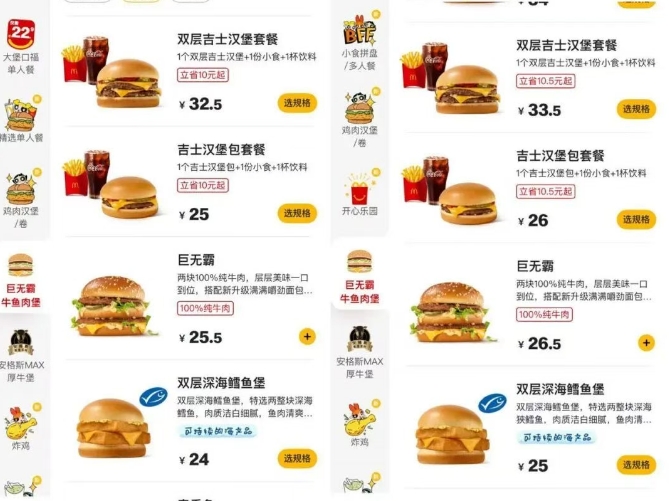
麦当劳连续三年调价
21世纪经济报道· 2025-12-15 09:38
Core Viewpoint - McDonald's has recently increased prices on most menu items by 0.5 to 1 yuan, while the "1+1 Flexible Combo" remains unchanged at 13.9 yuan, indicating a strategic pricing adjustment amidst rising operational costs [1][3]. Price Adjustments - The price increase affects various products, including burgers, snacks, and meal combos, with the adjustment being part of a broader trend of annual price hikes since 2021 [3]. - In December 2023, McDonald's announced an average price increase of approximately 3% across its menu, with specific items like the "1+1 Flexible Combo" not experiencing a price change [3][4]. Operational Insights - McDonald's China CEO emphasized the importance of maintaining affordable pricing while ensuring sustainable business practices, indicating a cautious approach to pricing strategies [4]. - The company's Q3 2025 report showed a revenue of $7.08 billion, a 3% year-over-year increase, and a net profit of $2.28 billion, reflecting a slight decline in adjusted net profit compared to the previous year [4].
麦当劳确认涨价
2 1 Shi Ji Jing Ji Bao Dao· 2025-12-15 07:53
Core Viewpoint - McDonald's has recently increased prices on most menu items by 0.5 to 1 yuan, while the "1+1 Flexible Match" meal remains unchanged at 13.9 yuan, indicating a strategic pricing adjustment amidst rising operational costs [1][3]. Pricing Adjustments - The recent price increase affects various burgers, snacks, and meal sets, with the adjustment being part of a broader trend of annual price hikes that McDonald's has implemented since 2021 [1][3]. - In February 2023, McDonald's confirmed a price adjustment on breakfast items and Happy Meals, with a similar increase of 0.5 yuan [3]. - The average price increase across selected products in December 2023 was approximately 3%, reflecting changes in operational costs [3]. Promotional Strategies - McDonald's is currently running a promotional event called "Ten Yuan Eat Burger," aiming to provide value to consumers despite the price increases [1]. - The company emphasizes its commitment to maintaining affordable pricing through its restaurant and supply chain scale advantages, while also acknowledging the need for sustainable pricing strategies in the long term [4]. Financial Performance - In the third quarter of 2023, McDonald's reported revenues of $7.08 billion, a 3% year-over-year increase, slightly below market expectations [4]. - The net profit for the same period was $2.28 billion, reflecting a 2% year-over-year growth, although adjusted net profit showed a slight decline compared to the previous year [4]. - Same-store sales in the international franchise market, including China, grew by 4.7% in the third quarter [4].

巨无霸、麦乐鸡贵了1元!麦当劳今日起部分产品涨价
Di Yi Cai Jing· 2025-12-15 07:39
Group 1 - The core viewpoint of the articles highlights McDonald's third-quarter financial performance, reporting revenue of $7.078 billion, a 3% year-over-year increase, and net profit of $2.278 billion, a 1% year-over-year increase [2] - McDonald's has raised prices on several menu items by 0.5 to 1 yuan, including popular burgers and snacks, effective from December 15 [1] - The company emphasizes its commitment to providing high-quality meals and value options for consumers, while also promoting ongoing promotional activities [1] Group 2 - The fast-food industry faces challenges in cost control and risk management due to price volatility in agricultural products such as rice, meat, and vegetables [3] - Competitor KFC also implemented a price increase at the end of last year, with an average adjustment of 2%, reflecting the need to adapt to market cost changes [3]

部分餐品涨价0.5元到1元,麦当劳回应
Bei Ke Cai Jing· 2025-12-15 07:25
Core Viewpoint - McDonald's has increased the prices of several menu items, including burgers and meals, effective December 15, 2025, with price hikes ranging from 0.5 to 1 yuan [2]. Group 1: Price Changes - The price of the Big Mac has risen by 1 yuan, the Double Fillet-O-Fish has increased by 1 yuan, and the McFish has also gone up by 1 yuan [1]. - The price adjustments affect "some menu items" as stated by the company [2]. Group 2: Promotional Activities - McDonald's is currently running a promotional event called "McDonald's Farm Food Festival," offering burgers for 10 yuan [2]. - The company emphasizes its commitment to providing consumers with value and convenience despite the price increases [2].
麦当劳中国回应涨价
Di Yi Cai Jing Zi Xun· 2025-12-15 07:05
Group 1 - McDonald's has increased the prices of most menu items by 0.5 to 1 yuan, including various burgers, snacks, and meal sets [2] - The price increase is effective from December 15, 2025, and is part of McDonald's commitment to providing high-quality meals and value options [2] - Specific items such as the Big Mac, Double Fillet-O-Fish, and McChicken have seen a price increase of 1 yuan, while items like medium fries and desserts have increased by 0.5 yuan [2] Group 2 - The "1+1 Flexible Combo" meal, humorously referred to as the "poor man's meal," remains priced at 13.9 yuan, but some combinations may incur an additional 1 yuan cost due to ingredient price increases [3] - If customers choose specific items like the Double Cheeseburger, the total price for the combo will rise to 14.9 yuan [3] - The base price of the "1+1 Flexible Combo" remains unchanged if customers opt for non-special items [3]

麦当劳中国回应涨价
第一财经· 2025-12-15 06:54
Core Viewpoint - McDonald's has increased the prices of most menu items by 0.5 to 1 yuan, effective from December 15, 2025, while still promoting value through ongoing discount campaigns [2][3]. Price Adjustments - The price increase affects various items, including classic burgers like the Big Mac and Double Fillet-O-Fish, which have risen by 1 yuan. Other items such as McNuggets and medium fries have seen a 0.5 yuan increase [2]. - The "1+1 Flexible Combo," humorously referred to as the "poor man's meal," maintains its starting price at 13.9 yuan, but certain combinations may incur an additional 1 yuan cost due to ingredient price increases [3].
网友:麦当劳涨价0.5到1元,包括多款汉堡、小食及套餐
Ge Long Hui· 2025-12-15 05:20
Core Viewpoint - McDonald's has increased the prices of various menu items by 0.5 to 1 yuan, indicating a trend of price adjustments within the fast-food industry [1] Price Adjustments - The price of the Big Mac has risen by 1 yuan - The Double Fillet-O-Fish has also increased by 1 yuan - The price of the Filet-O-Fish has gone up by 1 yuan - Other food items such as McNuggets, Chicken Sandwich, and various fries have seen price increases ranging from 0.5 to 1 yuan [1] Specific Items Affected - McNuggets: increased by 1 yuan - Chicken Sandwich: increased by 1 yuan - Red Oil Crispy Meat: increased by 0.5 yuan - Medium Fries: increased by 0.5 yuan - Crispy Fries: increased by 0.5 yuan - Corn Cup: increased by 0.5 yuan - McFlurry and Sundae: increased by 0.5 yuan [1] Notable Exceptions - The "1+1 Flexible Combo" package, humorously referred to as the "poor man's meal," remains unchanged at a starting price of 13.9 yuan, although some combinations within this package have seen a 1 yuan increase [1]