
基建

Search documents
10月经济前瞻:渐行渐缓,蓄势明年
Hua Xia Shi Bao· 2025-11-07 05:54
Group 1: Industrial Production and Economic Trends - Industrial production showed signs of slowdown in October, with expected year-on-year growth of 5.3% for industrial added value [2] - Manufacturing demand has weakened due to pre-holiday demand release and international trade uncertainties, with the new orders index dropping to 48.8% [3] - The service sector experienced an increase in activity, with the business activity index rising to 50.2%, driven by holiday-related consumption [3] Group 2: Consumer Retail and Spending - Social retail sales are projected to grow by 2.8% year-on-year in October, a slight decline from the previous 3% [4] - The effectiveness of the trade-in policy for consumer goods has diminished, compounded by reduced fiscal support, leading to pressure on retail sales [5] - The restaurant and alcohol retail sectors are expected to remain under pressure due to regulatory measures affecting public spending [5] Group 3: Investment Trends - Fixed asset investment is anticipated to decline by 0.9% year-on-year from January to October, with manufacturing investment growth at 4.0% and real estate investment down by 14.1% [7] - Manufacturing investment is expected to improve slowly, with recent developments in US-China trade negotiations potentially boosting investor confidence [8] - Infrastructure investment is projected to stabilize, with new policy financial tools fully deployed, indicating a potential recovery in construction activity [12] Group 4: Export and Trade Dynamics - October export growth is expected to be 3.2%, with imports at 1.6%, reflecting a shift towards non-US markets [17] - China's share in non-US markets has increased, with significant growth in exports to Africa and Latin America [18] - The trade cycle between investment and exports to non-US countries is strengthening, particularly in manufacturing sectors [19] Group 5: Price Trends and Inflation - Consumer price index (CPI) is expected to show a slight increase to 0.1% year-on-year, while producer price index (PPI) is projected to decline by 2.6% [20] - Pork prices remain weak, contributing to overall low inflationary pressures, while oil prices are also under pressure due to global supply dynamics [21][22] - Core CPI is anticipated to maintain a recovery trend, supported by holiday consumption and promotional activities [22] Group 6: Employment and Labor Market - The urban unemployment rate is expected to stabilize at 5.1%, with ongoing government efforts to support job creation for graduates [24] - Employment policies are focused on stabilizing job opportunities, particularly for vulnerable groups such as migrant workers [24][25] Group 7: Financial Data and Monetary Policy - Social financing is projected to increase by 750 billion, with a decline in new loans expected at 1 trillion [26][27] - The M2 money supply growth is anticipated to decrease to 8.1%, reflecting weak demand for credit and a shift towards non-bank financial products [28] - Future monetary policy is expected to balance financial stability with support for the real economy, with a focus on gradual adjustments rather than aggressive tightening [29]


工业5G国际标准公布,关注中游产业升级
Hua Tai Qi Huo· 2025-11-07 03:13
Industry Overview Key Events - China-led industrial 5G international standard officially released, filling the gap in the international standard of industrial 5G [1] - The State Council approved the "Land and Space Plan for the Chengdu-Chongqing Economic Circle (2021 - 2035)", with specific targets for cultivated land, ecological protection, urban development, and water use by 2035 [1] - In the first three quarters, the advertising business revenue of top advertising enterprises and institutions reached 1388.09 billion yuan, a year-on-year increase of 9.6%. Internet advertising maintained rapid growth, with a revenue of 712.88 billion yuan, a year-on-year increase of 22.5%, accounting for 81.2% of the total advertising release revenue [1] Market Conditions - **Upstream**: Prices of iron ore and rebar declined; international oil prices and liquefied natural gas prices dropped slightly [3] - **Midstream**: PX operating rate was at a high level; power plant coal consumption remained stable; asphalt operating rate increased slightly [3] - **Downstream**: Commercial housing sales in first, second, and third-tier cities continued to decline; domestic flight frequencies increased slightly, and the film box office was in the off-season [3] Price Indicators - **Agriculture**: On November 6, the spot price of corn was 2152.9 yuan/ton, up 0.27% year-on-year; the spot price of eggs was 6.2 yuan/kg, up 0.81% year-on-year; the spot price of palm oil was 8760.0 yuan/ton, down 0.66% year-on-year; the spot price of cotton was 14826.2 yuan/ton, down 0.22% year-on-year; the average wholesale price of pork was 18.1 yuan/kg, up 1.46% year-on-year [34] - **Nonferrous Metals**: On November 6, the spot price of copper was 85936.7 yuan/ton, down 2.36% year-on-year; the spot price of zinc was 22476.0 yuan/ton, up 1.08% year-on-year; the spot price of aluminum was 21376.7 yuan/ton, up 0.90% year-on-year; the spot price of nickel was 120750.0 yuan/ton, down 1.21% year-on-year; another spot price of aluminum was 17318.8 yuan/ton, up 0.28% year-on-year [34] - **Black Metals**: On November 6, the spot price of rebar was 3133.0 yuan/ton, down 2.05% year-on-year; the spot price of iron ore was 792.2 yuan/ton, down 3.51% year-on-year; the spot price of wire rod was 3305.0 yuan/ton, down 1.78% year-on-year; the spot price of glass was 14.0 yuan/square meter, up 1.30% year-on-year [34] - **Non-metals**: On November 6, the spot price of natural rubber was 14616.7 yuan/ton, down 0.90% year-on-year; the China Plastic City price index was 776.9, down 0.08% year-on-year [34] - **Energy**: On November 6, the spot price of WTI crude oil was 59.6 US dollars/barrel, down 1.46% year-on-year; the spot price of Brent crude oil was 63.5 US dollars/barrel, down 2.16% year-on-year; the spot price of liquefied natural gas was 4288.0 yuan/ton, down 1.15% year-on-year; the coal price was 824.0 yuan/ton, up 1.85% year-on-year; the spot price of PTA was 4561.1 yuan/ton, up 0.19% year-on-year [34] - **Chemicals**: On November 6, the spot price of polyethylene was 7011.7 yuan/ton, down 1.34% year-on-year; the spot price of urea was 1597.5 yuan/ton, down 1.39% year-on-year; the spot price of soda ash was 1203.6 yuan/ton, down 0.71% year-on-year; the national cement price index was 136.7, down 0.36% year-on-year [34] - **Real Estate**: On November 6, the building materials composite index was 111.8 points, down 1.55% year-on-year; the national concrete price index was 90.9 points, down 0.15% year-on-year [34]
国泰海通:DRAM存储器延续上涨态势 AI算力需求井喷持续拉动电子产业链景气
Zhi Tong Cai Jing· 2025-11-06 13:09
Core Insights - The demand for AI applications and inference computing power is surging, leading to a significant increase in the demand for high-performance storage chips, with DRAM spot prices rising by 9.8% month-on-month, continuing an accelerating upward trend [1][5] - The semiconductor sales in China increased by 15.0% year-on-year in September, indicating further improvement in growth rates and sustained high levels of prosperity in the semiconductor and electronics industries [1][5] Industry Performance - The electronic industry continues to show high prosperity, with improved export demand [2][3] - AI computing power demand is driving the electronic industry chain's prosperity, with tight supply and demand conditions for DRAM storage prices leading to continued price increases [3][5] - The Shanghai Container Freight Index (SCFI) has significantly increased month-on-month, reflecting improved expectations for export demand due to positive developments in US-China trade negotiations [3] Downstream Consumption - Real estate sales are struggling, with a 39.9% year-on-year decline in transaction area for commercial housing in 30 major cities, and significant drops in first, second, and third-tier cities [4] - Durable goods consumption is under pressure, with a 9.0% year-on-year decline in retail sales of passenger cars and a notable decrease in air conditioning production for both domestic and foreign markets [4] - Agricultural prices are showing signs of improvement, with live pig prices rising by 4.1% month-on-month due to better supply-demand dynamics [4] Technology & Manufacturing - The demand for high-performance storage chips is being driven by the surge in AI applications and inference computing power, with DRAM spot prices continuing to rise [5] - Construction demand remains weak, influenced by environmental regulations, leading to a tightening of supply in the steel industry and a rebound in steel prices [5] Upstream Resources - Coal prices remained stable month-on-month due to tight supply ahead of safety inspections, while industrial metal prices are experiencing narrow fluctuations [7] Logistics and Transportation - Passenger transport demand is showing signs of recovery, with a 2.1% month-on-month increase in long-distance travel demand [9] - Port throughput has improved month-on-month, reflecting positive developments in export expectations [9]

帮主郑重财经解读:央行出手买债,股市要变天?
Sou Hu Cai Jing· 2025-11-06 08:23
Core Viewpoint - The central bank's announcement to conduct treasury bond trading in the secondary market marks a significant development, being the first of its kind in over twenty years, enhancing the central bank's toolkit [1] Group 1: Market Impact - This operation is likened to installing an "intelligent faucet" in the market, allowing the central bank to buy treasury bonds to inject liquidity when needed and sell them to absorb excess liquidity [3] - Short-term effects include increased market liquidity, benefiting brokers and banks, while mid-term effects may lead to a smoother yield curve for treasury bonds, potentially restoring valuations in high-dividend and asset-heavy sectors such as infrastructure and electricity [3] Group 2: Policy Implications - The central bank emphasizes that this is not a measure for excessive liquidity injection, but rather a tool for "adjusting the surplus and deficiency of funds," indicating a cautious approach to market stimulation [3] - For long-term investors, a richer policy toolkit enhances market stability, which is viewed as a genuine positive development [3] Group 3: Investment Strategy - It is suggested to focus on interest rate-sensitive sectors, but caution is advised against chasing high prices, as market excitement may be short-lived while logical investment strategies are essential for the long term [3]
帮主郑重:7000亿"活水"来袭,市场要沸腾了?
Sou Hu Cai Jing· 2025-11-05 01:42
Core Viewpoint - The central bank is set to inject 700 billion yuan through a buyout-style reverse repurchase operation, marking one of the largest operations this year, aimed at ensuring liquidity in the market for three months [1][3]. Group 1: Central Bank Operations - The operation has a term of 91 days, indicating a focus on maintaining stable liquidity through the year-end [3]. - The use of multiple price bidding allows more institutions to access funds, enhancing the distribution of liquidity [3]. - The buyout-style reverse repurchase provides greater flexibility in fund usage, showcasing a strategic approach to liquidity management [3]. Group 2: Market Implications - The liquidity injection is expected to lead to three major benefits: increased cash availability for banks, enhanced lending capacity, and alleviated pressure on the bond market, potentially stabilizing yields [3]. - The stock market sentiment is likely to improve, particularly benefiting sectors sensitive to funding [3]. - Investment focus can be directed towards banks and brokerage sectors, as well as real estate and infrastructure chains that are sensitive to funding rates [3].
10月出海活动回顾:中东出海机遇在哪些行业?
吴晓波频道· 2025-11-05 00:29
Core Insights - The article emphasizes the importance of Chinese companies accurately capturing growth opportunities in overseas markets, particularly in the Middle East, by avoiding blind expansion and focusing on specific sectors [2][4]. Group 1: Market Opportunities - The Gulf Cooperation Council (GCC) countries, particularly Saudi Arabia and the UAE, are highlighted as key target markets for Chinese enterprises due to their high GDP per capita, exceeding three times the world average, and a young population [4][5]. - In 2024, Saudi Arabia is projected to attract foreign direct investment (FDI) of 119 billion RMB, a 24% increase year-on-year, while the UAE's FDI is expected to grow by 48%, reaching a historical high [6]. - The core opportunities in these markets are concentrated in infrastructure, digitalization, and renewable energy, with Chinese state-owned enterprises actively bidding for local projects [7]. Group 2: Consumer Market Dynamics - The consumer market in the region is described as a pyramid structure, with high-end luxury goods targeting wealthy individuals and low-cost daily necessities aimed at foreign laborers, indicating limited space for middle-class products [8]. - The UAE, particularly Dubai, is characterized as a trade and financial hub, with a significant Chinese business presence, including over 8,000 Chinese companies [8][10]. Group 3: Strategic Considerations for Chinese Enterprises - Chinese companies are advised to conduct thorough country selection and internal/external assessments before entering the Middle Eastern market, ensuring compliance and establishing efficient operational teams [11]. - The article notes that successful Chinese brands like Huawei, OPPO, and BYD have already established a presence in the region, indicating a positive reception for Chinese products [10]. Group 4: Upcoming Events and Focus Areas - The article outlines a series of closed-door meetings organized by the Huashang Outbound Industry Alliance, focusing on various overseas markets, including the U.S., Indonesia, and Mexico, to provide practical guidance for companies looking to expand internationally [15][18][21].
十五五规划,释放的9大信号!
Sou Hu Cai Jing· 2025-11-04 18:30
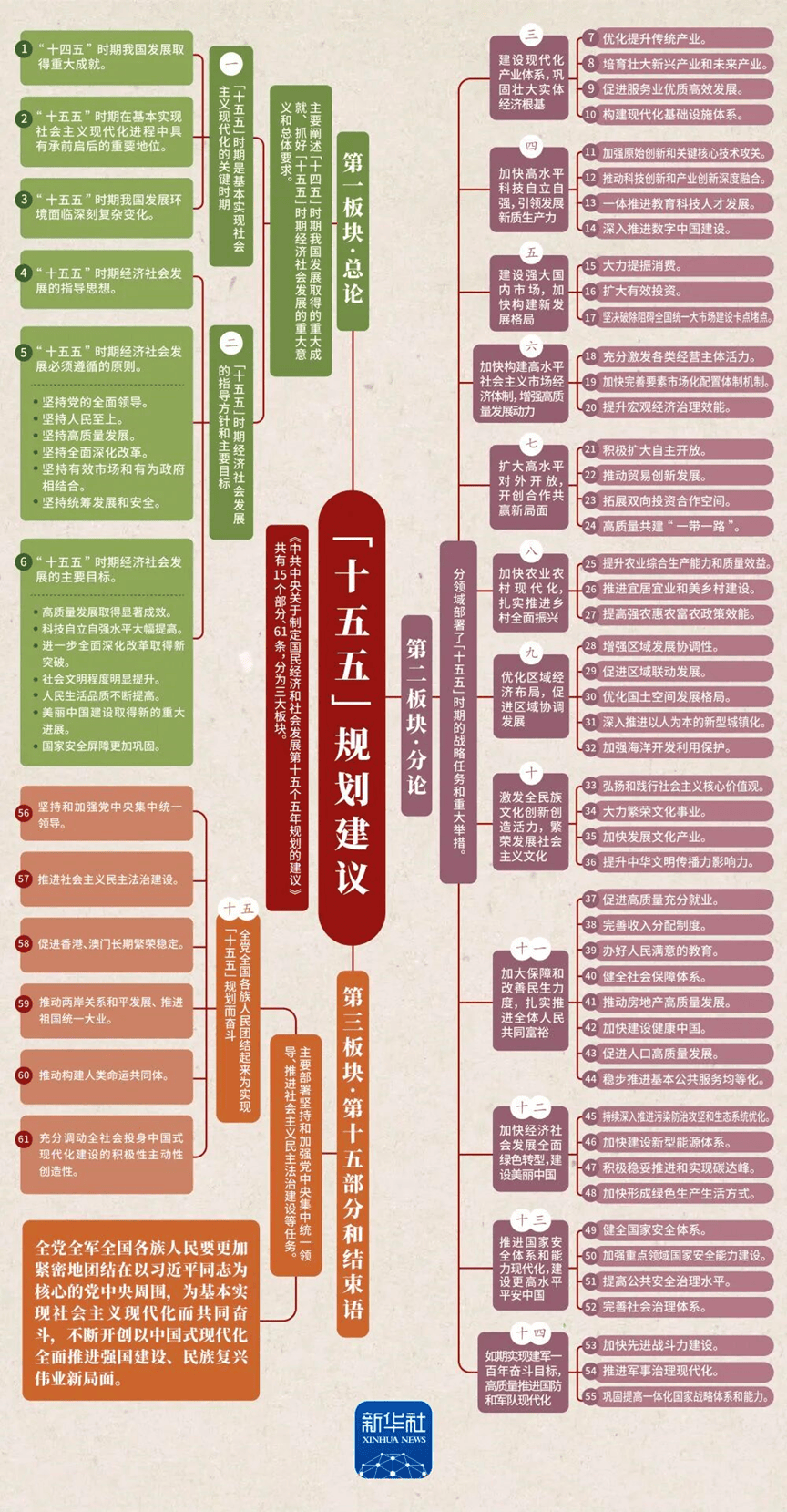
Core Insights - The "15th Five-Year Plan" is a critical roadmap for China's socio-economic development from 2026 to 2030, focusing on high-quality growth and strategic deployment towards modernization by 2035 [3][5]. Group 1: Economic Performance and Goals - During the "14th Five-Year Plan," China's GDP grew at an average rate of 5.5%, reaching 134 trillion RMB, with per capita GDP increasing from $10,632 in 2020 to $13,445 in 2024 [5]. - The "15th Five-Year Plan" aims for significant milestones, including a 70% urbanization rate by 2028, achieving carbon peak by 2030, and a 90% penetration rate for AI applications [3][5]. Group 2: Development Priorities - The plan outlines five main development lines: infrastructure, technology, finance, consumption, and livelihood [4]. - Infrastructure development will focus on major projects like the Sichuan-Tibet Railway and the national water network, which are expected to stabilize the economy [8]. - Technology will shift from factor-driven to innovation-driven growth, emphasizing high-end manufacturing, AI, and energy reform [9][10]. Group 3: Financial Sector - The financial sector is deemed essential for national competitiveness, with a focus on building a robust financial system characterized by strong institutions and regulatory frameworks [10][11]. Group 4: Consumption and Livelihood - The plan addresses insufficient domestic demand, proposing measures to increase household income and reduce consumption burdens, aiming for a consumption rate of 39.9% by 2024 [14][15]. - It emphasizes the importance of public investment in education, healthcare, and social security to stimulate consumption [17][18]. Group 5: Social Policies - The "15th Five-Year Plan" will tackle challenges in public service equality, income stability, and aging population issues, with a focus on health and education [21][22]. - It aims to enhance the quality of life through initiatives in healthcare, childcare, and social welfare, including the introduction of a national childcare subsidy [88][90]. Group 6: Market and Global Integration - The plan emphasizes the establishment of a unified national market to eliminate local protectionism and market fragmentation, which is crucial for enhancing internal stability [40][66]. - It encourages global integration through the "China + N" strategy, promoting international collaboration and investment [72]. Group 7: Key Signals for the Future - The plan reiterates the importance of economic construction, aiming for per capita GDP to reach the level of a moderately developed country by 2035 [74]. - It highlights the commitment to common prosperity, with specific targets for income distribution and social welfare improvements [76][78]. - The focus on "anti-involution" aims to streamline competition and improve industry standards, particularly in emerging sectors like renewable energy and technology [87].
月度前瞻 | 短期经济会否“超预期”?(申万宏观·赵伟团队)
赵伟宏观探索· 2025-11-04 16:21
Economic Activity Changes - Economic activity has faced new pressures on both supply and demand sides since October, with a decrease in working days and high inventory levels constraining production [2][9] - The manufacturing PMI dropped by 0.8 percentage points to 49%, indicating a contraction in manufacturing activity, with the production index declining more than new orders [2][9] - Demand pressure is particularly evident in the manufacturing sector, as companies accelerate debt repayments, which negatively impacts fixed asset investment [2][20] Profitability and Cost Pressures - Excluding low base effects, industrial profits are weaker than in previous years, with the overall cost rate at a historical high of 85.4% [3][31] - In September, industrial profits increased by 2.6 percentage points to 22.5%, but the two-year compound growth rate fell by 5.3 percentage points to -5.9% [3][31] Policy Measures to Mitigate Growth Pressure - The introduction of "incremental policies" aims to alleviate the investment squeeze caused by debt resolution, with nearly 300 billion yuan in new policy financial tools deployed by October [4][39] - The "Double Eleven" shopping festival is expected to temporarily boost retail sales, while service consumption remains resilient, with a projected retail sales rebound of 3.4% in October [4][50] Export Dynamics - The U.S. threatened to impose a 100% tariff on all Chinese goods starting in November, which may trigger a "rush to export" phenomenon, supporting October's export figures [5][60] - October's export growth is expected to remain resilient at 7%, bolstered by a rise in processing trade imports [5][60] Monthly Data Performance - The PPI is expected to recover slightly to -2.1% in October, driven by rising prices of upstream commodities like copper and coal, despite low capacity utilization in downstream sectors [6][74] - CPI is projected to rise to 0.4% year-on-year in October, supported by low base effects and resilient service consumption [6][82] Summary of Economic Outlook - Policies are actively countering internal economic pressures, with the actual GDP for October estimated at 4.6%, indicating sustained high growth [7][95] - High inventory levels and accelerated debt repayments are constraining supply and demand, but recent policy measures and easing U.S.-China tariff tensions may signal a potential economic recovery [7][95]

2026年经济与资产展望:经济渐入稳态,风偏继续提升
HUAXI Securities· 2025-11-04 15:17
证券研究报告 经济渐入稳态,风偏继续提升 ——2026年经济与资产展望 大类资产首席分析师:孙付 SAC NO:S1120520050004 2025年11月4日 请仔细阅读在本报告尾部的重要法律声明 1 核心观点 经济基本面展望: 政策展望: 2 ● 2026是"十五五"开局之年,技术革命浪潮风起云涌、科技自强自立迈向新征程,中国经济的全要素劳动生产率和 产业竞争力将继续提升,供给端优势将进一步显现。 外需:产业和产品的较强竞争力是支撑,中美经贸关系步入阶段性缓和,出口多元化格局进一步塑造,汇率保持相对弹 性,出口有望总体稳定。 内需:扩大内需是战略基点,短期政策刺激和长期机制完善将共同促内需。财政和货币政策将继续积极加码发力支持消 费和有效投资。统一大市场建设和要素市场化改革将清理内需扩张障碍,增进内需潜能。 ● 物价:在食品价格企稳、文娱消费延续回升、反内卷破除恶性价格竞争下,2026年物价将回升,预计CPI中枢0.6%, PPI中枢-0.8%,下半年GDP平减指数将转正。 ● GDP增速:综合经济增长趋势特征与宏观政策效能,预计2026年实际GDP增速在4.5%附近,名义GDP增速约4.7%,名义 增 ...
元瞻经纬总量月报(2025年10月):“十五五”承前启后,接续奋进谱新篇-20251104
Guoyuan Securities· 2025-11-04 02:34
Group 1 - The "15th Five-Year Plan" emphasizes high-quality development as the core theme and primary goal, reflecting a significant historical moment and the need to align with economic development trends [3][22][23] - The plan prioritizes the construction of a modern industrial system, placing it at the forefront of strategic tasks, indicating a shift in focus compared to the previous five-year plan [27][28] - The report highlights the importance of domestic demand in driving economic growth, suggesting that enhancing domestic consumption is crucial for sustainable development [23][24] Group 2 - The industrial sector is identified as a key area for development, with a focus on upgrading traditional industries and fostering new and future industries, such as renewable energy and advanced manufacturing [31][32] - The report indicates that consumer confidence is gradually recovering, with policies aimed at stimulating consumption and improving living standards being prioritized [35][36] - The financial sector is experiencing a decline in social financing and credit, indicating a need for recovery in the financing demands of the real economy [4][25]