
算力

Search documents
2.51万亿猛攻AI!两大龙头净吸金均超10亿
Xin Lang Cai Jing· 2025-12-10 10:17
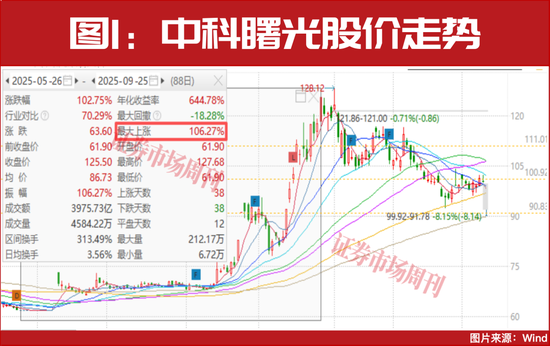
炒股就看金麒麟分析师研报,权威,专业,及时,全面,助您挖掘潜力主题机会! 来源:证券市场周刊市场号 文 |牛犇 今天,A股市场维持平稳,但向上趋势没有改变。 板块方面,前期热门的AI相关产业链普遍调整,不过往后看,AI仍是未来最热的主线之一。 算力链的一个大消息 据笔者观察,今天涨得最好的当数海南自贸、锂电等相关产业链,罗牛山、海南瑞泽、海南高速等一众 相关标的或触及涨停,或涨幅居前。相对而言,服务器、覆铜板、存储器、IDC(算力租赁)、电路 板、AI算力等AI相关产业链跌幅靠前,这与算力龙头一则最新消息相关。 12月9日晚间,海光信息和中科曙光同时发布《关于终止重大资产重组的公告》,原计划海光信息通过 向中科曙光全体A股换股股东发行A股股票的方式换股吸收合并中科曙光并募集配套资金,但由于本次 交易规模较大、涉及相关方较多,使得重大资产重组方案论证历时较长,目前市场环境较本次交易筹划 之初发生较大变化,本次实施重大资产重组的条件尚不成熟,双方决定终止本次交易事项。 也就是说,这起曾被市场视为算力领域最大规模收购之一的计划就此告终了。受此影响,在公告发出的 次一交易日,也就是今日,中科曙光股价跌停,海光信息同样 ...


良性回调!周三,A股会开启新反弹了
Sou Hu Cai Jing· 2025-12-09 11:39
盘后,大家都情绪化了。又是4000家股票下跌,光模块、算力再次大涨,也不能说是诱惑你接盘,本来就是正常的反弹行情罢了。之前跌得很多,目前涨得 多很正常。 小凡也趁机买了它们,不过是间接持有。我们是抄底的2900多点的创业板,也跟着它们上涨了,所以为什么要讨厌它们上涨,股市任何筹码上涨都是好事 儿,毕竟都利好指数…… 良性回调! 小凡的策略肯定有用,关键是大多数连看文章的耐心都没有。别说让他们持有耐心了,我们一熬几年,守着自己这点一亩三分地。他们是消费者,我们是投 资者。股市和生活一样,守店的人赚钱,游客是消费者。 今日的回调在预期里面,这里对降息的预期,对工作会议的预期,不可能证券连续拉升,目前关键的行业还是证券、地产了,地产连续大幅回调是加速大消 费赶底。 月初的时候是7.5成仓,目前只有7成仓了,证券、创业都逢高减掉了浮仓。接下来,如果地产、白酒继续跌,可能会动用余粮补仓了,计划补到8成仓,这 样算大概率还可以接受它们跌10%…… 最后总结 不惧波动,就怕自己没有交易计划,跌了不敢买,涨了舍不得卖。为什么大家舍不得卖,因为你都是套住的筹码啊,不像我们是用浮仓捡的带血筹码,卖飞 也没有心理成本。 股市,不要 ...

川财证券陈雳:资本市场对实体经济的服务作用不言而喻
Xin Lang Cai Jing· 2025-12-09 09:43
专题:2025中国企业竞争力年会 他谈到,科技壁垒高的中小企业可通过科创板、北交所上市,从二级市场获取发展资金。这一体系的成 效已充分显现,今年以来创新药、算力、机器人等新质生产力相关板块涨幅显著,既契合当前经济发展 重点,也反映出市场对这类企业成长潜力的认可。 陈雳强调,新质生产力的发展是一项系统工程,离不开宏观经济导向、产业布局规划、链主龙头企业引 领与区域协同发展的多方支撑。在百年未有之大变局与外部环境高度不确定的背景下,我国需练好内 功,推动国产自立与科技突破,而资本市场通过聚焦金融 "五篇大文章" 与新质生产力,进一步强化资 金保障,既能解决企业发展中的资金难题,又能助力破解国家与行业发展的关键问题,最终实现多方共 赢。 新浪声明:所有会议实录均为现场速记整理,未经演讲者审阅,新浪网登载此文出于传递更多信息之目 的,并不意味着赞同其观点或证实其描述。 责任编辑:李思阳 专题:2025中国企业竞争力年会 "2025中国企业竞争力年会"于12月9日至10日在北京举行。川财证券首席经济学家、研究所所长陈雳指 出,资本市场对实体经济的服务作用不言而喻,其中一级市场投行业务是直接融资的核心抓手。 当前,投行在 ...
市场“慢牛”与投资“求真”——中信保诚基金2026年展望:基本面、科技、新消费与出海
Xin Lang Cai Jing· 2025-12-09 08:47
Group 1 - The A-share market achieved multiple historical records in 2025, with a significant recovery in market confidence driven by technology and new consumption [2][14] - The total market capitalization of A-shares surpassed 100 trillion yuan in June 2025, and trading volume reached a historical high in August, indicating deep recovery in market participation and confidence [14] - The rise of new consumption, exemplified by successful products like Labubu and the global box office success of "Nezha 2," injected new growth momentum into the consumption sector [14] Group 2 - After the National Day holiday, the market experienced fluctuations, particularly in the technology sector, due to both external factors like the Federal Reserve's interest rate expectations and internal profit-taking [15] - Despite short-term volatility, the core narrative supporting market optimism remains unchanged, with expectations of a reasonably ample domestic liquidity environment and gradual recovery in corporate earnings [15] Group 3 - The market style in 2026 is expected to become more balanced and refined, moving away from being dominated by a single style [16] - The investment focus is anticipated to shift towards AI applications, with a transition from infrastructure to actual applications and commercialization [16] - Companies with solid performance in AI applications, domestic substitution, and overseas expansion are likely to attract market attention due to their high growth potential [16] Group 4 - From a financial perspective, 2026 may exhibit characteristics of "profit handover," with key areas of focus including the "computing power-storage-power-manufacturing" chain and the commercialization of application endpoints [17] - Monitoring order and profit recovery progress will be crucial, alongside attention to supply-side reforms and capital market optimizations [17] Group 5 - The key investment factor in 2026 is expected to be the ability to deliver on fundamental performance, with a shift in market scrutiny towards the quality of earnings growth and sustainability of business models [18] - Companies with core technologies and clear commercialization paths in sectors like AI, pharmaceuticals, and high-end manufacturing are likely to stand out [18] Group 6 - Positive factors include ongoing anti-involution policies improving the corporate profit environment and a long-term trend of asset allocation towards equity markets, potentially leading to substantial incremental capital [19] - The upward trend in industries like AI, semiconductors, and smart vehicles may provide clear investment lines [19] Group 7 - Opportunities are expected to arise in new consumption areas, particularly those integrating AI technology, such as intelligent companionship and interactive entertainment [21] - The AI computing infrastructure and consumer electronics driven by AI innovations are anticipated to see significant growth, alongside the international expansion of healthcare sectors [21]
ETF日报 | 摩尔线程将发新品,“硬科技”持续高歌猛进!哪些板块率先受催化?
Xin Lang Cai Jing· 2025-12-09 08:04
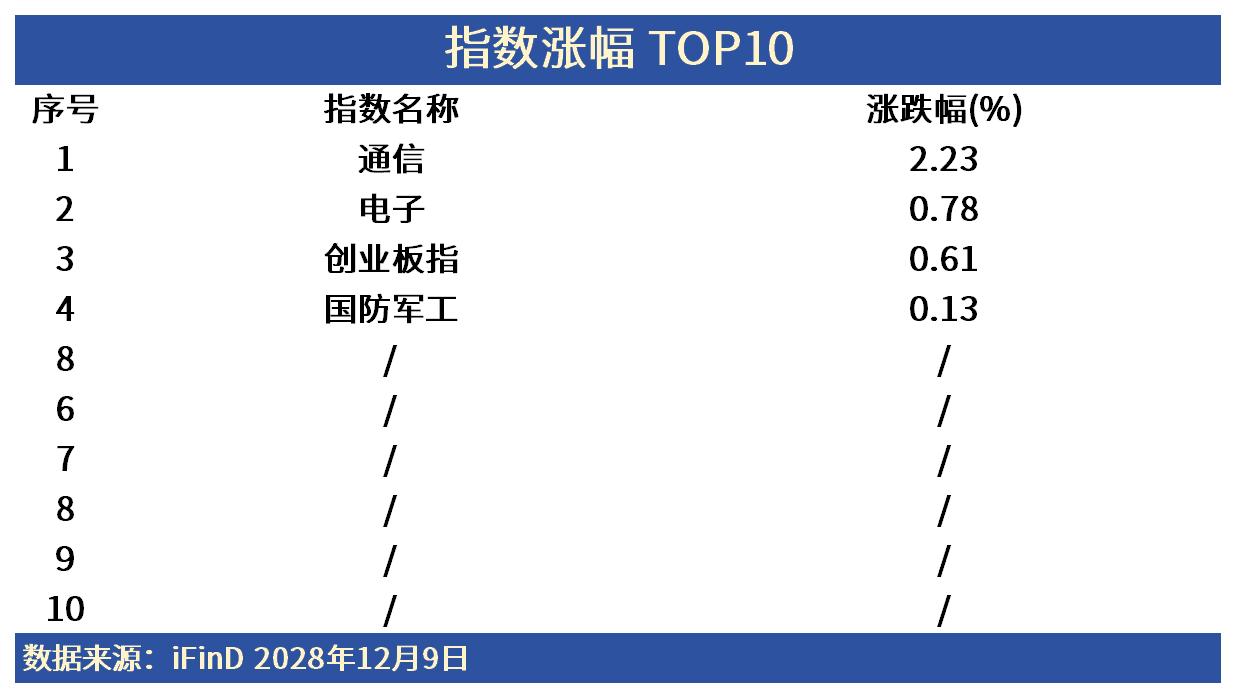
Wind数据显示,截至2025年12月9日A股收盘,通信、电子、创业板指领涨市场,涨幅分别为2.23%、0.78%、0.61%。 通信、电子、创业板指 国盛证券评论,所有科技进展仍然指向算力,Gemini3.0PRO跃迁式进展、DeepSeekV3.2进展迅速但指出不管预训练、后训练有更多算力会更进步,字节手 机展现出超级自定义Agent场景,可能其他巨头不会再沉得住气。上述事件,对国内资本支出是好事,全行业支出有望进一步提升,服务器链、AIDC链、算 力服务链是明确利好。 据摩尔线程官微,12月19日至20日,摩尔线程首届MUSA开发者大会将在北京中关村国际创新中心拉开帷幕。摩尔线程创始人、董事长兼CEO张建中将首次 系统阐述以MUSA为核心的全栈发展战略与未来愿景,并重磅发布新一代GPU架构、推出涵盖产品体系、核心技术及行业解决方案的完整布局,分享多领域 落地案例与生态建设进展。 天风证券表示,坚定看好算力产业链核心标的的投资机会。其中,海外算力产业链高景气度依旧,相关公司财报持续体现AI相关需求的高景气,相关产业 链的基本面共振更强,持续看好海外算力产业链投资机会。国内方面,后续伴随着国产算力持续发展, ...
A股异动丨算力概念股强势,工业富联一度大涨近8%
Ge Long Hui A P P· 2025-12-09 06:18
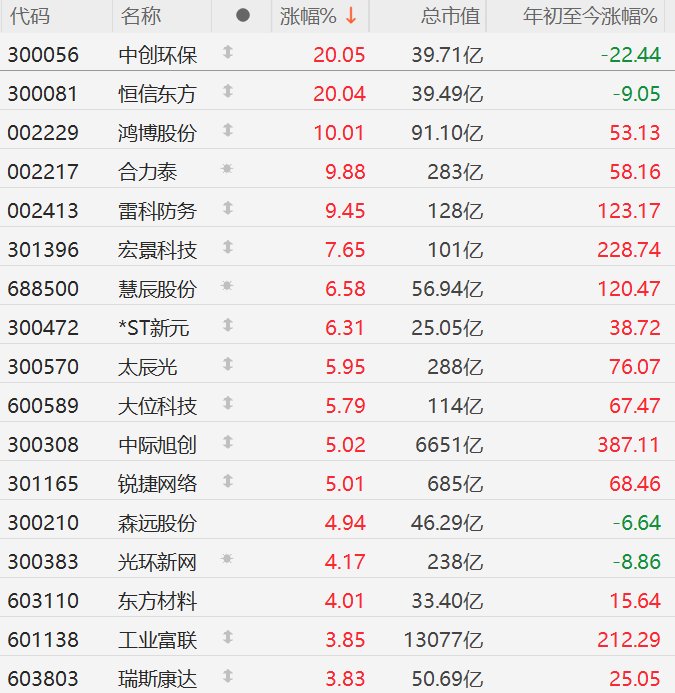
Group 1 - The A-share market has seen strong performance in computing power concept stocks, with notable gains including Zhongchuang Environmental and Hengxin Oriental reaching the daily limit of 20% increase [1] - The recent listing of Moore Threads on the A-share market has led to a surge in its stock price, with its market value exceeding 300 billion yuan at one point, which is believed to have opened up valuation space for domestic computing power concept stocks [1] - Major cloud service providers are increasing their capital expenditures, with Meta raising its forecast for capital spending from $66 billion to $72 billion, Google increasing its guidance from $85 billion to $91-93 billion, and Amazon's expected capital expenditure for the year being around $125 billion, with further increases anticipated in 2026 [1] Group 2 - The stock performance of several companies in the computing power sector has been impressive, with Zhongchuang Environmental and Hengxin Oriental both achieving a 20% increase, and Hongbo Shares rising by 10% [2] - Other companies such as Helitai and Leike Defense are approaching their daily limit increases, while Zhongji Xuchuang has reached a historical high, and Industrial Fulian has seen a nearly 8% increase [1][2] - The acquisition of semiconductor startup Celestial AI by Marvell for $3.25 billion indicates ongoing consolidation and investment in the semiconductor industry [1]



6700亿巨头,“A股最靓的仔”
Zhong Guo Zheng Quan Bao - Zhong Zheng Wang· 2025-12-09 04:41
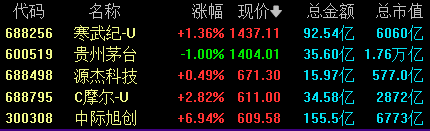
Group 1: Market Performance - Leading stocks in the computing power sector showed significant performance, with stocks like Zhongji Xuchuang, Shenghong Technology, and Xinyi Sheng all experiencing notable increases in trading volume and price [2][5] - Zhongji Xuchuang's stock price rose by 6.94%, closing above 600 yuan, marking a new historical high with a market capitalization of 677.3 billion yuan [3][2] - The A-share market saw a mixed performance, with the Shanghai Composite Index down by 0.13%, while the Shenzhen Component Index and the ChiNext Index rose by 0.09% and 1.07%, respectively [3] Group 2: Sector Trends - The computing power industry chain continued to rise, with segments such as optical modules, copper cables, and liquid-cooled servers showing strong performance [5] - Notable individual stocks in the computing power sector included Dekeli and Shaanxi Huada, which saw significant price increases of 20% and 17.36%, respectively [6] - The recent listing of Moer Thread on the A-share market, which surged by 425.46%, has opened up valuation space for domestic computing power concept stocks [7] Group 3: Corporate Developments - Baidu announced plans to evaluate the potential spin-off and independent listing of Kunlun Chip, which is currently under consideration [8] - Marvell's acquisition of Celestial AI for $3.25 billion highlights the growing interest in photonic technology to enhance data transmission capabilities in data centers [9] - Alibaba expressed intentions to invest further in artificial intelligence capabilities beyond its previously committed investment of 380 billion yuan over three years [10] Group 4: Consumer Sector Performance - The consumer sector saw a rise, with retail, dairy, and food processing manufacturing sectors experiencing gains, leading to stocks like Central Plaza and Maoye Commercial hitting their daily price limits [10][11] - The food and beverage industry is witnessing structural growth driven by new demands and emerging channels, with traditional industry leaders stabilizing their market shares [12] - Huachuang Securities recommended focusing on traditional undervalued leading companies and opportunities in the restaurant supply chain as well as growth-oriented beverage companies [12]

中信建投:看好“跨年行情”的五个理由
Sou Hu Cai Jing· 2025-12-09 04:39
Group 1 - The core viewpoint of the article emphasizes the anticipation of a year-end market rally in A-shares, analyzed from five perspectives: fundamentals, policies, capital, valuations, and technicals [1] Group 2 - Fundamentals have not shown significant improvement yet [1] - Policy measures continue to be implemented, with a focus on maintaining stability and enhancing quality and efficiency in economic work, alongside more proactive fiscal and moderately loose monetary policies [1] - Incremental capital is gradually entering the market, with participation from various sources including individual investors, state-owned enterprises, and northbound funds [1] Group 3 - Valuations indicate that there may still be upward potential, with the risk premium of the entire A-share market at 54.01% as of December 8, 2025, remaining above the opportunity threshold [1] - The technical analysis shows that the Shanghai Composite Index has broken through the resistance line formed by the highs of 2007 and 2015, which may now serve as a support line for the current market trend [1] Group 4 - Investment strategies suggested include: (1) focusing on growth over dividends; (2) prioritizing sectors such as technology (overseas computing power, consumer electronics, edge computing, robotics, gaming, domestic computing power), lithium batteries (solid-state batteries, energy storage), non-ferrous metals, and innovative pharmaceuticals; (3) considering counter-cyclical buying in the aforementioned sectors during significant market declines [1]

杀疯了!半小时500亿元!刚刚,重磅利好彻底引爆!
券商中国· 2025-12-09 03:38
继昨日(12月8日)疯狂抢筹之后,今日(12月9日)早盘,算力板块再度大爆发,CPO概念头半个小时成交近 500亿元,中际旭创、新易盛、胜宏科技等大幅拉升,并带领创业板指走强。 消息面上,据环球网援引路透社、彭博社等媒体报道,美国总统特朗普当地时间12月8日在社交媒体上发文宣 布,美国政府将允许英伟达向中国出售其H200人工智能芯片,但对每颗芯片收取一定费用。对此,英伟达回 应称,"向商业客户供应H200是一种值得肯定的举措。" CPO再度杀疯! 国盛证券认为,这对国内资本支出是好事,全行业支出有望进一步提升。 再度飙涨 算力相关彻底爆了!今早,CPO概念股再度大涨近2.5%,半小时内成交近500亿元,德科立、跃岭股份等飙 涨,中际旭创、胜宏科技、新易盛等表现给力。 当地时间12月8日,特朗普在社交媒体上发文宣布,美国政府将允许英伟达向中国出售其H200人工智能芯片, 但对每颗芯片收取一定费用。《纽约时报》称,H200芯片为英伟达"性能第二强"的芯片。特朗普表示,美方 将从相关芯片出口中收取25%的分成。他还称,美国商务部正在敲定相关安排细节,同样的安排也将适用于超 微半导体公司、英特尔等其他人工智能芯片公司 ...


金鹰基金梁梓颖:春季躁动有望提前 重点关注三条主线
Xin Lang Cai Jing· 2025-12-09 02:18
Group 1 - The Bank of Japan's governor hinted at a possible interest rate hike in December, causing a rise in Japanese bond yields and concerns over the reversal of carry trades, leading to adjustments in global markets [1][5] - The U.S. "small non-farm" payrolls report showed a surprising decline of 32,000 jobs in November, far below the expected increase of 10,000, which heightened expectations for a Federal Reserve rate cut [1][5] - As of December 6, the market is pricing in an 86.2% probability of a 25 basis point rate cut by the Federal Reserve in December [1][5] Group 2 - In China, the manufacturing PMI slightly rebounded in November but remained below the expansion threshold, with the manufacturing PMI at 49.2% (up 0.2 percentage points month-on-month) and the non-manufacturing PMI at 49.5% (down 0.6 percentage points month-on-month) [1][6] - The production index and new orders index for November were 50.0% (up 0.3 percentage points month-on-month) and 49.2% (up 0.4 percentage points month-on-month), respectively, indicating improvements in both production and demand [6] - The high-tech manufacturing, equipment manufacturing, and consumer goods manufacturing PMIs showed varying degrees of decline, while the PMI for high-energy-consuming industries rebounded from low levels [6] Group 3 - Despite a cautious market sentiment ahead of significant macroeconomic events in mid-December, the A-share market experienced a slight increase, supported by expectations of a Federal Reserve rate cut and adjustments in insurance company risk factors [2][6] - Global commodity markets continued to rise, with non-ferrous metals leading the gains [2][6] - The overall news sentiment was positive, with potential measures to expand broker capital and adjust insurance company investment risk factors expected to bring considerable incremental funds to the market [2][6] Group 4 - From a mid-term perspective, the upward trend of the index remains intact, with the possibility of an early spring rally starting in January or February due to the short interval between the Lunar New Year and the National People's Congress [2][6] - Investment recommendations include focusing on three areas: high-dividend assets such as banks and coal, growth sectors like computing and electricity with mid-term fundamentals, and flexible opportunities in themes like commercial aerospace and robotics [2][7]