证券业

Search documents
央行发布会关键细节
2026-01-16 02:53
央行和外管局在最新的新闻发布会上提出了哪些关键政策变化? 在最新的新闻发布会上,央行和外管局提出了几项关键政策变化。首先,货币 政策方面,央行强调要保持社会融资条件相对宽松,引导金融合理增长,并推 出了 8 项增量政策,其中 6 项为结构性工具。这些措施包括统一下调各类结构 性货币政策工具利率 0.25 个百分点,并增加 9,000 亿结构性货币政策工具额 度,其中支农支小再贷款额度提高 5,000 亿,科技创新和技术改造贷款额度增 加 4,000 亿。此外,还优化了智能智享再贷款和再贴现的使用范围,将支持对 象扩大到中型民营企业,并拓展碳减排、服务消费及养老再贷款工具的覆盖范 围。 央行发布会关键细节 20260115 摘要 央行倾向于稳健的货币政策,通过结构性工具而非总量宽松来支持经济, 如统一下调结构性货币政策工具利率 0.25 个百分点,并增加 9,000 亿 结构性货币政策工具额度,包括支农支小再贷款和科技创新贷款。 尽管市场预期不高,但 2026 年降准降息的可能性仍然存在,特别是三 季度经济增长压力较大时,人民币升值空间和银行息差压力缓解为货币 宽松提供了窗口。 预计 2026 年人民币汇率将保 ...
金融“五篇大文章”落地成色足 支持实体经济效果明显
Jin Rong Shi Bao· 2026-01-16 01:13
Core Viewpoint - The People's Bank of China (PBOC) has implemented a moderately accommodative monetary policy in 2025, resulting in significant support for the real economy and a notable increase in social financing and loan balances [1][2]. Group 1: Financial Statistics - By the end of 2025, the total social financing stock reached 442.12 trillion yuan, a year-on-year increase of 8.3% [1]. - The balance of RMB loans to the real economy was 268.4 trillion yuan, growing by 6.3% year-on-year [1]. - The broad money supply (M2) increased by 8.5%, significantly outpacing the nominal GDP growth rate [2]. Group 2: Policy Implementation - The PBOC utilized various monetary policy tools to maintain ample liquidity and guide financial institutions to meet the effective financing needs of the real economy [2]. - The issuance of government bonds was accelerated, with a total issuance scale of 16 trillion yuan in 2025, net increasing by 6.6 trillion yuan [3]. - The PBOC's liquidity support through operations like reverse repos has stabilized market expectations and facilitated government bond issuance [3]. Group 3: Financing Structure - In 2025, the incremental social financing was 35.6 trillion yuan, with direct financing accounting for 46.9% of this total, marking a 7.8 percentage point increase compared to the last year of the 13th Five-Year Plan [4]. - The net financing from government bonds was 13.84 trillion yuan, and non-financial corporate bond financing reached 2.39 trillion yuan, reflecting a strong support for private enterprises [4]. - The balance of loans in the "Five Major Financial Articles" reached 107.7 trillion yuan, with significant growth in technology and green loans [6][7]. Group 4: Future Monetary Policy Outlook - The PBOC plans to continue implementing a moderately accommodative monetary policy in 2026, focusing on stabilizing economic growth and ensuring a suitable monetary environment [8]. - There is still room for further reductions in the reserve requirement ratio and interest rates, as the average reserve requirement ratio stands at 6.3% [9]. - The PBOC aims to lower comprehensive financing costs for enterprises by promoting transparency in loan costs and optimizing the financing environment [9].
央行出台八项政策措施支持实体经济
Sou Hu Cai Jing· 2026-01-16 00:31
Group 1 - The core viewpoint of the news is that the People's Bank of China (PBOC) is implementing monetary policies to support high-quality development of the real economy, with a focus on increasing credit support and optimizing economic structure [2][3][4] - By the end of December 2025, the social financing scale stock increased by 8.3% year-on-year, and the broad money supply (M2) grew by 8.5%, significantly outpacing nominal GDP growth [2] - The PBOC plans to introduce eight policy measures to enhance credit allocation in key sectors, including a 0.25 percentage point reduction in various structural monetary policy tool rates [3][4] Group 2 - The PBOC will merge the agricultural and small enterprise re-loan and rediscount quotas, increasing the agricultural and small enterprise re-loan quota by 500 billion yuan, with a dedicated quota of 1 trillion yuan for private enterprises [3] - The quota for re-loans supporting technological innovation and transformation will be increased from 800 billion yuan to 1.2 trillion yuan, expanding the support to high R&D investment private SMEs [3] - The PBOC aims to lower the minimum down payment ratio for commercial property loans to 30% in collaboration with financial regulatory authorities [3] Group 3 - In 2025, the average weighted interest rate for new corporate loans and personal housing loans was around 3.1%, a decrease of 2.5 and 2.6 percentage points respectively since the second half of 2018 [7] - By the end of 2025, the total RMB loan balance was approximately 271.91 trillion yuan, with a year-on-year growth of 6.4%, indicating strong credit support for the real economy [7] - The manufacturing sector saw a 6.6% year-on-year increase in medium to long-term loans, while infrastructure and service sectors also experienced significant growth [7] Group 4 - The foreign exchange market in China is expected to operate stably, with a total trading volume of 42.6 trillion USD in 2025, and a net inflow of 302.1 billion USD for the year [5][6] - The proportion of enterprises conducting cross-border trade settlements in RMB is around 30%, which helps mitigate the impact of exchange rate fluctuations [6] - By the end of 2025, China's foreign assets and liabilities reached historical highs of 11.5 trillion and 7.5 trillion USD respectively, with foreign exchange reserves stable at 33,579 billion USD [5]

财联社1月16日早间新闻精选
Xin Lang Cai Jing· 2026-01-16 00:28
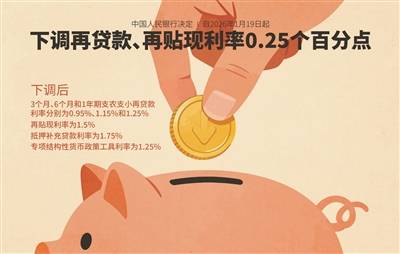
Monetary Policy and Financial Support - The People's Bank of China (PBOC) has lowered the interest rates of various structural monetary policy tools by 0.25 percentage points, with the one-year relending rate decreasing from 1.5% to 1.25% [1] - The minimum down payment ratio for commercial housing loans has been reduced to 30%, and the relending quota for supporting agriculture and small enterprises has been increased by 500 billion yuan, with a total quota for private enterprises set at 1 trillion yuan [2][3] - The loan quota for technological innovation and transformation has been raised from 800 billion yuan to 1.2 trillion yuan, including support for private small and medium-sized enterprises with high R&D investment levels [2][3] Financial Market Data - As of the end of December, the broad money supply (M2) stood at 340.29 trillion yuan, reflecting a year-on-year growth of 8.5% [3] - The total social financing scale for the year 2025 reached 35.6 trillion yuan, an increase of 3.34 trillion yuan compared to the previous year, with new RMB loans amounting to 16.27 trillion yuan [3] Regulatory Developments - The Financial Regulatory Bureau has emphasized the need for effective risk resolution for small financial institutions and the establishment of a normalized financing coordination mechanism for urban real estate [5] - The Ministry of Finance announced a tax exemption policy for foreign institutions investing in the domestic bond market, effective from January 1, 2026, to December 31, 2027 [8] Corporate Announcements - China Aerospace Science and Technology Corporation has set a goal to advance reusable rocket technology and promote commercial aerospace development in 2026 [7] - Liou Technology announced a significant contract with CATL worth 120 billion yuan, but the stock will remain suspended for one additional day due to uncertainties [12] - Mu Yuan Co. has projected a net profit of 14.7 billion to 15.7 billion yuan for 2025, indicating a year-on-year decline of 12.20% to 17.79% [16] Stock Market Performance - The three major U.S. stock indices closed higher, with the Dow Jones up by 0.60%, the S&P 500 rising by 0.26%, and the Nasdaq increasing by 0.25% [17] - The Nasdaq Golden Dragon China Index fell by 0.6%, indicating a mixed performance among popular Chinese concept stocks [17]
中信建投:A股预计迎来可观量级的增量资金,有望推动慢牛持续
Xin Lang Cai Jing· 2026-01-16 00:00
Core Viewpoint - The A-share market is expected to welcome a significant amount of incremental funds in 2026, which may sustain a slow bull market. The first quarter is projected to be the peak period for the maturity of fixed deposits, with funds likely flowing from insurance and wealth management channels into the equity market, marking the most abundant time for incremental funds throughout the year [3][4][62]. Group 1: Incremental Funds Sources - Incremental funds are primarily sourced from the migration of household deposits and pressures from asset scarcity, with insurance premium income continuing to grow significantly. By Q3 2025, the equity allocation ratio is expected to rise to 15.5%, nearing historical highs, which could release over 840 billion yuan into the market [4][6][66]. - The total amount of fixed deposits maturing in 2026 is estimated to be around 45 trillion yuan, which will likely lead to increased allocations in wealth management and "fixed income+" products, contributing over 900 billion yuan in medium to long-term funds to the A-share market [4][14][17]. - Public funds are expected to see a net inflow of approximately 230 billion yuan in 2026, driven by the recovery of fund net values and the enhanced motivation of individual investors to enter the market [4][33][34]. Group 2: Market Dynamics - The market's main contradictions in 2026 will shift towards verifying economic prosperity and performance realization, with medium to long-term funds providing a safety net. Active funds from public and private sectors are anticipated to further strengthen the "technology + resource products" dual mainline market, with accelerated sector rotation [4][62][64]. - The "national team" funds are expected to see a significant reduction in inflows, with a projected net inflow of about 200 billion yuan in 2026, as their role shifts in a bull market environment [19][22][23]. - High-risk funds, represented by margin trading and private equity, are expected to remain active, with margin trading net inflows estimated at around 450 billion yuan and private equity assets projected to grow to 8.5 trillion yuan, contributing approximately 700 billion yuan in incremental funds [4][26][31]. Group 3: Global and Domestic Influences - Overseas funds are anticipated to strategically allocate to Chinese assets, with northbound capital expected to net inflow around 100 billion yuan in 2026, although this impact on the overall market is expected to be limited [4][36][39]. - The macro liquidity environment is favorable, with a global interest rate cut cycle entering its later stages, but the marginal improvement in policies is expected to gradually converge. The micro-funding situation is likely to improve significantly, supporting a strong performance in equities over fixed income [4][45][49].


2025年12月金融数据点评:如何解读12月金融数据?
Hua Yuan Zheng Quan· 2026-01-15 13:41
Group 1: Investment Rating of the Report - No information provided regarding the industry investment rating Group 2: Core Views of the Report - Credit demand remains weak, with new loans in December slightly lower year-on-year. Personal loans decreased by 916 million yuan, and corporate loans increased by 1.07 trillion yuan. Personal short-term loans decreased by 1023 million yuan, and personal long-term loans increased by 100 million yuan, indicating weak consumer and mortgage credit demand. Corporate short-term loans increased by 370 billion yuan, corporate long-term loans increased by 330 billion yuan, and bill financing increased by 350 billion yuan, suggesting the use of corporate short-term loans and bill financing to boost credit scale [2]. - The growth rate of M1 continued to decline. The new - caliber M1 growth rate at the end of December was 3.8%, down 1.1 percentage points from the end of last month. The M1 growth rate has been falling since the end of September. The M2 growth rate at the end of December was 8.5%, up 0.5 percentage points from the end of last month [2]. - The social financing growth rate continued to decline in December, and it may continue to fall in 2026. The social financing increment in December was 2.21 trillion yuan, significantly lower than the same period last year. The shortfall mainly came from the net financing of government bonds. It is expected that new loans (in the social financing caliber) will slightly decrease year - on - year in 2026, the net financing of government bonds will expand, the increment of social financing will be similar year - on - year, and the social financing growth rate will slightly decline to about 7.4% by the end of 2026 [2]. - Pay attention to the coupon of 3 - 5Y capital bonds and seize the opportunity of long - bond trading. Since the second half of 2025, the bond market has often deviated from the fundamentals and is mainly driven by institutional behavior. It is expected that the wealth management scale will increase by more than 3 trillion yuan in 2026, and wealth management will significantly increase the allocation of credit bonds with a remaining maturity of less than 3 years and 5Y credit bonds. The decline in bank liability costs will support government bonds within 10Y. It is recommended to allocate 3 - 5Y capital bonds for coupons, trade long - bonds, and explore multi - asset opportunities [2]. Group 3: Summary by Related Catalogs Credit Situation - In December, due to weak credit demand, new loans were lower year - on - year. Personal loans decreased, and corporate loans increased. Personal short - term and long - term loans both decreased significantly year - on - year, while corporate short - term loans, long - term loans, and bill financing were used to boost credit scale. Credit demand may be weak in the long term due to factors such as fiscal policy and industry over - capacity [2]. M1 and M2 Situation - The new - caliber M1 growth rate at the end of December was 3.8%, down 1.1 percentage points from the end of last month, and it has been falling since September. The M1 growth rate rose from January to September due to factors such as the stock market recovery and a lower base, but it declined significantly in Q4 as the base returned to normal. The M2 growth rate at the end of December was 8.5%, up 0.5 percentage points from the end of last month [2]. Social Financing Situation - The social financing increment in December was 2.21 trillion yuan, lower than 2.85 trillion yuan in December 2024. The shortfall mainly came from government bond net financing. The social financing growth rate at the end of December decreased by 0.2 percentage points to 8.3%. It is expected that the social financing growth rate will slightly decline to about 7.4% by the end of 2026 [2]. Bond Investment Suggestion - Since the second half of 2025, the bond market has been mainly influenced by institutional behavior. The growth of wealth management scale will support credit bonds within 3Y, and the decline in bank liability costs will support government bonds within 10Y. It is recommended to allocate 3 - 5Y capital bonds for coupons, trade long - bonds, and explore multi - asset opportunities. The yield of the active 30Y Treasury bond is expected to slowly return to about 2.2% in the first quarter [2].
东兴证券晨报-20260115
Dongxing Securities· 2026-01-15 10:28
Economic News - The Ministry of Finance announced a tax refund policy for taxpayers selling their own homes and purchasing new ones within one year, with full refunds for new purchases equal to or greater than the sale price of the old home [2] - The Ministry of Finance held a video conference to promote a package of policies aimed at boosting domestic demand, emphasizing the need for simplified processes and effective implementation [2] - The Anhui Provincial Government issued measures to support entrepreneurship, allowing a maximum investment loss tolerance of 80% for provincial angel funds [2] - The State Administration of Taxation exposed two tax evasion cases involving online anchors, indicating a crackdown on tax violations in this sector [2] - The U.S. State Department suspended visa processing for 75 countries to combat potential public burden applicants [2] - The situation between the U.S. and Iran remains tense, with potential military actions being discussed [2] - Chinese banks have accelerated capital replenishment, with 39 institutions changing their registered capital or plans, primarily through targeted stock issuance [2] - The Japanese government plans to take action against excessive speculation in the foreign exchange market [2] - The People's Bank of China will conduct a 900 billion yuan reverse repurchase operation to maintain liquidity in the banking system [2] - China's foreign trade in 2025 reached 45.47 trillion yuan, with exports growing by 6.1% and imports by 0.5% [5] Company Insights - Tianli Lithium Energy's subsidiary will undergo maintenance from January 14 to February 28, 2026, reducing lithium iron phosphate production by 1,500 to 2,000 tons, but not significantly impacting operations [5] - Zhuoyi Information's stock price has deviated significantly from market trends, raising concerns about speculative risks [5] - Huazheng New Materials expects a net profit of 260 million to 310 million yuan for 2025, indicating a turnaround from losses due to market expansion and cost reduction efforts [5] - CITIC Securities reported a revenue of 74.83 billion yuan for 2025, a year-on-year increase of 28.75%, with net profit rising by 38.46% [5] - Hu Silicon Industry anticipates a net loss of 1.53 billion to 1.28 billion yuan for 2025, indicating a worsening financial situation compared to the previous year [5] Industry Analysis - The photovoltaic industry may see a second growth curve with the concept of space photovoltaic technology, which could significantly increase demand for solar energy in space applications [7][8] - The current leading technology for space photovoltaic is gallium arsenide, but its high production costs may lead to the adoption of P-type HJT technology, which is more suitable for space conditions [9] - Perovskite tandem batteries are expected to become a key option for future space photovoltaic applications due to their high efficiency and lightweight characteristics [10] - The short-term growth in low-orbit satellites is expected to drive demand for space photovoltaics, with HJT and perovskite technologies being favored for their adaptability to extreme environments [10]
1月15日晚间重要公告一览
Xi Niu Cai Jing· 2026-01-15 10:25
Group 1 - Siyuan Electric reported a total operating revenue of 21.205 billion yuan for 2025, a year-on-year increase of 37.18%, with a net profit attributable to shareholders of 3.163 billion yuan, up 54.35% year-on-year [1] - VisiOn expects a negative net profit for 2025, indicating a loss in operating performance [2] - Chongqing Steel anticipates a net loss of 2.5 billion to 2.8 billion yuan for 2025, which is an improvement from a net loss of 3.196 billion yuan in the previous year [3] - Lianfa Co. forecasts a net profit of 280 million to 320 million yuan for 2025, representing a year-on-year growth of 38.92% to 58.77% [4] Group 2 - CICC announced that the audit work related to the absorption merger with Dongxing Securities and Xinda Securities has not yet been completed [5] - Dalong Real Estate's subsidiary won a project bid worth 763 million yuan [6] - Zhongchuang Zhiling plans to issue convertible bonds to raise no more than 4.35 billion yuan for various projects [7] - Jintong Co. intends to acquire a 24% stake in Jinsha Molybdenum for 1.731 billion yuan [8] Group 3 - Nami Technology expects a net profit of 128 million to 145 million yuan for 2025, an increase of 54.51% to 75.03% year-on-year [9] - China State Construction reported a new contract total of 4.5458 trillion yuan for 2025, a 1% increase year-on-year [12] - China Metallurgical Group's new contract amount for 2025 is expected to decrease by 10.8% to 1.1136 trillion yuan [13] Group 4 - Beiding Co. reported a net profit of 111 million yuan for 2025, a year-on-year increase of 59.05% [14] - Southwest Securities expects a net profit of 1.028 billion to 1.098 billion yuan for 2025, an increase of 47% to 57% [15] - China Eastern Airlines reported a 4.93% year-on-year increase in passenger capacity for December 2025 [20] Group 5 - *ST Aowei's stock may be delisted due to a closing price below par value [21] - Yilian Network expects a net profit of 2.542 billion to 2.648 billion yuan for 2025, a decrease of 0% to 4% year-on-year [22] - Huochen Co. anticipates a net profit of 420 million to 540 million yuan for 2025, recovering from a loss of 2 million yuan in the previous year [17] Group 6 - Guoli Electronics expects a net profit of 68 million to 80 million yuan for 2025, an increase of 124.89% to 164.57% [28] - Jinchuan Group forecasts a net profit of 11 billion to 12 billion yuan for 2025, a year-on-year increase of 73.57% to 89.34% [41] - Triangle Tire plans to invest 3.219 billion yuan in a new tire project in Cambodia [42]






成交额超116亿,A500ETF基金(512050)交投活跃,机构称阶段性调整有助于行情延续
Xin Lang Cai Jing· 2026-01-15 03:54
Group 1 - The core viewpoint of the news highlights the strong performance of the A-share market, with significant trading activity and a notable increase in the A500 ETF fund's scale [1][2] - The A500 index has shown a slight increase of 0.01%, with several constituent stocks like Guanglianda and Wolong Nuclear Materials rising by over 10% [1] - The A500 ETF fund has experienced a substantial growth of 165.61 billion yuan in scale over the past month, indicating a robust market interest [1] Group 2 - The A500 index tracks 500 large-cap, liquid securities across various industries, reflecting the overall performance of representative listed companies [2] - As of December 31, 2025, the top ten weighted stocks in the A500 index account for 20.33% of the index, including major companies like Ningde Times and Kweichow Moutai [2] - The A500 ETF fund has several related products, including various connection funds and enhanced index funds, indicating a diverse investment offering [2]
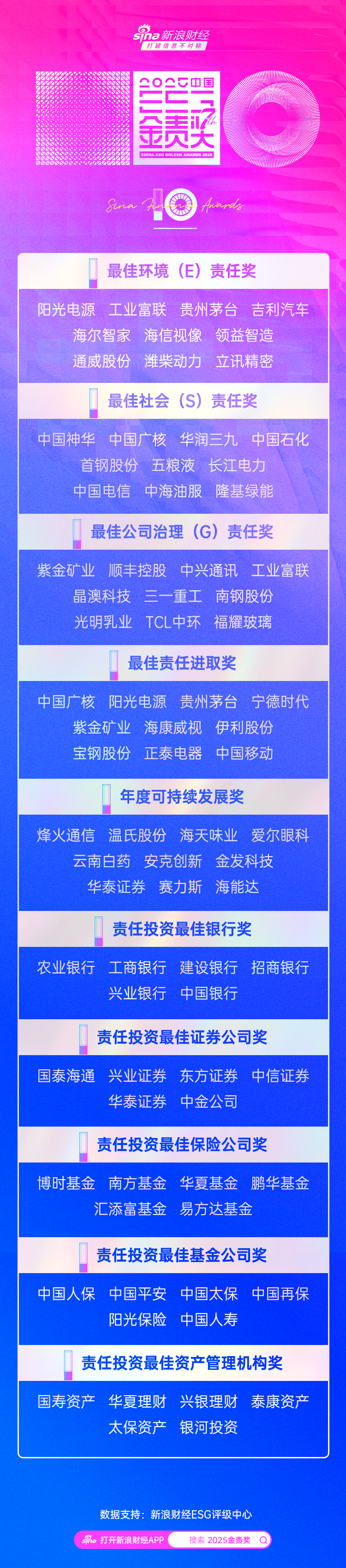
2025中国企业ESG“金责奖”评选结果揭晓 共筑可持续发展新生态
Xin Lang Cai Jing· 2026-01-15 02:38
Core Viewpoint - The 2025 China Enterprise ESG "Golden Responsibility Award" aims to recognize companies and institutions that have made significant contributions to ESG initiatives in China, reflecting a shift from voluntary practices to compliance requirements in ESG performance [1][18]. Group 1: Award Categories and Winners - The award includes ten categories: Best Environmental Responsibility Award, Best Social Responsibility Award, Best Corporate Governance Responsibility Award, Best Responsibility Initiative Award, Annual Sustainable Development Award, Best Responsible Investment Bank Award, Best Responsible Investment Securities Company Award, Best Responsible Investment Insurance Company Award, Best Responsible Investment Fund Company Award, and Best Responsible Investment Asset Management Institution Award [1][18]. - The Best Environmental Responsibility Award winners include: Sungrow Power Supply, Industrial Fulian, Kweichow Moutai, Geely Automobile, Haier Smart Home, Hisense Visual Technology, Linyang Electronics, Tongwei Co., Weichai Power, and Luxshare Precision [10][28]. - The Best Social Responsibility Award winners include: China Shenhua, China General Nuclear Power, China Resources Sanjiu, Sinopec, Shougang, Wuliangye, Yangtze Power, China Telecom, China Oilfield Services, and LONGi Green Energy [10][28]. - The Best Corporate Governance Responsibility Award winners include: Zijin Mining, SF Holding, ZTE Corporation, Industrial Fulian, JA Solar, Sany Heavy Industry, Nanjing Steel, Bright Dairy, TCL Zhonghuan, and Fuyao Glass [10][28]. - The Best Responsibility Initiative Award winners include: FiberHome Technologies, Wens Foodstuff Group, Haitian Flavoring and Food, Aier Eye Hospital, Yunnan Baiyao, Anker Innovations, Kingfa Sci. & Tech., Huatai Securities, Silex, and Hainengda [11][28]. - The Annual Sustainable Development Award winners include: China General Nuclear Power, Sungrow Power Supply, Kweichow Moutai, Contemporary Amperex Technology, Zijin Mining, Hikvision, Yili, Baosteel, Chint Electric, and China Mobile [11][28]. Group 2: Responsible Investment Awards - The Best Responsible Investment Bank Award winners include: Agricultural Bank of China, Industrial and Commercial Bank of China, China Construction Bank, China Merchants Bank, Industrial Bank, and Bank of China [11][28]. - The Best Responsible Investment Securities Company Award winners include: Guotai Junan, Everbright Securities, CITIC Securities, Huatai Securities, and CICC [12][28]. - The Best Responsible Investment Insurance Company Award winners include: China Life Insurance, China Ping An, China Pacific Insurance, China Re, Sunshine Insurance, and China Life [13][28]. - The Best Responsible Investment Fund Company Award winners include: Bosera Funds, Southern Fund, China Asset Management, Penghua Fund, Huitianfu Fund, and E Fund [14][28]. - The Best Responsible Investment Asset Management Institution Award winners include: China Life Asset Management, Huaxia Wealth Management, Xingyin Wealth Management, Taikang Asset, Taikang Asset, and Galaxy Investment [15][28]. Group 3: ESG Development Context - By 2025, China's ESG development has transitioned from "setting standards" to "strengthening regulations," with a comprehensive disclosure standard system being established [1][18]. - The ESG performance of enterprises is now a compliance requirement, linking commercial value with social value [1][18]. - The ESG rating center aims to promote sustainable development and responsible investment, enhancing the ESG performance of listed companies [17][34].