
公用事业

Search documents
融资资金布局,成本管控是核心
Sou Hu Cai Jing· 2026-01-28 02:37
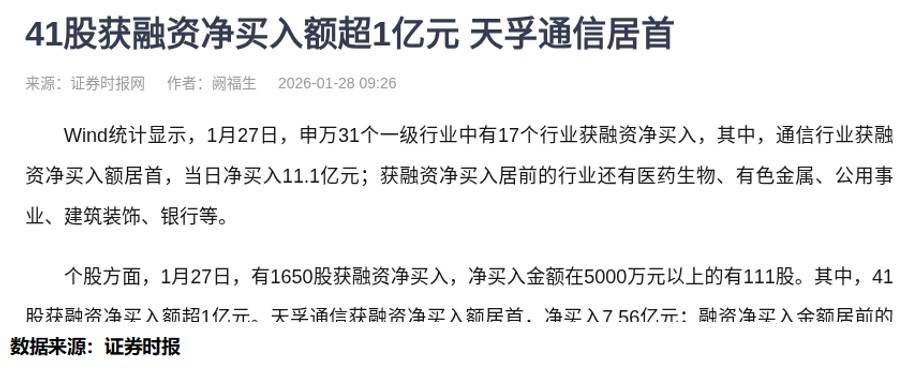
Group 1 - The core viewpoint of the article emphasizes that while short-term capital inflows can indicate market trends, the long-term performance of stocks is primarily determined by institutional investors' cost control strategies [1][3]. - In the recent analysis, 17 out of 31 primary industries received net capital inflows, with the communication sector leading, followed by pharmaceuticals, non-ferrous metals, and public utilities [1]. - Over 1,600 stocks experienced net capital inflows, with 111 exceeding 50 million yuan and 41 surpassing 100 million yuan, indicating significant investor interest [1]. Group 2 - Cost control is a fundamental aspect of value investing, as demonstrated by Warren Buffett's long-term investment in Coca-Cola, where he maintained a low average cost per share [3]. - Institutional trading logic focuses on the safety of holding costs, contrasting with retail investors who often prioritize expected returns [3]. - Quantitative data can reveal institutional trading behaviors, such as increased activity in "institutional inventory" before significant price movements, indicating proactive cost management [3][5]. Group 3 - The behavior of institutional cost management is applicable to both large and small-cap stocks, with early signs of institutional interest often preceding price increases [5]. - Not all small-cap stocks attract institutional interest; for instance, a small-cap stock with low trading volume showed no active institutional inventory, leading to a brief price increase followed by a decline [7]. - The size of a stock's float is not the sole determinant of its performance; rather, the depth of institutional cost management is crucial [9]. Group 4 - Long-term trading behaviors of institutions, such as maintaining active "institutional inventory" for extended periods, can lead to superior stock performance [9]. - Quantitative data can help investors move beyond superficial market sentiments and understand the underlying trading logic of institutional investors [11]. - By focusing on objective trading characteristics, investors can develop a more sustainable and disciplined investment approach, leveraging quantitative data to replace subjective speculation [11].

1月27日机械设备、汽车、国防军工等行业融资净卖出额居前
Sou Hu Cai Jing· 2026-01-28 02:05
Summary of Key Points Core Viewpoint - As of January 27, the latest market financing balance is 27,059.04 billion yuan, showing a decrease of 2.12 billion yuan compared to the previous trading day, with 17 industries experiencing an increase in financing balance, while 14 industries saw a decrease [1]. Industry Financing Balance Changes - The communication industry had the highest increase in financing balance, rising by 1.11 billion yuan to a total of 1,339.67 billion yuan [1]. - Other industries with notable increases include: - Pharmaceutical and biological: increased by 0.44 billion yuan to 1,696.03 billion yuan - Non-ferrous metals: increased by 0.41 billion yuan to 1,494.54 billion yuan - Public utilities: increased by 0.29 billion yuan to 569.69 billion yuan [1]. - Conversely, the following industries experienced significant decreases in financing balance: - Machinery and equipment: decreased by 1.70 billion yuan to 1,418.93 billion yuan - Automotive: decreased by 0.96 billion yuan to 1,242.31 billion yuan - National defense and military: decreased by 0.68 billion yuan to 1,040.47 billion yuan [2]. Percentage Changes in Financing Balance - The coal industry recorded the highest percentage increase in financing balance at 1.09%, totaling 149.82 billion yuan [1]. - Other industries with notable percentage increases include: - Communication: 0.84% - Steel: 0.79% - Agriculture, forestry, animal husbandry, and fishery: 0.59% [1]. - Industries with the largest percentage decreases include: - Machinery and equipment: decreased by 1.19% - Comprehensive: decreased by 1.10% - Oil and petrochemicals: decreased by 0.89% [1].
2025年工业企业利润数据点评:同比转正,新旧分化
GF SECURITIES· 2026-01-27 15:35
Revenue Trends - In 2025, the revenue of industrial enterprises above designated size increased by 1.1% year-on-year, slightly lower than the 2.1% growth in 2024 and consistent with 2023, remaining in the low range of 1%-3% for three consecutive years[3]. - December 2025 saw a 3.2% year-on-year decline in revenue, marking three consecutive months of negative growth[3]. - The nominal GDP growth for the secondary industry in Q4 2025 was 1.28%, down from 1.45% in Q3, while the tertiary industry maintained a growth rate of 5.7%[3]. Profit Trends - The profit of industrial enterprises above designated size in 2025 increased by 0.6% year-on-year, ending three years of consecutive negative growth from 2022 to 2024, which recorded -4.0%, -2.3%, and -3.3% respectively[4]. - December 2025 profits showed a significant improvement with a 5.3% year-on-year increase, contrasting sharply with the negative growth seen in the previous months[4]. - The profit margin for 2025 was 5.31%, a slight decrease of 0.03 percentage points year-on-year, indicating a stabilization in profit rates[4]. Sector Performance - High-growth sectors in 2025 included high-tech manufacturing, non-ferrous metals, and public utilities, with specific industries like smart drones and semiconductors showing profit growth rates of 102.0% and 172.6% respectively[8]. - The mining sector experienced a profit decline of 26.2% in 2025, continuing a trend of negative growth from previous years[8]. - The profit share of high-tech manufacturing and non-ferrous metals reached a historical high of 44.6% in 2025, while traditional high-energy-consuming industries dropped to 18.3%[12]. Inventory and Debt - By the end of 2025, the nominal inventory of industrial enterprises grew by 3.9% year-on-year, with a sales-to-inventory ratio of 0.49 in December, indicating a slower inventory reduction compared to the previous year[13]. - The asset-liability ratio for industrial enterprises was 57.6% at the end of 2025, reflecting a decrease in debt growth to a historical low of 4.2% year-on-year[13].
——12月工业企业利润点评:企业利润开门红在望
Changjiang Securities· 2026-01-27 11:44
Group 1: Economic Overview - In December 2026, the total profit of industrial enterprises above designated size increased by 5.3% year-on-year, ending two consecutive months of negative growth[6] - The operating revenue for the same month decreased by 3.2% year-on-year, indicating a decline in sales despite profit growth[6] Group 2: Profit Recovery Drivers - The recovery in profits is driven by a rebound in exports and rising raw material prices, with mining profits declining by 2.7%, manufacturing profits increasing by 5.0%, and public utility profits rising by 23.1%[10] - The profit growth in December was primarily supported by the non-ferrous smelting sector, which contributed a 5.6 percentage point increase in profit growth[10] Group 3: Inventory and Turnover Improvements - By the end of December, the nominal year-on-year growth rate of industrial product inventories fell to 3.9%, reflecting improved inventory turnover due to stronger exports[10] - The average turnover days for industrial enterprises' inventories decreased to 19.9 days, and accounts receivable turnover days fell to 67.9 days, indicating reduced turnover pressure[10] Group 4: Future Outlook - The first quarter of 2026 is expected to see a strong start for enterprise profits, supported by robust external demand and a gradual recovery in internal investment policies[10] - As of January 25, 2026, new special bonds issued amounted to 367.7 billion yuan, exceeding the planned issuance by 146.3 billion yuan, signaling a focus on stabilizing investment[10]
全球股市立体投资策略周报1月第4期:地缘风险频发,避险资产领涨
GUOTAI HAITONG SECURITIES· 2026-01-27 10:25
Market Performance - Emerging markets saw a narrowing increase of 0.9%, while developed markets declined by 0.6%, with the MSCI Global index down 0.4%[9] - The Japanese 10Y government bond yield rose by 7.1 basis points, while the French yield saw the largest decline of 2.3 basis points[9] - COMEX silver and gold prices increased by 14.5% and 8% respectively, indicating strong performance in precious metals[9] Investor Sentiment - Trading volume in the A-share and Hong Kong markets decreased, with the Hang Seng Index trading volume down to 143 billion shares and $639 billion[21] - The short-selling ratio in Hong Kong increased to 13.1%, indicating a slight rise in bearish sentiment among investors[21] Earnings Expectations - The earnings forecast for the Hang Seng Index for 2025 was revised down from 2069 to 2065, while the S&P 500's forecast was adjusted up from 273 to 274[69] - The financial sector in Hong Kong saw the largest upward revision in earnings expectations, while the consumer staples sector experienced the most significant downward adjustment[69] Economic Outlook - The U.S. economic surprise index rose, reflecting a potential recovery, while the European index declined amid trade tensions[69] - Market expectations indicate that the Federal Reserve is unlikely to cut interest rates in January, with a projected average of 1.8 rate cuts for 2026[52] Capital Flows - Recent capital inflows into the Hong Kong market totaled HKD 155 billion, with stable foreign capital contributing HKD 184 billion[64] - The overall liquidity in the U.S. is expected to remain stable, with the SOFR-OIS spread widening, indicating a slight increase in liquidity risk[52]
滨海投资1月27日斥资斥资9120港元回购8000股
Zhi Tong Cai Jing· 2026-01-27 10:12
滨海投资(02886)发布公告,于2026年1月27日该公司斥资9120港元回购8000股股份,回购价格为每股 1.14港元。 ...
滨海投资(02886)1月27日斥资9120港元回购8000股
智通财经网· 2026-01-27 10:11
智通财经APP讯,滨海投资(02886)发布公告,于2026年1月27日该公司斥资9120港元回购8000股股份, 回购价格为每股1.14港元。 ...
2025年工企利润数据点评:期待2026年初投资“实物工作量”
Bank of China Securities· 2026-01-27 09:19
宏观经济 | 证券研究报告 — 总量点评 2026 年 1 月 27 日 风险提示:海外衰退风险;地缘关系的不确定性。 相关研究报告 2025 年工企利润数据点评 期待 2026 年初投资"实物工作量" 价格端对工业企业利润的拖累仍存。制造业对工业企业盈利的整体带动作用 延续凸显。期待 2026 年初投资"实物工作量"。 国家统计局网站 1 月 27 日信息显示,2025 年 1-12 月(下文简称"1-12 月")全国规模以上工业企业(以下简称为"工业企业")实现利润总 额 73982.0 亿元,同比增长 0.6%,增速较 1-11 月加快 0.5 个百分点; 2025 年 12 月(下文简称"12 月"),工业企业利润同比增长 5.3%,增 速较 11 月明显加快 18.4 个百分点。 营业收入、成本方面,1-12 月工业企业营业收入同比增长 1.1%,增幅较 1-11 月收窄 0.5 个百分点,每百元资产实现营业收入 75.9 元,较 1-11 月 增加 1.5 元。1-12 月工业企业营业成本同比增长 1.3%,增幅较 1-11 月收 窄 0.5 个百分点。盈利能力方面,1-12 月规模以上工业企业营 ...
多家银行业绩快报亮相,高股息板块防御底色凸显,中证红利ETF(515080)连续6年跑赢基准
Sou Hu Cai Jing· 2026-01-27 05:18
Core Viewpoint - The A-share market continues to experience fluctuations, with a notable divergence in popular sectors under the "cooling" expectations, leading to a pullback in cyclical and dividend sectors [1] Group 1: Market Performance - As of January 26, the CSI Dividend Index has a 40-day return difference of -8.89% compared to the Wind All A Index, indicating significant underperformance [1] - The latest dividend yield of the CSI Dividend Index is 5.06%, while the yield of the 10-year government bond is 1.82%, highlighting the relative value of high dividend configurations [1][14] Group 2: Banking Sector Insights - Eight banks, including China Merchants Bank and Shanghai Pudong Development Bank, reported 2025 performance forecasts, with seven showing growth in both operating income and net profit attributable to shareholders, indicating a stable industry development [1] - China Merchants Bank achieved an operating income of 337.5 billion yuan, remaining stable year-on-year, and a net profit of 150.2 billion yuan, reflecting a 1.2% increase [1] Group 3: Investment Strategies - Long-term funds, represented by insurance capital, are increasingly investing in high-dividend assets, particularly in the banking and public utility sectors, due to the scarcity of high-yield assets in a low-interest-rate environment [2][21] - The CSI Dividend ETF (515080) tracks high-dividend stocks, reflecting the overall performance of the A-share market's high-dividend stocks [2][6] Group 4: Future Outlook - The insurance capital's stake acquisitions reached a near 10-year high in 2025, driven by the low-interest-rate environment and the need for stable high-dividend assets [2][21] - The regulatory framework is encouraging long-term capital to enter the market, which may provide stability and mitigate concerns over interest rate differentials [22]




345家公司2025年业绩预增
Zheng Quan Shi Bao Wang· 2026-01-27 01:36
1119家公司公布了全年业绩预告,业绩预增公司有345家,占比30.83%。 证券时报·数据宝统计显示,截至1月27日,已经有1119家公司公布了2025年度业绩预告。业绩预告类型 显示,预增公司345家、预盈104家,合计报喜公司比例为40.13%;业绩预亏、预降公司分别有363家、 143家。 | | 能 | | | | | 备 | | --- | --- | --- | --- | --- | --- | --- | | 002636 | 金安国 | 2026.01.22 | 763.47 | 26.36 | 57.75 | 电子 | | | 纪 | | | | | | | 300435 | 中泰股 | 2026.01.06 | 677.22 | 33.58 | 51.13 | 公用事 | | | 份 | | | | | 业 | | 003035 | 南网能 | 2026.01.20 | 667.73 | 5.93 | 29.48 | 公用事 | | | 源 | | | | | 业 | | 603086 | 先达股 | 2026.01.27 | 660.38 | 9.00 | 9.49 | 基础化 | ...