
基建

Search documents
深圳出海e站通牵线搭桥,深沙政企精准对接共拓中东市场
Nan Fang Du Shi Bao· 2025-10-30 01:43
Core Insights - The "China-Saudi Arabia Collaborative Global Business Exchange Conference" was successfully held in Shenzhen, attracting nearly a hundred entrepreneurs from Shenzhen and a delegation of over 20 representatives from Riyadh, Saudi Arabia [1][3]. Group 1: Event Overview - The event was co-hosted by Shenzhen Outbound E-Station and the Riyadh City Government, focusing on opportunities for cooperation between Shenzhen and Saudi Arabia [1][3]. - The conference aimed to create an efficient platform for industrial collaboration, emphasizing sectors such as smart city construction, green energy, supply chain logistics, infrastructure technology, artificial intelligence, and data security [3][4]. Group 2: Government and Market Opportunities - Riyadh's Deputy Mayor highlighted the city's role as a global business hub and its ongoing efforts to optimize the business environment, attracting over a thousand multinational companies [4]. - The Deputy Mayor promoted three key areas for investment: new energy development, smart city construction, and infrastructure upgrades, aligning with Shenzhen's industrial strengths [3][4]. Group 3: Shenzhen Enterprises' Strengths - Various Shenzhen enterprises showcased their capabilities in technology research, product innovation, and service capacity, indicating strong potential for international collaboration [6]. - Companies like China Railway Construction Corporation and others presented their comprehensive service offerings in sectors such as smart construction, renewable energy solutions, and AI technology [6][8]. Group 4: Collaboration and Future Plans - Several Shenzhen enterprises reached preliminary cooperation intentions with Saudi representatives in areas like new energy projects and supply chain collaboration [8]. - Shenzhen Outbound E-Station plans to provide tailored follow-up services to assist companies in navigating local policies and resources, enhancing their international business strategies [9][11].

苏商集团董事局主席严昕42岁财富550亿元位列胡润榜第101名,身家比上年增长50亿元增长率10%,排名下降25位
Xin Lang Zheng Quan· 2025-10-28 10:27
Core Insights - The 2025 Hurun Rich List reveals that Yan Xin, a prominent entrepreneur from Jiangsu, has a net worth of 55 billion yuan, an increase of 5 billion yuan from the previous year, representing a growth rate of 10% [1][3] - Yan Xin's ranking dropped from 76th last year to 101st this year, indicating a significant shift in wealth distribution among the richest individuals [1][3] Company Overview - Yan Xin is the chairperson of Su Business Group, which is a major player in infrastructure construction, focusing on investments, construction, and management of various infrastructure projects [3] - The company specializes in highways, underwater tunnels, cross-sea bridges, ports, and large municipal and water conservancy projects, positioning itself as a leader in the technical and innovative infrastructure sector in China [3] - Su Business Group is recognized for its advanced capabilities in urban integration, sponge city development, smart transportation, ecological engineering, and green building, holding multiple first-class qualifications in various construction sectors [3] - In 2025, Su Business Group ranked 338th on the Fortune Global 500 list, highlighting its significant presence in the global market [3]

【观投研】股指期货全线上涨,有色金属领涨商品
Sou Hu Cai Jing· 2025-10-27 15:03
Group 1 - The futures market showed structural differentiation on October 27, with industrial products outperforming agricultural products, indicating optimistic expectations for infrastructure and manufacturing demand [1] - The black and base metal sectors led the gains, while agricultural products weakened due to anticipated supply increases [1] - Strong performance in stock index futures was noted, with the CSI 500 (IC2512) rising 1.76% to 7254.4 points, reflecting optimism towards technology growth and cyclical sectors [1] Group 2 - The macroeconomic environment was dominated by positive signals, including a basic consensus reached in US-China trade talks, alleviating external uncertainties [1] - The emphasis on technological innovation and green development in the "14th Five-Year Plan" strengthened policy expectations, contributing to the recovery of risk asset valuations [1] Group 3 - In commodity futures, copper and tin main contracts rose by 1.73% and 1.15% respectively, supported by supply bottlenecks and green demand [1] - Coking coal prices remained strong due to environmental regulations limiting production in the Ulanqab region [1] Group 4 - Short-term policy benefits are expected to support risk appetite, with mid-cap stocks (IM, IC) showing better elasticity, although caution is advised regarding potential valuation corrections [1] - Clear supply-demand gaps for copper and aluminum warrant attention to South American copper mine strikes and domestic inventory changes [1] Group 5 - The fuel oil market is expected to continue its range-bound oscillation, influenced by the interplay between a relatively strong fundamental backdrop and macroeconomic pressures [3] - The PVC market is characterized by high supply and weak demand, with cost support and seasonal maintenance failing to provide sufficient upward momentum [4] Group 6 - Despite high US production levels, expectations for tightening supply and recovering demand are increasing, suggesting that oil prices may continue to run strong in the short term [5] - The urea market is supported by weather and agricultural demand, but overall demand remains weak, with limited upward price potential [6]
热点思考 | 投资“失速”的真相?(申万宏观·赵伟团队)
申万宏源宏观· 2025-10-27 14:16
Core Viewpoint - The article discusses the significant decline in fixed asset investment in China since the second half of 2025, highlighting a broad downturn across various sectors including infrastructure, services, real estate, and manufacturing [1][10][19]. Investment Growth Decline - Fixed asset investment growth has dropped sharply by 9.1 percentage points to -6.5% in September 2025, marking a five-year low. The actual investment growth, excluding price disturbances, fell by 7.8 percentage points to -4.1% [1][10]. - Investment in broad infrastructure, services, real estate, and manufacturing has all seen declines, with respective drops of 13.1, 11.1, 9.3, and 9.1 percentage points [1][10][19]. - Specific sectors like major projects, consumer infrastructure, and manufacturing have also experienced notable declines, with infrastructure investments in IT services, public utilities, and facility management dropping around 20 percentage points [1][12]. Reasons for Investment Slowdown - The primary reason for the investment slowdown is the acceleration of debt resolution, which has occupied investment funds, explaining over half of the investment decline. The Ministry of Finance allocated 800 billion for special refinancing bonds, with issuance rising to 1.2 trillion since June, reducing available government investment funds [2][29]. - Companies have been increasing investments through debt, but the current push for debt repayment has led to a reduction in available funds for new investments. This has particularly affected state-owned enterprises, which are under pressure to clear debts more quickly [3][40]. - A lack of new projects has also contributed to the investment decline, with new and expansion projects seeing significant drops in growth rates, while renovation projects maintain a higher growth rate [4][44]. Policy Optimization Impact - Historical data suggests that debt issues can significantly constrain corporate cash flow and economic performance. The proportion of accounts receivable has risen to around 15%, with private enterprises having the highest share [5][53]. - The ongoing debt resolution process may improve corporate cash flow, potentially restoring economic momentum. Recent data shows a decline in accounts receivable growth for both private and state-owned enterprises, which could alleviate the "triangle debt" issue [5][60]. - Recent fiscal measures have introduced new funding aimed at addressing the investment decline, particularly in economically significant provinces. The central government has allocated 500 billion for local debt resolution and project construction, which may help mitigate the investment downturn [6][66].
毕马威重磅发布《大变局:基建与交通运输行业新兴趋势》
Sou Hu Cai Jing· 2025-10-27 02:40
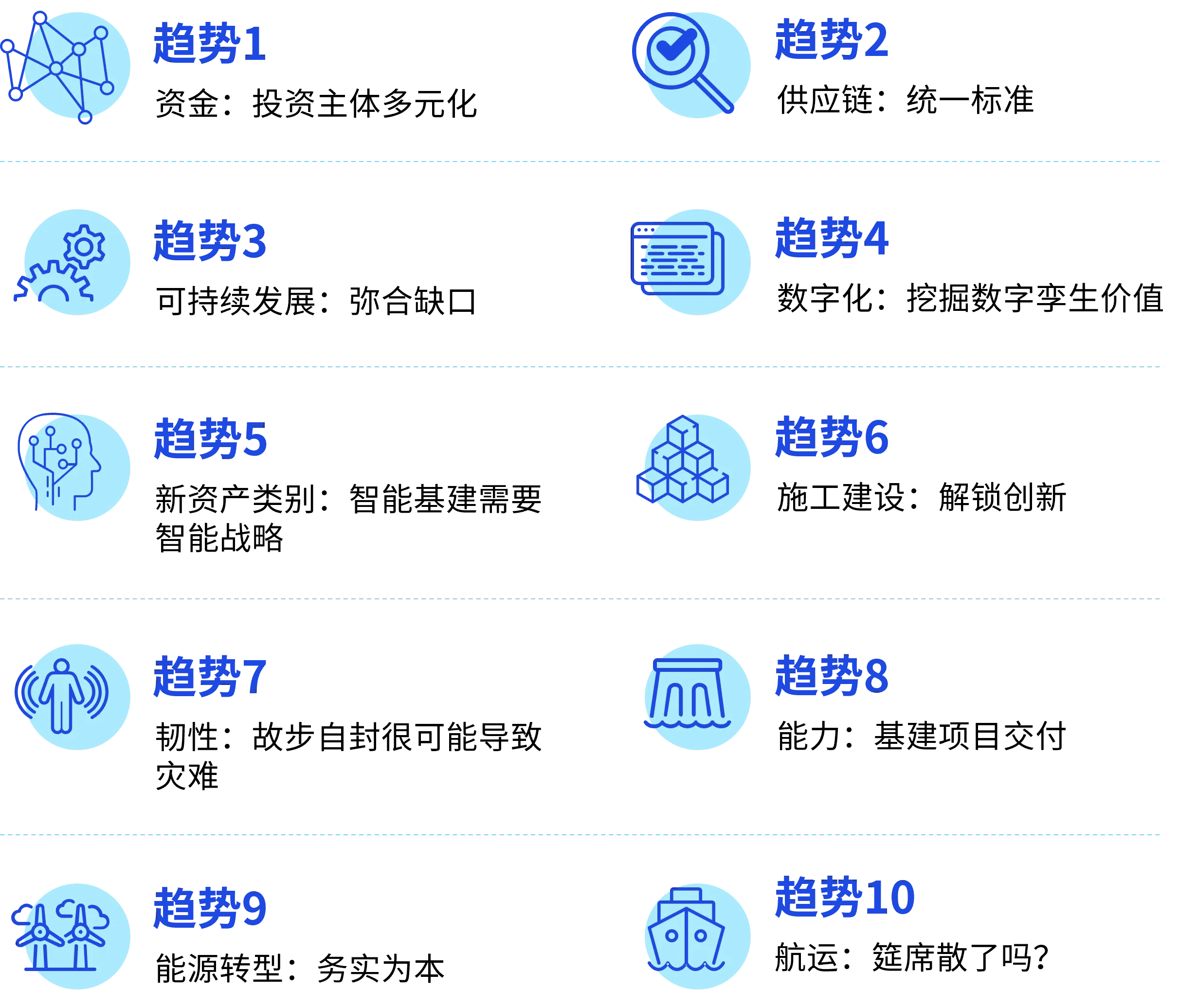
Core Insights - The report by KPMG titled "Transformations: Emerging Trends in Infrastructure and Transportation" analyzes significant changes facing the industry and provides forward-looking predictions for the next year [1] - The report is based on insights from ten senior leaders in the infrastructure sector, offering a deep understanding of the global shifts impacting the industry [1] Key Judgments - By 2025, rising public debt yields, withdrawal of bilateral investments, and a stronger dollar will intensify fiscal pressures, leading to fierce competition among countries for patient capital, making private investment and diversified investment entities crucial trends [6] - Governments will face increased funding costs due to rising public debt yields, while the retreat of bilateral investments and development aid will further weaken the fiscal capacity of emerging markets [7] - The demand for resilient infrastructure and modern services is expected to surge, with governments needing to meet public expectations to ensure social and economic stability [7] Predictions and Recommendations - Countries will compete for patient capital, with some emulating India's National Monetization Pipeline (NMP) to accelerate private investment in specific sectors [8] - Establishing clear asset listing channels with transparent regulatory frameworks will encourage innovation and reinvestment, providing reasonable returns for private investors [8] - Stakeholders must engage with citizens, national pension funds, and institutional investors to identify target assets and conduct due diligence [8] Key Developments in Supply Chain - By 2025, supply chains will face immense pressure due to trade wars and new tariff regulations, necessitating efficiency improvements and stricter evaluations of emissions [11] - The need for supply chain standardization will be recognized, although actual implementation will take time [10][12] - Companies will be compelled to enhance supply chain efficiency through collaboration with government and industry bodies [11] Sustainable Transformation - Governments and enterprises will begin to bridge the gap between actions and goals, ensuring daily operations align with long-term sustainability objectives [13][14] - Major regulations will drive sustainable transformations, with construction owners needing to understand material sources and carbon footprints [15] Digital Twin Technology - By 2025, digital twin technology will become a key tool for enhancing operational efficiency and decision-making due to decreasing costs and increasing demand for insights [16][17] - Companies that do not adopt digital twins will face scrutiny from stakeholders and competitive disadvantages [18] Dynamic Strategic Planning - Enterprises should transition from static annual plans to dynamic strategic planning methods, leveraging real-time data and advanced technologies to improve decision quality and efficiency [19][20] - This shift will enhance performance and profitability while providing significant benefits to all stakeholders [21] Construction Industry Pressures - Construction companies will face exponential growth pressures, particularly in energy and infrastructure sectors, but can leverage technology and AI to improve efficiency and profit margins [22][23] - Companies are advised to invest in technology, enhance supply chains, and adjust operational models to drive innovation [24] Infrastructure Asset Management - Infrastructure asset failures could lead to catastrophic consequences, necessitating comprehensive assessments to evaluate risks and develop operational resilience goals [26][27] - Companies should prioritize high-risk asset updates and protections to avoid future risks and costs [28] Supply Chain Management - Owners of public and private infrastructure investment portfolios will actively engage in supply chain management, establishing long-term relationships with suppliers to address delivery capacity and talent bottlenecks [29][30] - Digitalization and technology will enhance supply chain efficiency, enabling companies to prepare for future disruptions [31] Pragmatism in Financing - Pragmatism will drive companies to strengthen collaboration and develop hybrid financing models to enhance social and environmental project impacts [32][33] - Companies will focus on data capture and reporting to demonstrate project benefits, balancing environmental impact with economic practicality [34] Shipping Industry Adaptation - Shipping companies must adapt to rate fluctuations and sustainability pressures amid trade protectionism and supply chain disruptions [35][36] - Companies are encouraged to reconsider investment strategies, focusing on long-term effective areas and engaging in scenario planning [37]
绿地控股20天新增诉讼1344件 资产负债率89%新业务尚处投入期
Chang Jiang Shang Bao· 2025-10-27 01:45
Core Viewpoint - Greenland Holdings is facing significant legal challenges and financial losses, with a total of 1,344 new lawsuits filed in a short period, reflecting ongoing operational and compliance risks in the real estate and infrastructure sectors [1][2][3]. Legal Challenges - From October 1 to 20, 2025, Greenland Holdings and its subsidiaries faced 1,344 new lawsuits, involving a total amount of 6.381 billion yuan [2]. - Among the new lawsuits, 1,278 cases involved Greenland Holdings as the defendant, totaling 5.894 billion yuan, with the majority related to construction and real estate disputes [2]. - The number of lawsuits has increased significantly over the years, with 6,998 cases and 29.824 billion yuan involved by mid-2025, indicating a growing legal burden [2]. Financial Performance - Greenland Holdings reported continuous losses over the past two and a half years, with net losses of 9.556 billion yuan in 2023, 15.55 billion yuan in 2024, and 3.506 billion yuan in the first half of 2025, totaling over 28.6 billion yuan [4][5]. - The company attributes its losses to market downturns, declining asset prices, and increased financial expenses due to reduced capitalization of interest [4]. Debt Pressure - As of mid-2025, Greenland Holdings had total liabilities of 936.9 billion yuan and an asset-liability ratio of 89.05%, indicating significant short-term repayment pressure and liquidity risks [5]. Strategic Response - To address its challenges, Greenland Holdings has implemented measures such as forming task forces and enhancing litigation management to resolve ongoing lawsuits [3]. - The company aims to stabilize its operations and improve its financial performance by focusing on asset management, project delivery, and exploring new business avenues, although these new ventures are still in early stages and not yet contributing significantly to revenue [5]. Market Confidence - There is a noted decline in market confidence regarding Greenland Holdings, with ongoing operational and financial challenges potentially impacting its future stability [6].


9月基建投资环比回落,“十五五”管网新增投资有望超5万亿
Guotou Securities· 2025-10-26 13:38
Investment Rating - The industry investment rating is "Outperform the Market" [4] Core Viewpoints - Infrastructure investment in September showed a month-on-month decline, but the new investment demand for underground pipeline networks during the 14th Five-Year Plan is expected to exceed 5 trillion yuan [3][19] - The overall infrastructure investment has maintained steady growth since the beginning of the year, but the growth rate has been declining month-on-month. Q4 is typically a peak construction season, and infrastructure investment is expected to accelerate [2][17] - The 14th Five-Year Plan emphasizes expanding domestic demand and effective investment, with a focus on underground pipeline construction as a key direction [3][19] Summary by Sections Industry Dynamics Analysis - In the first three quarters, the GDP reached 101.50 trillion yuan, with a year-on-year growth of 5.2%. Fixed asset investment (excluding rural households) was 37.15 trillion yuan, down 0.55% year-on-year [1][16] - Infrastructure investment grew by 1.1% year-on-year, while real estate development investment fell by 13.9% [1][16] Market Performance - The construction industry rose by 2.91%, outperforming the Shanghai Composite Index [20][21] - The top five stocks in the industry saw significant gains, with Huylv Ecology up 32.77% [21] Company Announcements - Major contracts were awarded, including a project by Anhui Construction with a total bid of 10.295 billion yuan [31] - China State Construction reported a new contract amount of 3.29 trillion yuan in the first nine months, a year-on-year increase of 1.4% [32] Industry News - The Ministry of Industry and Information Technology emphasized the need for high-quality development in the cement industry, aiming for a revenue target of over 300 billion yuan for green building materials by 2026 [33][34] - The Fourth Plenary Session of the 20th Central Committee highlighted the importance of expanding domestic demand and effective investment [34]
全球瞭望丨肯尼亚媒体:中国经济稳健增长为全球经济提供稳定之锚
Xin Hua Wang· 2025-10-26 01:40
Group 1 - The article emphasizes that China's development philosophy resonates deeply in African countries like Kenya, providing a stable anchor for the global economy through its robust growth and open approach [1] - China's new development concepts, including innovation, coordination, green development, openness, and sharing, offer solutions to structural issues troubling the global economy, particularly through initiatives like the Belt and Road [1] - The article highlights China's commitment to expanding openness, contrasting with other nations that adopt isolationist policies, and notes the establishment of trade corridors and manufacturing parks as drivers of regional and global economic growth [1] Group 2 - China's diplomatic policy, rooted in the concept of "harmony," emphasizes peace, dialogue, and equality, which resonates strongly on the African continent, promoting respect for sovereignty and non-interference in domestic affairs [1] - The article points out that China is a stabilizing and positive force in the world, with investments in Africa, such as infrastructure projects, fulfilling long-standing commitments that have often been neglected by other countries [1] - The cooperation between Kenya and China aligns perfectly with Kenya's "Vision 2030" and the African Union's Agenda 2063, paving the way for industrialization, technology transfer, and sustainable development [2]
暴增超7100%!A股公司,密集利好!
证券时报· 2025-10-25 03:16
Core Viewpoint - The article highlights the impressive financial performance of several A-share companies in their third-quarter earnings reports, showcasing significant revenue and profit growth across various sectors [2][4][6]. Group 1: Company Performance - Ecovacs (科沃斯) reported a third-quarter revenue of 4.2 billion yuan, a year-on-year increase of 29.26%, and a net profit of 438.47 million yuan, up 7160.87% [2][3]. - Tianbao Infrastructure (天保基建) achieved a revenue of 2.32 billion yuan in the first three quarters, reflecting a growth of 47.99%, with a net profit of 64.61 million yuan, up 7158.91% [4]. - Shanhe Intelligent (山河智能) reported a revenue of 5.06 billion yuan for the first three quarters, a decrease of 2.08%, but a net profit of 96.65 million yuan, an increase of 177.57% [5]. - Suobede (硕贝德) recorded a third-quarter revenue of 782 million yuan, a growth of 53.05%, and a net profit of 17.18 million yuan, up 3052.98% [6]. - Antong Holdings (安通控股) reported a third-quarter revenue of 2.15 billion yuan, an increase of 18.85%, with a net profit of 152 million yuan, up 2155.18% [7]. - Guoxuan High-Tech (国轩高科) achieved a third-quarter revenue of 10.11 billion yuan, a year-on-year increase of 20.68%, and a net profit of 2.17 billion yuan, up 1434.42% [8]. Group 2: Financial Metrics - The overall revenue growth for Ecovacs in the first three quarters was 12.88 billion yuan, a 25.93% increase, with a net profit of 1.42 billion yuan, up 130.55% [3]. - Tianbao Infrastructure's total revenue for the first three quarters was 2.32 billion yuan, with a net profit of 64.61 million yuan, reflecting a significant increase [4]. - Shanhe Intelligent's total revenue for the first three quarters was 5.06 billion yuan, with a net profit of 96.65 million yuan, indicating strong profitability despite a slight revenue decline [5]. - Suobede's total revenue for the first three quarters was 1.99 billion yuan, a growth of 50.25%, with a net profit of 50.71 million yuan, up 1290.66% [6]. - Antong Holdings' total revenue for the first three quarters was 6.54 billion yuan, a growth of 22.65%, with a net profit of 664 million yuan, up 311.77% [7]. - Guoxuan High-Tech's total revenue for the first three quarters was 29.51 billion yuan, a growth of 17.21%, with a net profit of 2.53 billion yuan, up 514.35% [8].



9月经济数据点评:供给侧强,需求侧弱
LIANCHU SECURITIES· 2025-10-24 08:57
Economic Overview - In Q3, the actual GDP growth rate slowed to 4.8%, with a cumulative growth rate of 5.2%[3] - Nominal GDP growth rate was 3.7%, with a cumulative growth rate of 4.1%, indicating a "volume increase and price drop" pattern[3] - The GDP deflator narrowed to -1.1%, reflecting a decrease in price levels[3] Production Insights - In September, industrial added value grew by 6.5% year-on-year, exceeding market expectations and increasing by 1.3 percentage points from the previous month[4] - The service production index maintained stability with a year-on-year growth rate of 5.6%[4] - Mining and manufacturing sectors saw growth rates of 6.4% and 7.3%, respectively, while the electric heat and water industry dropped to 0.6%[4] Investment Trends - Fixed asset investment showed a negative growth of -7.1% in September, with a cumulative growth rate of -0.5%[5] - Infrastructure investment slowed significantly, with broad and narrow infrastructure cumulative growth rates at 3.3% and 1.1%, respectively[5] - Real estate investment fell sharply by -21.3% in September, with cumulative growth at -13.9%[20] Consumption Patterns - Retail sales growth slowed to 3.0% year-on-year in September, down 0.4 percentage points from the previous month[31] - Restaurant consumption growth was only 0.9%, a decline of 1.2 percentage points from the previous month[31] - Consumer electronics, particularly home appliances, saw a significant drop in growth to 3.3%, down 11.0 percentage points[31] Future Outlook - The implementation of 500 billion yuan in policy financial tools is expected to effectively stimulate infrastructure investment and alleviate current downward pressure on investment[7] - Close attention is needed on the progress of policy implementation and its transmission effects on the real economy[7]