
石化化工

Search documents
石化化工行业“反内卷”相关政策措施有望出台 | 投研报告
Zhong Guo Neng Yuan Wang· 2025-09-02 02:40
Core Viewpoint - The petrochemical industry is facing significant "involution" competition, leading to a decline in profit margins, with the industry's operating income profit margin dropping from 8.03% in 2021 to 4.85% in 2024, and remaining low in the first half of 2025 [2] Oil Price Trends - In August, international crude oil prices showed volatility, with Brent crude settling from $69.7 per barrel at the beginning of the month to $68.1 per barrel at the end, and WTI crude dropping from $67.3 per barrel to $64.2 per barrel [4] - The supply side is influenced by OPEC+ production increases and a decline in U.S. shale oil rig counts, while weak global economic recovery suppresses long-term demand expectations [4] - Short-term support comes from seasonal fuel consumption and a temporary decrease in U.S. crude oil inventories [4] Industry Competition and Policy - The petrochemical industry is experiencing severe competition characterized by low-quality and homogeneous products, resulting in a profit squeeze due to over-investment and capacity oversupply [2][3] - The central government has initiated comprehensive rectification measures to address these issues, including promoting self-discipline, enhancing innovation, and eliminating non-compliant capacities based on energy efficiency and environmental standards [2][3] Chemical Industry Performance - As of August 29, the China Chemical Products Price Index (CCPI) reported 4009 points, a 7.48% decrease from January 2's 4333 points, indicating a slight decline in major chemical product prices [5] - The manufacturing PMI for July was 49.3%, down 0.4 percentage points from the previous month, indicating a slowdown in market demand [5] Sector-Specific Insights - **Refining and Petrochemicals**: China's refining capacity exceeds 1 billion tons/year, but utilization rates have dropped to around 70%, indicating structural oversupply [6] - **Ethylene**: The domestic ethylene market faces a supply gap, with a projected net import of 214.5 million tons in 2024, highlighting the competitive advantage of low-cost production methods [7] - **Potash Fertilizer**: Recommended investment in YK International, which has significant potash resources and is expanding production capacity [8] - **Fluorochemicals**: The market for refrigerants is expected to see price increases due to structural changes and demand growth in liquid cooling technologies [9] Investment Recommendations - The investment portfolio includes YK International, China Petroleum, Baofeng Energy, Juhua Co., and Satellite Chemical, focusing on sectors with improving supply-demand dynamics and unique resource attributes [10]
广东发布10条措施加快扩大工业有效投资 人才政策向AI机器人等新赛道倾斜
Nan Fang Ri Bao Wang Luo Ban· 2025-09-01 09:20
Core Viewpoint - The Guangdong Provincial Government has released the "Implementation Plan for Accelerating the Expansion of Effective Industrial Investment (2025-2027)", aiming to create an "attraction field" for industrial investment, with a focus on new sectors such as artificial intelligence and robotics [1][4]. Group 1: Measures for Industrial Investment - The plan outlines 10 measures to accelerate effective industrial investment, including strengthening investment mechanisms, expanding investment in advantageous industries, and promoting innovation [2]. - Guangdong will continue to invest in traditional advantageous industries like electronics, petrochemicals, and automotive, while also pushing for major projects such as "Guangdong Strong Chip" [2][4]. - The province aims to seize future industrial development opportunities by establishing a new mechanism for cultivating new sectors, focusing on industries like artificial intelligence, integrated circuits, and advanced equipment [2][3]. Group 2: Innovation and Technology Transfer - To facilitate the transition of innovation from laboratories to production lines, the plan proposes various methods to accelerate the development of new materials and intelligent robotics [3]. - A new technology transfer system will be established to promote the conversion of scientific achievements into practical applications, utilizing models like "pay after use" and "off-site incubation" [3][4]. Group 3: Talent and Resource Support - Talent policies will be directed towards new sectors, with support for the targeted recruitment and cultivation of high-level talent in artificial intelligence and robotics [5][6]. - The plan emphasizes the importance of resource support, including land, energy, and environmental capacity, to ensure project implementation [4][5].

广东省人民政府关于印发《广东省加快扩大工业有效投资实施方案(2025—2027年)》的通知
Sou Hu Cai Jing· 2025-08-30 03:58
Core Points - The article outlines the implementation plan for accelerating effective industrial investment in Guangdong Province from 2025 to 2027, emphasizing the importance of expanding industrial investment to promote new industrialization and enhance new productivity [5][6]. Group 1: Investment Expansion Strategies - The plan includes upgrading and establishing a provincial industrial development investment fund to attract social capital into new project investments [2][6]. - It encourages state-owned enterprises and private capital to invest in new sectors through collaborative projects and innovative partnerships [2][6]. - The government aims to create a flexible regulatory mechanism to support innovation and tolerate failures, fostering a conducive environment for investment [2][8]. Group 2: Focus on Key Industries - The strategy emphasizes continuous investment in key industries such as electronics, petrochemicals, automotive, and machinery, aiming to strengthen and stabilize industrial chains [6][7]. - It promotes the introduction of high-quality projects with significant market potential and advanced technology, enhancing the overall investment level [6][7]. Group 3: Project Acceleration and Innovation - The plan establishes a project promotion mechanism that involves provincial and municipal collaboration to expedite the implementation of strategic and emerging projects [6][7]. - It includes initiatives to promote the commercialization of innovative research outcomes and the establishment of innovation centers and technology transfer systems [7][8]. Group 4: Financial Support and Resource Allocation - The government plans to enhance financial support for new sectors, including prioritizing funding for new project investments and encouraging financial institutions to innovate their service models [6][8]. - It aims to ensure resource availability for major manufacturing projects, including land and energy, to facilitate project initiation and completion [7][8]. Group 5: Creating a Favorable Business Environment - The article highlights the importance of establishing a market-oriented, law-based, and international business environment to attract investment [8]. - It emphasizes the need for transparent regulatory frameworks and regular communication between the government and enterprises to address business needs [8].
【智库研报】控量 改造 油转化——石化“反内卷”进行时
Zhong Guo Hua Gong Bao· 2025-08-30 01:45
Group 1 - The Ministry of Industry and Information Technology and other departments have initiated a nationwide assessment of outdated petrochemical production facilities, focusing on those that have been in operation for over 20 years [2][10] - The assessment aims to establish a comprehensive database and prepare for the upcoming elimination and renovation of outdated facilities, which is part of a broader effort to address supply surplus and enhance industry standards [2][5][10] - The petrochemical industry is currently facing significant supply surplus issues, with refining capacity exceeding 1 billion tons per year and utilization rates dropping to around 70% [6][9] Group 2 - The supply-side structural reform has entered its 2.0 phase, building on the initial reforms that began in 2015, which successfully addressed overcapacity in the steel and coal industries [3][5] - The current state of the petrochemical industry reflects a systemic overcapacity, with many products experiencing price declines and widespread losses among companies [5][8] - The government has set a target to reduce crude oil processing capacity to below 1 billion tons by the end of 2025, focusing on eliminating inefficient production capacities [9][11] Group 3 - The assessment of outdated facilities is expected to lead to targeted measures for upgrading or closing down inefficient plants, particularly those with capacities below 300 million tons [11] - The industry is encouraged to adopt new technologies and business models to transition towards greener and more efficient operations, with support from government policies [11][12] - A shift from oil-based products to specialty chemicals is emphasized, aiming for a balanced ratio of crude oil used for refining and chemical production [12][13]



广东:加快发展人工智能、机器人、集成电路等产业 形成一批新的投资热点
Xin Hua Cai Jing· 2025-08-29 08:37
Group 1 - The core viewpoint of the article is the Guangdong Provincial Government's implementation plan to accelerate effective industrial investment from 2025 to 2027, focusing on emerging investment hotspots and enhancing existing industries [1][2][3] Group 2 - The plan emphasizes the identification of new investment hotspots in advanced technologies and products such as solid-state batteries, graphene, carbon fiber, AI devices, and 6G mobile communication equipment [1] - It aims to continuously expand investment in advantageous industries, including electronics, petrochemicals, automotive, and food and beverage sectors, while promoting major projects like "Guangdong Strong Chip" [2] - The strategy includes a full industrial chain approach to upgrade traditional industries, enhance product innovation, and attract high-quality projects with significant market potential [2]
反内卷政策演进、化工龙头与液冷介质
2025-08-27 15:19
Summary of Key Points from Conference Call Records Industry Overview - The petrochemical industry is undergoing significant policy adjustments aimed at controlling new capacity and optimizing industrial structure, including the suspension of new coal-to-methanol projects and revisions to the petrochemical industry planning layout [1][2][4] - The industry has experienced a three-and-a-half-year downturn and is currently at a cyclical turning point, with global capacity reduction evident in regions like Europe, South Korea, and Japan [1][6][7] - The oil and infrastructure sectors are expected to see upward development in the next 1 to 1.5 years, particularly for leading companies whose fixed assets have significantly increased [1][8][9] Key Policy Changes - The National Development and Reform Commission (NDRC) has implemented a dynamic adjustment mechanism for energy-saving reviews of major projects, particularly in refining, ethylene, and coal chemical industries [2][4] - A comprehensive suspension of new coal-to-methanol projects has been mandated, with existing projects requiring central review [2][4] - A growth stabilization plan for the petrochemical industry is anticipated, which may include the elimination of small refining units with capacities below 2 million tons [2][4] Market Dynamics - The liquid cooling technology market, particularly for fluorinated chemicals, is projected to grow significantly, with demand expected to reach over 50,000 tons by 2028 [1][10][12] - The current supply of liquid cooling solutions is insufficient to meet market demand, presenting opportunities for Chinese companies to fill the gap left by foreign exits [1][10][12] Company-Specific Insights Hengli Group - Hengli Group's profitability has declined due to falling prices of refined oil and aromatics, but its integrated production model and coal cost advantages have maintained good cash flow [1][16] - The company is expected to achieve a profit of approximately 6 billion yuan in 2025, with potential for 10 billion yuan in 2026 if competitors exit the market [1][17][18] Wanhua Chemical - Wanhua Chemical is viewed as reaching a performance inflection point in 2025, with significant earnings potential from cost reduction and efficiency improvements in its petrochemical projects [2][19] - The company anticipates a profit increase of nearly 3 billion yuan in 2026 due to the commissioning of its ethylene project [20][24] Longbai Group - Longbai Group faces challenges in the titanium dioxide market due to low price differentials but may benefit from recovering demand as global economic conditions improve [25] - The company is expanding its production capacity, which is expected to enhance profitability [25] Phosphate Fertilizer Sector - The phosphate fertilizer sector has shown strong performance, with prices rising and expected profits between 5.5 to 6 billion yuan in 2025 [26] - Future growth is anticipated due to new capacity additions in the sector [26] Long Fiber and PTA Industry - The long fiber and PTA sectors are expected to see growth based on natural capacity cycles rather than policy changes, with companies like Xin Fengming and Tongkun having significant earnings elasticity [2][27][28] Conclusion - The petrochemical industry is at a critical juncture with policy changes aimed at sustainable growth and capacity control. Leading companies are positioned to benefit from these changes, with significant opportunities in emerging technologies like liquid cooling. The overall outlook for the industry remains cautiously optimistic, with potential for recovery and growth in the coming years.

超150亿,加仓
Zhong Guo Ji Jin Bao· 2025-08-26 05:59
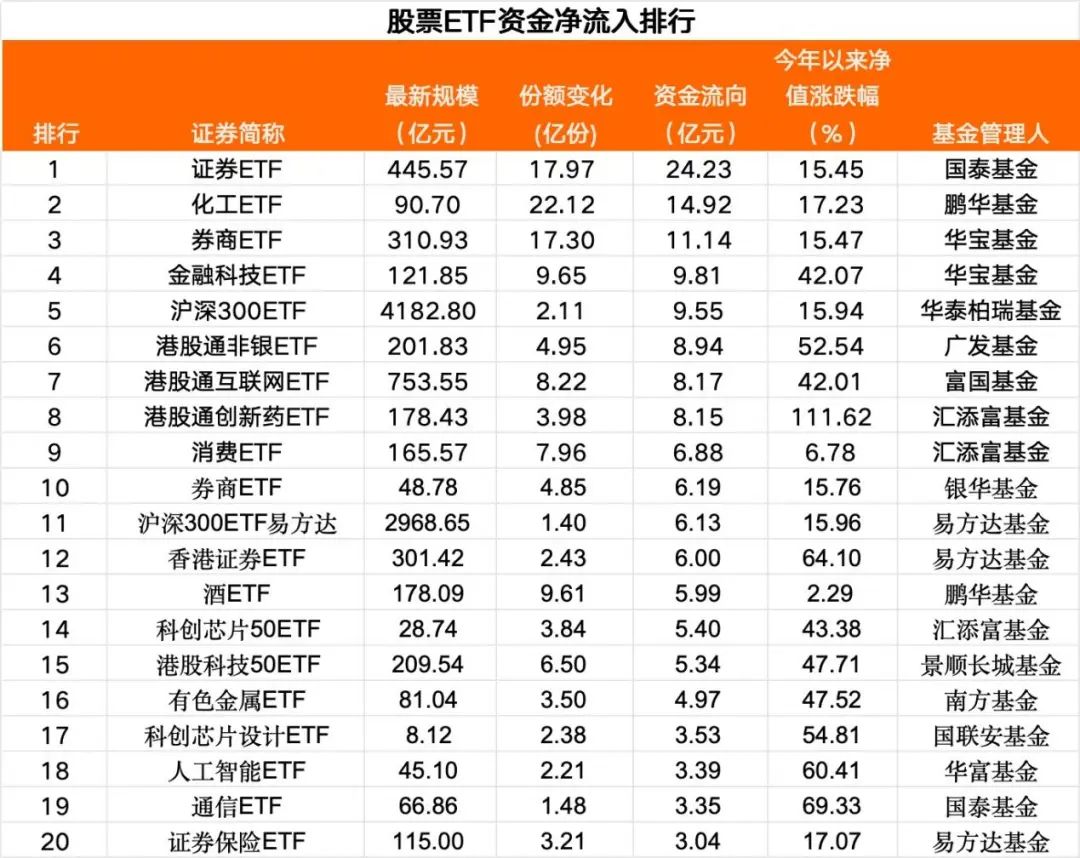
Group 1 - On August 25, the stock ETF market saw a net inflow of 15.3 billion yuan, with the total market capitalization of stock ETFs reaching 4.21 trillion yuan [2][3] - The overall trend for stock ETFs in August has been positive, with a total net inflow exceeding 40 billion yuan, including 30 billion yuan for Hong Kong-related ETFs [9][10] - The top sectors attracting inflows on August 25 included securities (4.87 billion yuan), artificial intelligence (2.16 billion yuan), semiconductors (2.08 billion yuan), and petrochemical industries (1.68 billion yuan) [4][9] Group 2 - A total of 70 stock ETFs experienced net inflows exceeding 100 million yuan on August 25, with the top three being Guotai Securities ETF, Penghua Chemical ETF, and Huabao Securities ETF, each with inflows over 1 billion yuan [4][8] - Conversely, 31 stock ETFs saw net outflows exceeding 100 million yuan, particularly in the ChiNext, STAR Market, and CSI 500 ETFs [8][9] - The top outflowing ETFs included the STAR 50 ETF, CSI 500 ETF, and ChiNext ETF, with outflows of 2.21 billion yuan, 1.18 billion yuan, and 848 million yuan respectively [11] Group 3 - The performance of the Hong Kong Stock Connect non-bank financial ETF has been notable, with a total inflow of over 17.1 billion yuan this year and a recent market capitalization surpassing 20 billion yuan [5][9] - The market outlook remains optimistic, with expectations of continued structural opportunities driven by policy support and technological advancements [10] - The technology sector is identified as a key driver for market highs, with significant capital inflows observed in the domestic ecosystem [9][10]
广西力争2027年新增1个5000亿级产业
Zhong Guo Chan Ye Jing Ji Xin Xi Wang· 2025-08-21 23:15
Core Viewpoint - The "Action Plan for Strengthening and Extending Key Advantage Industries in Guangxi" aims to enhance the quality of industrial clusters by focusing on traditional and emerging industries, promoting high-quality development in manufacturing [1] Group 1: Key Industries and Goals - Guangxi will focus on strengthening and extending industrial chains in key sectors such as machinery, automotive, new energy vehicles, high-end green home furnishings, light industry textiles, and resource recycling [1] - The plan sets a target to add one 500 billion yuan industry and one 400 billion yuan industry by the end of 2027, while cultivating leading enterprises and enhancing the integration of innovation, funding, and talent within industrial chains [1][2] Group 2: Implementation Actions - The plan outlines six major actions: extending industries, strengthening chains, enhancing technology, exploring application scenarios, market matching, and platform construction [1] - Specific actions include developing a roadmap for traditional industries, compiling a high-quality development map for key industrial chains, and implementing a "cutting-edge" technology initiative to address core technology challenges [2][3] Group 3: Organizational Support - To ensure effective implementation, Guangxi will establish a "chain leader + chain master" working mechanism, appointing responsible leaders and forming specialized working groups [3]
“苏”道如砥,凯歌以行——2025年下半年江苏省区域及城投信用风险分析及展望
Xin Lang Cai Jing· 2025-08-19 08:43
Economic Performance - Jiangsu Province achieved a GDP of 66,967.8 billion yuan in the first half of 2025, maintaining its position as the second-largest economy in China, with a growth rate of 5.7%, surpassing the national average by 0.4 percentage points [2] - The province's economic structure is optimized, with a significant contribution from the digital economy and cultural tourism industries, leading to a service sector share of 55%, a historical high [2] Industrial Growth - The industrial added value in Jiangsu increased by 7.4% in the first half of 2025, exceeding the national average by 1 percentage point, with 33 out of 40 industrial sectors experiencing growth [3] - Jiangsu's manufacturing sector remains robust, with a 7.9% increase in industrial added value, driven primarily by equipment manufacturing, which grew by 10.2% [3] Investment and Consumption - Fixed asset investment saw a year-on-year decline, but infrastructure investment rose by 6.9%, becoming a key growth driver, while manufacturing investment accounted for 45.8% of total investment [2] - Retail sales in Jiangsu grew by 5.0% year-on-year, supported by policies encouraging consumption upgrades [2] Service Sector Development - The service sector has become the core engine of Jiangsu's economic growth, with significant revenue increases in internet advertising services and travel-related services, growing by 15.4% and 12.8% respectively [4] - Financial services are also thriving, with new loans reaching 2.09 trillion yuan and social financing increasing by 2.63 trillion yuan, both leading the nation [4] High-tech Industry and Innovation - High-tech industries accounted for 51.8% of the total industrial output value, with a year-on-year growth of 11.8% in high-tech manufacturing added value [5] - The digital economy's core industries saw a revenue increase of 7.9%, indicating a continuous release of new and old kinetic energy conversion [5] Fiscal Management - Jiangsu's general public budget revenue reached 583.7 billion yuan in the first half of 2025, with a year-on-year growth of 1.1%, ranking second among major economic provinces [6] - The province's fiscal self-sufficiency rate was 80.61%, slightly down from the previous year, indicating challenges in maintaining fiscal balance [6] Debt Management - Jiangsu's debt management strategy has been recognized by the State Council, with a comprehensive plan to mitigate local debt risks [7] - The province issued 236.5 billion yuan in new special bonds, increasing by 29.7%, which facilitated over 1.2 trillion yuan in effective social investment [7] Urban Investment and Transformation - Jiangsu's urban investment enterprises issued approximately 637 billion yuan in bonds in the first half of 2025, maintaining the highest issuance scale in the country [8] - Despite challenges in transformation, Jiangsu's urban investment enterprises are well-positioned due to the province's strong economic foundation and abundant financial resources [10] Future Outlook - Jiangsu is expected to leverage its position as a core engine of the Yangtze River Delta economic circle and a hub for the Belt and Road Initiative to drive economic growth [11] - The province aims to enhance debt monitoring and risk prevention measures, with a focus on maintaining stable debt growth [11]

河北组织建设零碳工业园区培育库
Zhong Guo Hua Gong Bao· 2025-08-18 13:33
Core Viewpoint - Hebei Province is establishing a cultivation database for zero-carbon factories and industrial parks to accelerate the green and low-carbon transformation of its industrial sector, focusing on leading industries such as petrochemicals [1][2] Group 1: Policy and Implementation - The notice encourages the selection of high-quality industrial enterprises and parks with relatively high levels of green and low-carbon development for focused cultivation [1] - It aims to build a project reserve for applying for national zero-carbon factories and industrial parks, promoting innovative exploration in energy-saving and carbon-reduction technologies [1][2] Group 2: Support and Guidance - Local industrial and information departments are required to provide support and guidance to the cultivated units, encouraging green low-carbon construction [2] - Existing policy measures will be utilized to support cultivated units in green low-carbon transformation and large-scale equipment updates, prioritizing them for national project applications [2] Group 3: Evaluation Criteria - The criteria for applying for industrial parks include management systems, clean energy utilization, green low-carbon industry development, and carbon management systems [2] - Key indicators include the proportion of green low-carbon industry value added, the proportion of green factories, and the comprehensive utilization rate of industrial solid waste [2]