
光模块

Search documents
春季躁动进入下半场:量缩价涨:躁动下半场:量缩价涨——策略周聚焦
Huachuang Securities· 2026-01-18 12:46
Group 1 - The spring market rally has entered its second half, characterized by reduced trading volume and rising prices, as regulatory signals promote a return to rationality in the market [4][6][10] - The average maximum increase of the Shanghai Composite Index during the past 16 spring rallies was 15.8%, while the current rally has seen a maximum increase of 9.8%, indicating potential for further price increases [10][12] - Economic data is showing positive trends, with expectations for a continued rally supported by improving PPI figures and favorable policies from the government [10][20] Group 2 - The focus of the market is shifting from risk appetite to earnings growth, with a notable increase in the proportion of companies reporting positive earnings forecasts, reaching 37.8% as of January 17 [13][19] - The reduction in competitive pressure (internal competition) is leading to a significant increase in the proportion of companies with improved earnings, particularly in industries such as steel, construction materials, and media [20][22] - The overall improvement in earnings among non-financial companies in the A-share market is evident, with a 5.8% increase in the proportion of companies reporting positive net profit growth [20][22] Group 3 - Investment recommendations focus on sectors with strong earnings growth expectations, including non-bank financials, cyclical industries, and technology innovation [23][24] - Non-bank financials have shown the highest proportion of earnings revisions, with a 400% increase in companies adjusting their profit forecasts positively [23][24] - Cyclical sectors such as materials and energy are expected to benefit from fiscal stimulus and demand-side support, with significant upward revisions in profit forecasts [23][24]
上行趋势下的震荡,耐心掘金结构
Haitong Securities International· 2026-01-18 12:03
Investment Focus - Since the beginning of 2026, the Shanghai Composite Index has broken above the 4,000 and 4,100 thresholds and is approaching 4,200, indicating signs of market overheating with significant inflows into commercial aerospace and AI application sectors, leading to a record turnover of RMB 3.6 trillion [1][26] - Margin financing inflows reached RMB 91.2 billion over the first four trading days of the week, with outstanding margin balances exceeding RMB 2.7 trillion, reflecting a strong inflow intensity comparable to the cyclical highs of August-September 2025 [1][26] - Retail investor inflows have been consistently rising, indicating increased participation from individual investors [1][26] Regulatory Environment - On January 15, 2026, the China Securities Regulatory Commission emphasized a "stability-first" approach to consolidate market momentum and prevent extreme fluctuations, including raising the minimum margin financing collateral ratio from 80% to 100% [2][27] - A significant net outflow of RMB 66.809 billion was recorded in broad-based A-share ETFs on January 15, marking the highest outflow on record, with the Huatai-PineBridge CSI300 ETF experiencing a net outflow of RMB 20.157 billion [2][27] - The relocation of high-frequency traders' servers is expected to enhance trading fairness and curb excessive speculation, which may dampen short-term speculative sentiment but not alter the medium-term market trend [2][27] Market Outlook - The market may enter a phase of consolidation as regulatory cooling measures take effect, particularly affecting previously leading sectors like commercial aerospace, which saw significant declines [3][28] - Despite short-term fluctuations, a slow-bull trend remains a common goal for both regulators and long-term capital, suggesting that the spring rally is not over but may require a "washout" for a healthier uptrend [3][28] Investment Strategy - During the consolidation phase, it is recommended to remain patient while maintaining a medium-term bullish outlook, focusing on identifying Chinese assets with strong medium-to-long-term value [3][29] - A-shares and Hong Kong equities are expected to complement each other, with Hong Kong tech stocks likely to outperform A-shares in the near term due to upcoming AI product launches [3][29] - Investors are advised to align with regulatory intentions to curb speculative trading and focus on structural opportunities in sectors such as semiconductors, innovative drugs, and Hong Kong tech leaders [3][30] Sector Highlights - **Semiconductors**: TSMC's 2026 capex guidance is set at USD 52-56 billion, exceeding 100% of its previous year's operating cash flow, indicating strong demand driven by AI [3][30] - **Innovative Drugs**: The healthcare sector has seen a net outflow of RMB 4.3 billion over the past four months, contrasting sharply with previous inflows, while remaining in a favorable policy environment with new drug listings [3][32] - **Hong Kong Tech Leaders**: Companies like Alibaba and Tencent are integrating AI into their ecosystems, with strong growth in overseas business for Alibaba Cloud and potential upgrades for Baidu's listing status [3][33] - **Optical Modules**: Following significant gains, the sector is now in a consolidation phase, with a shift towards earnings certainty as A-shares enter the annual results pre-announcement window [3][34]
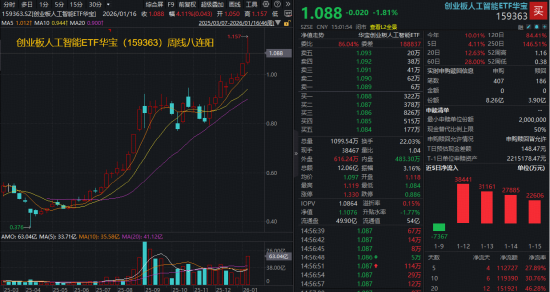
创业板人工智能ETF(159363)周线八连阳!算力+AI应用双驱动,标的指数本轮累涨超34%跑赢同类
Xin Lang Cai Jing· 2026-01-18 11:14
Core Viewpoint - The article discusses the recent performance of the ChiNext AI sector, highlighting a 2% decline in the ChiNext AI index while significant capital inflows continue, particularly into the AI application and computing power sectors [1][7]. Group 1: Market Performance - The ChiNext AI sector experienced a 2% drop, with AI application stocks like Hand Information, BlueFocus, and Kunlun Wanwei falling over 10% [1][7]. - Despite the decline in AI application stocks, computing power stocks such as LianTe Technology, TaiChen Guang, and ZhiShang Technology saw gains of over 5% [1][7]. - The ChiNext AI ETF (159363) recorded a 1.81% decrease, with a trading volume exceeding 1.2 billion yuan and a net subscription of 436 million units on that day [1][7]. Group 2: Fund Inflows and ETF Performance - The ChiNext AI ETF (159363) has seen a total inflow of approximately 1.678 billion yuan over the week, with 1.2 billion yuan added in the previous four days [1][9]. - As of January 15, the ChiNext AI ETF reached a record size of 5.527 billion yuan, with an average daily trading volume of nearly 800 million yuan over the past six months, leading among eight ETFs tracking the ChiNext AI index [3][11]. Group 3: Sector Outlook and Investment Strategy - The article emphasizes the ongoing high demand for computing power driven by AI applications, with the light module sector expected to be a key area for investment during the current market correction [3][11]. - The light module industry is in a high prosperity cycle, with significant growth in demand for high-end light modules anticipated due to AI computing needs [3][11]. - The ChiNext AI ETF is positioned to benefit from the commercialization of AI technology, with approximately 60% of its portfolio allocated to computing power and 40% to AI applications [5][11].


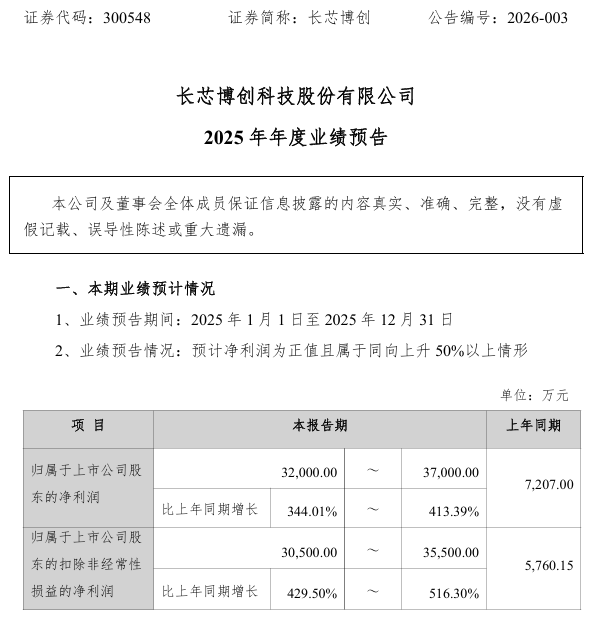
上市公司密集公告业绩利好!长芯博创净利最高预增超4倍
Zheng Quan Shi Bao· 2026-01-18 01:51
Core Viewpoint - The A-share listed companies are gradually disclosing their performance forecasts for the year 2025, with a significant number of companies expecting substantial profit growth, driven by advancements in technology and market demand [1]. Group 1: Performance Forecasts - As of January 17, 2025, 365 listed companies have released their performance forecasts, with 138 companies expecting positive results [1]. - Longxin Bochuang (300548) anticipates a net profit of 320 million to 370 million yuan, representing a year-on-year growth of 344.01% to 413.39% [1]. - Shenghong Technology (300476) expects a net profit of 4.16 billion to 4.56 billion yuan, with a growth rate of 260.35% to 295.00% [4]. - Haitai Technology (301022) forecasts a net profit of 51.5 million to 66.8 million yuan, indicating a growth of 226.86% to 323.97% [8]. - Haineng Technology (920476) projects a net profit of 41 million to 44 million yuan, with a growth of 213.65% to 236.61% [16]. - Hongyuan Pharmaceutical (301246) expects a net profit of 113 million to 137 million yuan, reflecting a growth of 119.57% to 166.2% [17]. - Northern Rare Earth (600111) anticipates a net profit of 2.176 billion to 2.356 billion yuan, with an increase of 116.67% to 134.60% [20]. - Lishang Guochao (600738) forecasts a net profit of 14 million to 17 million yuan, indicating a growth of 92.96% to 134.31% [22]. - Cambridge Technology (603083) expects a net profit of 252 million to 278 million yuan, with a growth of 51.19% to 66.79% [25]. Group 2: Industry Trends - The demand for new generation information technologies such as cloud computing, artificial intelligence, and big data is driving the rapid growth of the data communication market, positively impacting companies' revenues and profits [1]. - Shenghong Technology is consolidating its technological leadership in the global PCB manufacturing sector, with high-end products achieving large-scale production, contributing to significant revenue growth [4]. - Haitai Technology benefits from a high industry boom and increasing orders due to the gradual release of production capacity from its initial public offering projects [8]. - Haineng Technology is experiencing growth in new materials, new energy, and pharmaceuticals, supported by overall market demand recovery [16]. - Northern Rare Earth has successfully increased its sales of lanthanum and cerium products, achieving significant inventory reduction and production growth [20].



回踩五日线,资金加速净流入!创业板人工智能ETF(159363)单周吸金近17亿元!加仓逻辑有哪些?
Xin Lang Ji Jin· 2026-01-16 11:20
Core Viewpoint - The AI sector in the ChiNext market is experiencing a significant influx of capital, despite a recent 2% decline in the ChiNext AI index, with notable fluctuations in AI application stocks and continued strength in computing power-related stocks [1][3]. Group 1: Market Performance - The ChiNext AI ETF (159363) has shown strong performance, achieving an eight-week consecutive increase with a cumulative gain of 34.66%, outperforming similar AI-themed indices [1][3]. - The ETF recorded a daily net subscription of 436 million units, with a total weekly inflow of approximately 1.678 billion yuan, indicating robust investor interest [1][3]. Group 2: Sector Analysis - The light module industry is in a high prosperity cycle, driven by the explosive demand for AI computing power, with supply becoming a core issue [3]. - Major manufacturers in the light module sector are accelerating capacity expansion, with expectations of a significant release of production capacity in Q1 2026, which could drive a new performance growth phase [3]. Group 3: Fund Characteristics - The ChiNext AI ETF (159363) has reached a record size of 5.527 billion yuan, with an average daily trading volume of nearly 800 million yuan over the past six months, leading among eight ETFs tracking the ChiNext AI index [3]. - The ETF has been included in the Stock Connect program, effective January 19, which is expected to enhance its trading activity and attract northbound capital [3]. Group 4: Investment Strategy - The current trend in AI development is shifting from computing power construction to application implementation, making the ChiNext AI ETF a direct beneficiary of the commercialization of AI technology [5]. - The ETF's portfolio consists of approximately 60% in computing power (primarily light modules) and 40% in AI applications, representing both core computing and true AI application sectors [5].
A股收评:沪指跌0.26%险守4100点、创业板指跌0.2%,半导体、存储芯片及人形机器人概念股走高,AI应用股遭遇跌停潮
Jin Rong Jie· 2026-01-16 07:14
Market Performance - The A-share market experienced a high opening but closed lower, with the Shanghai Composite Index down 0.26% at 4101.91 points, the Shenzhen Component down 0.18% at 14281.08 points, and the ChiNext Index down 0.2% at 3361.02 points. The STAR Market 50 Index rose by 1.35% to 1514.07 points [1] - The total trading volume in the Shanghai and Shenzhen markets reached 3.03 trillion yuan, with over 2900 stocks declining [1] Sector Performance - The semiconductor industry chain showed strong performance, with stocks like Changdian Technology hitting the daily limit and reaching a five-year high. Other stocks such as Meige Technology, Kangqiang Electronics, and Shenghui Integration also hit the daily limit [1][4] - The storage chip concept saw a significant rise in the afternoon, with stocks like Baiwei Storage and Jiangbolong reaching historical highs [1] - The human-robot concept gained traction, with stocks like Wuzhou New Spring and Founder Electric hitting the daily limit [1] - The electric grid equipment sector remained active, with stocks like Siyuan Electric and Guangdian Electric also hitting the daily limit [2] Investment Insights - According to Dongfang Securities, the spring market is not over, and a slow bull market is expected to continue. The market is gradually returning to a healthy and rational state, with recent hot sectors experiencing larger corrections [7] - Shenwan Hongyuan noted that the market is currently in a "structural bull" high area, anticipating some corrections but with limited magnitude. They expect a phase of adjustment after the spring market [8] - China International Capital Corporation (CICC) forecasts a continued slowdown in financial growth in the first half of 2026, with a focus on quality over quantity in fiscal policy [8] Notable Developments - The electric grid company is expected to invest 4 trillion yuan during the 14th Five-Year Plan period, a 40% increase from the previous plan, aimed at promoting high-quality development in the new power system supply chain [2] - The carbon fiber sector saw a rise in stocks like Zhongjian Technology and Huayang Co., with the successful production of domestically made T1000-grade carbon fiber, which will be used in various high-tech applications [3] - The optical module concept also saw a resurgence, with stocks like Shijia Technology and Kechuan Technology hitting the daily limit, driven by an increase in long-term shipment expectations for Google's TPU chips [6]


20cm速递|创业板50ETF国泰(159375)飘红,光模块、PCB、存储板块景气度延续
Mei Ri Jing Ji Xin Wen· 2026-01-16 06:23
Group 1 - The core viewpoint indicates a marginal easing of the funding environment, an increase in risk appetite, and a preference for growth stocks over value stocks, with a balanced style maintained despite rising risks following a significant slowdown in local government bond issuance [1] - The ChiNext 50 ETF (159375) tracks the ChiNext 50 Index (399673), which has a daily price fluctuation limit of 20%. This index selects 50 securities with large market capitalization and good liquidity from the ChiNext market, focusing on sectors such as information technology, new energy, and pharmaceuticals to reflect the overall performance of core assets in the ChiNext market [1] - The index constituents cover high-tech fields, showcasing high growth potential and good liquidity [1]
A股午评 | 股指宽幅巨震,宽基ETF成交额再次放大!AI应用板块持续走低
智通财经网· 2026-01-16 03:55
Market Overview - A-shares opened higher but retreated, with all three major indices closing in the red. The Shanghai Composite Index fell by 0.22%, the Shenzhen Component Index by 0.1%, and the ChiNext Index by 0.01%. The half-day trading volume in the Shanghai and Shenzhen markets reached 1.99 trillion yuan, an increase of 117.1 billion yuan compared to the previous trading day [1] ETF Trading Activity - Several broad-based ETFs saw increased trading volumes, with the Huatai-PB CSI 300 ETF, Southern CSI 500 ETF, Huatai-PB A500 ETF, and Huaxia A500 ETF each exceeding 10 billion yuan in trading volume. Additionally, multiple ETFs surpassed 5 billion yuan in trading volume, indicating significant investor interest [1] Sector Performance Strong Sectors - **Electric Grid Equipment and Power Stocks**: Continued to show strength, with stocks like Siyuan Electric, Guangdian Electric, and Huayin Power hitting the daily limit [3] - **Semiconductor Industry**: The entire semiconductor supply chain saw gains, particularly in materials, equipment, and packaging, with stocks like Kangqiang Electronics and Shenghui Integration reaching the daily limit [4] - **Optical Module Concept**: Stocks such as Sijia Technology and Kecuan Technology surged, driven by positive forecasts for Google's TPU chip shipments [5] - **Humanoid Robot Concept**: Stocks like Rifei Co., Henggong Precision, and Slin Intelligent Drive performed well, with significant gains observed [6] Weak Sectors - **AI Applications**: Experienced a significant pullback, with major stocks like Xinhua Net and People's Daily hitting the daily limit down [2] - **Oil and Gas Stocks**: Showed volatility, with companies like Tongyuan Petroleum and Keli Co. dropping over 10% [2] - **Lithium Battery Sector**: Continued to decline, with stocks like Tianji Co. and Lingpai Technology falling more than 8% [2] - **Tourism and Retail**: Both sectors faced corrections, with stocks like Zhongxin Tourism and Sanjiang Shopping hitting the daily limit down [2] Institutional Insights - **Dongfang Securities**: Anticipates that the spring market is not over, predicting a slow bull market continuation. The Shanghai Composite Index is expected to fluctuate between 4,000 and 4,200 before the Spring Festival, focusing on growth styles, especially in future industries [7] - **Shenwan Hongyuan**: Indicates that the market is currently in a "structural bull" phase, with expected corrections but limited amplitude. A significant bull market is likely concluding, leading to a potential phase of quarterly adjustments [8] - **CICC**: Projects that financial growth rates may continue to slow in the first half of 2026, influenced by government debt expansion and a focus on quality over quantity in fiscal policy [9]
中际旭创深度报告解读电话会
2026-01-16 02:53
Summary of the Conference Call on Zhongji Xuchuang Industry Overview and Market Prospects - **Optical Module Market Logic**: Optical technology is crucial for future interconnect and computing fields due to its physical advantages in speed and scalability, particularly in SerDes above 224G and 448G [3][4] - **Market Size and Technological Iteration**: The scale-up market is emerging, with the same generation bandwidth being nine times that of scale-out, indicating significant future growth potential. Optical module rates are expected to continue evolving from 800G to 12.8T, showcasing a broad market space [3] - **2026 as a Key Year**: Anticipated significant growth in optical module volumes, particularly for 800G and 1.6T, with overall market size expected to increase, leading to improved industry profit margins [3] - **Supply and Demand Dynamics**: The optical module market is projected to experience a supply shortage from 2026 to 2027, with strong demand. Companies that can deliver more optical modules will have a competitive edge [3] Company Positioning and Technical Advantages - **High-End Product Focus**: The company has positioned itself in high-end products since its inception and was one of the first suppliers certified by Google, indicating a strong technical foundation [3] - **Performance Driven by Cloud Capital Expenditure**: Over the past decade, the company's performance has been closely tied to the capital expenditure of overseas cloud vendors, with revenue growth following capital expenditure trends [3] - **Short to Medium-Term Performance Drivers**: The expected demand for 1.6T optical modules in 2026 is projected to reach 20-30 million units, a tenfold increase year-on-year, driven by AI penetration and data center speed upgrades [3] Technological Layout and Long-Term Competitiveness - **Silicon Photonics Capability**: The company aims to address EML shortages and improve gross margins in the short term while laying the groundwork for higher integration optical modules in the long term [4] - **Diverse Technological Routes**: The company is pursuing multiple technology paths, including NPO, CPC, and CPO, with plans to showcase demos and launch products in 2026 [4] - **3.2T Optical Module Development**: The company is advancing in the development of 3.2T optical modules, with expectations to maintain a competitive edge in the market [4] Valuation and Market Position - **Transition to a Platform Company**: The company is evolving from an optical module manufacturer to a platform company, expanding its product market to include switches and other areas, which is expected to enhance profit margins [4] - **Undervalued Stock**: The company is perceived to be undervalued, with future PE ratios expected to be around 20-30 times, indicating potential for valuation re-rating [4] - **Hong Kong Listing Expectations**: A potential listing in Hong Kong could lead to a revaluation, as foreign investors tend to assign higher premiums to leading companies [4] AI Demand and Data Center Capital Expenditure - **Increased AI Penetration**: By early 2026, the consumption of OpenAI's API tokens is expected to increase by over 900% compared to early 2025, indicating a surge in AI-related demand [4] - **Formation of AI Commercialization Loop**: As of October 2025, 74% of U.S. tech companies are paying for AI services, a nearly 40 percentage point increase year-on-year, supporting the demand for AI computing infrastructure [4] Optical Interconnect Penetration - **Improving Optical Interconnect Rates**: The transition from copper to optical interconnects is becoming more pronounced, with optical technology beginning to penetrate scale-up scenarios, driving demand for 1.6T optical modules [4] - **Physical Limits of Copper Connections**: As single-wave rates approach 400G, the physical limitations of copper connections are becoming evident, highlighting the inherent advantages of optical technology [4]

中际旭创20260115
2026-01-16 02:53
Summary of the Conference Call for Zhongji Xuchuang Industry Overview - The optical module market is expected to continue expanding in 2026 and 2027, particularly with the onset of the "scale up" market, leading to a projected 9-fold increase in traffic bandwidth [2][3] - 2026 is anticipated to be a significant year for the optical module industry, with substantial growth in 800G and 1.6T products, driven by new technologies like OCS and MPO, which will enhance profit margins [2][6] Company Insights - Zhongji Xuchuang, as a leading player in the optical module sector, is enhancing its profit margins through self-developed core chip devices and a vertical integration strategy, while also securing its supply chain to address demand-supply imbalances [2][7] - The company is transitioning towards a platform-based model, which is expected to improve its valuation as performance is released [2][7] - Positioned as a high-end product supplier and certified by Google, Zhongji Xuchuang's performance is driven by capital expenditures from overseas cloud vendors, with potential valuation premiums from its planned Hong Kong IPO [2][9] Demand Drivers - The demand for 1.6T optical modules is projected to surge, with estimates of 20 to 30 million units needed in 2026, reflecting a year-on-year growth of over 10 times, indicating strong industry demand [2][10] - AI computing infrastructure is significantly increasing data center investments, with OpenAI forecasting a quadrupling of annual spending to $45 billion by 2028, and a cumulative expenditure of $115 billion over the next five years, with a compound annual growth rate of 95% [4][13] Technological Trends - The optical technology is shifting from "scale out" to "scale up," with the latter expected to be the fastest-growing market segment, enhancing the penetration of optical interconnects in data centers [4][11] - The transition from copper to optical connections is becoming more pronounced, as copper approaches its physical limits, necessitating more efficient optical connections [14][15] Competitive Advantages - Zhongji Xuchuang maintains a leading market share among North American clients and has ensured supply chain stability through partnerships with domestic manufacturers [12][17] - The company’s capabilities in optical return (归光) are crucial for addressing short-term shortages and enhancing gross margins, while also laying the groundwork for future product developments in the 3.2T and higher segments [12][17] Future Outlook - The company is actively pursuing multiple technological routes to maintain its competitive edge, including advancements in NPO, CPC, and CPO solutions, as well as developing capabilities for OCS system design [16][17] - Zhongji Xuchuang's core competencies include robust supply chain management, optical return capabilities, and a strategic shift towards becoming a comprehensive platform enterprise, which may further support and enhance its valuation [17]