保险等

Search documents
3800点基民大调查 基金仍是主流配置
Zhong Guo Ji Jin Bao· 2025-08-25 15:32
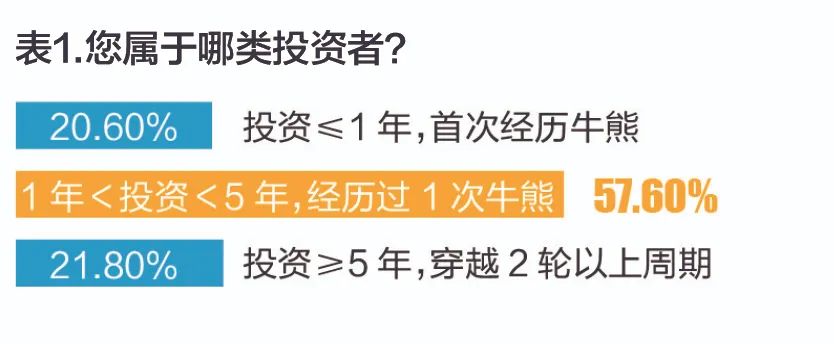
Core Insights - The Shanghai Composite Index has surpassed 3800 points, reaching its highest level in over ten years, with investor sentiment shifting towards cautious optimism [1][15][20] - A survey of over 50,000 fund investors indicates a significant portion are adopting defensive strategies while maintaining a long-term optimistic outlook on the market [1][18][21] Investor Sentiment and Behavior - Approximately 49.7% of investors are opting to reduce their positions or lower risk, while 70% believe the market will continue to break through resistance levels [18][20] - The majority of investors (57.6%) have 1-5 years of investment experience, indicating a relatively inexperienced investor base [5][3] - Fund investments are the primary choice for 62.5% of respondents, highlighting a preference for mutual funds over other asset classes [8] Investment Strategies - A mix of investment strategies is evident, with 45.8% favoring swing trading and 39.9% opting for long-term holding [28] - The use of leverage is divided, with 35.2% of investors employing it, while 51.1% avoid it altogether, reflecting varied risk appetites [27] Sector Preferences - Over 50% of investors are optimistic about the technology sector, with significant interest also in consumer and financial sectors [25][26] - A notable 90.3% of investors plan to adjust their portfolio structures, with a strong inclination towards value stocks [26] Information Sources and Decision-Making - Investors primarily rely on financial media (62.0%) and social platforms (53.8%) for investment information, indicating a shift towards more accessible information sources [29] - Company financial reports and macroeconomic data are the most critical factors influencing investment decisions, with 53.6% and 40.7% of investors respectively prioritizing these [30] Trends in Fund Management - The preference for index funds and ETFs has risen, with 51% of investors favoring these over actively managed funds [33][34] - The influence of star fund managers is waning, with 55% of investors viewing their insights as merely reference points rather than definitive guidance [35][36] Investor Concerns and Suggestions - Economic downturns are the primary concern for 46.9% of investors, followed by liquidity tightening and policy shifts [24] - Investors express a desire for lower fees and improved transparency in fund management, reflecting a growing demand for better investment practices [38]

A股当下的行情是水牛市,国家队真金白银加大了对市场的控制力
Sou Hu Cai Jing· 2025-08-21 00:39
Market Overview - The current market is characterized as a "water bull market," indicating a situation where liquidity is abundant but market sentiment is cautious, leading to a temporary supply shortage of market chips [1] - The term "water" signifies a market environment where valuation levels are detached from economic fundamentals, suggesting a speculative nature in the current bull market [1] Liquidity Dynamics - There is an excess of cash in the market due to continuously declining interest rates, prompting large institutions, including insurance companies, to shift assets from bond markets to stock markets [3] - In July, there was a significant decrease in resident deposits by 1.11 trillion yuan year-on-year, while non-bank financial institutions saw an increase of 2.14 trillion yuan, marking a ten-year high [3][4] Federal Reserve Impact - The likelihood of the Federal Reserve maintaining interest rates in September is 18.1%, while the probability of a 25 basis point cut is 81.9% [4] - A Fed rate cut is generally seen as favorable for the Chinese stock market, as it enhances global liquidity, although it does not guarantee immediate gains for A-shares [5][8] Investment Sentiment - The current market environment is described as having a cold macroeconomic backdrop but a hot liquidity and sentiment scenario, indicating a divergence between market performance and economic fundamentals [11] - Investment opportunities are expected to be more concentrated in structural stories such as "anti-involution" and technological self-reliance, rather than a broad-based bull market [11] Risk Considerations - While the margin trading balance and the number of new accounts have increased, they remain significantly lower than the peaks seen in 2015, suggesting that the current risk level is not particularly high [11]

智通港股沽空统计|8月21日
智通财经网· 2025-08-21 00:21
Summary of Key Points Core Viewpoint - The report highlights the top short-selling stocks in the market, indicating significant investor sentiment and potential volatility in these companies' stock prices [1][2][3]. Short Selling Ratios - The top three stocks by short-selling ratio are: - Sun Hung Kai Properties-R (80016) at 100.00% - Lenovo Group-R (80992) at 98.00% - Tencent Holdings-R (80700) at 87.44% [2][3]. Short Selling Amounts - The leading stocks by short-selling amount are: - Xiaomi Group-W (01810) with a short-selling amount of 2.084 billion - Tencent Holdings (00700) at 1.612 billion - Pop Mart (09992) at 1.110 billion [1][3]. Deviation Values - The stocks with the highest deviation values are: - Tencent Holdings-R (80700) at 47.80% - Lenovo Group-R (80992) at 41.56% - China Mobile-R (80941) at 40.57% [1][3]. Additional Insights - The report provides a detailed table of the top ten stocks by short-selling ratios, amounts, and deviation values, indicating a trend of increased short-selling activity in certain sectors [2][3].






中信证券:8月份中报业绩期将是港股行情是否延续的重要节点
Di Yi Cai Jing· 2025-08-13 00:40
Core Viewpoint - The article highlights that while the profit growth rate for Hong Kong stocks is expected to slow down in the first half of 2025, sectors such as retail, education, diversified finance, and gaming are anticipated to see continued profit growth [1] Group 1: Market Trends - The Hong Kong stock market is set to experience a concentrated disclosure of mid-year reports in late August, with a slight expansion in the A/H premium observed since the end of July [1] - The shift in A/H premium dynamics is expected to evolve from a simplistic investment approach based on H-share discount rates to a more multifaceted strategy that incorporates company fundamentals, chip structure, and historical discount percentiles [1] Group 2: Policy Impact - The ongoing "anti-involution" measures are projected to benefit certain sectors, particularly those facing overcapacity and price/profit pressure in the resource and service industries [1] - The market is anticipated to transition from liquidity-driven momentum to a phase driven by performance and policy validation, with mid-year earnings reports serving as a critical juncture for the continuation of the Hong Kong stock market rally [1] Group 3: Investment Recommendations - Recommended sectors include: 1) Direct beneficiaries of the "anti-involution" policies such as solar energy, rare earths, lithium, and express delivery, along with indirectly benefiting insurance [1] 2) High-growth sectors like pharmaceuticals and technology, where performance expectations are likely to be met and guidance may be upgraded [1] 3) High-quality leading enterprises with scarcity and stable performance are expected to undergo value reassessment in the context of a low interest rate environment in mainland China [1]

午评:两市走强创指涨0.91% 燃气板块领涨
Zhong Guo Jing Ji Wang· 2025-08-12 03:40
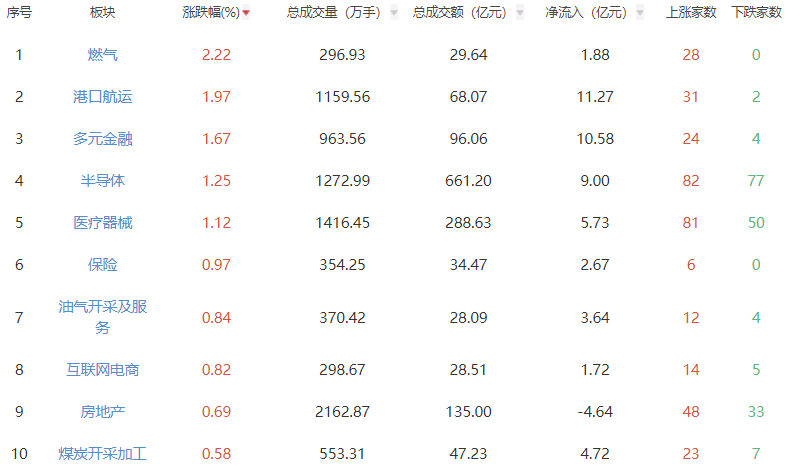
Market Overview - The A-share market saw all three major indices rise in early trading, with the Shanghai Composite Index at 3666.33 points, up 0.51%, the Shenzhen Component at 11330.34 points, up 0.34%, and the ChiNext Index at 2401.52 points, up 0.91% [1] Sector Performance - The gas sector led the gains with a rise of 2.22%, followed by the port and shipping sector at 1.97%, and diversified finance at 1.67% [2] - Other notable sectors included medical devices at 1.12% and insurance at 0.97%, indicating a positive trend in these areas [2] Declining Sectors - The energy metals, military equipment, and small metals sectors experienced the largest declines, with the worst performer being the photovoltaic equipment sector, down 1.33% [2] - The chemical pharmaceuticals sector also faced a decline of 1.32%, reflecting challenges in this industry [2]
收评:指数持续分化沪指涨0.16% 半导体板块走强
Zhong Guo Jing Ji Wang· 2025-08-07 07:34
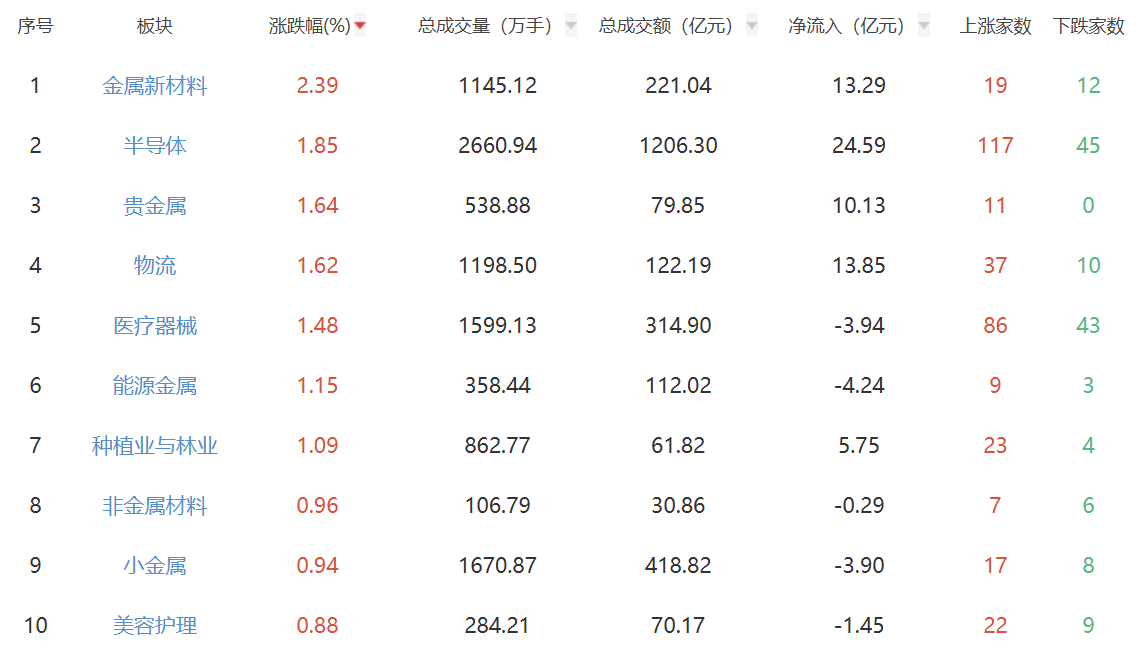
Market Overview - The A-share market showed mixed performance with the Shanghai Composite Index slightly up by 0.16% closing at 3639.67 points, while the Shenzhen Component Index fell by 0.18% to 11157.94 points, and the ChiNext Index decreased by 0.68% to 2342.86 points [1] Sector Performance - The top-performing sectors included: - Metal New Materials with a gain of 2.39%, total trading volume of 1145.12 million hands, and a total transaction value of 221.04 billion [2] - Semiconductor sector increased by 1.85%, with a trading volume of 2660.94 million hands and transaction value of 1206.30 billion [2] - Other notable sectors included Logistics (1.62% increase) and Medical Devices (1.48% increase) [2] - Conversely, the sectors with the largest declines were: - Biological Products, which fell by 1.51%, with a trading volume of 647.83 million hands and a transaction value of 155.31 billion [2] - Chemical Pharmaceuticals and Insurance sectors also experienced significant declines [1]
开评:沪指跌0.30% CPO概念等涨幅居前
Zheng Quan Shi Bao Wang· 2025-07-31 01:29
Group 1 - The A-share market opened with mixed performance on July 31, with the Shanghai Composite Index down by 0.30%, the Shenzhen Component Index up by 0.05%, and the ChiNext Index up by 0.65% [1] - Sectors that performed well included components, tourism, and CPO concepts, while sectors that saw declines included shipbuilding, non-ferrous metals, and insurance [1]
午评:沪指涨0.44%,钢铁、煤炭等板块拉升,水电概念爆发
Zheng Quan Shi Bao Wang· 2025-07-21 05:15
Group 1 - The core viewpoint indicates that the A-share market is showing positive signals, with the Shanghai Composite Index maintaining above 3500 points, suggesting a potential upward trend in the market [1] - The market is experiencing a broad-based rally, with over 3500 stocks rising, particularly in sectors such as engineering machinery, building materials, steel, and coal [1] - The trading volume in the Shanghai, Shenzhen, and North exchanges reached 1.1028 trillion yuan, reflecting strong market activity [1] Group 2 - The medium to long-term outlook for the A-share market remains bullish, supported by long-term funds entering the market, particularly from insurance capital [2] - There are structural opportunities emerging due to economic transformation, with a focus on high-margin assets, technology growth sectors, and consumer sectors boosted by policy support [2] - Specific sectors to watch include technology growth, military industry, and consumer sectors, alongside opportunities in mergers and acquisitions [2]
国泰海通 · 晨报0718|策略、通信
国泰海通证券研究· 2025-07-17 14:02
Core Viewpoint - The overall economic growth remains constrained, but improvements in emerging technologies and certain cyclical sectors are becoming increasingly evident [3] Group 1: Economic Overview - In Q2, the economy is characterized by "volume increase and weak prices," with improvements in exports and consumption but insufficient investment momentum [3] - As of July 16, 1531 companies have disclosed mid-year performance forecasts, with a positive forecast rate of 43.7%, lower than the past three years [3] - Estimated profit growth for the entire A-share market and non-financial A-shares in the first half of the year is 1.0% and 1.2%, respectively [3] Group 2: Sector Performance - The growth of new and old economies is increasingly divergent, with mid and downstream sectors performing better than upstream, particularly in high-tech industries like equipment manufacturing [3] - Industries such as technology hardware, resource products, and non-bank financials are experiencing rapid profit growth, with sectors like electronics, non-ferrous metals, and agriculture showing high growth forecasts [3] - Conversely, the real estate sector and consumer durables like automobiles and furniture are experiencing weaker growth [3] Group 3: Industrial Challenges - Industrial enterprises are facing challenges, with accounts receivable turnover declining and inventory turnover showing little improvement, indicating ongoing operational difficulties [4] - The overall gross profit margin for industrial enterprises is decreasing, leading to actual profits being weaker than reported profits [4] - Industries with noticeable improvements in turnover include military, non-ferrous metals, and agricultural products [4] Group 4: Emerging Technologies - Emerging technologies are the main area of improvement, particularly in globally competitive sectors where performance is accelerating due to domestic demand and export growth [5] - Industries benefiting from this trend include military, innovative pharmaceuticals, and media gaming, while AI capital expenditure is facing uncertainties [5] Group 5: Cyclical and Financial Sector Improvements - Certain cyclical products, such as rare earths and small metals, are seeing price increases, while sectors like steel and building materials are showing signs of performance improvement [6] - Non-bank financials are benefiting from capital market improvements, with active trading levels and a downward trend in risk-free interest rates contributing to high growth in brokerage and insurance sectors [6]

生态跃迁——2025中国金融产品年度报告
华宝财富魔方· 2025-06-22 13:14
Core Insights - The 2025 China Financial Products Annual Report titled "Ecological Leap" has been officially released, marking the 14th consecutive year of publication by Huabao Securities [1][2] - The report emphasizes the industry's transition towards service-oriented wealth and asset management, a concept that gained traction in the previous year and has seen significant progress in 2024 [2] - The theme of this year's report, "Ecological Leap," reflects the need for collaborative efforts across the industry to reconstruct and upgrade the wealth ecosystem, indicating a profound transformation [2][3] Section Summaries Part One - Insights into the Wealth Ecosystem in 2024 - The report discusses the potential decline in yields for deposit-replacement products and the challenges in getting clients to accept net-value fixed-income products [3] - It explores insights from the "Fat Donglai" case for wealth management institutions and the hidden secrets behind investors' choices between funds and wealth management [3] - The impact of the trend towards tool-based and index-based investments on the competitive landscape of financial products is analyzed [3] Part Two - Review and Outlook of Various Financial Products - The report includes a comprehensive review of bank wealth management over the past 20 years, highlighting the return to net value [4] - It provides an overview of the public fund market, focusing on the ecological landscape and the challenges of low-profit margins [4] - The ETF market is examined, showcasing its rapid growth and the factors contributing to its success, including efficiency, transparency, and low costs [4] Part Three - Ecological Leap: Shaping a New Landscape for Wealth and Asset Management - The report compares cross-market financial products and discusses the cognitive load resulting from product homogeneity [6] - It emphasizes the importance of fund strategy indices in making fund investments more scientific and transparent [6] - The report addresses the role of large models in reshaping wealth management services and the evolution of practitioners within the ecological leap [6]