
银行等

Search documents
今日112只A股封板 计算机行业涨幅最大
Zheng Quan Shi Bao Wang· 2026-01-14 04:32
Market Overview - The Shanghai Composite Index increased by 1.20% today, with a trading volume of 1,254.46 million shares and a total transaction value of 22,460.00 billion yuan, representing a decrease of 8.95% compared to the previous trading day [1] Industry Performance - The computer industry saw the highest increase at 5.84%, with a transaction value of 2,796.30 billion yuan, down 2.36% from the previous day, led by Meideng Technology which rose by 29.99% [1] - The media sector followed with a 4.40% increase, transaction value of 1,486.16 billion yuan, down 6.68%, with Liujin Technology leading at 29.98% [1] - Retail trade increased by 2.75%, with a transaction value of 356.80 billion yuan, down 8.65%, led by Kaichun Co. which rose by 20.00% [1] - The banking sector experienced the largest decline at -0.66%, with a transaction value of 189.05 billion yuan, down 19.13%, led by Chongqing Bank which fell by 1.23% [2] Notable Stocks - Meideng Technology in the computer sector increased by 29.99% [1] - Liujin Technology in the media sector rose by 29.98% [1] - Kaichun Co. in retail trade increased by 20.00% [1] - Nake Equipment in the electronics sector rose by 20.01% [1] - External Service Holdings in social services increased by 10.04% [1]
收评:创业板指跌近2%,军工、半导体等板块下挫,医药板块逆市上扬
Zheng Quan Shi Bao Wang· 2026-01-13 07:43
Core Viewpoint - The A-share market experienced a decline, with major indices falling, while trading volume reached a historical high of approximately 3.7 trillion yuan [1]. Market Performance - The Shanghai Composite Index fell by 0.64% to 4138.76 points, the Shenzhen Component Index dropped by 1.37%, the ChiNext Index decreased by 1.96%, and the STAR Market 50 Index declined by 2.8% [1]. - The overall trading volume across the Shanghai, Shenzhen, and Beijing markets was about 3.7 trillion yuan, marking a new historical high [1]. Sector Performance - The military and semiconductor sectors saw the largest declines, while the automotive, coal, and real estate sectors also experienced downturns [1]. - Concepts related to military trade and commercial aerospace underwent significant corrections, whereas sectors such as insurance, oil, pharmaceuticals, and banking showed upward movement [1]. - AI medical concepts and innovative drug concepts remained active in the market [1]. Future Market Outlook - According to Zhongtai Securities, by 2026, the trend of increased capital inflow and enhanced market confidence is expected to strengthen, making the technology sector a long-term focus for capital markets [1]. - Long-term capital support, along with policy-driven market activity, is anticipated to maintain liquidity conditions, with overall downward risks being manageable [1]. - The market is unlikely to present a unilateral bullish trend, but structural opportunities are expected to remain active, characterized by theme-driven movements and rapid capital rotation among different industry leaders [1].

今日沪指涨0.75% 传媒行业涨幅最大
Zheng Quan Shi Bao Wang· 2026-01-12 05:03
Market Overview - The Shanghai Composite Index increased by 0.75% with a trading volume of 1,269.59 million shares and a transaction value of 23,324.19 billion yuan, representing a 12.11% increase compared to the previous trading day [1] Industry Performance - The media sector saw the highest increase at 6.95%, with a transaction value of 1,270.49 billion yuan, up 70.89% from the previous day, led by Liujin Technology which rose by 29.92% [1] - The computer industry followed with a 6.09% increase, transaction value of 2,547.87 billion yuan, up 47.96%, with Zhongcheng Technology leading at 30.00% [1] - The defense and military industry rose by 5.08%, with a transaction value of 1,978.95 billion yuan, down 6.68%, led by Lihua Navigation at 20.00% [1] - The sectors with the largest declines included oil and petrochemicals at -1.13%, coal at -0.88%, and banking at -0.33% [2] Notable Stocks - Liujin Technology in the media sector increased by 29.92% [1] - Zhongcheng Technology in the computer sector rose by 30.00% [1] - Lihua Navigation in the defense sector increased by 20.00% [1] - China Petroleum & Chemical Corporation in the oil sector decreased by 3.90% [2]
资金行为研究双周报:军工行情底线牢固,传媒或迎布局良机-20260109
ZHONGTAI SECURITIES· 2026-01-09 07:43
Market Overview - Institutional funds show fluctuating behavior, with a reduction in outflow momentum in the Sci-Tech Innovation Board. Although there is a phase of outflow, the net outflow slope for the Sci-Tech Innovation Board is gentler compared to the ChiNext and the entire A-share market. Retail investor inflows remain relatively stable, with significant net inflows into the ChiNext compared to the Sci-Tech Innovation Board [5][9][10] Market Capitalization and Valuation Style - The small-cap style represented by the CSI 2000 has seen synchronized net inflows from both institutional and retail investors, with institutional inflows being more stable. In contrast, institutional funds have continued to experience slight outflows from high-valuation styles, while retail investors have significantly increased their inflows into these high-valuation stocks [9][10][15] Major Industry Style - Institutional funds have shown repeated behavior, with cyclical manufacturing becoming a structural highlight. As of December 26, institutional funds were in a sustained net inflow into cyclical manufacturing, only turning to net outflow on December 30, indicating its relative resilience. Retail investors have also shown consistent net inflows into cyclical manufacturing, further highlighting its short-term structural appeal [15][19] Primary Industry Fund Flow Upstream Resources - Among upstream resources, non-ferrous metals remain a key focus for speculation, with coal receiving cumulative net inflows from both institutional and retail investors. Institutional funds have shown fluctuating behavior towards basic chemicals and non-ferrous metals, with a brief recovery after December 31 before continuing to flow out [23][24] Midstream Materials & Manufacturing - Institutional funds have shown a net inflow trend in midstream manufacturing, resonating with retail investor behavior. The net inflow rate for institutional funds in the defense and military sector is currently greater than that of retail investors, indicating strong institutional support for the military sector in the short term [27][28] Downstream Essential Consumption - In the downstream essential consumption sector, biopharmaceuticals are the focal point for fund allocation. Institutional funds saw a significant inflow on January 5, followed by a short-term outflow, before turning back to inflows after January 7. The net inflow rate for biopharmaceuticals is approaching zero, indicating increasing consensus between institutional and retail investors [31][32] Downstream Discretionary Consumption - In the downstream discretionary consumption sector, both institutional and retail funds have shown continuous net inflows into light industry manufacturing, with institutional investors enhancing their allocation in this area. The net inflow rate for light industry manufacturing is currently in negative territory, indicating strong institutional support [44][45] TMT Sector - In the TMT sector, institutional investment in the media sector has increased, while funds in the electronics and communications sectors have shown significant volatility. Institutional funds significantly increased their allocation to media around December 31, indicating stronger buying power compared to retail investors [48][49] Financial Sector - In the financial sector, both institutional and retail funds have shown net inflows into banks, while the non-bank financial sector has experienced significant volatility. Institutional funds increased their allocation to banks on January 5, but the net outflow from non-bank financials has accelerated [55][56] Support Services - In the support services sector, both institutional and retail funds have accumulated net inflows into comprehensive and public utilities. The latest values for the net inflow rate indicate that retail investor buying power remains stronger than that of institutional investors [66][67] Leverage Fund Overview - The margin financing balance has reached a new high, with the average market guarantee ratio continuing to rise. As of January 7, the margin financing balance was approximately 2.6 trillion yuan, with liquidity remaining ample. The average guarantee ratio is at 286.52%, indicating a tight leverage structure in the short term [69][70]
【盘中播报】沪指涨0.02% 国防军工行业涨幅最大
Zheng Quan Shi Bao Wang· 2026-01-08 06:35
Market Overview - The Shanghai Composite Index increased by 0.02% with a trading volume of 1,263.50 million shares and a transaction value of 22,566.56 billion yuan, a decrease of 5.56% compared to the previous trading day [1] - A total of 3,889 stocks rose, with 103 hitting the daily limit, while 1,453 stocks fell, including 5 hitting the lower limit [1] Industry Performance - The top-performing industries included: - Defense and Military Industry: Increased by 4.17% with a transaction value of 2,049.82 billion yuan, up 16.74% from the previous day, led by Hailanxin with a rise of 20.00% [1] - Media: Increased by 1.86% with a transaction value of 686.02 billion yuan, up 6.64%, led by Yilv Media with a rise of 9.99% [1] - Real Estate: Increased by 1.83% with a transaction value of 291.21 billion yuan, up 22.41%, led by Daming City with a rise of 6.18% [1] Underperforming Industries - The worst-performing industries included: - Non-Bank Financial: Decreased by 2.32% with a transaction value of 682.58 billion yuan, down 2.41%, led by Hualin Securities with a drop of 9.84% [2] - Nonferrous Metals: Decreased by 1.61% with a transaction value of 1,329.14 billion yuan, down 23.58%, led by Zhongkuang Resources with a drop of 7.37% [2] - Banking: Decreased by 1.00% with a transaction value of 219.66 billion yuan, down 5.13%, led by Pudong Development Bank with a drop of 2.46% [2]





今日沪指涨1.14% 有色金属行业涨幅最大
Zheng Quan Shi Bao Wang· 2026-01-06 04:43
相关ETF (原标题:今日沪指涨1.14% 有色金属行业涨幅最大) 证券时报•数据宝统计,截至上午收盘,今日沪指涨1.14%,A股成交量1037.56亿股,成交金额17961.97亿元,比上一个交易日增加9.00%。个股方 面,3696只个股上涨,其中涨停107只,1590只个股下跌,其中跌停2只。从申万行业来看,有色金属、非银金融、综合等涨幅最大,涨幅分别为 3.91%、3.31%、2.79%;通信、美容护理、银行等跌幅最大,跌幅分别为1.45%、0.12%、0.12%。(数据宝) 今日各行业表现(截至上午收盘) | 申万行业 | 行业 成交额 | | 比上日 | | 涨跌幅 | | --- | --- | --- | --- | --- | --- | | | 涨跌 (亿元) | | (%) | 领涨(跌)股 | (%) | | | (%) | | | | | | 有色金属 | 3.91 1282.80 26.40 | | | 天力复合 | 16.75 | | 非银金融 | 3.31 | 812.46 81.00 | | 华林证券 | 9.99 | | 综合 | 2.79 | 31.79 31.90 | ...

A股市场大势研判:沪指十二连阳重返4000点迎开门红
Dongguan Securities· 2026-01-06 01:41
Market Overview - The Shanghai Composite Index has returned to above 4000 points, marking a twelve-day winning streak, with a closing increase of 1.38% [1][6] - The Shenzhen Component Index rose by 2.24%, while the ChiNext Index led the gains with a 2.85% increase [2][6] Sector Performance - The top-performing sectors included Media (4.12%), Pharmaceuticals (3.85%), Electronics (3.69%), Non-Bank Financials (3.14%), and Computers (2.71%) [3] - Conversely, the worst-performing sectors were Oil & Petrochemicals (-1.29%), Banks (-0.34%), Transportation (-0.30%), Retail (-0.17%), and Agriculture, Forestry, Animal Husbandry, and Fishery (0.00%) [3] Conceptual Sector Highlights - The leading conceptual sectors were Brain-Computer Interface (13.70%), Hyperbaric Oxygen Chamber (7.01%), Blood Oxygen Monitor (5.65%), and New Technology Stocks (5.19%) [3] - The lagging conceptual sectors included Hainan Free Trade Zone (-2.93%), Duty-Free Shops (-1.08%), Free Trade Ports (-0.94%), Pork (-0.28%), and Ride-Hailing (-0.05%) [3] Future Outlook - The market opened strong on the first trading day of 2026, with significant participation from over 4100 stocks rising, including 127 hitting the daily limit [6] - The manufacturing PMI showed a seasonal rebound, indicating improved supply and demand, while the construction PMI saw a significant month-on-month increase, suggesting a potential boost to the economy [6] - The report anticipates continued market liquidity and risk appetite improvement, supported by favorable domestic policies and a strengthening RMB, with a focus on sectors such as TMT, Finance, Machinery, Military, Power, and Nonferrous Metals for investment opportunities [6]
港股25年收官:铜、黄金等有色板块大涨,大金融、半导体、创新药集体活跃
Ge Long Hui· 2025-12-31 07:05
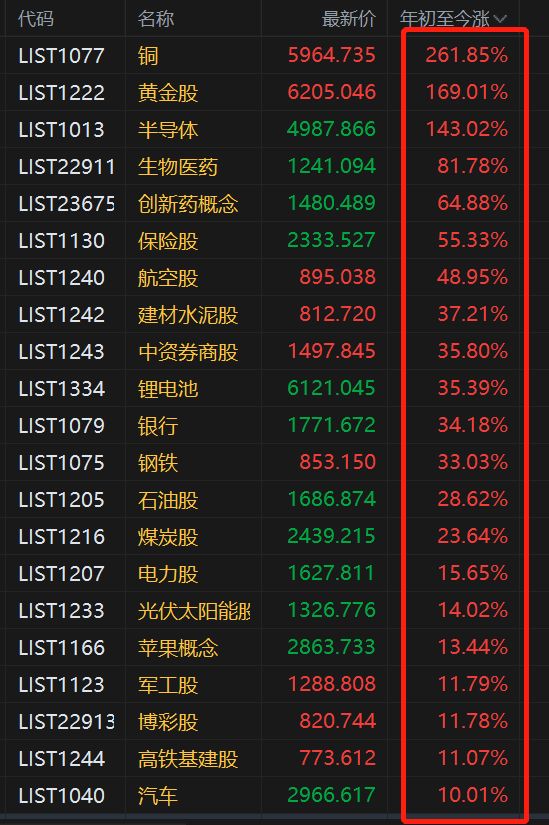
Core Viewpoint - The Hong Kong stock market in 2025 has shown significant performance across various sectors, with the copper sector leading the gains, followed by gold and semiconductors, indicating a strong market response to global re-inflation and geopolitical factors [1] Group 1: Market Performance - The copper sector has seen a remarkable increase of 261.85% year-to-date [2] - Gold stocks have also performed well, with a year-to-date increase of 169.01% [2] - The semiconductor sector has experienced a growth of 143.02% [2] - Other strong performers include biopharmaceuticals (81.78%), innovative drug concepts (64.88%), and insurance stocks (55.33%) [2] Group 2: Market Themes - The strongest theme identified is Resources and Inflation, which includes copper, gold, oil, coal, and steel, reflecting a re-evaluation of the long-term value of resources amid global re-inflation and energy transition [1] - The core theme is Technology and Innovation, represented by semiconductors, innovative concepts, biopharmaceuticals, and lithium batteries, indicating a focus on national industrial upgrades and self-sufficiency [1] - The defensive theme is Financials and Heavy Assets, including insurance, banking, electricity, and infrastructure, which provide stable earnings and high dividend yields amid uncertainty [1]
市场分析:金融石化行业领涨,A股小幅上行
Zhongyuan Securities· 2025-12-29 09:02
Market Overview - On December 29, the A-share market experienced slight fluctuations, with the Shanghai Composite Index facing resistance around 3983 points, closing at 3965.28 points, up 0.04%[2][7] - The Shenzhen Component Index closed at 13537.10 points, down 0.49%, while the ChiNext Index fell by 0.66%[7][8] - Total trading volume for both markets was 21,578 billion yuan, slightly lower than the previous trading day[3][7] Sector Performance - Strong performers included banking, petrochemicals, wind power equipment, and software development sectors, while energy metals, pharmaceutical commerce, batteries, and electricity sectors lagged[3][7] - Over 60% of stocks in the two markets declined, with notable gains in sectors like petrochemicals and aerospace, while energy metals and pharmaceuticals saw significant losses[7][9] Valuation and Investment Strategy - The average P/E ratios for the Shanghai Composite and ChiNext are 16.28 times and 50.25 times, respectively, above the median levels of the past three years, indicating a suitable environment for medium to long-term investments[3][16] - The recent Central Economic Work Conference emphasized a shift towards quality and sustainability in macro policies, focusing on technology and industrial strength[3][16] Economic Outlook - The domestic monetary policy is expected to remain "moderately loose," with the market anticipating that the Federal Reserve will continue its rate-cutting cycle into 2026, contributing to a more favorable global liquidity environment[3][16] - The recent strengthening of the RMB enhances the attractiveness of RMB-denominated assets, likely facilitating capital inflows[3][16] Short-term Recommendations - Investors are advised to closely monitor macroeconomic data, changes in overseas liquidity, and policy developments, with a focus on sectors such as electronic components, petrochemicals, finance, and wind power equipment for short-term investment opportunities[3][16]

招期金工股票策略环境监控周报(2025年12月22日-2025年12月26日):本周宽基指数普升,可增仓复制指数T和不依赖小微盘的交易型Alpha策略-20251229
Zhao Shang Qi Huo· 2025-12-29 02:23
1. Report Industry Investment Rating - No relevant content provided 2. Core Viewpoints of the Report - This week, broad - based indices generally rose, with most volatility declining. Market activity was at a medium - high level, and 77.4% of industries achieved positive returns. The current sentiment repair is relatively optimistic, component stock returns have strengthened, the profitability outside the index is poor, the basis has continuously converged to the growth level, and the intraday Alpha and trading - type Alpha environments have warmed up. Overall, the basis cost is favorable, the excess environment is weak, and the tail risk is moderately high. For long - only stock strategies, one can increase positions in trading - type Alpha or intraday Alpha, and strictly control the proportion of component stocks in long - only stock strategies with low exposure to small and micro - cap stocks. Neutral strategies can seize the window of low - cost position building and increase positions in replication T and strictly controlled exposure strategies that do not rely on the return contribution of small and micro - cap stocks [9]. 3. Summary by Relevant Catalogs 3.1 Equity Market Review - **Broad - based Index Performance**: As of December 26, 2025, this week, the CSI 500 index rose 4.03%, the CSI 1000 index rose 3.76%, the CSI 2000 index rose 3.06%, the CSI All - Share index rose 2.78%, the CSI A500 rose 2.75%, the SSE 50 index rose 1.95%, and the CSI Dividend index rose 0.55%. From the perspective of Barra style factors, the top three factors with the highest returns this week were BETA (1.16%), mid - cap (0.60%), and momentum (0.58%); the bottom three were leverage (0.03%), value (- 0.03%), and profitability (- 0.11%) [14]. - **Industry Index Performance**: This week, 77.4% of industries achieved positive returns, with the non - ferrous metals sector leading. The top three industries with the highest weekly returns were non - ferrous metals (6.43%), national defense and military industry (6.00%), and power equipment (5.37%); the bottom three were banks (- 1.01%), social services (- 1.05%), and beauty care (- 1.08%) [25]. - **Style Factor Performance**: The BETA, mid - cap, and momentum factors performed well, while the leverage, value, and profitability factors performed poorly. Among the Juchao stock style indices, the top three with the highest returns were small - cap growth (5.13%), mid - cap growth (3.28%), and large - cap growth (2.70%); the bottom three were mid - cap value (2.64%), small - cap value (2.19%), and large - cap value (- 0.02%) [27][32]. - **Futures Market**: The basis of IF, IC, and IM converged, and the basis volatility slightly increased, but the cost control pressure decreased. The estimated average returns of neutral products affected by each contract's hedging this week were - 0.38% for 300 neutral, - 0.50% for 500 neutral, and - 0.63% for 1000 neutral. Since the beginning of this year, the estimated average returns of neutral products affected by each contract's hedging were - 1.96% for 300 neutral, - 6.13% for 500 neutral, and - 7.71% for 1000 neutral [40]. - **Options Market**: This week, most implied volatilities declined, which is expected to be unfavorable for option - buying and arbitrage strategies [44]. 3.2 Strategy Environment Monitoring - **Intraday Alpha Environment**: Overall, it is conducive to intraday Alpha accumulation. The daily average trading volume of the stock market has slightly increased, the average intraday amplitude cross - sectional volatility is at a normal level, the proportion of high - volatility stocks is normal, and the short - term volatility of major indices is decreasing. Although the stock market has a daily net outflow, considering the market's upward trend, the actual capital inflow is beneficial for intraday Alpha accumulation [48][51][54]. - **Trading - type Alpha Environment**: The weekly average trading volume and turnover rate of the stock market are at a relatively high level, which is conducive to trading - type Alpha accumulation. The stock market shows a small - cap style, which is beneficial for trading - type Alpha accumulation, but the number of stocks that can beat the benchmark index has dropped to a low level, which is significantly unfavorable for trading - type Alpha accumulation [55][62]. - **Holding - type Alpha Environment**: It is generally conducive to holding - type Alpha accumulation and stability. The short - term returns of major broad - based indices are mostly positive, the trend smoothness of some factors is high, the style is small - cap, the number of daily limit and down - limit stocks is normal, the stock liquidity is normal, the volatility is high, the style return difference volatility is decreasing, the industry correlation coefficient is normal, and the factor rotation speed is at a high level [67][73][84]. - **Neutral Strategy Hedging Environment**: The basis of IF, IC, and IM converged, the basis volatility slightly increased, and the cost control pressure decreased [91]. 3.3 Future Strategy研判 - **Return Performance**: Based on the 20 - day rolling return, the relative returns of the CSI 1000, CSI 2000, and CSI 500 compared to the SSE 50 are in the normal or extremely high range, and the SSE 50 return is in the relatively high range [93]. - **Derivatives Market Sentiment**: In the options market, the sentiment towards the CSI 1000, SSE 50, and CSI 500 is generally cautious but shows structural differentiation. In the futures market, the basis of IF, IC, and IM converged, and market sentiment has recovered [97][102]. - **Risk Preference**: As of December 25, 2025, the margin trading balance was 2.53 trillion yuan, at the highest level in the past three years, indicating a high risk preference [105]. - **Trading Heat**: The trading heat of the SSE 50, CSI 500, CSI 1000, and CSI 2000 is at different levels, and the market trading volume is at an extremely high level [107]. - **Style Attention Multiple**: The CSI 1000 is in the relatively high range, the CSI 2000 is in the normal range, and the CSI 500 is in the extremely high range [110]. - **Profit Spread and Dividend Spread**: The profit spreads of the CSI 1000, CSI 500, CSI 2000, and SSE 50 are at different levels, mostly in the normal or extremely low range. The dividend spreads are all in the normal range [111][113]. - **Trading Crowding**: The trading heat of the TMT sector is in the low range, the trading heat of small - micro - cap sectors is in the high range, and the overall market trading volume is in the extremely high range [117].