船舶

Search documents
时代新材:目前CR450动车组上公司已装车应用全系减振悬挂部件
Mei Ri Jing Ji Xin Wen· 2025-11-18 07:57
Core Viewpoint - The company has received over ten million yuan in orders related to the CR450 train set and anticipates significant revenue growth in the coming years, particularly in the carbon fiber product market [1] Group 1: Orders and Revenue Growth - The company has secured orders exceeding ten million yuan for the CR450 train set, which includes various vibration damping components [1] - The company expects to achieve a revenue increase to the scale of hundreds of millions of yuan over the next three years by focusing on expanding its market for new products like carbon fiber [1] Group 2: Production Capacity and Investment - In response to the anticipated demand from the mass production of the CR450, the company is upgrading its traditional vibration damping industry while simultaneously increasing investment in carbon fiber products [1] - The company is proactively allocating production capacity resources to ensure the smooth delivery of future orders [1]

宏观超话:10月经济数据解读
2025-11-18 01:15
Summary of Conference Call Notes Industry Overview - The macroeconomic environment shows increasing downward pressure, with fixed asset investment declining year-on-year and external demand turning negative, indicating potential negative impacts on the stock market [1][3] - Industrial production growth has dropped below 5%, with high-tech industries experiencing a decline in prosperity, although high-end, intelligent, and green industries, as well as shipbuilding, aerospace, and automotive manufacturing, remain resilient [1][4] Key Economic Indicators - Retail sales of consumer goods are declining due to weakened demand, particularly in home appliances, furniture, and automotive sectors, while communication equipment and cosmetics show growth [1][6] - Investment across various sectors is weakening, with significant declines in real estate new starts and sales area, and housing prices experiencing a larger month-on-month drop [1][8] - Infrastructure investment has decreased more than expected, influenced by debt resolution, insufficient project reserves, and local government debt constraints, although digital infrastructure and energy security projects may provide some support [1][8] Sector-Specific Insights - Investment demand in the chemical, food, pharmaceutical, and non-ferrous metal industries has contracted, but the core logic of industrial upgrading remains intact [1][9] - Manufacturing investment shows positive signals, particularly in computer electronics and electrical machinery, with a need to observe the sustainability of this recovery and its impact on overall investment [1][10] Consumer Behavior and Employment - National dining consumption improved in October due to the National Day and Mid-Autumn Festival, but overall retail sales continue to decline [1][6] - Despite weak goods consumption, there are positive signs of recovery in service consumption, supported by policy measures [1][6] Challenges and Policy Responses - The economy faces challenges with internal demand slowing and external demand declining, which may impact the fourth quarter's economic performance [1][12] - Historical trends suggest that as economic downturns and employment pressures rise, there will be an increase in counter-cyclical policies, with potential for new policy deployments [1][13] Market Dynamics - The capital market's resilience may diverge from the slowing economic momentum, reflecting long-term economic logic rather than short-term fluctuations [1][14] - Structural changes in the economy, particularly in the technology innovation sector, are expected to drive asset revaluation, suggesting a need for patience regarding short-term fundamental fluctuations [1][15]
最新报告:中国猛追,5年内韩国十大产业全线失守
Guan Cha Zhe Wang· 2025-11-18 00:34
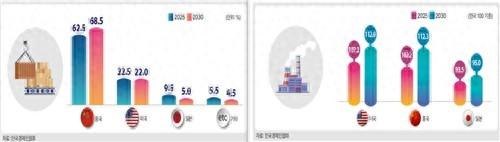
Core Insights - The report from the Korea Economic Association indicates that half of South Korea's top ten export industries have been surpassed by China in terms of competitiveness, with a prediction that all ten industries may lose their competitive edge within five years [1][2]. Industry Competitiveness - A survey of 200 South Korean companies revealed that 62.5% identified China as their biggest competitor, significantly higher than the 22.5% who chose the United States and 9.5% who chose Japan. This perception is expected to increase, with 68.5% anticipating China as the main competitor by 2030 [1][2]. - The competitiveness levels, with South Korean companies using a standard of 100, are perceived as follows: the United States at 107.2, China at 102.2, and Japan at 93.5. By 2030, these levels are projected to be 112.9 for the U.S., 112.3 for China, and 95 for Japan, indicating a significant shift in competitiveness [2][4]. Sector Analysis - In specific sectors, South Korean companies believe that Chinese firms lead in steel (112.7), general machinery (108.5), batteries (108.4), displays (106.4), and automotive parts (102.4). However, South Korea still maintains an edge in semiconductors (99.3), electronics and electrical machinery (99), shipbuilding (96.7), petrochemicals (96.5), and biopharmaceuticals (89.2) [2][4]. - The report highlights that China has advantages in price competitiveness, production capacity, and government support, while the U.S. excels in branding, skilled talent, and core technologies. Currently, South Korea only leads in brand competitiveness, which is expected to be overtaken in five years [4][6].

指引发布实施一周年:从软约束到硬指标 上市公司市值管理迈入新阶段
Xin Hua She· 2025-11-17 01:29
Core Viewpoint - The article discusses the transition of market value management for listed companies in China from soft constraints to hard indicators, emphasizing the implementation of the "Guidelines for the Supervision of Listed Companies No. 10 - Market Value Management" and the increasing use of various tools to enhance investment value and return to investors [1][2]. Group 1: Value Enhancement through Dividends and Buybacks - Cash dividends and share buybacks have become frequently used tools in the market value management toolbox over the past year, with companies encouraged to clarify buyback mechanisms and develop long-term dividend plans [1][2]. - As of October 31, 2023, 1,195 companies in China's stock market have announced 1,525 buyback plans for 2025, with 899 completed and a total buyback amount of 92.3 billion yuan, of which 36% was from self-owned funds and 26% from cancellation buybacks [3]. - A total of 1,033 listed companies announced cash dividend plans for the first three quarters, an increase of 141 from the previous year, with total cash dividends amounting to 734.9 billion yuan [3]. Group 2: Mergers and Acquisitions Market Activity - Mergers and acquisitions (M&A) have been highlighted as a key tool for market value management, with a notable increase in activity in the "hard technology" sector and accelerated integration of state-owned enterprises [6][7]. - Representative M&A cases include the acquisition of 72.33% of shares in ChipLink by ChipLink Integrated and the merger of Haiguang Information with Zhongke Shuguang, showcasing the trend of industry chain advantages [6]. - Policy support has been crucial for the active M&A market, with recent reforms aimed at enhancing efficiency and market vitality, including the introduction of new guidelines and streamlined approval processes [7]. Group 3: Employee Stock Ownership and Incentives - Stock incentives have gained prominence as a market value management tool, with companies encouraged to establish long-term incentive mechanisms [8][9]. - As of June 2023, nearly 3,500 listed companies have implemented stock incentive or employee stock ownership plans, representing 64% of A-share listed companies, with over 5,000 stock incentive plans launched [8]. - The recognition of stock incentives as a significant method for market value management has deepened, with expectations for more companies to adopt these tools in the future [9].
雷尔伟11月14日获融资买入424.57万元,融资余额1.64亿元
Xin Lang Cai Jing· 2025-11-17 01:27
Group 1 - The core viewpoint of the news is that 雷尔伟 (Railway Technology Co., Ltd.) is experiencing fluctuations in its financing activities and stock performance, with a notable decrease in net buying and a high financing balance relative to its market value [1][2] - As of November 14, 雷尔伟's financing balance is 164 million yuan, accounting for 3.84% of its circulating market value, which is above the 90th percentile level over the past year, indicating a high financing level [1] - The company reported a revenue of 252 million yuan for the first nine months of 2025, reflecting a year-on-year growth of 5.66%, while the net profit attributable to shareholders decreased by 3.09% to 44.73 million yuan [2] Group 2 - 雷尔伟 has distributed a total of 178 million yuan in dividends since its A-share listing, with 160 million yuan distributed over the past three years [3] - The number of shareholders as of September 30 is 11,700, which is a decrease of 14.61% from the previous period, while the average circulating shares per person increased by 17.11% to 17,770 shares [2]

A股分析师前瞻:11月,主题投资更占优
Xuan Gu Bao· 2025-11-16 14:07
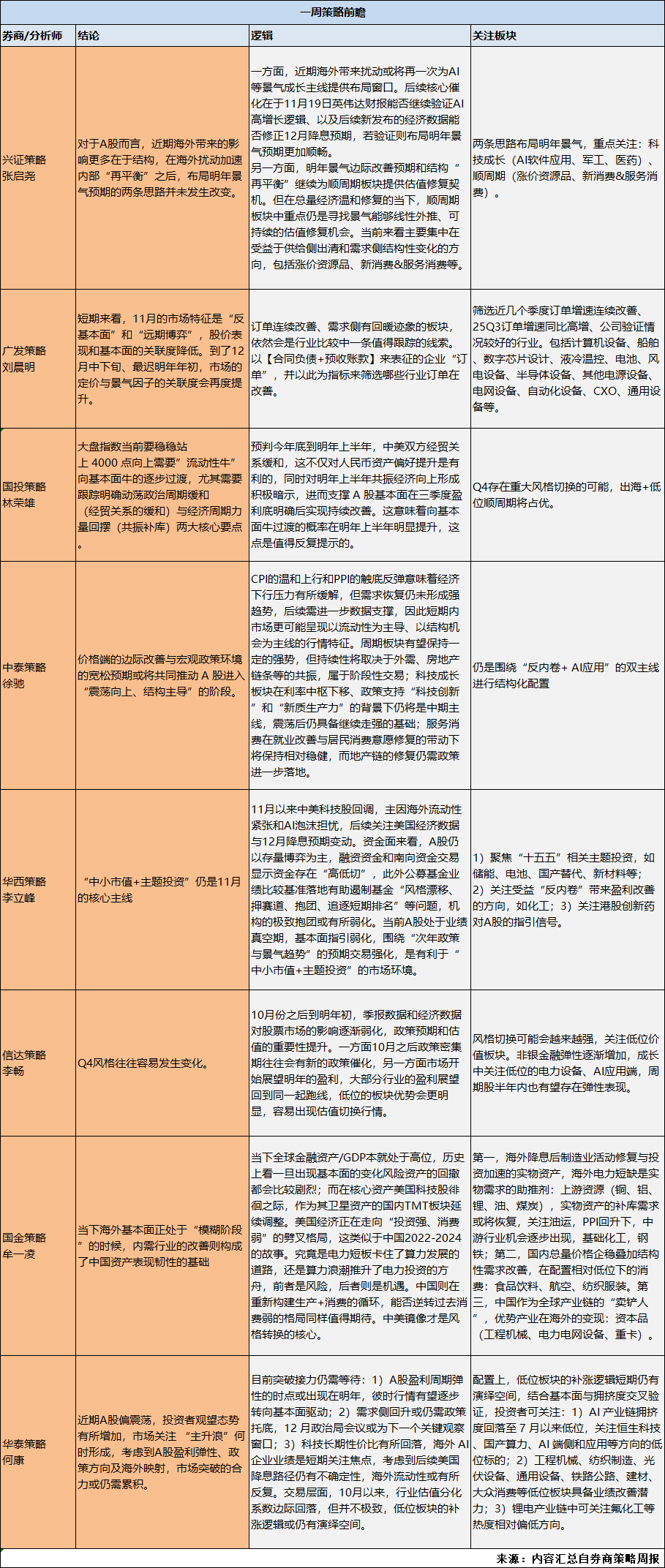
Core Insights - The main discussion among analysts revolves around the year-end style switch, with a focus on the impact of U.S. economic data and interest rate expectations on market performance [1][2][3] Group 1: Market Trends - Analysts from Huaxi Strategy noted that the recent pullback in Chinese and U.S. tech stocks is primarily due to tight overseas liquidity and concerns over the AI bubble, with attention shifting to U.S. economic data and December rate cut expectations [1] - The current A-share market is characterized by stock selection based on existing liquidity, with a notable "high-low cut" in trading activities, indicating a preference for mid and small-cap stocks and thematic investments [1][4] - The market environment in November is favorable for "small and mid-cap + thematic investments," as the fundamental guidance is weak and trading is increasingly based on expectations for next year's policies and economic trends [1][4] Group 2: Sector Focus - The focus on sectors benefiting from improving order growth includes computer equipment, shipbuilding, digital chip design, liquid cooling, batteries, wind power equipment, semiconductor equipment, and automation equipment [2][3] - Analysts from Xingzheng Strategy highlighted that the upcoming Nvidia earnings report on November 19 is crucial for validating the high growth logic of AI, which could provide a clearer outlook for next year's economic expectations [2][3] - The emphasis on sectors that have shown continuous improvement in order growth over recent quarters suggests a strategic focus on industries that are likely to benefit from structural changes in demand [2][3] Group 3: Policy and Economic Outlook - The period from October to early next year is expected to see a diminishing impact of quarterly reports and economic data on the stock market, with policy expectations and valuations becoming more significant [1][4] - The anticipated policy catalysts following the October period may lead to a reassessment of next year's earnings outlook, with many industries returning to a common starting line, making low-valued sectors more attractive [1][4] - The overall market is expected to transition from a liquidity-driven phase to one more influenced by fundamental factors, particularly as economic conditions stabilize and improve [4]
压力下的突围:中国出口韧性从何而来,能否持续?
Hua Xia Shi Bao· 2025-11-14 07:56
Core Viewpoint - Despite significant pressure from increased tariffs and geopolitical uncertainties, China's overall export growth has exceeded market expectations, showcasing remarkable resilience in the face of challenges [2][3]. Group 1: China's Export Resilience - In the first three quarters of 2025, China's total export reached $2.8 trillion, a year-on-year increase of 6.1%, marking the highest level for the same period in nearly three years [2][3]. - The net export of goods and services contributed 1.5 percentage points to GDP growth, the second-highest in nearly a decade, only behind the recovery period of 2021 [2]. Group 2: Market Diversification and Structural Upgrading - Exports to non-U.S. markets have shown significant growth, compensating for the decline in exports to the U.S. [5][6]. - In the first three quarters of 2025, exports to Africa, ASEAN, India, the UK, the EU, Latin America, and Canada grew by 28.3%, 14.7%, 12.9%, 8.7%, 8.2%, 6.9%, and 5.1% respectively, collectively contributing approximately 6.3 percentage points to overall export growth [5][6]. Group 3: Changes in Export Structure - The share of intermediate goods in total exports increased from 41.7% in 2017 to 47.4% in the first three quarters of 2025, while the share of consumer goods decreased from 37.2% to 32.5% [9][10]. - Intermediate goods and capital goods have become the main drivers of overall export growth, with intermediate goods exports growing by 10.2% year-on-year in the first three quarters of 2025 [9][11]. Group 4: Trade Relations with Major Economies - The trade relationship with developed economies like the U.S. and EU is shifting from complementarity to a mix of competition and cooperation, with China's exports to these regions facing pressure [12][13]. - Despite challenges, there remains potential for growth in high-value intermediate and capital goods exports to developed economies, as China's competitiveness in high-tech sectors continues to improve [14][15]. Group 5: Emerging Markets as Growth Drivers - Emerging markets, particularly in Africa, are becoming significant growth markets for Chinese exports, with a shift in the export structure from consumer goods to capital and intermediate goods [19][20]. - China's exports to Africa have increased from 4.2% to 5% of total exports from 2017 to 2024, with capital goods' share rising from 17.4% to 24% during the same period [19][20].

10月工业增速高位放缓,高技术制造业仍有亮眼表现
Sou Hu Cai Jing· 2025-11-14 03:52
Core Insights - In October, the industrial added value of large-scale enterprises increased by 4.9% year-on-year, a decline of 1.6 percentage points compared to September. For the period from January to October, the industrial added value grew by 6.1% [1] - The manufacturing Purchasing Managers' Index (PMI) for October was 49.0%, down 0.8 percentage points from the previous month, indicating a contraction in manufacturing activity [1] - Among the three major sectors, mining added value grew by 4.5%, manufacturing by 4.9%, and the production and supply of electricity, heat, gas, and water by 5.4% in October [1] Economic Type Analysis - In October, state-owned enterprises saw a 6.7% year-on-year increase in added value, while joint-stock enterprises grew by 5.2%, foreign and Hong Kong, Macao, and Taiwan-invested enterprises by 4.0%, and private enterprises by 2.1% [2] High-tech Manufacturing Insights - High-tech manufacturing added value increased by 7.2% year-on-year in October, surpassing the overall industrial added value growth by 2.3 percentage points. Cumulatively, from January to October, high-tech manufacturing added value rose by 9.3% [3] Industry Performance - Out of 41 major industries, 29 reported year-on-year growth in added value in October. Notable growth was seen in the automotive manufacturing sector at 16.8%, transportation equipment manufacturing at 15.2%, electrical machinery and equipment manufacturing at 4.9%, and computer, communication, and other electronic equipment manufacturing at 8.9% [5] - The decline in industrial production momentum in October is attributed to the fading impact of short-term factors from September and a decrease in export growth, which is expected to affect industrial production [5] Policy and Economic Outlook - The National Development and Reform Commission announced that 500 billion yuan in new policy financial tools have been fully allocated, supporting 2,300 projects with a total investment of approximately 7 trillion yuan. Additionally, 500 billion yuan in special bonds have been allocated to support local investment projects [6] - Analysts predict a potential slight rebound in exports in November, supported by fiscal policies aimed at stabilizing growth, which may bolster industrial production [6] - The economic growth momentum is expected to shift from manufacturing to services, marking a significant change from the previous year [6] - Despite supportive policies, challenges remain with a persistent imbalance between strong supply and weak demand, alongside pressures from slowing exports and rising base effects [6][7]
中国出口的真正“爆单王”,为什么是遥远的非洲?
Ge Long Hui· 2025-11-13 09:23
Core Insights - China's exports to Africa have surged by 25.9% year-on-year, significantly outpacing other regions, with total exports expected to exceed $200 billion in 2023 [1][2] - The increase in exports is driven by strategic policy changes, strong demand, and China's competitive manufacturing advantages [2][3] Group 1: Policy and Trade Dynamics - Strategic policy initiatives, such as the implementation of a 100% zero-tariff policy on goods from 53 African countries, have opened new trade opportunities [2][5] - The restructuring of global trade dynamics, particularly in contrast to U.S. tariffs on African trade partners, has positioned China favorably in the African market [2][6] Group 2: Market Potential and Demand - Africa's significant market potential, characterized by a young population and a growing demand for infrastructure, has made China an essential partner in the continent's industrialization [3][4] - Key import categories from China include machinery, electrical equipment, and vehicles, which account for approximately 55% of imports, driving export growth [3][4] Group 3: Competitive Advantages - China's manufacturing sector benefits from a complete industrial chain, allowing for cost-effective production and competitive pricing in the African market [3][4] - The depreciation of the offshore RMB has further enhanced the price competitiveness of Chinese goods in Africa [4][5] Group 4: Structural Challenges and Risks - Despite the growth potential, Africa's economic and political risks, including varying levels of stability across countries, pose challenges for sustained trade [6][7] - The continent's weak industrial base, with manufacturing contributing only 10%-11% to GDP, indicates a reliance on primary product exports, making it vulnerable to global commodity price fluctuations [7][10] Group 5: Strategic Recommendations - Companies should adopt a long-term strategy focused on deepening cooperation and establishing a strong market presence rather than seeking quick profits [8][9] - Emphasizing core product categories, particularly in infrastructure and renewable energy, will be crucial for capturing growth opportunities in Africa [9][10]
年末怎么投?未来重要事件前瞻!
摩尔投研精选· 2025-11-10 10:41
Market Overview - The A-share market shows a divergence with the main board strengthening while the ChiNext board remains under pressure, with the Shanghai Composite Index successfully reclaiming the 4000-point mark [2] - Market sentiment is fluctuating, with over 3300 stocks closing in the green, and the total trading volume in the Shanghai and Shenzhen markets reaching 2.17 trillion, an increase of 175.4 billion from the previous trading day [3] Economic Indicators - The strong performance of consumer sectors such as food and beverage, liquor, and tourism is attributed to the rebound in October's CPI and core CPI data, signaling a recovery in domestic demand and boosting confidence in economic stabilization [3][4] - The Ministry of Finance has reiterated its commitment to continue implementing special actions to boost consumption, providing policy support to these sectors [4] Policy Outlook - The release of the "14th Five-Year Plan" marks the beginning of a new five-year economic and industrial development framework, which will serve as a foundation for future policies and provide a starting point for the policy tone leading up to 2026 [5][7] - Key areas of focus include industrial structure upgrades, technological self-reliance, and boosting domestic consumption [8][10] Sector Focus - For industrial structure upgrades, attention should be directed towards sectors such as mining, chemicals, machinery, and shipbuilding [11] - In terms of technological self-reliance, sectors like new energy, new materials, low-altitude economy, artificial intelligence, integrated circuits, and industrial mother machines are highlighted [11] - The domestic consumption boost should focus on retail, social services, food and beverage, and certain new consumption areas [11] Market Trends - The TMT (Technology, Media, and Telecommunications) and advanced manufacturing sectors are expected to remain the main themes of the bull market [12] - Historical trends indicate that the current market may be in the second phase of a multi-stage rally, with significant potential for growth [14] Investment Opportunities - In the TMT sector, key areas of interest include AI and storage, with AI driving technological innovation and industry transformation, while storage is expected to benefit from sustained demand due to AI [15][16] - In advanced manufacturing, focus areas include humanoid robots, liquid cooling, solid-state batteries, and PCB, with significant developments anticipated in 2026 [17][18] Future Market Dynamics - The market is expected to enter a phase of intense policy expectation, with domestic policies centered around the "14th Five-Year Plan" and the upcoming Central Economic Work Conference, while international policies will be influenced by U.S.-China relations and potential policy shifts from the U.S. midterm elections [21] - Key upcoming events include annual performance forecasts and quarterly reports, which will further validate industry conditions [22]