
金融业

Search documents
国泰海通:沙特非油经济贡献稳步提升 中沙互利合作拓展至新能源等领域
智通财经网· 2025-09-22 05:52
Core Insights - Saudi Arabia's economic vitality has improved significantly in recent years, with the non-oil economy contributing over 70% to GDP [1][2] - The relationship between China and Saudi Arabia is strengthening in the context of global multipolarity and economic globalization, with cooperation expanding into various strategic sectors [1][4] Economic and Regulatory Environment - The growth of the non-oil economy is driven by private sector expansion, upgrades in key sectors, and accelerated growth in emerging industries [2] - Saudi Arabia is transitioning from an export-driven economy to one driven by domestic demand, with increased contributions from investment and consumption [2] - The unemployment rate has dropped to a historical low, supported by a young population, rising female employment, and high educational attainment [2][3] Regional and Geopolitical Context - Saudi Arabia plays a dual role as an economic engine and stabilizer in the Middle East, crucial for stabilizing international oil prices and facilitating regional cooperation [3] - The geopolitical landscape is shifting towards cooperation, with Saudi Arabia's "Vision 2030" becoming a central national strategy that transcends traditional security dependencies [4] Industry Transformation and Investment Opportunities - Under "Vision 2030," Saudi Arabia's manufacturing, consumption, and high-tech industries are accelerating, with significant progress in digital economy, green energy, and high-end manufacturing [5] - The country is attracting foreign direct investment (FDI), particularly in manufacturing, construction, and financial services, indicating a growing investment potential [5]

新城市志|第二座5万亿之城来了,中国城市格局怎么变
Xin Lang Cai Jing· 2025-09-20 06:17
Core Insights - Beijing is set to become the second city in China to surpass a GDP of 5 trillion yuan, following Shanghai, marking a significant milestone in the urban economic landscape of China [1][14] - The achievement is attributed to long-term high-quality development and continuous optimization of the economic structure, with a projected GDP of 49,843.1 billion yuan in 2024, reflecting a growth of 5.2% year-on-year [3][14] Economic Growth and Structure - Beijing's economic growth is driven by the optimization of its industrial structure, with the information service industry emerging as the largest pillar, contributing significantly to GDP [4] - The financial sector in Beijing has assets exceeding 220 trillion yuan, accounting for about half of the national total, with a growth rate of 7.6% in 2024 [5] - The city has seen a robust increase in technology innovation, with over 2,400 AI companies and a core AI industry scale surpassing 300 billion yuan [5] Consumption and Investment - Consumer spending has been stimulated by various events, with an expected market total consumption exceeding 3 trillion yuan by 2025 [6] - Fixed asset investment is projected to surpass 1 trillion yuan, indicating strong investment activity in the city [6] Regional Development and Collaboration - The "Beijing-Tianjin-Hebei coordinated development" strategy has been pivotal in driving regional economic growth, with over 4,000 Beijing-based enterprises establishing operations in Xiong'an New Area [7][8] - Transportation infrastructure improvements have facilitated better connectivity within the region, enhancing economic interactions [9] Future Outlook - The competition among cities is shifting from total economic volume to quality, with a focus on technological innovation, industrial upgrades, and regional collaboration as key competitive advantages [14][15] - The number of trillion-yuan cities is expected to increase, with cities like Tangshan and others on the verge of breaking into the trillion-yuan GDP club [15]



美联储降息对中国的三重机遇与双向冲击
Sou Hu Cai Jing· 2025-09-20 00:54
Group 1 - The potential interest rate cut by the Federal Reserve in September 2025 is a key external factor influencing the Chinese economy, with a 92% probability of a rate cut reflected in the U.S. interest rate futures market [1] - The U.S. labor market shows signs of weakness, with a 0.8 percentage point decline in GDP growth from the first to the second quarter, and the core PCE price index year-on-year growth falling to 2.3%, creating room for the Fed to ease monetary policy [1] Group 2 - The narrowing of the China-U.S. 10-year government bond yield spread from 2.1 percentage points in 2023 to 0.3 percentage points is a significant positive development, potentially allowing for a 150 basis point reduction in China's reserve requirement ratio [3] - The aviation and real estate sectors are expected to benefit first, with the former holding $38.7 billion in dollar-denominated debt and the latter having approximately $52.6 billion in outstanding dollar debt, alleviating financial cost pressures from exchange rate fluctuations [3] Group 3 - Over the past 12 months, northbound capital has net flowed into the A-share market by 243 billion yuan, with the consumer electronics, new energy vehicles, and high-end equipment manufacturing sectors accounting for 62% of this inflow [3] - In the MSCI China index, stocks with foreign ownership exceeding 5% have an average valuation below the central value of the past five years by 23%, indicating potential for value reassessment during the Fed's rate cut cycle [3] Group 4 - The CFETS RMB exchange rate index, if it rises to the 101-103 range, could reduce the average procurement cost of basic imported goods by 6.3%, significantly impacting strategic materials like iron ore and crude oil [4] - The apparel and textile sectors may face pressure, with a 1% appreciation in the RMB potentially eroding profit margins by 4.7%, affecting over 120,000 export enterprises [4] Group 5 - The manufacturing PMI has remained above the threshold for four consecutive months, with the new export orders index rising to 51.6, indicating effective structural adjustments [4] - The recent 9.2% increase in the global commodity price index may offset some benefits from alleviating input deflationary pressures [4]

中蒙俄经济走廊建设迈出新步伐
Jing Ji Ri Bao· 2025-09-18 22:04
Core Insights - The meeting between the leaders of China, Russia, and Mongolia highlights the steady development and tangible results of trilateral cooperation, with a focus on high-quality development of the China-Mongolia-Russia Economic Corridor [1] Trade and Economic Cooperation - Bilateral and multilateral trade between China, Russia, and Mongolia has shown significant growth, with China-Russia trade increasing from $69.5 billion in 2016 to $244.8 billion in 2024, an annual growth rate of 17.0% [1] - In 2024, China-Mongolia trade is projected to reach $18.62 billion, a year-on-year increase of 10.1%, surpassing the overall growth rate of China's foreign trade by 5 percentage points [1] - China remains the largest trading partner for both Russia and Mongolia, with trade accounting for over 30% of Russia's total foreign trade and nearly 70% of Mongolia's total foreign trade [1] Investment Trends - Chinese investment in Russia remains stable at over $10 billion, covering traditional sectors such as mining, agriculture, and manufacturing, with notable growth in research and technology services [2] - In Mongolia, Chinese foreign investment stock reached $5.44 billion, representing 16.3% of the total foreign investment in the country, primarily concentrated in the mining sector [2] Infrastructure Development - The China-Mongolia-Russia Economic Corridor has made significant progress in infrastructure connectivity, with national-level ports along the corridor accounting for about one-third of the total in the country [2] - By 2024, the cargo volume at key ports like Manzhouli and Erenhot is expected to exceed 45 million tons, with over 7,700 trains operating on the China-Europe Railway Express [2] Open Platforms and Future Prospects - Various open platforms are being established to enhance cooperation, including the China-Mongolia Erenhot-Zamyn-Uud Economic Cooperation Zone and multiple customs special supervision areas [3] - The potential for cooperation in infrastructure, energy development, modern agriculture, cross-border tourism, and digital economy is significant, with a call for deeper strategic alignment and policy communication among the three countries [3]
“2025年中国上市公司治理指数”显示:上市公司治理水平稳步提升 金融行业表现突出
Shang Hai Zheng Quan Bao· 2025-09-18 19:05
Core Insights - The average governance index for Chinese listed companies in 2025 is 64.94, showing a slight increase from 64.87 in 2024, indicating a steady improvement in governance quality [1][2][3] - Financial sector companies exhibit the highest governance levels, with an average index of 67.32, while the main board companies require further improvement [4][5][17] Governance Index Overview - The governance index has increased by 0.07 from 2024 to 2025, with improvements in shareholder governance, board governance, and stakeholder governance, while supervisory board governance, management governance, and information disclosure have declined [1][3][6] - The distribution of governance ratings shows that 84.43% of companies fall into the B, C, and D categories, with no companies rated AAA or AA [2][3] Industry and Sector Analysis - The governance index varies significantly across industries, with financial companies leading, followed by sectors like scientific research, accommodation, and manufacturing [4][5] - The governance index for private-controlled companies continues to outperform state-owned companies, with companies without actual controllers showing the best governance performance [4][5] Regional Governance Characteristics - Governance levels show a gradient improvement from coastal to inland regions, with 32 regions having an average index above 62.00, indicating a reduction in regional disparities [5] Detailed Dimension Analysis - Shareholder governance index increased from 69.42 to 69.73, driven by improvements in dividend continuity and protection of minority shareholders [7][8] - Board governance index rose to 65.26, reflecting better operational efficiency and structure [8] - Supervisory board governance index slightly decreased to 59.12, indicating a decline in the competency of supervisory board members [9] - Management governance index fell to 60.39, with a slight improvement in appointment systems but a decline in incentive mechanisms [9] - Information disclosure index slightly decreased to 66.19, although relevance and timeliness improved [10] - Stakeholder governance index increased to 69.70, despite a decrease in stakeholder participation [12] Recommendations for Improvement - Establish a mechanism for the audit committee to prevent governance risks during transitional periods [18][19] - Encourage the participation of actual controllers in governance while establishing accountability mechanisms [19][20] - Leverage digital tools to enhance governance efficiency and reduce costs [20][21] - Develop tailored governance guidelines for private-controlled companies to address recent declines in governance quality [20] - Promote differentiated governance standards based on industry characteristics [21] - Create a governance-oriented market value management system to enhance governance premiums [21] - Expand investor litigation channels to strengthen market oversight and protect shareholder rights [22] - Encourage institutional investors to actively participate in governance activities [22]
深夜,中国资产爆发
财联社· 2025-09-18 00:23
Core Viewpoint - The Federal Reserve's decision to cut interest rates by 25 basis points does not indicate the start of a long-term easing cycle, which dampens market bullish sentiment [1][3]. Market Dynamics - The Dow Jones increased by 260.42 points (0.57%) to 46018.32, while the Nasdaq fell by 72.63 points (0.33%) to 22261.33, and the S&P 500 decreased by 6.41 points (0.10%) to 6600.35 [4]. - Among the 11 sectors of the S&P 500, the financial sector rose by 0.96%, and the energy sector increased by 0.28%, while the industrial sector fell by 0.47% and the information technology sector declined by 0.7% [4]. - In the ETF market, the semiconductor ETF dropped by 0.64%, while the energy ETF rose by 0.23% and the financial ETF increased by 0.97% [4]. Stock Performance - Major tech stocks showed mixed results, with Nvidia down 2.62%, Amazon down 1.04%, and Google A down 0.65%, while Microsoft rose by 0.19% and Apple increased by 0.35% [5]. - Lyft's stock surged by 13% following the announcement of a partnership with Waymo for autonomous taxi services in Nashville, while competitor Uber fell by 5% [6]. - Workday's shares rose by 7.25% after reports of Elliott Management acquiring over $2 billion in shares [7]. - StubHub's stock fell over 6% on its first day of trading, marking a reversal in the hot IPO market [8]. - Chinese concept stocks mostly rose, with the Nasdaq Golden Dragon China Index up 2.85%, including Baidu up over 11% and NIO up over 6% [8].

税收数据显示横琴“四新”产业潜力迸发
Sou Hu Cai Jing· 2025-09-17 08:53
Group 1 - The tax incentives in the Hengqin Guangdong-Macao Deep Cooperation Zone are showing positive effects, with a 52% year-on-year increase in the number of enterprises benefiting from a 15% corporate income tax rate in 2024, and a 2.81% increase in tax reductions [1] - Over 1,500 Macao residents have benefited from personal income tax incentives, with a total tax reduction exceeding 70 million yuan, indicating a continuous increase in the number of beneficiaries and tax refunds [1] - The number of Macao residents living and working in the cooperation zone has reached 28,000 by the end of August 2025, reflecting accelerated integration of livelihoods between Hengqin and Macao [1] Group 2 - The cooperation zone's economic activity is robust, with a 17.74% year-on-year increase in total invoiced amounts from enterprises from January to August 2025, and a 6.33% increase in the number of invoicing entities [2] - The "Four New" industries account for over 40% of the invoiced amounts, with significant growth in manufacturing (31.18%), information software services (31.47%), finance (9.71%), and health and social work (37.06%) [2] - The implementation of tax rule alignment mechanisms has deepened, with 18 tax-related alignment items established, and 55 tax professionals from Hong Kong and Macao obtaining practice qualifications in Hengqin [2]
访英礼包?特朗普暗示愿做贸易让步,据称将签超百亿协议、英国搁置美钢铁零关税计划
Hua Er Jie Jian Wen· 2025-09-16 19:13
Group 1 - President Trump is set to visit the UK for the second time this year, with expectations of announcing over $10 billion in new economic agreements, including significant investments in the technology sector [1][3] - The UK government has indefinitely shelved plans to completely eliminate tariffs on US steel exports, maintaining a 25% tariff, which affects 6% of the UK's total steel exports and 9% of its export value [4][5] - Trump indicated a willingness to make concessions in trade discussions with the UK, suggesting that the UK is seeking better terms in their trade agreement [2][3] Group 2 - The anticipated economic agreements during Trump's visit will cover various sectors, including technology cooperation, defense technology collaboration, and strengthening financial ties between the two countries [3] - A nuclear cooperation agreement is also expected to be signed, allowing both countries to utilize each other's reactor design safety assessments to expedite nuclear power plant approvals [3] - The UK steel industry is facing significant financial challenges, with government intervention in several steel plants, highlighting the need for stronger trade protection measures to ensure sustainability in the domestic market [5]
智库要览丨服务贸易为全球经济发展注入更多新机遇
Sou Hu Cai Jing· 2025-09-16 07:38
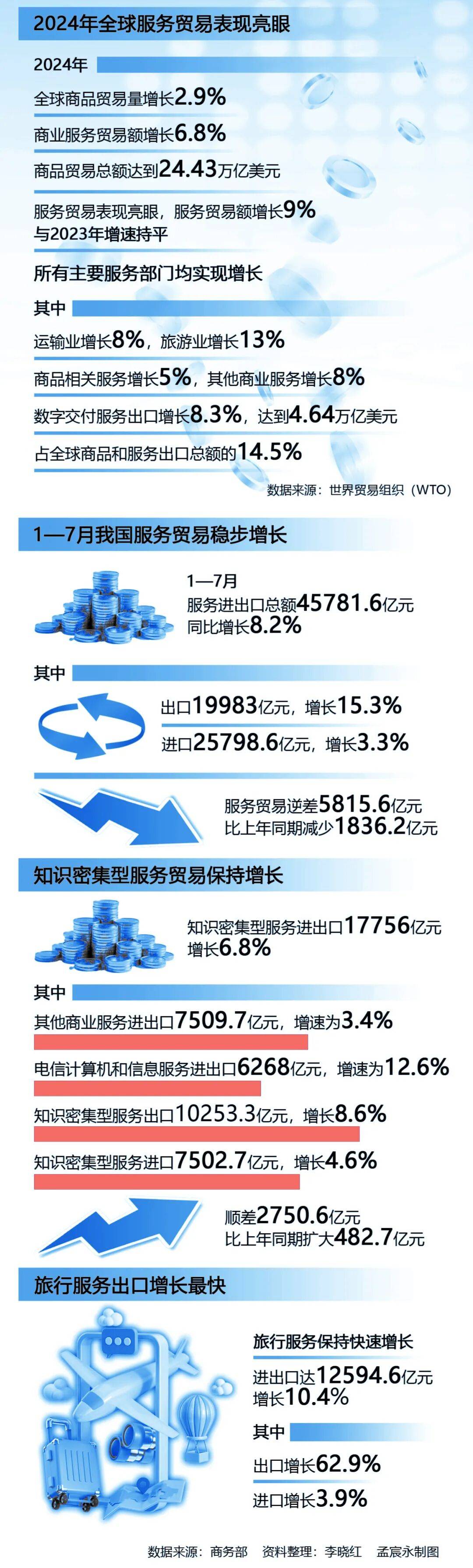
Core Viewpoint - The global service trade is increasingly becoming a key driver of trade growth, with a notable resilience in the trade system despite multiple economic challenges. Service trade is expected to grow by 9% in 2024, maintaining its growth rate from 2023, while all major service sectors are projected to experience growth [2][3][24]. Group 1: Global Service Trade Growth - The global service trade is projected to grow by 9% in 2024, with all major service sectors achieving growth, including transportation (8%), tourism (13%), and other commercial services (8%) [3][10][24]. - The total value of global goods trade is expected to reach $24.43 trillion in 2024, with a 2.9% increase in goods trade volume [3][10][24]. - Digital delivery service exports are anticipated to grow by 8.3%, reaching $4.64 trillion, accounting for 14.5% of total global goods and services exports [3][10][24]. Group 2: Regional Trade Performance - In 2024, Asia is expected to see the strongest growth in service trade at 13%, while Africa's service trade growth is projected at only 3% [4][10][24]. - North America is also expected to exceed import growth expectations, while Europe is experiencing a trade contraction [4][10][24]. Group 3: Inclusive Development in Service Trade - The demand for inclusive development in global service trade is on the rise, with digitalization playing a positive role in promoting this development [5][26]. - The "Global Service Trade Inclusive Development Trends Report 2025" outlines eight strategic recommendations to enhance inclusive service trade development, including improving digital infrastructure and supporting developing countries [6][26][27]. Group 4: China's Service Trade Dynamics - China's service trade is entering a phase of rapid development, with a focus on high-quality and diversified services, particularly in sectors like information services and finance [16][21][29]. - In the first seven months of 2023, China's service trade reached a total of 45,781.6 billion yuan, reflecting an 8.2% year-on-year growth [10][30][31].
2025年8月经济增长数据点评
Ping An Securities· 2025-09-16 06:58
Economic Growth Data - In August 2025, China's industrial added value and service production index grew by 5.2% and 5.6% year-on-year, respectively, showing a month-on-month slowdown of 0.5 and 0.2 percentage points[2] - The retail sales of consumer goods increased by 3.4% year-on-year, while fixed asset investment grew by only 0.5%, reflecting a month-on-month decline of 0.3 and 1.1 percentage points, respectively[2] Sector Performance - High-tech manufacturing added value rose by 9.3%, maintaining the previous month's level and significantly outpacing the overall industrial added value growth[2] - The production index for information transmission, software, and IT services, as well as finance and leasing services, grew by 12.1%, 9.2%, and 7.4% year-on-year, respectively, indicating strong service sector performance[2] Consumer Trends - Restaurant income increased by 2.1% year-on-year, while retail sales of goods grew by 3.6%, with the former showing a month-on-month increase of 1 percentage point and the latter a decrease of 0.4 percentage points[2] - The "old-for-new" policy continues to show effects, although the growth rates for related retail categories like home appliances and furniture have begun to slow down[2] Investment Insights - From January to August, infrastructure investment grew by 2.0%, manufacturing investment by 5.1%, and real estate development investment decreased by 12.9%, with all showing a decline compared to the previous month[2] - Private investment fell by 0.8 percentage points to -2.3%, with real estate development private investment dropping by 16.7%, significantly impacting overall private investment growth[2] Future Outlook - Economic growth momentum in August 2025 has slowed, but new policy measures are expected to stabilize growth, including the potential introduction of new financial tools and early allocation of local government debt limits for 2026[2] - Risks include the possibility of ineffective growth stabilization policies, unexpected overseas economic downturns, and escalating geopolitical conflicts[10]