国防军工

Search documents
商业航天近期调整不改中长期产业趋势,关注大飞机国际化认证进展
Orient Securities· 2026-01-19 05:19
Investment Rating - The report maintains a "Positive" outlook for the defense and military industry [4] Core Insights - The report emphasizes the importance of commercial aerospace and the progress of domestic large aircraft international certification [2] - The European Union Aviation Safety Agency (EASA) has begun flight testing the C919, which is expected to accelerate the global expansion of China's commercial aviation [11] - The aerospace work conference highlighted the need to break through reusable rocket technology, which is anticipated to accelerate the development of China's commercial aerospace industry [12] - The report continues to favor investment opportunities in commercial aerospace, military trade, and new quality combat capabilities [14] Summary by Sections 1.1 EASA Flight Testing of C919 - EASA has initiated flight evaluations of the C919 in Shanghai, indicating that the aircraft's performance is good and safe, with minor adjustments needed [11] - This certification is crucial for the C919 to enter international markets and compete with Boeing and Airbus, potentially reshaping the global civil aviation market [11] 1.2 Breakthrough in Reusable Rocket Technology - The aerospace work conference emphasized the importance of advancing reusable rocket technology and developing commercial aerospace and low-altitude economies [12] - The focus on low-orbit satellite constellations is seen as a new arena for major powers in space competition, with significant implications for satellite manufacturing, launching, and operations [13] 1.3 Continued Focus on Investment Opportunities - The report suggests that the "14th Five-Year Plan" will enhance the military sector's value, with a focus on unmanned and anti-unmanned equipment, deep-sea technology, and combat informationization [14] - The military sector is expected to see growth from both civilian and military trade, with a list of recommended stocks for investment opportunities in various segments [14][15]


航天南湖涨9.76%,股价创历史新高
Zheng Quan Shi Bao Wang· 2026-01-19 03:32
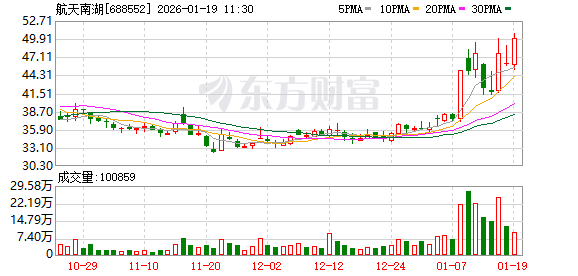
Group 1 - The stock price of Aerospace Nanhu reached a historical high, increasing by 9.76% to 50.60 yuan, with a trading volume of 7.4088 million shares and a transaction value of 352 million yuan, resulting in a turnover rate of 8.53% [2] - The total market capitalization of Aerospace Nanhu in A-shares is 17.065 billion yuan, with a circulating market value of 4.393 billion yuan [2] - The defense and military industry, to which Aerospace Nanhu belongs, has an overall increase of 0.70%, with 92 stocks rising, including Aerospace Nanhu, which has the highest increase [2] Group 2 - The latest margin trading data shows that the margin balance for Aerospace Nanhu is 222 million yuan, with a recent increase of 75.9248 million yuan, representing a growth of 52.07% [2] - As of January 10, the number of shareholders for Aerospace Nanhu reached 16,964, an increase of 2,618 from the previous period, indicating a continuous trend of share dispersion [2] - The company reported a revenue of 585 million yuan for the first three quarters, a year-on-year increase of 579.06%, and a net profit of 37.4859 million yuan, up 163.91% [3]


更“耗材”的全球投资周期意味着什么?
HTSC· 2026-01-19 02:52
Group 1: Global Investment Trends - The global capital expenditure is expected to accelerate by 2026, with "consumables" growth significantly surpassing the initial phase of AI investments[1] - AI investment in 2025 is projected to reach $460 billion, accounting for approximately 1.5% of GDP, exceeding the peak of the internet bubble period[13] - The demand for commodities related to AI is anticipated to increase exponentially, with a low price sensitivity due to supply-side constraints[2] Group 2: Fiscal Policies and Defense Spending - Major economies like the US, Europe, and Japan are implementing expansionary fiscal policies, focusing on defense and supply chain security, which will increase "consumable" demand[2] - NATO countries' defense spending is expected to rise from 2.1% of GDP in 2024 to 3.5% by 2035, with annual increases of 0.13 percentage points required for EU countries[49] - Germany and France are projected to reach defense spending targets of 3-3.5% of GDP by 2030, necessitating annual increases of 0.2 percentage points[52] Group 3: Manufacturing and Economic Recovery - The global manufacturing sector is likely to experience an upturn, driven by AI-related investments and infrastructure demands, positively impacting exports, especially from Asia[59] - The uncertainty surrounding tariffs is expected to decrease, which may alleviate the drag on manufacturing investments[61] - The US corporate investment growth forecast for 2026 has been revised upward to 4.8%[62]
特朗普向华尔街-开火-美联储主席之争出现变数
2026-01-19 02:29
Summary of Key Points from the Conference Call Industry and Company Involvement - The discussion primarily revolves around the U.S. financial markets and the impact of the Trump administration's policies on Wall Street and various sectors, particularly housing and energy [1][2][4][5][7]. Core Insights and Arguments - **Trump Administration's Policies**: A series of five significant measures were introduced, including capping credit card interest rates at 10%, which aims to alleviate the financial burden on consumers but poses risks to financial institutions due to price controls [2][4]. - **Housing Affordability Crisis**: The U.S. housing affordability index is at a historical low, with credit card delinquency rates nearing pre-2008 levels, and average credit card interest rates at 21%, indicating severe financial strain on middle and low-income households [1][4]. - **Impact of AI on Energy Prices**: The administration's push for electric grid auctions and requiring tech companies to build their own power plants is a response to rising electricity costs driven by AI advancements, which have increased living expenses [5][6]. - **Midterm Election Strategy**: The focus has shifted from stock prices to living costs, with Trump likely prioritizing voter concerns over Wall Street interests, potentially sacrificing some corporate benefits to secure electoral support [1][7]. - **Market Reactions**: Small-cap stocks, such as those in the Russell 2000 index, have outperformed larger tech stocks, reflecting a shift in investment strategies towards safer, less policy-affected sectors [1][8]. Other Important but Overlooked Content - **Federal Reserve Chair Controversy**: The likelihood of Kevin Settle remaining as Fed Chair has decreased, while Kevin Walsh's chances have risen to 57%, leading to increased volatility in the bond market and a rise in the 10-year Treasury yield above 4.2% [2][9]. - **Independence of the Federal Reserve**: Despite Trump's attempts to influence the Fed, including a DOJ investigation into Powell, there is strong resistance from Wall Street and Senate leaders, suggesting that the Fed's independence will likely be maintained in the short term [10][12]. - **Future Rate Cut Expectations**: Expectations for rate cuts have diminished due to stable economic data and inflation, with the rise of Walsh's candidacy reinforcing this outlook [11][12]. - **Potential for Policy Exchange**: Trump may seek to negotiate with Wall Street on financial regulations to achieve his goal of lowering interest rates, indicating ongoing volatility in the capital markets [13].
中国银河证券:A股市场长牛、慢牛基础进一步夯实 关注“两条主线+两条辅助线”
Zhi Tong Cai Jing· 2026-01-19 00:20
Core Viewpoint - The report from China Galaxy Securities indicates that investor sentiment has become highly active since the beginning of 2026, with a continuous increase in margin financing balance, reflecting policy signals aimed at guiding rational investment and maintaining market stability [1][4]. Group 1: Market Performance - During the week of January 12-16, the A-share market showed mixed performance, with the overall index rising by 0.49%. The Sci-Tech 50 index led with a 2.58% increase, while the Shanghai Composite Index and CSI 300 recorded declines [2]. - Small-cap stocks outperformed, with the CSI 1000 index rising by 1.27%, compared to a 0.57% drop in the CSI 300. Growth and cyclical styles also saw gains of 1.78% and 0.94%, respectively, while financial stocks fell by 2.73% [2]. Group 2: Fund Flows - A-share market trading activity significantly increased, with daily trading volume averaging 34,651 billion yuan, up by 6,131.1 billion yuan from the previous week. The average turnover rate rose to 2.705%, an increase of 0.47 percentage points [3]. - As of Thursday, the margin financing balance reached 27,187.27 billion yuan, an increase of 911.36 billion yuan from the previous week [3]. - In the week, 17 new equity funds were established, with a total issuance of 13.152 billion units, up by 12.191 billion units from the previous week, representing 68.17% of total issuance [3]. - From January 8 to January 14, global funds saw a net inflow of 4.111 billion USD into A-shares, accelerating from a previous inflow of 0.374 billion USD [3]. Group 3: Valuation Changes - The overall A-share index's PE (TTM) valuation increased by 0.28% to 23.28 times, placing it at the 94.63 percentile since 2010. The PB (LF) valuation also rose by 0.28% to 1.92 times, at the 56.28 percentile since 2010 [3]. Group 4: Investment Outlook - The report emphasizes that the recent increase in margin financing balance and the adjustment of financing margin ratios are intended to stabilize the market and promote rational investment. The central bank has implemented a series of monetary policy measures to support economic transformation and indicated that there is still room for further rate cuts, which is expected to boost market confidence [4].

行情结束还是结构转向?
Huaan Securities· 2026-01-18 13:56
Market Insights - The report indicates that the increase in financing margin ratios is gradually being digested by the market, with the impact nearing its end. The central bank's structural interest rate cuts are expected to boost policy expectations, and additional policies may be introduced following the release of macroeconomic data for 2025, which could enhance market risk appetite [3][4] - The upcoming release of 2025 macroeconomic data on January 19 is anticipated to show a significant decline in GDP growth for Q4 compared to Q3. This, combined with various policy measures, suggests an increased probability of a "good start" for Q1, which is likely to uplift market risk appetite [4][11] Industry Allocation - The report asserts that the acceleration in market trends has not ended, but the structure of the upward trend is shifting towards computing power. The previous leading sectors, such as military and AI applications, have seen declines, raising investor concerns about the end of the current market phase. However, the report suggests that the current market phase may still extend with potential acceleration in sectors related to computing power [5][20] - As of January 12, 2026, the electric equipment sector has not yet reached new highs, indicating that the growth style and six major growth industries have not simultaneously achieved new highs. The report highlights that the electric equipment index has room for approximately 3% growth to meet this condition [20][23] - The report identifies that the communication and electronic sectors, which were previously strong, may experience a rapid rebound, with potential upward space of no less than 10%. The report emphasizes that the current market conditions do not satisfy the "stronger gets stronger" characteristic, as the leading sectors have not maintained their strength [20][24] - The report also notes that the turnover rates for the growth style and the communication sector are approaching their respective highs, but the communication sector still has a significant gap to close. This suggests that the current market phase has not yet concluded, and a rapid increase in turnover rates may accompany a rebound in the communication sector [27][31] Key Investment Themes - The report suggests two main investment themes: 1. The AI industry chain, particularly in computing power (CPO/PCB), supporting components (fiber optics/liquid cooling/power equipment), and applications (robots/games/software), is expected to continue its upward trend. The report anticipates that applications may experience high volatility, while computing power is likely to see accelerated growth [32][33] 2. Areas supported by favorable market conditions or significant events, such as storage and energy storage chains, military industry, and machinery, are also highlighted. The storage sector is expected to benefit from supply disruptions and increased AI demand, while the military sector may gain from commercial aerospace and geopolitical events [33]
量化择时和拥挤度预警周报(20260116):市场下周有望震荡上行-20260118
GUOTAI HAITONG SECURITIES· 2026-01-18 12:37
Quantitative Models and Construction 1. Model Name: Liquidity Shock Indicator - **Model Construction Idea**: The model measures market liquidity by assessing deviations from the average liquidity level over the past year[4][8] - **Model Construction Process**: The liquidity shock indicator is calculated based on the standard deviation of the current market liquidity relative to the average liquidity over the past year. For the CSI 300 Index, the indicator value on Friday was 3.32, which is 3.32 standard deviations above the average liquidity level of the past year[4][8] - **Model Evaluation**: Indicates that the current market liquidity is significantly higher than the historical average, suggesting a favorable environment for trading[4][8] 2. Model Name: Sentiment Model - **Model Construction Idea**: The model evaluates market sentiment using factors such as limit-up and limit-down board data to assess the strength of market sentiment[4][14] - **Model Construction Process**: The sentiment model score is derived from various sub-factors, including: - Net limit-up ratio - Next-day return after limit-down events - Proportion of limit-up boards - Proportion of limit-down boards - High-frequency board-hitting returns The overall sentiment score is 2 out of 5, indicating a moderate sentiment level[4][14][19] - **Model Evaluation**: The model reflects a weakening in market sentiment but still indicates a positive trend[4][14] 3. Model Name: High-Frequency Capital Flow Model - **Model Construction Idea**: This model uses high-frequency capital flow data to generate buy/sell signals for major broad-based indices[4][14] - **Model Construction Process**: The model tracks the capital flow trends for indices such as CSI 300, CSI 500, and CSI 1000. Based on the data, the model generates signals for aggressive long, aggressive short, conservative long, and conservative short positions. For all three indices, the signals are consistently positive, indicating a "buy" recommendation[4][14][19] - **Model Evaluation**: The model suggests that the major indices are in a "buy" cycle, supporting a positive market outlook[4][14] --- Model Backtesting Results 1. Liquidity Shock Indicator - CSI 300 Index: Indicator value = 3.32 (3.32 standard deviations above the historical average)[4][8] 2. Sentiment Model - Overall sentiment score: 2/5 - Sub-factor signals: - Net limit-up ratio: 1 - Next-day return after limit-down events: 0 - Proportion of limit-up boards: 1 - Proportion of limit-down boards: 0 - High-frequency board-hitting returns: 0[4][14][19] 3. High-Frequency Capital Flow Model - CSI 300 Index: All signals (aggressive long, aggressive short, conservative long, conservative short) = 1 - CSI 500 Index: All signals = 1 - CSI 1000 Index: All signals = 1[4][14][19] --- Quantitative Factors and Construction 1. Factor Name: Small-Cap Factor - **Factor Construction Idea**: Measures the performance of small-cap stocks relative to the market[20][21] - **Factor Construction Process**: The factor's crowding level is calculated using four metrics: - Valuation spread - Pairwise correlation - Market volatility - Return reversal The composite score for the small-cap factor is 0.20[20][21] - **Factor Evaluation**: The factor's crowding level is stable, indicating no significant risk of factor failure[20][21] 2. Factor Name: Low-Valuation Factor - **Factor Construction Idea**: Tracks the performance of low-valuation stocks[20][21] - **Factor Construction Process**: Similar to the small-cap factor, the crowding level is calculated using the same four metrics. The composite score for the low-valuation factor is -0.75[20][21] - **Factor Evaluation**: The negative score suggests a potential risk of underperformance due to crowding[20][21] 3. Factor Name: High-Profitability Factor - **Factor Construction Idea**: Focuses on stocks with high profitability metrics[20][21] - **Factor Construction Process**: The factor's crowding level is calculated using the same four metrics. The composite score for the high-profitability factor is 0.35[20][21] - **Factor Evaluation**: Indicates moderate crowding but still within acceptable levels[20][21] 4. Factor Name: High-Growth Factor - **Factor Construction Idea**: Targets stocks with high growth potential[20][21] - **Factor Construction Process**: The factor's crowding level is calculated using the same four metrics. The composite score for the high-growth factor is 0.55[20][21] - **Factor Evaluation**: Suggests a favorable environment for high-growth stocks[20][21] --- Factor Backtesting Results 1. Small-Cap Factor - Valuation spread: 0.43 - Pairwise correlation: 0.22 - Market volatility: -0.28 - Return reversal: 0.41 - Composite score: 0.20[20][21] 2. Low-Valuation Factor - Valuation spread: -1.22 - Pairwise correlation: -0.05 - Market volatility: 0.26 - Return reversal: -2.01 - Composite score: -0.75[20][21] 3. High-Profitability Factor - Valuation spread: -0.55 - Pairwise correlation: 0.31 - Market volatility: -0.01 - Return reversal: 1.65 - Composite score: 0.35[20][21] 4. High-Growth Factor - Valuation spread: 1.09 - Pairwise correlation: 0.46 - Market volatility: -0.29 - Return reversal: 0.95 - Composite score: 0.55[20][21]
A股投资策略周报:近期资本市场资金面异动分析-20260118
CMS· 2026-01-18 11:33
Core Insights - The report indicates that the recent acceleration in net financing inflow has provided incremental capital to the market, driving individual stock performance while significantly increasing overall market leverage and potential volatility risks [5][30]. - To mitigate the rapid rise in leverage, regulatory measures have been intensified, including raising the margin requirement for financing from 80% to 100%, which aims to control new leverage without impacting existing contracts [7][17]. - The report anticipates that the A-share market is likely to shift to a volatile trend after reaching previous highs, with a focus on performance disclosures expected to intensify as the earnings forecast disclosure peak approaches on January 15 [2][30]. Market Analysis - The report highlights that the A-share market experienced a high trading volume, with total market turnover exceeding 3.9 trillion yuan in the first half of the week, followed by a drop below 3 trillion yuan after the margin policy announcement [32]. - The technology sector, particularly AI computing and semiconductor equipment, is identified as a key battleground for January, alongside resource products represented by industrial metals [5][30]. - The report notes that the net outflow from ETFs, amounting to 129.6 billion yuan, has contributed to cooling market enthusiasm, with significant withdrawals from major ETFs such as the CSI 300 ETF [12][15]. Sector Performance - The report indicates that sectors such as computing, electronics, and non-ferrous metals have seen positive valuation trends, while sectors like defense, real estate, and steel have experienced declines [30][33]. - The report emphasizes the importance of cyclical and technology sectors for investment strategies, recommending a focus on industries such as electric equipment, machinery, non-bank financials, electronics, and basic chemicals [6][31]. - The report also highlights the improvement in the semiconductor industry, with December exports of integrated circuits showing a year-on-year increase of 47.72%, indicating a positive trend in the tech sector [38][41]. Investment Strategy - The report suggests a preference for large-cap growth stocks in the current market environment, recommending index combinations including CSI 300, STAR Market 50, and quality indices [6][31]. - It advises that industry allocation should focus on spring market dynamics and forward-looking clues from annual reports, particularly in cyclical and technology sectors [6][31]. - The report underscores the significance of monitoring performance disclosures, especially for small-cap and thematic stocks, as they may face pressure from earnings forecasts [5][30].
大盘或进入高波动状态
HTSC· 2026-01-18 11:32
Quantitative Models and Construction Methods 1. Model Name: A-Share Technical Scoring Model - **Model Construction Idea**: The model aims to fully explore technical information to depict market conditions, breaking down the vague concept of "market state" into five dimensions: price, volume, volatility, trend, and crowding. It generates a comprehensive score ranging from -1 to +1 based on equal-weighted voting of timing signals from 10 selected indicators[9][14][15] - **Model Construction Process**: 1. Select 10 effective market observation indicators across the five dimensions (e.g., 20-day Bollinger Bands, 20-day price deviation rate, 60-day turnover rate volatility, etc.)[14] 2. Generate long/short timing signals for each indicator individually 3. Aggregate the signals through equal-weighted voting to form a comprehensive score[9][14] - **Model Evaluation**: The model provides a straightforward and timely way for investors to observe and understand the market[9] 2. Model Name: Dividend Style Timing Model - **Model Construction Idea**: The model times the dividend style by analyzing the relative performance of the CSI Dividend Index against the CSI All Share Index, using three indicators: relative momentum, 10Y-1Y term spread, and interbank pledged repo trading volume[16][19] - **Model Construction Process**: 1. Generate daily signals (0, +1, -1) for each indicator, representing neutral, bullish, and bearish views, respectively 2. Aggregate the scores to determine the overall long/short view on the dividend style 3. When bullish, fully allocate to the CSI Dividend Index; when bearish, fully allocate to the CSI All Share Index[16][19] - **Model Evaluation**: The model has consistently maintained a bearish view on the dividend style this year, favoring growth style instead[16] 3. Model Name: Large-Cap vs. Small-Cap Style Timing Model - **Model Construction Idea**: The model evaluates the crowding level of large-cap and small-cap styles based on momentum and trading volume differences, adjusting the strategy based on whether the market is in a high or low crowding state[20][22][24] - **Model Construction Process**: 1. Calculate momentum differences and trading volume ratios between the Wind Micro-Cap Index and the CSI 300 Index over multiple time windows 2. Derive crowding scores for both large-cap and small-cap styles based on percentile rankings of the calculated metrics 3. Use a dual moving average model with smaller parameters in high crowding states and larger parameters in low crowding states to determine trends[20][22][24] - **Model Evaluation**: The model effectively captures the medium- to long-term trends in low crowding states and reacts to potential reversals in high crowding states[22] 4. Model Name: Industry Rotation Model (Genetic Programming) - **Model Construction Idea**: The model employs genetic programming to directly extract factors from industry index data (e.g., price, volume, valuation) without relying on predefined scoring rules. It uses a dual-objective approach to optimize factor monotonicity and top-group performance[27][30][31] - **Model Construction Process**: 1. Use NSGA-II algorithm to optimize two objectives: |IC| and NDCG@5 2. Combine multiple factors with weak collinearity into industry scores using greedy strategies and variance inflation factors 3. Select the top five industries with the highest composite scores for equal-weighted allocation[30][33][37] - **Model Evaluation**: The dual-objective genetic programming approach enhances factor diversity and reduces overfitting risks[30][33] 5. Model Name: China Domestic All-Weather Enhanced Portfolio - **Model Construction Idea**: The model adopts a macro factor risk parity framework, emphasizing diversification across underlying macro risk sources (growth and inflation surprises) rather than asset classes[38][41] - **Model Construction Process**: 1. Divide macroeconomic scenarios into four quadrants based on growth and inflation surprises 2. Construct sub-portfolios within each quadrant using equal-weighted assets, focusing on downside risk 3. Adjust quadrant risk budgets monthly based on macro momentum indicators, actively overweighting favorable quadrants[41][42] - **Model Evaluation**: The strategy achieves enhanced performance by actively allocating based on macroeconomic expectations[38][41] --- Model Backtesting Results 1. A-Share Technical Scoring Model - Annualized Return: 20.67% - Annualized Volatility: 17.33% - Maximum Drawdown: -23.74% - Sharpe Ratio: 1.19 - Calmar Ratio: 0.87[15] 2. Dividend Style Timing Model - Annualized Return: 16.65% - Maximum Drawdown: -25.52% - Sharpe Ratio: 0.91 - Calmar Ratio: 0.65 - YTD Return: 5.78%[17] 3. Large-Cap vs. Small-Cap Style Timing Model - Annualized Return: 27.79% - Maximum Drawdown: -32.05% - Sharpe Ratio: 1.16 - Calmar Ratio: 0.87 - YTD Return: 6.27%[25] 4. Industry Rotation Model (Genetic Programming) - Annualized Return: 31.95% - Annualized Volatility: 17.44% - Maximum Drawdown: -19.62% - Sharpe Ratio: 1.83 - Calmar Ratio: 1.63 - YTD Return: 3.31%[30] 5. China Domestic All-Weather Enhanced Portfolio - Annualized Return: 11.82% - Annualized Volatility: 6.20% - Maximum Drawdown: -6.30% - Sharpe Ratio: 1.91 - Calmar Ratio: 1.88 - YTD Return: 2.02%[42]
申万宏源:真正将“行稳致远”纳入思考框架
Xin Lang Cai Jing· 2026-01-18 09:25
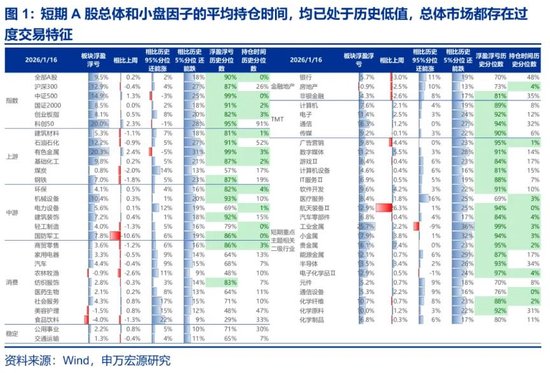
Group 1 - The 2026 market opening shows a clear characteristic of increased risk appetite driven by inflow of incremental funds, with commercial aerospace and AI application industries trending upwards [1][16] - The current market is experiencing strong momentum and excessive trading, which may lead to a short-term consolidation phase [1][16] - The average holding period for defense and military stocks is significantly lower than historical lows, indicating a decrease in stability for short-term momentum trades [1][19] Group 2 - The opening market is viewed as an extension of the strong structural technology market from 2025, which is now entering a high valuation adjustment phase [2][17] - Since September 2025, several high-momentum industries have entered a high-level consolidation phase, with notable examples including Nvidia's computing chain and Google's computing chain [2][17] - The market is expected to shift towards a consolidation phase after rapid valuation increases in new technology directions [2][17] Group 3 - The policy direction emphasizes a stable and long-term approach to avoid past investment pitfalls, such as the "deposit migration" of 2007 and the excessive trading of 2015 [10][26] - The A-share market has a mid-term upward basis, suggesting that a stable approach can balance short-term volatility with long-term goals [10][26] - The current market dynamics indicate a potential reduction in overall profit effects, with a need to wait for further economic and policy catalysts [10][28] Group 4 - The mid-term outlook for the A-share market suggests two phases of upward movement, with the first phase being driven by strong structural technology trends and the second phase potentially benefiting from cyclical improvements and increased asset allocation towards equities [12][28] - The characteristics of the two upward phases are interconnected, with the first phase led by cyclical alpha and AI computing, while the second phase may see a transition towards application-level AI trends [12][28]