家电

Search documents
广东新春第一会时间定了,聚焦这个主题
2 1 Shi Ji Jing Ji Bao Dao· 2026-02-23 23:13
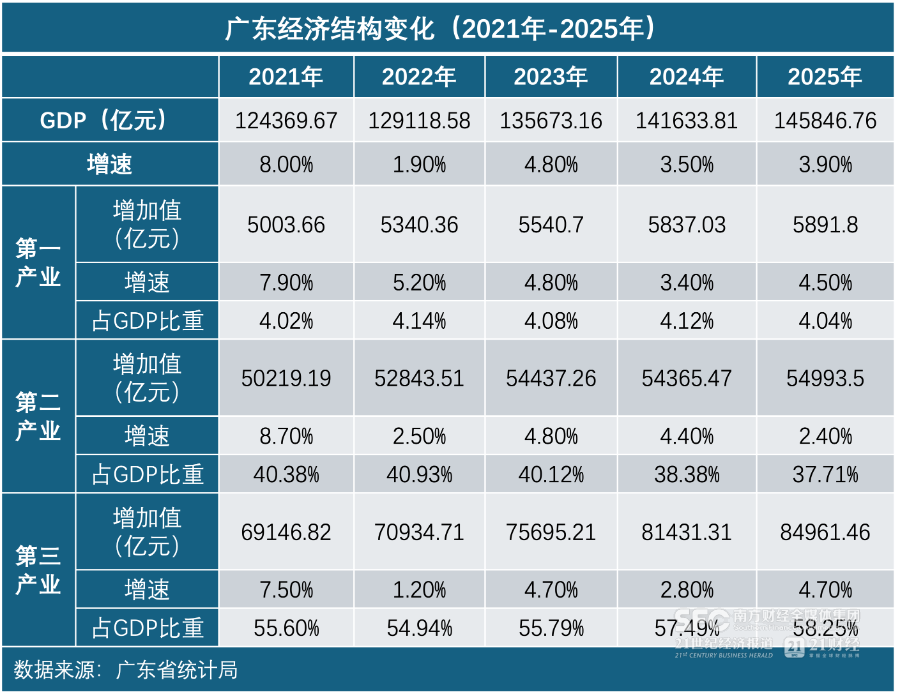
Core Viewpoint - Guangdong is focusing on high-quality development, emphasizing the integration of manufacturing and service industries as a key strategy for economic growth in 2026 [1][9]. Group 1: Economic Development and Structure - Guangdong's GDP is projected to reach 14.58 trillion yuan in 2025, maintaining its position as the largest economy in China for 37 consecutive years, accounting for over 10% of the national GDP [4]. - The contribution of the tertiary industry to Guangdong's GDP is increasing, with its share rising from 55.60% in 2021 to an expected 58.25% in 2025 [10]. - In 2025, the value added of the service industry is expected to grow by 4.7%, outpacing the GDP growth rate by 0.8 percentage points [10]. Group 2: Manufacturing Sector Insights - Guangdong's industrial enterprises' revenue increased from 14.9 trillion yuan to over 19 trillion yuan from 2021 to 2025, leading the nation [5]. - Traditional industries, including automotive, petrochemicals, and textiles, account for over 70% of the manufacturing value added, demonstrating resilience and growth potential [6]. - High-tech manufacturing's share of industrial value added is expected to rise from 29.9% in 2021 to 34.7% by 2025, with industrial robot production reaching 43.5% of the national total [6]. Group 3: Integration of Manufacturing and Services - The 2026 Guangdong High-Quality Development Conference will focus on the collaborative development of manufacturing and service industries, marking a significant shift in strategy [1][9]. - The integration of advanced manufacturing and modern services is seen as crucial, driven by external factors such as global supply chain restructuring and internal demands for high-end, intelligent, and green manufacturing [9]. - The service sector's growth is supported by advancements in technology, with significant increases in revenue from information transmission, software, and IT services, including a 12.2% growth in internet-related services [10].

【新春看市场】智能家电成新潮年货
Zhong Guo Jing Ji Wang· 2026-02-23 22:17
Group 1 - The demand for upgraded refrigerators has significantly increased, particularly among younger consumers, leading to a rise in sales of smart refrigerators with advanced preservation capabilities [1] - The "Lego New Year" campaign launched by the Ministry of Commerce includes a series of policies aimed at stimulating consumer spending during the Spring Festival, including a trade-in program and financial support [2] - The trend towards AI-enabled home appliances is growing, with products that can interact and adapt to user needs becoming popular among consumers [3] Group 2 - The "Lego New Year" initiative includes three major components: a trade-in program with 625 billion yuan in subsidies, a prize invoice program with over 1 billion yuan in rewards, and financial support for various consumer sectors [2] - The trade-in policy is expected to promote the upgrade of consumer goods towards greener and smarter options, with future adjustments to include energy-efficient appliances and smart home products [2] - In January, the trade-in program benefited 16.13 million people, generating 92.56 billion yuan in sales across various categories, indicating a strong growth in offline retail and cross-sector consumption [3]

智能家电成新潮年货
Jing Ji Ri Bao· 2026-02-23 22:12
Core Insights - The demand for upgrading refrigerators has increased significantly, particularly among younger consumers, driven by the need for larger capacity and better preservation capabilities [1] - The "Lego New Year" initiative launched by the Ministry of Commerce aims to stimulate consumer spending through various policies, including trade-in programs and financial support [2] Group 1: Consumer Trends - Younger consumers, particularly those born in the 1990s and 2000s, are becoming the main force in purchasing new year goods, leading to a rise in demand for "burden-reducing" and "atmospheric" home appliances [1] - Smart home appliances that offer convenience and efficiency, such as washing machines and dishwashers, are gaining popularity as "new year goods" [1][3] Group 2: Policy Initiatives - The "Lego New Year" program includes three major components: a trade-in policy with 625 billion yuan in national subsidies, a prize invoice initiative with over 1 billion yuan in rewards, and financial support measures from banks and financial institutions [2] - The trade-in policy is expected to promote the upgrade of consumer goods towards greener and smarter options, with future adjustments to include subsidies for energy-efficient appliances [2] Group 3: Market Performance - In January, the trade-in program benefited 16.13 million people, generating sales of 92.56 billion yuan across automobiles, home appliances, and smart products, with a year-on-year growth of approximately 20% [3] - The trade-in initiative is not only boosting sales in the home appliance sector but also positively impacting other areas such as leisure, transportation, and dining, creating a multi-faceted consumption growth pattern [3]
“两业协同”开新局,一马当先向未来
Nan Fang Du Shi Bao· 2026-02-23 16:05
Core Viewpoint - Guangdong is focusing on the coordinated development of manufacturing and service industries as a strategy for high-quality economic growth, marking the beginning of a new phase in its development journey [1][2]. Group 1: Economic Strategy - The theme of the high-quality development conference emphasizes "coordinated development of manufacturing and service industries," aiming to set a clear direction for economic growth in 2024 and beyond [1]. - Guangdong has maintained its position as the top province in GDP for 37 consecutive years, showcasing a robust manufacturing base and a strong modern service sector [1]. - The province's manufacturing sector includes all 31 major categories and boasts 10 trillion-yuan-level industrial clusters, while the service sector has led the nation in added value for 41 years [1]. Group 2: Industry Transformation - The coordinated development of manufacturing and service industries is essential for upgrading the entire economic chain, with a focus on mutual enhancement rather than competition [2]. - Guangdong's manufacturing is transitioning towards smart, high-end, and green production, with service industries playing a crucial role in this transformation through the use of information technology and financial services [2]. - The "14th Five-Year Plan" suggests enhancing the integration of modern services with advanced manufacturing and modern agriculture, emphasizing the digitalization of services [2]. Group 3: Market Dynamics - The synergy between manufacturing and service industries is expected to enrich supply content, stimulate market demand, and promote consumption, ultimately benefiting the public [3]. - The "Guangdong Goods Go Global" initiative highlights the importance of service support, such as logistics and digital technology, in driving sales for local products [3]. - The coordinated development approach is not only about improving manufacturing efficiency but also about investing in human resources to enhance overall quality of life [3].
小字营销再现,大厂自卑拉满?
Sou Hu Cai Jing· 2026-02-23 15:44
Core Viewpoint - The article discusses the issue of "small print marketing," highlighting how companies mislead consumers through deceptive advertising practices, particularly in the context of gift boxes during the Spring Festival [3][5]. Group 1: Misleading Marketing Practices - A specific example involves a "nut gift box" that claims to weigh 958 grams, but only 33 grams are actual nuts, with the majority being drinks and snacks, raising concerns about consumer deception [3]. - The marketing strategy emphasizes "nuts" and "dried fruits" while downplaying the presence of drinks and snacks, which are only revealed in the detailed product description [3][5]. - This practice of "small print marketing" is not new and has been criticized in various industries, including electronics, where misleading claims are often made [5][7]. Group 2: Industry Implications - The prevalence of small print marketing reflects a lack of confidence among major brands, leading to a reliance on misleading tactics to avoid accountability [7][8]. - Such marketing strategies not only harm consumer trust but also diminish the overall brand value, as they prioritize short-term sales over genuine product quality [8]. - The article suggests that this trend has become an industry norm, allowing companies to engage in false marketing and exaggerate product benefits without facing repercussions [7][8].
消费金额同比增长17.1%,马年新春,南京人更舍得花钱了
Xin Lang Cai Jing· 2026-02-23 15:31
Core Insights - Nanjing has emerged as a popular tourist destination during the Spring Festival, with significant growth in consumer spending driven by cultural activities and promotional policies [1][6] Consumer Spending Trends - Total consumer spending in Nanjing during the holiday reached 33.0 billion yuan, marking an 11.1% year-on-year increase, with shopping malls and complexes seeing a 14.4% rise in sales [1] - The number of consumers increased by 25.1% compared to the previous year, indicating a strong recovery in consumer confidence [1] Retail and Dining Activities - Various shopping centers in Nanjing organized unique events, such as the "Dream Horse" mascot at Deji Plaza and the "Love at First Sight" campaign at Central Plaza, enhancing the festive atmosphere [2] - Major dining brands maintained operations throughout the holiday, offering special New Year's Eve meal packages and promoting services like live streaming and delivery to meet consumer demand [2] Cultural and Tourism Integration - The newly opened Jinling Changlefang combines cultural experiences with shopping, featuring over 200 brands, with more than 50% being new to Nanjing, attracting significant foot traffic [3] - The 40th Qinhuai Lantern Festival and other cultural events have drawn large crowds, contributing to increased tourism and spending in the area [4][6] International Visitor Engagement - Nanjing welcomed approximately 76,000 inbound and outbound travelers during the Spring Festival, including over 5,000 foreign visitors, highlighting the city's appeal to international tourists [5] - The city's duty-free shops and tax refund stores provided a variety of local products, enhancing the shopping experience for foreign guests [5] Policy-Driven Consumption Boost - The local government implemented various consumption vouchers and subsidies, including up to 150 yuan off dining expenses and significant discounts for automotive purchases, stimulating consumer spending [7][8] - The "Lucky Invoice" campaign encouraged participation in retail and dining sectors, with over 519,000 participants and nearly 2.77 million invoices submitted [9] Stable Supply of Essential Goods - The supply of essential goods, including vegetables and meat, remained stable during the holiday, with a notable increase in vegetable arrivals compared to the previous year [10] - Wholesale prices for key food items showed a decline, indicating a stable market environment for consumers [10]
逛吃买不停!阳江春节 “人从众” 模式,消费市场“热力全开”
Sou Hu Cai Jing· 2026-02-23 14:29
Group 1 - The overall consumer market during the Spring Festival is thriving, with significant participation in promotional activities across major shopping districts, leading to a festive atmosphere and increased sales [1][2] - Total foot traffic during the Spring Festival period exceeded 250,000, representing a 20% increase compared to the previous year [2] - Specific shopping venues, such as Yingxin Plaza and Changda Chang Supermarket, reported daily foot traffic of over 4,000, with peak sales reaching over 6,000 transactions in a single day [2][4] Group 2 - The dining sector also experienced a surge, with some restaurants reporting a 30% increase in customer volume during the holiday, driven by attractive discount coupons [4] - In the home appliance sector, the "trade-in for new" policy has led to a 10% increase in sales compared to previous years, particularly among returning youth and expatriates, supported by a 15% national subsidy [4]
马年收红包!关注黑马集中营!
Sou Hu Cai Jing· 2026-02-23 14:01
Group 1 - The article highlights four major signals that are expected to support the market as it opens for the Year of the Horse, including continuous policy support, strong consumer recovery, clear industry trends, and favorable external market conditions [4][6][9] - Policy measures are focused on equipment upgrades, consumer goods exchange programs, and significant support for new infrastructure, digital economy, and renewable energy sectors, which are expected to boost economic recovery [4] - Consumer spending has shown remarkable resilience, with record box office revenues during the Spring Festival, a doubling in travel bookings, and a nearly 500% increase in duty-free shopping in Hainan, alongside over 20% growth in dining and accommodation transactions [4] Group 2 - The article notes that the global market has been performing well, with significant gains in indices such as the Hang Seng Index and the Nikkei 225, which rose over 4%, creating a positive environment for the A-share market [6][7] - Commodity markets have also seen increases, with LME copper up 4%, London silver up 3%, and Brent crude oil rising 2.3%, providing support for cyclical sectors [7] Group 3 - The investment strategy for the Year of the Horse emphasizes a cautious approach, focusing on structural opportunities rather than broad market gains, with a prediction of a stable opening and active sector performance [9][10] - Four main investment themes are identified: the AI industry chain, semiconductors and advanced manufacturing, consumer recovery sectors, and cyclical resources, with AI being the strongest focus due to its recent performance [10][11][12] - The article advises against high-risk strategies, recommending a focus on core stocks within the identified themes and careful monitoring of key indicators such as trading volume and foreign capital inflows [13][14]

开年有序接单 家电行业步入理性增长通道
Zheng Quan Ri Bao Wang· 2026-02-23 13:32
Group 1 - The home appliance industry is experiencing a stable recovery after the Spring Festival, characterized by year-end inventory clearance and orderly order-taking at the beginning of the year [1] - Major brands and offline channels are launching promotional activities such as holiday sales, bundled discounts, and trade-in offers to optimize inventory structure and accelerate capital turnover [1] - The overall production and sales of home appliances have entered a phase of mild recovery, with production enterprises flexibly adjusting output based on market demand, focusing on mainstream products like green energy-saving and smart appliances [1] Group 2 - The market structure is becoming more rational, with green energy-saving, smart health, and integrated home appliance sets gaining popularity, driving market transactions [2] - Companies are focusing on brand and product value, steadily advancing high-end and integrated product layouts while continuing to penetrate lower-tier markets [2] - The home appliance market's stable order-taking reflects a rational return of business and channel strategies, with expectations for further supply-side vitality and quality growth driven by inventory optimization and product upgrades [2]

产品创新+场景深耕 深市消费类上市公司发力春节消费市场
Zheng Quan Ri Bao Wang· 2026-02-23 10:59
Group 1 - The core viewpoint of the articles highlights the robust performance of consumer companies listed on the Shenzhen Stock Exchange during the 2026 Spring Festival, driven by product innovation, diverse marketing strategies, and global expansion efforts [1][6] - The consumer market experienced a significant boost, with a notable increase in sales of smart wearable devices by 130%, smart blood pressure monitors and blood glucose meters by over 60%, and organic food by 52% during the festival [2] - Companies like Sanquan Foods and Yanjing Beer leveraged product innovation and extensive advertising to enhance brand recognition and meet consumer demands for quality and health during the festive season [3][4] Group 2 - Sanquan Foods introduced a low-fat dumpling product with a calorie count of 350 kcal per package, aligning with health-conscious consumer trends [2] - Yanjing Beer emphasized multi-dimensional advertising strategies to strengthen brand influence and prepare for market expansion in the new year [3] - Home appliance companies such as Hisense and TCL capitalized on the "replace old with new" policy, launching innovative products and promotional campaigns to stimulate consumer demand for home appliances [4][5]