
免税

Search documents
中金2026年展望 | 旅游酒店及餐饮:服务连锁正当时,布局反转和高成长
中金点睛· 2025-12-17 23:54
Core Viewpoint - The service industry is showing signs of stabilization and bottoming out after experiencing price pressure and same-store sales decline in 2024, with expectations for recovery in 2026, particularly in sub-sectors like hotels and duty-free [2][17]. Group 1: Industry Trends - The service consumption ratio is increasing, supported by improved infrastructure for chain operations, leading to the emergence of more quality brands [4][21]. - The government has introduced multiple policies to promote service consumption, indicating a potential for stronger recovery in domestic demand [18][20]. - The hotel sector is expected to see a rebalancing of supply and demand in 2026, with RevPAR stabilizing due to a low base and slowing supply growth [4][31]. Group 2: Sub-sector Analysis - **Hotels**: The hotel industry faced pressure from weak business travel demand and continued supply expansion, but RevPAR showed signs of recovery in October 2025, driven by ADR increases [26][33]. - **Duty-Free**: Duty-free sales are stabilizing, with a focus on the potential of new policies to boost sales from departing travelers and local residents [45][49]. - **Dining**: The dining sector is experiencing a controlled competitive environment, with affordable brands performing relatively well amidst a recovering landscape [36][44]. Group 3: Investment Opportunities - Companies that can effectively meet consumer demands for value and emotional satisfaction, possess strong operational capabilities, and capture sustainable growth drivers are likely to succeed [4][29]. - The focus on high-quality brands and those with strong internal capabilities is expected to yield better performance in the coming years [4][21]. Group 4: Market Performance - In 2025, companies like Gu Ming and Mi Xue have shown significant stock performance, indicating a trend where companies with strong growth potential outperform their peers [7][12]. - The overall market for the service sector is expected to see a gradual recovery, with structural opportunities emerging in the hotel and duty-free segments [6][31].






社服与消费视角点评 11 月国内宏观数据:社零环比回落,文旅服务消费表现仍好
Bank of China Securities· 2025-12-17 08:12
Investment Rating - The industry investment rating is "Outperform the Market" [1][29] Core Insights - The overall consumption data for November 2025 shows stable performance, with service consumption remaining robust, providing growth momentum for the industry. There is a focus on expanding domestic demand [3] - The total retail sales of consumer goods in November reached 4.4 trillion yuan, with a year-on-year growth of 1.3%, but a month-on-month decline. Restaurant revenue was 605.7 billion yuan, with a year-on-year increase of 3.2% [1][3] - The service sector PMI for October was 49.5%, indicating a contraction below the critical point of 50% [1] Summary by Sections Domestic Macro Data - Retail sales in November 2025 totaled 4.39 trillion yuan, with a year-on-year increase of 1.3%, but a month-on-month decline of 1.6 percentage points, falling short of the Wind consensus expectation of 2.93%. The decline was influenced by the early "Double Eleven" sales activities and a reduction in national subsidies. Retail sales of goods grew by 1.0% year-on-year, while restaurant revenue increased by 3.2% [1][3] - Service consumption remains strong, with a year-on-year growth of 5.4% in service retail sales from January to November, marking a continuous recovery over three months. This growth rate is 1.3 percentage points higher than that of goods retail sales during the same period [1][3] - The unemployment rate in November remained stable at 5.1%, with a slight year-on-year increase of 0.1 percentage points. The average weekly working hours for employed persons was 48.6 hours [1][3] Investment Recommendations - The report suggests focusing on companies likely to benefit from the recovery in tourism and travel consumption, such as Lingnan Holdings and Tongcheng Travel. Other recommended companies include Tianmuhu, Lijiang Co., Songcheng Performance, China Youth Travel, Jinjiang Hotels, Junting Hotels, and ShouLai Hotels, which are expected to benefit from the recovery in business travel [3] - Local dining representatives like Tongqinglou and quality targets in the performance industry such as Fengshang Culture and Dafeng Industrial are also highlighted. Key players in the conference and exhibition sector include Miao Exhibition and Lansheng Co. [3]
中信证券:资本市场表现与黄金价格上行带来的财富效应为奢侈品、高端旅游及博彩等顺周期板块提供了需求支撑
Xin Lang Cai Jing· 2025-12-17 05:34
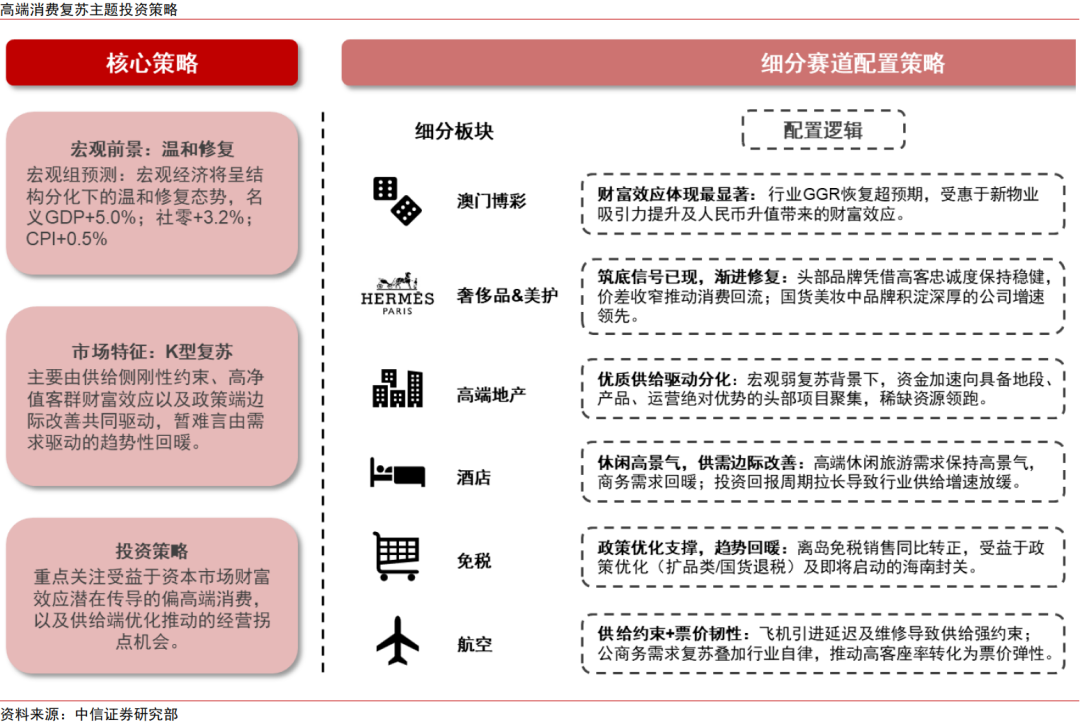
Core Viewpoint - The report from CITIC Securities indicates that the current Chinese consumer market exhibits a significant "K-shaped recovery" characteristic, with a clear divergence between the rebound in the consumption sector and the moderate recovery of mass consumption [1] Group 1: Market Dynamics - The divergence in the market is primarily driven by supply-side rigid constraints, the wealth effect from high-net-worth individuals, and marginal improvements in policy [1] - The aviation industry faces limitations in effective capacity growth due to delays in aircraft introduction and engine maintenance [1] Group 2: Sector Performance - High-end retail properties and luxury hotels are achieving leading recovery in foot traffic and revenue due to their scarce locations and brand barriers, despite pressure on demand [1] - The performance of the capital market and the rise in gold prices are providing demand support for cyclical sectors such as luxury goods, high-end tourism, and gaming [1] Group 3: Policy Impact - Industry self-regulatory agreements have effectively solidified the bottom line for airline ticket prices and yields [1] - The optimization of the offshore duty-free policy and the imminent closure of Hainan create potential incremental space for growth [1] Group 4: Investment Opportunities - The report suggests focusing on operational turning point opportunities driven by the transmission of wealth effects and supply-side optimization, particularly in high-end consumption sectors such as outbound tourism, hotels, gaming, duty-free, luxury goods, high-end beauty care, and premium real estate properties [1]

海南封关倒计时1天!哪些板块将直接受益?
Mei Ri Jing Ji Xin Wen· 2025-12-17 01:37
Core Viewpoint - Hainan Free Trade Port will officially start full island closure on December 18, enhancing convenience for personnel movement and expanding duty-free product categories, which may directly benefit the duty-free, hotel, and aviation sectors in the tourism industry [1] Group 1: Policy and Market Impact - The tourism industry is entering a dual benefit cycle of "policy dividends + demand release" with the upcoming New Year and the longest Spring Festival [1] - The new duty-free shopping policy in Hainan, effective from November 1, 2025, has shown significant results in Sanya, with duty-free sales reaching 1.63 billion yuan in the first month, a year-on-year increase of 24.3%, marking the highest monthly growth rate since 2025 [1] Group 2: Investment Opportunities - The tourism ETF (562510) tracks the CSI Tourism Theme Index, holding stocks like China Duty Free Group and Hainan Airport (600515), covering various sectors including scenic spots, airports, duty-free, and hotel catering [1] - The combination of Hainan's closure, the ice and snow economy, and the Spring Festival holiday is expected to create multiple catalysts for growth in the tourism sector [1]
中信证券:消费市场体现“K型复苏”特征 关注财富效应传导、供给端优化推动的经营拐点机会
Zhi Tong Cai Jing· 2025-12-17 01:04
Core Viewpoint - The report from CITIC Securities indicates that certain high-end consumer sectors in China, including luxury goods, high-end beauty, air travel, and high-end residential markets in core cities, have generally outperformed previous market expectations, reflecting a significant "K-shaped recovery" in the consumer market [1] High-End Consumer Sectors - The luxury goods and high-end beauty market in China showed signs of stabilization in Q3 2025, entering a gradual recovery phase, with top brands like Hermès maintaining steady sales due to high customer loyalty [6] - The Macau gaming sector demonstrated a notable recovery, with gross gaming revenue (GGR) in November increasing by 14.4% year-on-year to 21.09 billion MOP, recovering to 92% of the levels seen in the same month of 2019 [4] - The high-end retail properties and luxury hotels have achieved a leading recovery in foot traffic and revenue due to their scarcity and brand barriers, despite overall demand pressures [1][4] Policy and Market Dynamics - Policy improvements, such as the optimization of the offshore duty-free policy and the upcoming closure of Hainan, are expected to create potential incremental space for growth in the luxury sector [1] - The report emphasizes the importance of wealth effect transmission and supply-side optimization in driving operational turning points, particularly in high-end consumption areas like outbound tourism, hotels, gaming, and luxury goods [1][15] Real Estate Market - The high-end real estate market is characterized by a "K-shaped recovery" driven by quality supply, with capital and purchasing power increasingly concentrating on top projects with absolute advantages in location, product, brand, and operation [9] - The overall recovery in the real estate market remains slow, with a complex macro environment and high unemployment rates impacting consumer confidence [7] Hotel Industry - The mid-to-high-end hotel sector saw an average RevPAR increase of approximately 4% year-on-year in October-November 2025, benefiting from strong leisure tourism and a slight recovery in business demand [11] - The supply growth in the hotel industry is expected to slow down from 7%-8% in 2025 to 5%-6% in 2026 due to extended investment return cycles [11] Duty-Free Market - The offshore duty-free sales in Hainan showed signs of recovery, with sales turning positive in September and expanding in October-November, supported by wealth effect transmission and policy optimization [12] - The upcoming full closure of Hainan in December 2025 is anticipated to further enhance the overall development of the tourism retail market [12] Aviation Sector - The aviation industry faces supply constraints due to delays in aircraft introductions and engine repairs, which limit effective capacity growth [14] - Demand recovery and structural optimization are expected to accelerate, with airlines optimizing route structures to enhance profitability [14]
社服行业 2026 年度投资策略:星垂平野阔,潮生万象新
Changjiang Securities· 2025-12-16 14:55
Industry Overview - The service consumption sector in China has significant growth potential, with the current GDP per capita exceeding $13,000, indicating a shift from goods to service consumption as the economy matures [4][7][24] - The proportion of development-oriented and enjoyment-oriented service consumption in China is relatively low, particularly in cultural, leisure, and health sectors, suggesting substantial room for improvement [4][7][24] - Recent government policies at both central and local levels have been introduced to support service consumption, focusing on the needs of the elderly and Generation Z, which are expected to drive growth in health, tourism, and new consumption sectors [4][7][24] Tourism and Travel - The domestic tourism market is projected to grow significantly, with 4.998 billion trips expected in the first three quarters of 2025, reflecting an 18% year-on-year increase [8][46] - The government has implemented various supportive policies to enhance tourism, including the issuance of travel vouchers and promotional activities to stimulate demand [8][58] - The tourism industry is undergoing consolidation, with companies optimizing resources and enhancing operational efficiency to drive high-quality development [8][58] Local Lifestyle - The restaurant industry is expected to see steady growth, although there is significant market differentiation, with high-end dining facing challenges while mass dining remains robust [10][10] - The tea beverage sector is experiencing growth driven by delivery services, with leading brands expanding their store presence despite potential challenges from subsidy reductions [10][10] - Meituan is facing increased competition in the delivery market, with a focus on improving operational efficiency and service quality to enhance long-term value [10][10] Education and Employment - The education sector is gradually recovering, with leading institutions expected to gain market share due to their brand strength and resource capabilities [11][11] - The human resources sector is seeing structural demand recovery, with AI technology providing opportunities for cost reduction and efficiency improvements [11][11] Summary of Investment Opportunities - Investment opportunities are concentrated in sectors that combine valuation safety margins with growth logic, particularly in health, tourism, and new consumption areas driven by demographic changes [4][7][24]


12月港股消费观察:1-2月流动性改善后港股消费买什么?
2025-12-16 03:26
12 月港股消费观察:1-2 月流动性改善后港股消费买什么? 20251215 摘要 服务零售额逆势增长,2025 年累计同比增长 5.4%,超过出口和投资增 速,成为提高居民消费率的关键。服务消费受房地产市场波动影响小, 且不存在消费透支问题,政府可通过构建消费场景有效拉动。 茅台通过控价措施稳定批发价,预计 2026 年批价至少维持在 1,500 元 左右,供给侧显著改善。大众占比提升可弥补部分商务缺失,经销商有 维护批价动力,食品饮料板块或已见底,建议积极布局。 李宁公司处于经营周期底部,营销和产品推新动作频繁,重新获得中国 奥委会合作权益,多条产品线将在 2026 年推出新品。经销商渠道库存 处于低位,实控人持续增持,建议在底部布局。 服装和鞋类制造业订单自 2025 年二季度以来逐步恢复,三季度增速加 快,美国服装零售及批发的库销比处于近三年低位。预计 2025 年三季 度是制造业订单低谷,四季度开始下游将陆续补库。 2026 年鞋服代工龙头企业利润率有望修复,推荐高股息率的龙头公司, 如申洲国际、精苑国际和九星控股。港股新标的乐舒适在非洲卫生用品 市场占据领先地位,收入和净利润复合增长率显著。 Q ...
消费供需四象限策略剖析
2025-12-16 03:26
Summary of Conference Call Records Industry Overview - The conference call discusses the **domestic consumption market** in China, focusing on the **"2035 Income Doubling Plan"** aimed at increasing per capita GDP to over $20,000 by enhancing new productivity and achieving common prosperity through sectors like the semiconductor industry and healthcare systems [5][1]. Key Points and Arguments - **Wealth Effect and Consumer Recovery**: The recovery of consumption in the coming year is heavily reliant on the wealth effect, particularly among high-net-worth individuals. However, the purchasing power of the general public is constrained by salary structures and leverage capabilities, necessitating government intervention [1][6]. - **Challenges in the Consumption Market**: The current consumption market faces challenges such as: - **Salary Structure**: Companies are cutting costs and laying off employees to improve profit margins, which hampers salary growth for the middle class [3]. - **Leverage Issues**: Wealth concentration among the affluent increases, while the middle class struggles with mortgage pressures and slow income growth, limiting their borrowing capacity for consumption [3][8]. - **High-End Consumption Recovery**: The high-end consumption market is gradually recovering, with notable performance in high-end hotels, luxury cruises, and the gaming industry, indicating a positive trend in high-end consumer spending [3][22]. Important Insights - **CPI and Transfer Payments**: In 2026, key factors to watch include CPI expectations, transfer payments, and the wealth effect, particularly in high-end consumption sectors like medical aesthetics, which may benefit from stock market performance [9][6]. - **Tax Policy Impact**: Shifting from value-added tax to consumption tax could encourage local governments to stimulate consumption, supporting long-term economic goals despite short-term pressures on consumers [10][11]. - **Global Trade and Domestic Demand**: The uncertain global trade environment has highlighted the importance of domestic demand as a strategy to ensure stable GDP growth, especially in light of poor export data and weakening overseas PMIs [12]. Sector-Specific Developments - **Pet Food Sector**: The pet food sector has shown strong performance, with a three-year compound growth rate reaching two times, although profit margins remain low. The sector is driven by significant marketing efforts on platforms like Douyin and Tmall [14]. - **Hotel Industry**: The chain hotel industry is moving towards a more favorable investment phase, with average prices rising due to the recovery of high-end consumption post-pandemic [15]. - **Duty-Free Industry**: The duty-free sector is expected to improve as foreign cosmetic brands show growth, indicating a recovery in high-end consumption [16]. - **Medical Aesthetics**: The medical aesthetics sector is experiencing a K-shaped recovery, with high-end consumers opting for premium services while lower-tier markets seek affordable options [21]. Future Investment Opportunities - **Timing for Investment**: The best time to invest in the consumption sector will be from the lunar new year until early March 2026, coinciding with high policy expectations and increased consumer spending during holiday periods [23]. - **Emerging Sectors**: Other sectors to watch include luxury cruises, sports events, elder care, and high-quality gaming, all of which show significant long-term growth potential [18][19]. Conclusion - The conference call highlights the complexities of the domestic consumption market in China, emphasizing the need for strategic government policies to address current challenges and stimulate recovery. The focus on high-end consumption and emerging sectors presents potential investment opportunities for the future.
消费供需四象限策略剖析 (1)
2025-12-16 03:26
Summary of Conference Call Records Industry Overview - The focus is on the **domestic consumption market** in China, particularly in the context of the "2035 Income Doubling Plan" aimed at increasing per capita GDP to over $20,000 by enhancing new productivity and achieving common prosperity [1][5]. Key Points and Arguments Consumption Recovery - The recovery of consumption in the coming year is heavily reliant on the **wealth effect**, with high-net-worth individuals showing increased willingness to spend. However, the purchasing power of the general public is constrained by salary structures and leverage capabilities [1][6]. - The disparity between high-net-worth individuals and the general consumer is widening, with the middle class facing pressures from mortgage debts and stagnant wages, necessitating policy interventions to improve leverage capabilities [1][7][8]. Economic Policies and Projections - The **CPI expectations**, transfer payments, and policies like mortgage interest subsidies are critical for achieving a positive cycle of wages, consumption, and employment in 2026 [1][6][9]. - Transitioning from value-added tax to consumption tax could encourage local governments to support consumption stimulus, which may initially pressure consumers but ultimately aid local economic development [1][10][11]. Challenges in the Consumption Market - The current challenges include issues with salary structures and leverage capabilities, as companies are cutting costs and laying off employees to improve profit margins, which hampers wage growth for the middle class [1][3]. - The importance of domestic demand is emphasized due to increasing uncertainties in global trade, particularly in light of poor export data and weakening overseas PMIs [1][3][12]. Sector-Specific Insights - The **high-end consumption market** is gradually recovering, with notable performance in high-end hotels, luxury cruises, and the gambling industry, indicating a trend towards high-end consumer recovery [1][3][22]. - The **pet food sector** has shown strong performance, with a three-year compound growth rate reaching two times, although high valuations are driven more by market speculation than by actual company performance [1][14]. - The **medical beauty industry** is experiencing a K-shaped differentiation, where high spenders opt for premium services while others seek lower-priced options, indicating a need for investors to choose wisely between high-end and budget segments [1][21]. Future Investment Opportunities - The best time to invest in the consumption sector is projected to be from the lunar new year until March, coinciding with high policy expectations and numerous holidays that will boost consumer spending [1][23]. - The **duty-free industry** is expected to improve as foreign cosmetic brands show recovery, indicating a potential for continuous improvement in this sector [1][16]. Additional Important Insights - The **global trade situation** significantly impacts domestic GDP and demand, with a shift towards strengthening internal demand as a strategy to mitigate external trade risks [1][12]. - The **performance of high-end shopping malls** has increased due to data indicating a recovery in high-end consumption, prompting brands to enter the market [1][20]. This summary encapsulates the critical insights from the conference call, highlighting the current state and future outlook of the domestic consumption market in China, along with sector-specific trends and investment opportunities.
如何看2025年11月消费数据
2025-12-16 03:26
Summary of Key Points from Conference Call Records Industry Overview Retail Industry - In November 2025, the total retail sales of consumer goods grew at a rate of approximately 1%, indicating a slowdown in growth momentum. Restaurant revenue increased by 3.2% year-on-year but showed a month-on-month decline, reflecting weakened overall consumption market dynamics [1][3] - Online retail sales of physical goods accounted for 26% of total retail sales, but the growth rate has declined compared to previous periods. Offline retail, particularly convenience stores and supermarkets, remains relatively robust, while department stores and specialty shops show lower growth rates, indicating an imbalance in the development of online and offline retail formats [1][3] - Essential consumer goods like grain and oil maintain steady growth, while discretionary items such as cosmetics and gold jewelry perform well due to promotions and rising gold prices. However, home appliances are experiencing a year-on-year decline due to policy impacts and demand exhaustion, highlighting consumption differences across categories [1][3] Automotive Industry - The total retail sales of automobiles in November 2025 amounted to 445.4 billion yuan, down 8.3% year-on-year. Despite this, passenger car sales and export volumes continue to grow, with a penetration rate of new energy vehicles remaining high, indicating structural changes in the automotive market and potential for export growth [1][7] - The expected continuation of trade-in subsidies may release pent-up demand, with companies like Geely and Great Wall Motors being highlighted as potential investment opportunities. BYD is noted for its strong overseas market prospects, while XPeng Motors is recommended for its leading smart driving technology [1][7] Duty-Free Industry - The duty-free industry showed steady growth in the first ten months of 2025, with the fourth quarter benefiting from high-value items like gold jewelry and mobile phones. It is expected that Hainan's offshore duty-free sales will maintain positive growth at least until the third quarter of next year, reflecting the growth potential of duty-free consumption [1][6] - Companies to watch include China Duty Free Group, ShouLai JinJiang, Huazhu, and Atour, along with restaurant chains like Haidilao and Baosheng China, which are noted for their strong management capabilities and new brand incubation strategies [1][6] Food and Beverage Industry - The food and beverage sector experienced relatively flat demand in November 2025, with retail sales of tobacco and alcohol declining by 3.4% year-on-year. The overall demand is in a slow recovery phase, influenced by seasonal factors and the timing of the upcoming Spring Festival [1][11] Home Appliance Industry - The home appliance sector faced significant sales declines due to the impact of national subsidy policies, with retail sales down 19.4% year-on-year. However, there is an expectation that these policies may continue into next year, suggesting a focus on resilient demand in white goods and two-wheeler markets, as well as overseas market opportunities [1][2][14] Alcohol Industry - The liquor industry is currently in a phase of active destocking, with high-end brands like Moutai experiencing price corrections that support demand. The upcoming Spring Festival is expected to see marginal improvements in sales, with recommendations to gradually allocate investments in the liquor sector, particularly in high-end brands [1][12] Textile and Apparel Industry - In November 2025, online sales of clothing and textiles grew by 3.5% year-on-year, although there was a month-on-month decline. The overall performance is expected to improve in the fourth quarter, aiding inventory reduction and setting the stage for a favorable market in the following year [1][9] Investment Recommendations - Focus on companies with strong growth potential in the beauty and personal care sector, such as MaoGaoPing and Shangmei, and in the gold jewelry sector, prioritize firms with strong product design and foundational support [1][4] - In the automotive sector, consider companies like Geely and Great Wall Motors, as well as BYD for overseas expansion opportunities [1][7] - For the duty-free sector, keep an eye on leading companies like China Duty Free Group and ShouLai JinJiang, as well as promising restaurant chains [1][6]