
煤炭开采和洗选业

Search documents
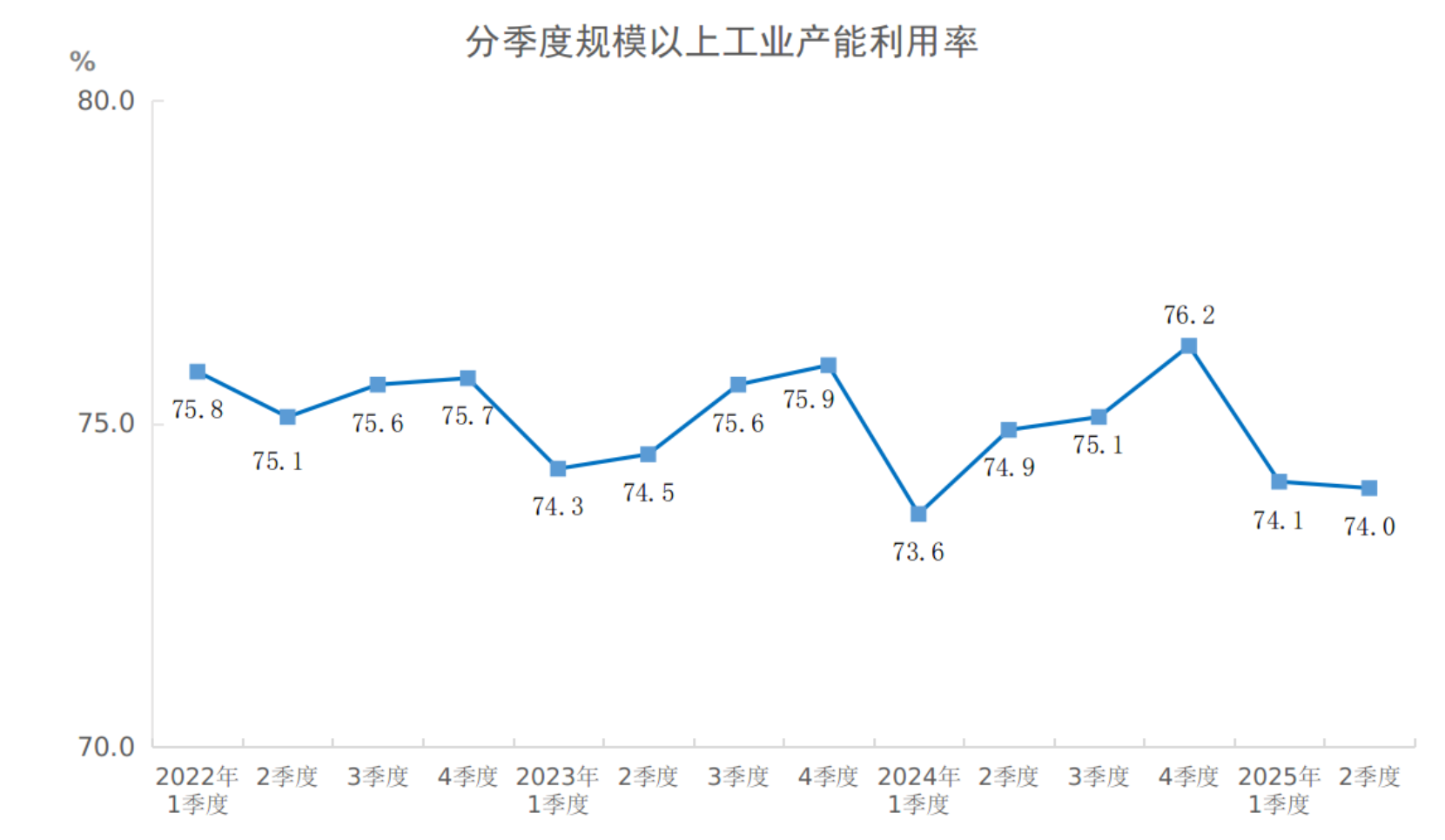
2025年二季度全国规模以上工业产能利用率为74.0%
Guo Jia Tong Ji Ju· 2025-07-15 02:00
Group 1 - The industrial capacity utilization rate for Q2 2025 is reported at 74.0%, showing a decrease of 0.9 percentage points compared to the same period last year [4] - The mining industry capacity utilization rate stands at 72.7%, down by 3.3 percentage points year-on-year [4] - The manufacturing sector's capacity utilization rate is 74.3%, reflecting a decline of 0.9 percentage points from the previous year [4] Group 2 - The electricity, heat, gas, and water production and supply industry has a capacity utilization rate of 71.5%, which is an increase of 0.1 percentage points compared to last year [4] - In the coal mining and washing industry, the capacity utilization rate is 69.3%, down by 3.5 percentage points year-on-year [4] - The petroleum and natural gas extraction industry shows a high capacity utilization rate of 90.9%, with a slight decrease of 0.9 percentage points from the previous year [4] Group 3 - The food manufacturing industry has a capacity utilization rate of 69.1%, which is an increase of 0.3 percentage points compared to last year [4] - The textile industry reports a capacity utilization rate of 77.8%, down by 1.3 percentage points year-on-year [4] - The chemical raw materials and chemical products manufacturing industry has a capacity utilization rate of 71.9%, reflecting a decrease of 4.5 percentage points from the previous year [4] Group 4 - The black metal smelting and rolling processing industry has a capacity utilization rate of 80.8%, which is an increase of 1.1 percentage points compared to last year [4] - The non-metallic mineral products industry shows a capacity utilization rate of 62.3%, down by 1.9 percentage points year-on-year [4] - The automotive manufacturing industry reports a capacity utilization rate of 71.3%, reflecting a decrease of 1.7 percentage points from the previous year [4] Group 5 - The electrical machinery and equipment manufacturing industry has a capacity utilization rate of 73.5%, down by 1.2 percentage points compared to last year [5] - The computer, communication, and other electronic equipment manufacturing industry shows a capacity utilization rate of 77.3%, which is an increase of 1.1 percentage points year-on-year [5] - The overall survey covers approximately 110,000 industrial enterprises, including both large and medium-sized enterprises [6]

整体物价低位运行与结构性涨价同在
2 1 Shi Ji Jing Ji Bao Dao· 2025-07-09 22:42
Economic Overview - In June, the Consumer Price Index (CPI) increased by 0.1% year-on-year, marking a shift from negative to positive growth, with food prices showing a reduced decline and non-food prices slightly rising [1] - The Producer Price Index (PPI) fell by 3.6% year-on-year, with a widening decline, indicating that living material prices performed better than production material prices [1] - The average CPI for the first half of the year was -0.1%, while the average PPI was -2.9%, reflecting a low overall price level in the domestic market [1] External Factors - International commodity prices have decreased, creating downward pressure on domestic prices, particularly affecting industries related to oil and gas, with oil and gas extraction prices down by 12.6% year-on-year and fuel prices down by 10.4% [1] - The rise of anti-globalization sentiments and "reciprocal tariffs" from the U.S. has led to increased trade barriers, impacting China's export industries and potentially leading to further price declines in related sectors [2] Internal Factors - The acceleration of energy structure transformation and the increase in green energy have contributed to lower energy prices, with coal mining and washing prices dropping by 21.8% year-on-year due to reduced demand for thermal power [2] - Intense market competition in certain industries, particularly in manufacturing, has led to price suppression, with many companies engaging in price wars due to product homogeneity [3] Structural Price Changes - Policies aimed at reducing "involution competition" have helped alleviate overcapacity in certain sectors, leading to a narrowing of price declines in industries such as automotive manufacturing and lithium battery production [3] - Consumption-boosting policies have positively impacted certain consumer goods sectors, resulting in price increases for items like arts and crafts, sports goods, and smart consumer products [4] - High-tech industries related to smart manufacturing and digital economy are experiencing rapid growth, with product prices showing a year-on-year increase, indicating a promising future for economic transformation [5]
专家解读:6月份CPI同比由降转涨 下半年货币政策仍有空间
Sou Hu Cai Jing· 2025-07-09 08:25
Group 1 - The Consumer Price Index (CPI) turned positive in June, increasing by 0.1% year-on-year after four consecutive months of decline, primarily driven by a recovery in industrial consumer goods prices [1][2] - The core CPI, excluding food and energy, rose by 0.7% year-on-year, indicating a gradual recovery in consumer demand [1][3] - The Producer Price Index (PPI) decreased by 0.4% month-on-month, with a year-on-year decline of 3.6%, reflecting a broader trend of price reductions in various industrial sectors [1][4] Group 2 - The decrease in PPI is attributed to seasonal price declines in raw materials, increased green energy production leading to lower energy prices, and downward pressure on prices in export-oriented industries due to a slowing global trade environment [4][5] - The cumulative CPI for the first half of the year was -0.1%, indicating weak domestic price levels and insufficient consumer demand, which provides ample policy space for further monetary easing and fiscal stimulus [3][5] - The decline in industrial prices is exacerbated by overcapacity in several sectors, prompting discussions on capacity reduction as part of a new round of supply-side reforms [5]
重磅公布:由降转涨!
中国基金报· 2025-07-09 05:59
Group 1: CPI Analysis - In June 2025, the Consumer Price Index (CPI) increased by 0.1% year-on-year, marking a shift from a decline that lasted for four consecutive months [3][9] - The rise in CPI was primarily influenced by the recovery in industrial consumer goods prices, with the year-on-year decline narrowing from 1.0% to 0.5% [3][4] - Core CPI, excluding food and energy, rose by 0.7% year-on-year, the highest increase in nearly 14 months [3][4] Group 2: PPI Analysis - The Producer Price Index (PPI) decreased by 0.4% month-on-month, with the decline remaining consistent with the previous month [6][7] - The year-on-year decline in PPI expanded by 0.3 percentage points, influenced by seasonal price decreases in raw material manufacturing and pressures in export-oriented industries [6][7] - Some industries showed signs of price stabilization and recovery, particularly in sectors benefiting from domestic market improvements and consumption policies [7][6] Group 3: Price Changes by Category - Food prices decreased by 0.3% year-on-year, with notable declines in pork prices by 8.5% and egg prices by 7.7% [9][17] - Non-food prices increased by 0.1% year-on-year, with service prices rising by 0.5% [9][10] - Among various categories, prices for durable goods and entertainment-related items showed increases, reflecting ongoing consumer demand [7][12]

黑色建材日报:市场稍显谨慎,黑色震荡偏弱-20250708
Hua Tai Qi Huo· 2025-07-08 09:22
1. Report Industry Investment Rating No relevant content provided. 2. Core Views of the Report - The market is somewhat cautious, and the black - related products are oscillating weakly. Steel prices are affected by factors such as the off - season consumption, production changes, and market sentiment. Iron ore prices are influenced by global shipments and iron - water production. Double - coking products are in a state of multi - empty game, and power coal prices are affected by supply, demand, and market sentiment [1][3][6][8] 3. Summary by Related Categories Steel - **Market Analysis**: Yesterday, the futures prices of rebar and hot - rolled coils were 3061 yuan/ton and 3191 yuan/ton respectively. The national urban inventory of building materials was 375.07 million tons, a 1.29% month - on - month increase, and the hot - rolled coil inventory was 174.22 million tons, a 1.87% month - on - month increase. The national building materials transaction volume was 96,000 tons. Building materials are in the off - season, with a slight increase in production and low inventory. Plate production has a slight month - on - month increase, and the current export remains high. The market lacks speculative demand, and the weak off - season demand will suppress steel prices [1] - **Strategy**: Unilateral trading is expected to be oscillating, while there are no strategies for inter - period, inter - variety, spot - futures, and options trading [2] Iron Ore - **Market Analysis**: Yesterday, the futures price of iron ore weakened slightly, with the main 2509 contract closing at 731 yuan/ton, a 0.68% decline. The prices of mainstream imported iron ore varieties at Tangshan Port remained stable. The global iron ore shipments decreased significantly this period, with a total of 29.95 million tons. The daily transaction volume of national main ports decreased by 8.14% month - on - month, and the forward spot transaction volume decreased by 13.13% month - on - month. In the short term, the iron ore price has rebounded, and the basis discount has been significantly repaired. In the long term, the supply - demand pattern is relatively loose [3] - **Strategy**: Unilateral trading is expected to be oscillating, while there are no strategies for inter - period, inter - variety, spot - futures, and options trading [4] Double - Coking Products - **Market Analysis**: Yesterday, the futures of double - coking products oscillated. The spot market of port coke was stable, and the domestic market sentiment improved. The inventory of the two ports increased slightly. The price of coking coal in the main production areas oscillated weakly. The expectation of domestic coal mine resumption is increasing, and the supply is expected to increase. The iron - water production of steel mills is at a high level but shows a downward trend. The supply - demand of coking coal has improved slightly. The profit of coke enterprises is not good, but the downstream steel demand has improved. In the short term, the supply - demand of coke has improved slightly, and in the long term, it is still in a relatively loose pattern [6] - **Strategy**: Both coking coal and coke are expected to oscillate in unilateral trading, while there are no strategies for inter - period, inter - variety, spot - futures, and options trading [7] Steam Coal - **Market Analysis**: The price of steam coal in the main production areas oscillated weakly. The procurement of chemical and platform large customers is stable, and some coal mines have balanced production and sales. The supply has basically recovered at the beginning of the month, and the market sentiment has cooled down. The upstream shipping cost at the port has increased, and there is a structural shortage of goods. The downstream rigid demand procurement has been completed in stages, and the coal consumption is expected to increase with the expansion of high - temperature areas. The high - calorie Australian coal has a price inversion with the domestic winning bid price, and the low - calorie Indonesian coal has obvious cost - performance advantages [8] - **Strategy**: No strategy is provided [8]
破内卷困局,离不开扩内需支撑
China Post Securities· 2025-07-08 02:57
Group 1: Economic Policy and Trends - The central government is reinforcing "anti-involution" policies to address low nominal economic growth and persistent negative PPI, focusing on eliminating low-price competition and overcapacity[1] - The manufacturing sector's capacity utilization rate was 74.10% at the end of Q1 2025, significantly below the historical average of 7.1% since 2018[16] - The PPI growth rate for coal mining and washing, general equipment, specialized equipment, automotive, and pharmaceuticals is at historically low levels, indicating potential "involution" issues in these sectors[17] Group 2: Industry Impact and Investment Opportunities - Key industries identified for "anti-involution" measures include coal mining, chemical raw materials, non-metallic minerals, and automotive manufacturing, which are expected to undergo significant policy scrutiny[17] - Recent price recovery in coal, rebar, and polysilicon suggests that the market has priced in expectations of "anti-involution" policies, presenting potential investment opportunities if policies align with market expectations[28] - If "anti-involution" policies fall short, there is a risk of price corrections in these industries, necessitating caution for investors[28] Group 3: Risks and Economic Challenges - The report highlights external uncertainties, including global trade tensions and geopolitical conflicts, which could exacerbate economic challenges[4] - The need for coordinated demand expansion policies alongside supply-side reforms is emphasized to mitigate potential structural pain in industrial production and employment[27] - The real estate sector is undergoing significant adjustments, impacting overall investment momentum and economic growth prospects[27]
★2025年5月份工业生产者出厂价格同比下降3.3%
Guo Jia Tong Ji Ju· 2025-07-03 01:56
Core Insights - In May 2025, the national industrial producer's ex-factory prices decreased by 3.3% year-on-year and 0.4% month-on-month, while the purchasing prices fell by 3.6% year-on-year and 0.6% month-on-month [1][3] Industrial Producer Price Year-on-Year Changes - In May, the ex-factory prices of production materials dropped by 4.0%, contributing approximately 2.98 percentage points to the overall decline in ex-factory prices. The mining industry saw a significant price drop of 11.9%, while raw materials and processing industries experienced declines of 5.4% and 2.8%, respectively. Consumer goods prices fell by 1.4%, with food prices also down by 1.4% [1][3] - The purchasing prices for fuel and power decreased by 9.8%, black metal materials by 7.3%, and chemical raw materials by 5.4%. Conversely, prices for non-ferrous metal materials and wires increased by 4.6% [1][2] Industrial Producer Price Month-on-Month Changes - In May, the ex-factory prices of production materials decreased by 0.6%, impacting the overall ex-factory price level by approximately 0.44 percentage points. The mining industry prices fell by 2.5%, while raw materials and processing prices decreased by 0.9% and 0.3%, respectively. Consumer goods prices remained stable [1][3] - The purchasing prices for fuel and power fell by 2.1%, chemical raw materials by 1.2%, and black metal materials by 0.6%. Prices for agricultural products remained unchanged [2][3] Key Industry Price Changes - The coal mining and washing industry saw a price drop of 3% year-on-year, while the oil and gas extraction industry experienced a decline of 5.6%. The black metal mining industry prices decreased by 0.9%, whereas the non-ferrous metal mining industry prices increased by 0.8% [3][4] - In the food manufacturing sector, prices fell by 0.3% year-on-year, while the beverage and refined tea manufacturing industry saw a slight increase of 0.1% [4]
前5月规上工业利润总额2.7万亿元,装备制造业增7.2%
2 1 Shi Ji Jing Ji Bao Dao· 2025-06-27 03:59
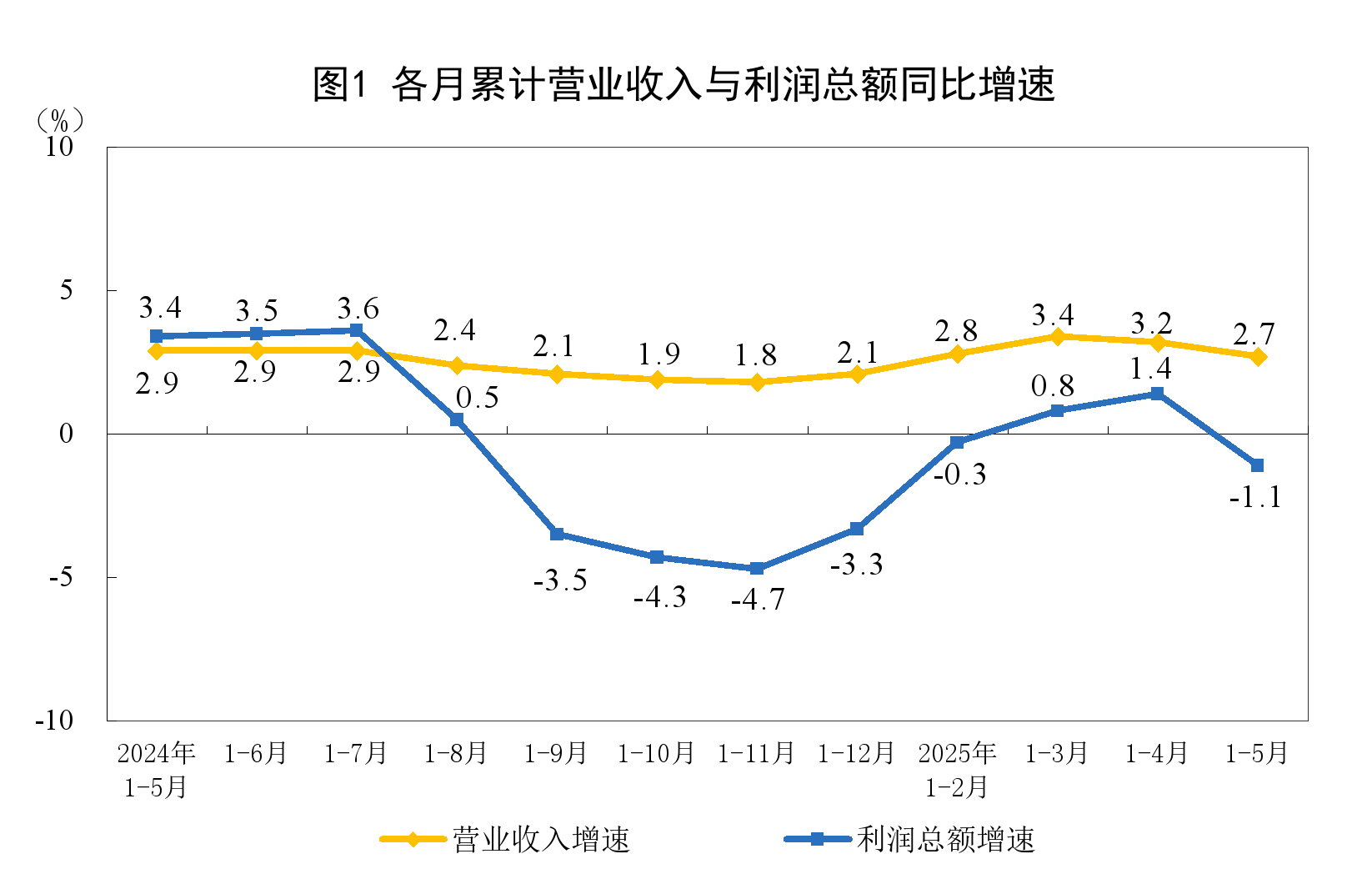
Core Insights - In the first five months of the year, profits of large-scale industrial enterprises increased by 603.4 billion yuan compared to the previous four months, but saw a year-on-year decline of 1.1% due to insufficient effective demand, falling industrial product prices, and short-term fluctuations [1][3] - The cumulative profit of large-scale industrial enterprises showed a recovery trend, with a year-on-year increase of 0.8% in January-March and 1.4% in April [3] - The overall revenue of large-scale industrial enterprises reached 54.76 trillion yuan, a year-on-year increase of 2.7%, while operating costs rose by 3% to 46.88 trillion yuan, resulting in a profit margin of 4.97%, down by 0.19 percentage points year-on-year [4] Profit Composition - The profit composition indicates that investment income and other short-term factors from the previous year had a high base, which dragged down the profit growth rate by 1.7 percentage points [1] - The gross profit of large-scale industrial enterprises increased by 1.1% year-on-year, contributing to a 3 percentage point increase in overall profits [4] Sector Performance - In terms of sector performance, the mining industry saw a profit decline of 29% to 358.04 billion yuan, while the manufacturing sector's profits increased by 5.4% to 20,201.4 billion yuan, and the electricity, heat, gas, and water production and supply sector grew by 3.7% to 3,422.5 billion yuan [3][5] - Notably, the agricultural and food processing industry experienced a profit increase of 38.2%, while the automotive manufacturing sector faced a significant decline of 11.9% [5] Equipment Manufacturing - The equipment manufacturing sector demonstrated strong performance, with profits increasing by 7.2%, contributing 2.4 percentage points to the overall profit growth of large-scale industries [5] - Among the eight industries within equipment manufacturing, seven reported profit growth, with electronics, electrical machinery, and general equipment showing double-digit growth rates [5] High-Quality Development - The aerospace, aviation, and maritime industries experienced a remarkable profit increase of 56% due to rapid development in the "three aviation" sectors [6] - Policies promoting equipment upgrades and consumer goods replacement have positively impacted profits in related sectors, with significant growth in smart consumer devices and kitchen appliances [6] Future Outlook - The focus for the next phase will be on implementing proactive macro policies to strengthen domestic circulation, enhance innovation, and promote high-quality industrial development, laying a solid foundation for the recovery of industrial enterprise profits [6]
二手房价环比跌幅扩大,新房销售承压
Hua Lian Qi Huo· 2025-06-22 14:08
Report Industry Investment Rating No relevant information provided. Core Viewpoints of the Report - In May, the month - on - month decline in second - hand housing prices in all tiers of cities widened, while the year - on - year decline continued to narrow. New housing prices in first - and second - tier cities turned down month - on - month [6]. - The year - on - year decline in the sales price of newly built commercial residential buildings in first - tier cities was 1.7%, narrowing by 0.4 percentage points from the previous month. The prices in second - and third - tier cities decreased by 3.5% and 4.9% year - on - year respectively, with the decline narrowing by 0.4 and 0.5 percentage points [6]. - The year - on - year decline in the sales price of second - hand residential buildings in first - tier cities was 2.7%, narrowing by 0.5 percentage points. The prices in second - and third - tier cities decreased by 6.1% and 6.9% year - on - year respectively, with the decline narrowing [6]. - In May, the added value of industrial enterprises above designated size increased by 5.8% year - on - year and 0.61% month - on - month. From January to May, it increased by 6.3% year - on - year [6]. - In May, the total retail sales of consumer goods were 4,132.6 billion yuan, a year - on - year increase of 6.4%. From January to May, the total retail sales of consumer goods were 20,317.1 billion yuan, a year - on - year increase of 5.0% [7]. - From January to May 2025, the national fixed - asset investment (excluding rural households) was 19,194.7 billion yuan, a year - on - year increase of 3.7% [7]. - From January to May 2025, the national real estate development investment was 3,623.4 billion yuan, a year - on - year decrease of 10.7% [7]. Summary by Relevant Catalogs National Economic Accounting - The GDP quarterly year - on - year growth rates from 2022 Q4 to 2025 Q1 were 3%, 4.7%, 6.5%, 5%, 5.3%, 5.3%, 4.7%, 4.6%, 5.4%, 5.4% respectively [9]. - The contributions of different industries to GDP growth and their year - on - year growth rates in different quarters from 2022 to 2025 are presented in the figures [9][15]. Industry Industrial Growth Rate - The year - on - year growth rates of the added value of major industries in May 2025 are as follows: coal mining and washing increased by 5.5%, oil and gas extraction increased by 5.3%, and the automobile manufacturing industry increased by 11.6% [6]. Major Output of Industrial Enterprises above Designated Size - The output of major industrial products such as crude oil, coal, and steel from May 2024 to May 2025 is presented in the figure [26]. Industry Electricity Consumption - The year - on - year growth rates of electricity consumption in major industries from December 2023 to April 2025 are presented in the figure [34]. Industrial Enterprise Profits - From January to April 2025, the total profits of industrial enterprises above designated size were 2,117.02 billion yuan, a year - on - year increase of 1.4% [37]. - The profits of different industries showed different trends. For example, the profit of the non - ferrous metal smelting and rolling processing industry increased by 24.5%, while the profit of the coal mining and washing industry decreased by 48.9% [37]. Industrial Enterprise Inventory - As of the end of April 2025, the finished - product inventory of industrial enterprises above designated size was 6.61 trillion yuan, a year - on - year increase of 3.9%, and the inventory growth rate decreased slightly [48]. Price Index CPI - In May 2025, the national consumer price index (CPI) decreased by 0.1% year - on - year. Food prices decreased by 0.4%, and non - food prices remained flat [53]. PPI - In May 2025, the national industrial producer price index (PPI) decreased by 3.3% year - on - year and 0.4% month - on - month. The industrial producer purchase price index decreased by 3.6% year - on - year and 0.6% month - on - month [60].
今年前5月辽宁规模以上工业增加值同比实际增长3.4%
Zheng Quan Shi Bao Wang· 2025-06-19 13:04
Economic Growth - Liaoning Province's industrial added value increased by 3.4% year-on-year from January to May 2023 [1] - Mining industry added value grew by 13.2%, manufacturing by 1.6%, and electricity, heat, gas, and water production and supply by 4.4% [1] Industry Performance - Among 40 major industries, 27 reported year-on-year growth, resulting in a growth rate of 67.5% [1] - Notable growth sectors include railway, shipbuilding, aerospace, and other transportation equipment manufacturing at 37.3%, and electrical machinery and equipment manufacturing at 12.9% [1] - Chemical raw materials and products manufacturing saw a decline of 5.0%, while automotive manufacturing decreased by 0.7% [1] Product Output - Out of 68 key products, 64 were produced, with 25 showing year-on-year growth, a growth rate of 39.1% [2] - Significant increases were seen in transformers (110.0% growth) and primary plastic forms (7.6% growth), while aluminum production fell sharply by 68.5% [2] Investment Trends - Fixed asset investment in Liaoning Province grew by 0.1% year-on-year, with first industry investment up by 16.3% and second industry investment by 1.7% [2] - Infrastructure investment increased by 1.5%, while manufacturing investment rose by 12.8% [2] - The number of construction projects decreased by 9.3%, with a total of 8,593 projects [2] Consumer Market - Social retail sales in Liaoning reached 419.1 billion yuan, a year-on-year increase of 6.4% [3] - Retail categories with significant growth included home appliances (91.2%) and furniture (77.0%), while petroleum products saw a decline of 1.9% [3] Trade Performance - Total import and export value for Liaoning was 304.8 billion yuan, a decrease of 1.8% year-on-year [3] - Exports increased by 12.1% to 161.55 billion yuan, while imports fell by 13.9% to 143.25 billion yuan [3]