新消费

Search documents
摩根资产管理《2025年中全球市场展望》正式发布!
Sou Hu Cai Jing· 2025-08-07 05:07
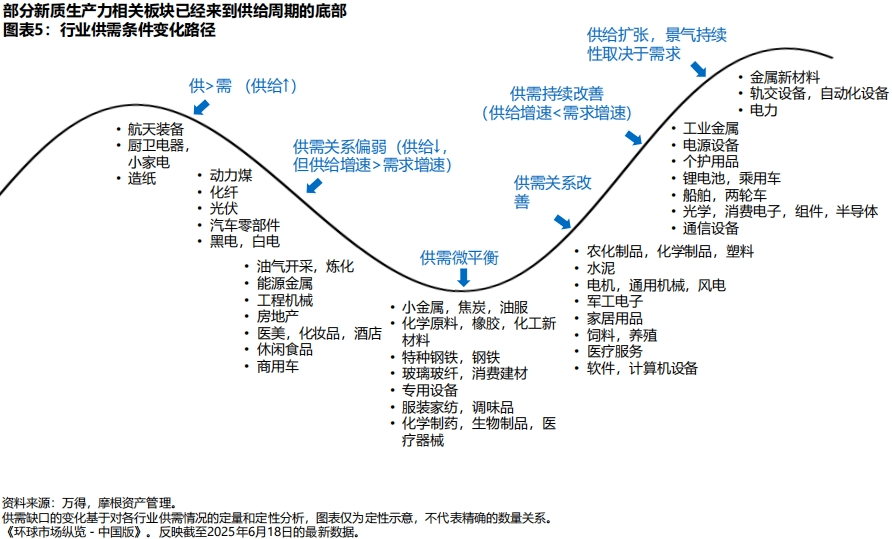
Global Market Outlook - Morgan Asset Management's report highlights significant uncertainty in the global economy and financial markets due to U.S. trade, fiscal policies, and geopolitical risks, suggesting investors should build resilient portfolios with global asset allocation to diversify returns and reduce volatility [1] China Equity Market - The report anticipates a structural slowdown in China's economic growth in the second half of the year due to weak confidence in households and businesses, ongoing real estate sector challenges, and deflationary pressures [2] - A "barbell strategy" combining growth and defensive sectors is expected to become mainstream, with potential opportunities in sectors related to new productivity, AI, new consumption, and innovative pharmaceuticals [2][4] Overseas Stocks - The U.S. economic outlook is influenced by tariff reductions, tax policies, and the Federal Reserve's interest rate decisions, with concerns about stagflation and declining consumer and business confidence [5] - European stocks are viewed favorably due to attractive valuations, reduced inflation pressures, and planned increases in defense spending and infrastructure investments, leading to a potential shift of investments back to Europe from U.S. markets [5] Asian Markets - Asian economies are experiencing reduced currency appreciation pressures, allowing central banks more room to lower interest rates to support growth, with Japan's stock market showing positive performance due to corporate transformation [6] Overseas Bonds - The report emphasizes focusing on non-U.S. bond markets, as central banks in mature markets and Asia may lower rates more aggressively than the Federal Reserve, presenting additional opportunities for bond investors [8] Alternative Assets - In uncertain environments, investors are encouraged to consider alternative assets such as infrastructure, real estate, and transportation, which historically have lower correlation with traditional stocks and bonds, providing predictable cash income and reducing portfolio volatility [10] Summary - The global economy faces downward risks and increased volatility, but a combination of fiscal and monetary policies may help mitigate risks outside the U.S. Investors are advised to diversify across regions and asset classes to enhance portfolio resilience against market shocks [13]

搭乘KKV驶向全球,中国新消费品牌开启大航海时代
Sou Hu Cai Jing· 2025-08-06 22:28
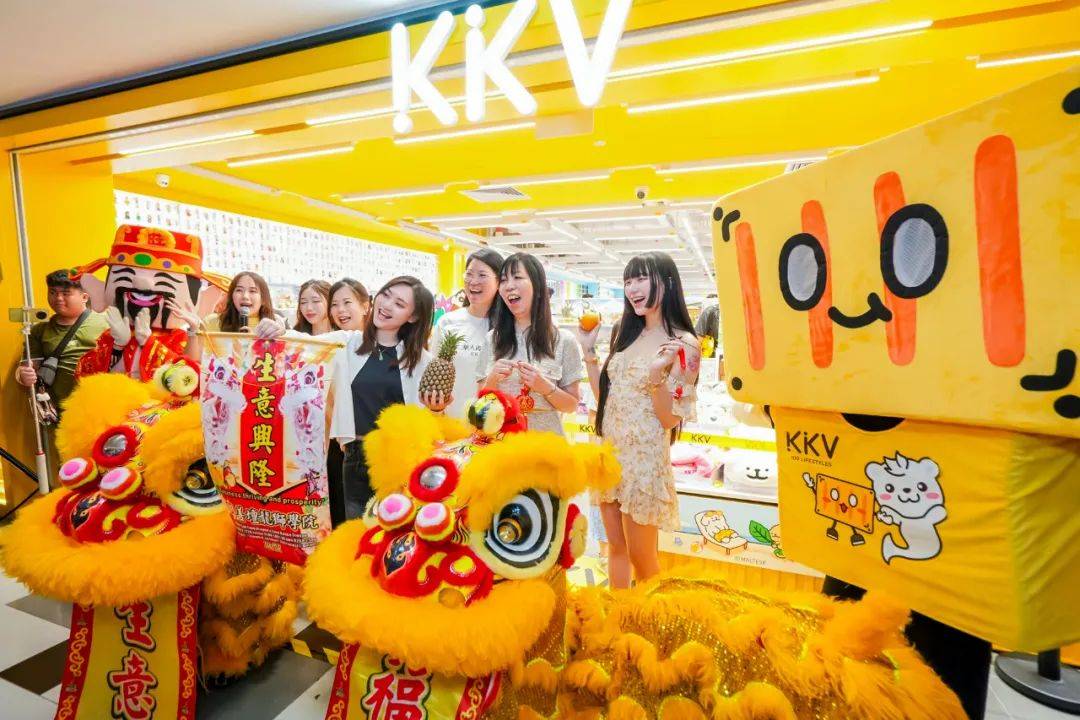
Core Insights - Southeast Asia is emerging as a high-certainty area for new consumption, with growth rates projected at 4.5% to 4.7% for ASEAN countries compared to a global average of 3.2% [2] - Chinese brands are capitalizing on this consumption upgrade trend, establishing a strong presence in Southeast Asia through various sectors, including tea, toys, and electronics [2][5] - The rise of Chinese brands in Southeast Asia reflects a broader trend of globalization and the adaptation of brands to local markets [2][6] Group 1 - Chinese tea brand Mixue Ice City has become particularly popular in Southeast Asia, with over a thousand stores in Vietnam and significant market penetration in Indonesia [6][8] - The toy brand Labubu has sparked a "Chinese toy craze" in Southeast Asia, significantly boosting sales and tourism in Thailand and Vietnam [8][10] - KKV, a new consumption brand, has opened over 50 stores in Southeast Asia, collaborating with numerous Chinese brands to enhance market presence [10][11] Group 2 - The initial strategy for Chinese brands entering Southeast Asia focused on rapid market penetration, exemplified by Mixue Ice City's aggressive store openings [13] - The second phase involves capturing consumer mindshare, as the Southeast Asian market is still in its early stages of market education [13] - Challenges for brands include regulatory hurdles and the need for localized operations, which can complicate market entry [16][17] Group 3 - KKV has facilitated market entry for various brands by handling import regulations and reducing costs associated with entering local markets [19][20] - The collaborative approach among Chinese brands has proven effective, allowing them to leverage shared resources and market knowledge [21][22] - The success of KKV's model in Southeast Asia may serve as a blueprint for future expansions into other regions, including the Middle East and Europe [38][42]
泡泡玛特、上美领涨!新消费股再度起飞:昙花一现还是蓄力冲关?
Sou Hu Cai Jing· 2025-08-06 15:10
Core Viewpoint - The new consumption sector in the Hong Kong stock market has shown significant growth, with several companies reporting positive earnings forecasts, contributing to the overall bullish trend in this segment [3][4][6]. Group 1: Stock Performance - Pop Mart (09992.HK) rose by 7.87%, while Shangmei Co. (02145.HK) increased by 7.34%, and Laopu Gold (06181.HK) saw a rise of 5.93% [1][2]. - The New Consumption Concept Index has recorded a year-to-date increase of 64.97%, outperforming the Hang Seng Index, which has risen by 24.18% [3]. Group 2: Earnings Forecasts - Shangmei Co. expects revenue for the first half of 2025 to be between 4.09 billion to 4.11 billion yuan, a year-on-year growth of 16.8% to 17.3%, with net profit projected to reach 540 million to 560 million yuan, an increase of 30.9% to 35.8% [3]. - Laopu Gold anticipates revenue of 12 billion to 12.5 billion yuan for the first half of 2025, representing a year-on-year growth of 241% to 255%, with net profit expected to be between 2.23 billion to 2.28 billion yuan, a growth of 279% to 288% [4]. - Pop Mart forecasts a revenue increase of no less than 200% and a profit increase of no less than 350% for the first half of 2025 [5]. Group 3: Market Trends and Sentiment - Investment firms are optimistic about the new consumption sector, noting a shift towards personalized and service-oriented consumption among residents [6]. - The Hong Kong consumption sector is seen as more aligned with current new consumption trends compared to the A-share market, indicating significant growth potential [6]. - Despite the current high valuations in the new consumption sector, the macro trend towards personalized and rational consumption remains intact, suggesting continued growth in related areas such as trendy toys, beauty care, and pet products [7][8].


太赚钱啦!
Datayes· 2025-08-06 11:06
Core Viewpoint - The article discusses the current bullish market in China, highlighting the significant increase in margin trading balances and the structural bull market driven by liquidity and market confidence [4][6]. Group 1: Market Overview - As of August 5, 2023, the margin trading balance in the Shanghai and Shenzhen markets reached 1.994 trillion yuan, with expectations to surpass 2 trillion yuan soon, marking a significant recovery since April [4]. - The article emphasizes a "structural bull market," where growth stocks are outperforming value stocks due to a shift in market dynamics and investor sentiment [6]. Group 2: Investment Strategies - Investors are encouraged to either follow market trends or wait for opportunities in undervalued stocks with cleared chip structures, rather than passively holding index funds [6]. - The article identifies sectors with potential for growth, such as new consumption represented by Pop Mart and the AI computing industry, particularly in optical modules and PCBs, as well as innovative pharmaceuticals [6]. Group 3: Fund Management Insights - Ping An Fund's recent announcement regarding redemption fee discounts for specific bond funds has sparked controversy, as it primarily benefits institutional investors while excluding most retail investors [7][9]. - The fund's A-share holdings are heavily concentrated, with 99.63% held by institutional investors, raising concerns about liquidity risks in case of large redemptions [9][10]. Group 4: Sector Performance - The article notes that the A-share market saw collective gains across major indices, with significant trading volumes and numerous stocks hitting their daily limits [12]. - The robotics sector is highlighted as a strong performer, driven by multiple catalysts and favorable news, including product launches and government initiatives [12][13]. Group 5: Industry Trends - The global platinum market is experiencing a price surge due to rapid inventory depletion, with prices rising 45% year-to-date [17]. - The express delivery industry is undergoing a price increase, with new minimum pricing regulations implemented in Guangdong province [18].


美国PMI再引动荡,军工、机器人引领大A新高!
格隆汇APP· 2025-08-06 10:22
Core Viewpoint - The article highlights the resilience of the Chinese stock market (A-shares) despite external pressures from disappointing U.S. economic data, with significant gains in sectors like military and robotics [2][3]. Group 1: Market Performance - Following the release of disappointing U.S. non-farm payroll data and ISM PMI data, U.S. stock markets experienced a downturn, while A-shares opened lower but rallied to close higher, with the Shanghai Composite Index surpassing 3,600 points, marking a new high since early 2022 [2]. - The military and robotics sectors saw substantial gains, with various stocks experiencing significant price increases [3]. Group 2: Sector Analysis - The military sector is currently the strongest performer, driven by upcoming events and new five-year planning requirements that highlight military applications of AI and drones, leading to a broad rally in this sector [3]. - The robotics sector is also gaining momentum, supported by new consumer incentives such as subsidies for purchasing robotic products and the launch of new products, indicating a potential new growth phase [3]. - Traditional sectors, particularly new consumption, are showing signs of stabilization after a prolonged adjustment period, with notable rebounds in leading stocks like Pop Mart [3]. Group 3: Market Outlook - The article expresses confidence in the ongoing bull market, suggesting that there are still opportunities to explore in various sectors post-earnings season, particularly in military and robotics [5]. - It emphasizes the importance of monitoring the performance of new consumption, anti-involution trends, and traditional industries for future investment strategies [5].

长城基金谭小兵:仍然看好创新药行情
Xin Lang Ji Jin· 2025-08-06 09:11
Group 1 - The domestic economy showed strong resilience in Q2, and the "anti-involution" policies continue to be implemented, leading to a steady rebound in A-shares in July [1] - In August, uncertainties from overseas tariffs and rising expectations for a Federal Reserve rate cut may impact the market, while domestic policies are expected to support the stabilization of the capital market [1] - The A-share mid-year reports are entering a concentrated disclosure period, increasing the importance of performance trading [1] Group 2 - Changcheng Fund's manager, Tan Xiaobing, believes that multiple factors will influence the market in August, including unclear US-China trade tensions and the important earnings window [1] - Tan Xiaobing is optimistic about sectors such as non-bank financials, military industry, and new consumption that has been consolidating for a while [1] - The innovative drug sector is also viewed positively, although due to significant gains in July and a lack of catalysts in August, this sector may experience fluctuations until key meetings and medical insurance negotiations in September [1]
港股收评:恒指涨0.03%科指涨0.2%!新消费回暖泡泡玛特涨超7%,中船防务涨7%,腾讯涨超1%,理想汽车跌超5%
Sou Hu Cai Jing· 2025-08-06 08:48
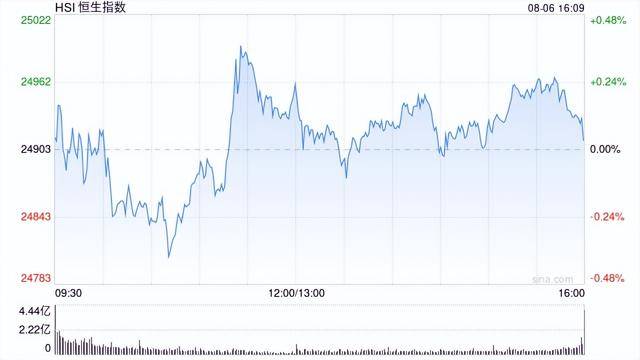
Group 1: Market Overview - The Hong Kong stock market showed mixed performance with the Hang Seng Index up by 0.03% closing at 24,910.63 points, while the Hang Seng Tech Index increased by 0.20% [2] - The Coal sector saw significant gains, with China Qinfa rising over 9%, driven by a 37% increase in coal prices since early July [1][2] - The military industry stocks surged, with China Shipbuilding Defense rising over 7%, supported by the initiation of the 14th Five-Year Plan and the approaching 2027 military goals [3][4] Group 2: Sector Performance - Semiconductor and chip stocks led the gains, with Jingmen Semiconductor increasing over 6%, reflecting optimistic growth projections for the global semiconductor market in 2025 [4][5] - New consumption concepts are showing signs of recovery, with Pop Mart rising over 7%, indicating potential for further growth in sectors like food additives and health products [5][6] - The coal price has rebounded to its highest level since the beginning of the year, with expectations of steady recovery in the second half of the year despite a projected decline in the coal price midpoint for 2025 [1]

国泰海通:港股新消费正处热度消化阶段 未来潮玩等悦己消费或延续亮眼表现
Zhi Tong Cai Jing· 2025-08-06 08:25
Group 1 - The current Hong Kong stock market new consumption sector is in a phase of heat digestion, following significant gains in the first half of the year [1][2] - Consumer preferences are shifting towards personalized and rational consumption, with trends such as "self-gratification" and "social consumption" leading the change [2][4] - Despite short-term overheating in some areas of new consumption, the macro trend towards personalized and value-for-money consumption remains unchanged, with continued growth expected in categories like trendy toys, beauty products, and pet-related items [1][4] Group 2 - Historical insights from Japan suggest that the transformation of consumer concepts may continue, with a shift from material to spiritual needs as income rises [3] - The Hong Kong stock market's new consumption sector has a more balanced industry distribution compared to the A-share market, which is dominated by traditional consumption sectors like liquor and home appliances [4] - The new consumption sector in Hong Kong is expected to attract public funds due to its scarcity and alignment with current consumption trends, with potential policy support to further enhance consumption [4]

港股新消费概念股回暖,泡泡玛特涨超8%
Mei Ri Jing Ji Xin Wen· 2025-08-06 07:43
(文章来源:每日经济新闻) 每经AI快讯,8月6日,港股新消费概念股回暖,泡泡玛特(09992.HK)涨超8%,老铺黄金(06181.HK)涨 近6%,蜜雪集团(02097.HK)涨超4%,毛戈平(01318.HK)涨3.8%。 ...
港股8月怎么投?四大赛道ETF受机构关注
Mei Ri Jing Ji Xin Wen· 2025-08-06 04:09
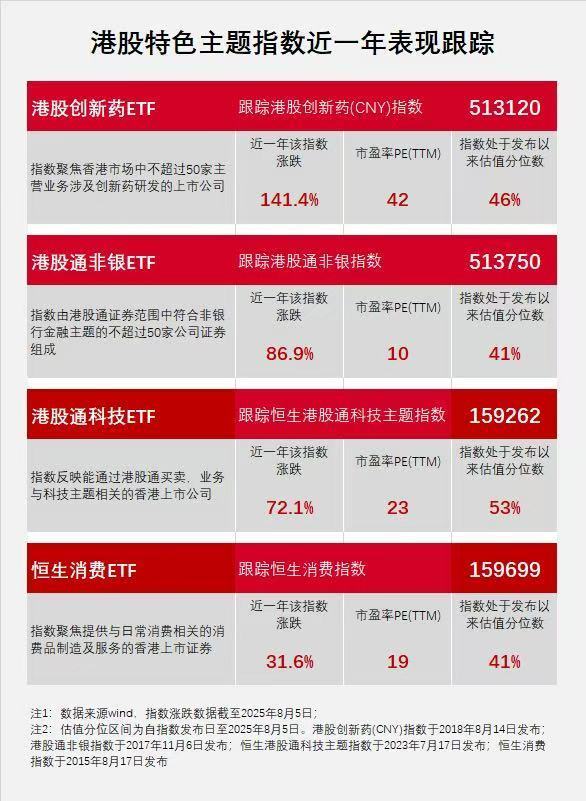
Core Viewpoint - The Hong Kong stock market has seen significant inflows and upward trends, with the Hang Seng Index and Hang Seng Tech Index both rising over 2.8% in July, driven by a combination of domestic and foreign investments [1] Group 1: Market Performance - In July, the Hong Kong Stock Connect saw an inflow of 125.2 billion RMB, an increase of over 70% compared to June, indicating a strong liquidity environment [1] - The Hang Seng Index and Hang Seng Tech Index both experienced substantial gains, with the Hang Seng Tech Index rising by 5.8% [1] Group 2: Investment Opportunities - According to Guosen Securities, Hong Kong stocks remain in a reasonable valuation range compared to A-shares, with a focus on sectors such as low-valuation internet and AI leaders, innovative pharmaceuticals, resources benefiting from "anti-involution," new consumption with strong fundamentals, and improving non-bank financial institutions [1] - Specific ETFs like the Hong Kong Stock Connect Tech ETF (159262), Innovative Pharma ETF (513120), Consumption ETF (159699), and Non-bank Financial ETF (513750) are highlighted as effective tools for investors to capture opportunities in these sectors [1] Group 3: ETF Performance - The Hong Kong Stock Connect Tech ETF (159262) has outperformed the Hang Seng Tech Index since its launch, rising over 13% compared to the index's 5.8% increase, with a TTM P/E ratio of 23.5, positioned at the 52nd percentile historically [2] - The Innovative Pharma ETF (513120) has seen a remarkable year-to-date return of over 102%, with a current size exceeding 16.5 billion RMB, making it the largest innovative pharma ETF in the market [2] - The Consumption ETF (159699) tracks the Hang Seng Consumption Index with a P/E ratio of 18.91, providing a balanced exposure to consumer trends, particularly among Generation Z [3] - The Non-bank Financial ETF (513750) has attracted significant investment, with a one-year return of 92.58% and a P/E ratio of approximately 10, indicating a strong valuation advantage [3] Group 4: Market Outlook - The combination of valuation recovery and ample liquidity in the Hong Kong market is expected to drive continued interest in technology, pharmaceuticals, new consumption, and non-bank financial sectors [4] - The ongoing "anti-involution" policies and rising global inflation expectations are likely to enhance the medium to long-term investment value of the technology and pharmaceutical sectors [4]