
电子

Search documents
AI的Memory时刻8:HBF在读为主应用优势显著
GF SECURITIES· 2026-02-26 14:33
Investment Rating - The report provides a "Buy" rating for the industry, indicating an expectation of stock performance exceeding the market by more than 10% over the next 12 months [38]. Core Insights - HBF is a high-bandwidth stacked storage medium based on 3D NAND technology, positioned between HBM and SSD, aimed at AI inference scenarios, offering higher capacity expansion, better energy efficiency, and lower total cost of ownership [3][10]. - HBF shows significant advantages in read-centric applications, with a single stack capable of providing up to 512GB of capacity, significantly reducing system unit cost compared to HBM. The first-generation HBF targets include a reading bandwidth of 1.6TB/s, approaching HBM levels while maintaining lower static power consumption [3][20]. - The commercialization process of HBF is accelerating, with partnerships and standardization efforts underway, including collaborations between Sandisk and SK Hynix, and plans to release HBF modules by late 2026 [3][26]. Summary by Sections HBF as a High-Bandwidth Stacked Storage Medium - HBF utilizes NAND flash memory in a stacked configuration, providing high bandwidth and large capacity storage solutions [10]. HBF's Advantages in Read-Centric Applications - HBF is designed for read-heavy applications, offering high capacity and efficiency, with a focus on reducing costs and improving performance in AI inference tasks [20][21]. Acceleration of HBF Commercialization - The report highlights the rapid progress in HBF commercialization, with major players like Sandisk and SK Hynix actively developing and promoting HBF technology [26][29]. Investment Recommendations - The report suggests focusing on key beneficiaries within the industry chain as AI memory continues to expand its capabilities and importance [32].





【债券日报】转债市场日度跟踪20260226-20260226
Huachuang Securities· 2026-02-26 14:14
1. Report Industry Investment Rating No information about the industry investment rating is provided in the document. 2. Core View of the Report - The convertible bond market experienced a volume - shrinking correction today, with valuations compressing on a month - on - month basis. The CSI Convertible Bond Index decreased by 1.03% month - on - month, and the trading sentiment in the convertible bond market weakened. The convertible bond price center declined, and the proportion of high - price bonds decreased. The valuation of convertible bonds was compressed, and most of the industry indices of underlying stocks declined [1][2]. 3. Summary According to Relevant Catalogs Market Main Index Performance - The CSI Convertible Bond Index closed at 525.93, down 1.03% day - on - day, - 0.53% in the past week, - 1.60% in the past month, and up 6.92% since the beginning of the year. The Shanghai Composite Index closed at 4146.63, down 0.01% day - on - day, up 0.31% in the past week, up 0.25% in the past month, and up 4.48% since the beginning of the year. The Shenzhen Component Index closed at 14503.79, up 0.19% day - on - day, up 1.55% in the past week, up 0.44% in the past month, and up 7.24% since the beginning of the year. Other major indices also showed different trends [7]. Market Capital Performance - The trading volume of the convertible bond market was 69.188 billion yuan, a month - on - month decrease of 7.81%. The total trading volume of the Wind All - A Index was 2556.639 billion yuan, a month - on - month increase of 3.05%. The net outflow of the main funds in the Shanghai and Shenzhen stock markets was 30.045 billion yuan, and the yield of the 10 - year Treasury bond increased by 1.30bp month - on - month to 1.83% [1][8]. Convertible Bond Price and Valuation - The weighted average closing price of convertible bonds was 143.90 yuan, a month - on - month decrease of 0.56%. The closing price of equity - biased convertible bonds was 218.78 yuan, a month - on - month decrease of 0.81%; the closing price of debt - biased convertible bonds was 121.74 yuan, a month - on - month decrease of 1.04%; the closing price of balanced convertible bonds was 134.76 yuan, a month - on - month decrease of 0.17%. The proportion of high - price bonds above 130 yuan was 78.17%, a month - on - month decrease of 4.27pct. The median price was 141.45 yuan, a month - on - month decrease of 1.01%. The fitted conversion premium rate of 100 - yuan par value was 39.86%, a month - on - month decrease of 1.43pct; the overall weighted par value was 108.96 yuan, a month - on - month increase of 0.41% [2]. Industry Performance - In the A - share market, the top three industries with the largest declines were real estate (- 2.25%), media (- 1.45%), and non - bank finance (- 1.42%); the top three industries with the largest increases were communication (+ 2.84%), electronics (+ 1.98%), and national defense and military industry (+ 1.52%). In the convertible bond market, 26 industries declined, and the top three industries with the largest declines were commerce and retail (- 2.55%), non - ferrous metals (- 2.44%), and media (- 2.37%); only two industries rose against the trend, namely communication (+ 4.48%) and power equipment (+ 2.21%) [3]. - In terms of different sectors: - Closing price: The large - cycle sector decreased by 1.31% month - on - month, the manufacturing sector decreased by 0.39% month - on - month, the technology sector increased by 0.22% month - on - month, the large - consumption sector decreased by 1.55% month - on - month, and the large - finance sector decreased by 0.82% month - on - month [3]. - Conversion premium rate: The large - cycle sector decreased by 1.8pct month - on - month, the manufacturing sector decreased by 2.0pct month - on - month, the technology sector decreased by 2.6pct month - on - month, the large - consumption sector decreased by 0.56pct month - on - month, and the large - finance sector decreased by 1.5pct month - on - month [3]. - Conversion value: The large - cycle sector increased by 0.11% month - on - month, the manufacturing sector increased by 1.40% month - on - month, the technology sector increased by 2.86% month - on - month, the large - consumption sector decreased by 0.72% month - on - month, and the large - finance sector decreased by 0.80% month - on - month [3]. - Pure - debt premium rate: The large - cycle sector decreased by 2.0pct month - on - month, the manufacturing sector decreased by 0.51pct month - on - month, the technology sector increased by 0.35pct month - on - month, the large - consumption sector decreased by 2.0pct month - on - month, and the large - finance sector decreased by 0.94pct month - on - month [4]. Industry Rotation - The communication, electronics, and national defense and military industry led the rise. For example, the communication industry had a daily increase of 2.84% in the underlying stocks and 4.48% in convertible bonds; the electronics industry had a daily increase of 1.98% in the underlying stocks and - 0.56% in convertible bonds; the national defense and military industry had a daily increase of 1.52% in the underlying stocks and - 0.84% in convertible bonds. The report also provided the weekly, monthly, and year - to - date increases, as well as the valuation quantiles of the underlying stocks [55].
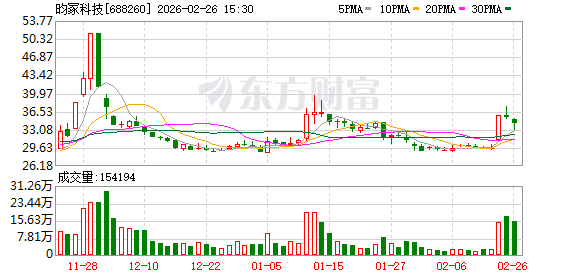
昀冢科技:公司持续推进MLCC重点产品的研发、生产
Zheng Quan Ri Bao· 2026-02-26 12:41
Group 1 - The core viewpoint of the article highlights that Yunzhong Technology is focusing on the development of its electronic ceramics business while continuing to strengthen its main consumer electronics operations [2] - The company is actively responding to market trends and industry changes, indicating a strategic approach to business development [2] - MLCC (Multi-Layer Ceramic Capacitor) is identified as a key long-term strategic direction for the company, with ongoing efforts in R&D and production of MLCC products [2] - The company aims to continuously enhance the craftsmanship and technical level of its related products [2]


北交所日报:温和上涨,关注金三银四和两会政策预期-20260226
Western Securities· 2026-02-26 12:08
Investment Rating - The report does not explicitly provide an investment rating for the industry, but it suggests a positive outlook based on structural opportunities and market conditions [3]. Core Insights - The North Exchange A-share market experienced a moderate increase, with a trading volume of 18.656 billion yuan on February 25, 2026, up by 2.277 billion yuan from the previous trading day. The North Exchange 50 Index closed at 1,547.201, rising by 0.77%, while the specialized index increased by 1.22% to 2,597.61 [1][8]. - A total of 294 companies were listed on the North Exchange, with 208 stocks rising, 6 remaining flat, and 80 declining. The top five gainers included Tonghui Information (10.3%), Anda Technology (8.2%), and Tianli Composite (6.3%), while the top five losers were Liancheng CNC (-7.1%) and Keli Co., Ltd. (-5.9%) [1][15][16]. - The report highlights structural characteristics within the North Exchange, aligning with the cyclical stock market trends, particularly in rare earths, phosphorus chemicals, and small metals [3]. Summary by Sections Market Review - On February 25, 2026, the North Exchange A-share trading volume reached 18.656 billion yuan, an increase of 2.277 billion yuan from the previous day. The North Exchange 50 Index rose by 0.77% to close at 1,547.201, with a PE_TTM of 65.09. The specialized index also saw a rise of 1.22% [1][8]. Important News - OpenAI's project faced funding issues, shifting its focus to managing internal data center resources rather than owning physical assets. Additionally, OpenAI is behind in custom chip development, with plans to start in 2025 [2][17]. - Murata Manufacturing, a major MLCC manufacturer, is considering raising prices for its passive components [2][18]. Key Company Announcements - Deere Chemical announced a projected revenue of 726 million yuan for 2025, a decrease of 7.21% year-on-year, with a net profit expected to drop by 33.54% [2][19]. - Hongzhi Technology expects a revenue of 47.228 million yuan for 2025, down 1.61% year-on-year, with a net profit decline of 16.96% [2][20][21].
龙虎榜 | 大族激光狂飙涨停,机构砸盘超3亿元!欢乐海岸现身雅化集团
Sou Hu Cai Jing· 2026-02-26 11:37
Market Overview - On February 26, the Shanghai Composite Index fell by 0.01%, while the Shenzhen Component Index rose by 0.19%, and the ChiNext Index decreased by 0.29% [1] - The total market turnover was 2.56 trillion yuan, with over 2800 stocks declining [1] - Sectors that performed well included CPO, PCB, liquid-cooled servers, cultivated diamonds, and sugar substitutes, while the film and television, real estate, and precious metals sectors saw declines [1] Individual Stock Performance - YN Energy Holdings achieved a six-day consecutive rise, Farsen had a four-day consecutive rise, and Chengxing Co. had a three-day consecutive rise [3] - Notable stocks with significant gains included: - Zhongke Environmental at 20.06% increase, trading at 7.78 yuan [4] - Yue'an New Materials at 20.01% increase, trading at 39.10 yuan [4] - Gaolan Co. at 20.01% increase, trading at 38.15 yuan [4] - Other stocks like Tongyu New Materials and Spring Intelligence Control also saw significant increases [4] Trading Insights - The top three net buying stocks on the Dragon and Tiger list were Huadian Co. with 14.13 billion yuan, Huasheng Tiancai with 4.25 billion yuan, and Gaolan Co. with 3.76 billion yuan [5] - The top three net selling stocks were Electric Science Blue Sky, Mingyang Electric, and Qingshuiyuan, with net sales of 1.94 billion yuan, 1.61 billion yuan, and 1.41 billion yuan respectively [5] Industry Trends - Nvidia reported a quarterly revenue of 68 billion USD, indicating a strong outlook for AI, which is expected to drive demand for high-performance PCBs [12][17] - Dongguan Securities noted that AI is pushing PCBs towards high-performance and high-density upgrades, increasing demand for high-value products [12] - Huadian Co. plans to invest 3.3 billion yuan in a new high-end PCB production project, expected to generate an additional 3.05 billion yuan in annual revenue [12] - Huasheng Tiancai is focusing on AI computing and applications, with a strategic push towards AI solutions [15] - Gaolan Co. is expanding its liquid-cooled server business, anticipating significant growth in net profit due to rising demand in North America [18] Key Trading Stocks - Huadian Co. saw a trading halt with a 10% increase, with a turnover of 115.58 billion yuan and a net buying of 7.37 billion yuan from deep stock connections [19] - Spring Intelligence Control also reached a trading halt with a 20% increase, with a net buying of 1.63 billion yuan [20] - Gaolan Co. achieved a trading halt with a 20% increase, with a net buying of 1.14 billion yuan [21]



风险月报 | 权益情绪明显回落,但预期仍保持平稳
中泰证券资管· 2026-02-26 11:32
Core Viewpoint - The overall market is experiencing a slight valuation adjustment, with a focus on the alignment between valuation and performance, as well as the effectiveness of policy implementation [2] Market Overview - The Zhongtai Asset Management risk system score for the CSI 300 index is 50.78, down from 60.35 last month, indicating a decline in market sentiment [2] - The CSI 300 valuation has slightly decreased to 61.74 from 65.54, remaining within a reasonable range over the past year [2] - Market expectations remain stable at 60.00, with macro analysts projecting a GDP growth target of around 4.5-5% for 2026 [2] Sector Analysis - Among 28 first-level industries, 12 sectors including chemicals, non-ferrous metals, electronics, and real estate have valuations above the historical 60th percentile, while sectors like agriculture, food and beverage, and non-bank financials are below the historical 10th percentile [2] Market Sentiment - Market sentiment has significantly declined to 35.21 from 55.33, indicating a shift from a "slightly positive" to a "neutral" zone [4] - Margin financing scores have dropped sharply, reflecting a decrease in leveraged fund activity [4] Investment Recommendations - Focus on the alignment of valuation and performance, particularly in light of upcoming annual reports from listed companies, emphasizing high certainty in earnings and stable cash flows [5] - The current market valuation increase is supported by economic recovery and policy support, suggesting a strategic approach within manageable risk levels [5] Economic Indicators - In January, the national consumer price index (CPI) rose by 0.2% year-on-year, indicating a gradual improvement in consumer demand [9] - The producer price index (PPI) decreased by 1.4% year-on-year, but the decline has narrowed, with a month-on-month increase of 0.4% [9] Financial Data - In January, the total social financing reached 7.22 trillion yuan, marking a historical high for the same period, with broad money (M2) growing by 9.0% year-on-year [10] - The central bank has maintained a "moderately loose" monetary policy, providing substantial support for the bond market [11] Bond Market Dynamics - The bond market has transitioned from a previous unilateral trend, with a focus on stable liquidity and long-term expectations [8] - The yield on 10-year government bonds has dropped below 1.8%, while the 30-year bonds are fluctuating around 2.20% [11]

浙商证券浙商早知道-20260226
ZHESHANG SECURITIES· 2026-02-26 11:25
Market Overview - On February 26, the Shanghai Composite Index fell by 0.01%, the CSI 300 decreased by 0.19%, the STAR Market 50 rose by 0.85%, the CSI 1000 increased by 0.76%, the ChiNext Index dropped by 0.29%, and the Hang Seng Index declined by 1.44% [3][4] - The best-performing sectors on February 26 were telecommunications (+2.84%), electronics (+1.98%), defense and military (+1.52%), machinery and equipment (+1.41%), and steel (+1.33%). The worst-performing sectors were real estate (-2.25%), media (-1.45%), non-bank financials (-1.42%), retail (-1.22%), and food and beverage (-1.2%) [3][4] - The total trading volume for the A-share market on February 26 was 25,566 billion yuan, with a net outflow of 7.366 billion HKD from southbound funds [3][4] Important Insights - The report focuses on the fixed income credit bond market, analyzing the pricing dynamics around the Chinese New Year. Historical trends show a pattern of "rising before the festival, followed by divergence afterward," characterized by three phases: loose trading, expectation adjustments, and the establishment of macro themes [5] - The institutional buying patterns across the festival period indicate that insurance companies maintained stable net purchases, while funds followed market trends. Major banks increased net selling after the festival, and smaller banks and wealth management products are expected to see concentrated allocation windows post-festival [5] - The report highlights that the pricing power in the bond market is shifting from the allocation of institutional investors to trading dynamics as the festival approaches. Notable characteristics include major banks focusing on purchasing 7-10 year government bonds, while smaller banks tend to buy in the first half and sell in the second half of the period [5][6]
深证成指年内新高
Tebon Securities· 2026-02-26 11:06
Market Analysis - The A-share market exhibited a mixed performance with the Shenzhen Component Index reaching a new high for the year, closing up 0.19% at 14,503.79 points, while the Shanghai Composite Index slightly declined by 0.01% to 4,146.63 points [2] - The overall market saw 2,481 stocks rise and 2,866 stocks fall, indicating a moderate overall profit effect, with total trading volume reaching 2.56 trillion yuan, an increase of 3.1% from the previous day [2] Sector Performance - The technology sector led the market, with the communication sector rising by 2.20%, and notable stocks such as Zhongtian Technology and Hengtong Optic-Electric hitting the daily limit [5] - The real estate sector declined by 2.13%, possibly due to profit-taking after favorable policies in the Shanghai housing market, while the non-bank financial sector fell by 1.46% [5] Currency and Economic Outlook - The report suggests that the trend of the Chinese yuan appreciating against the US dollar is likely to continue, with the offshore yuan reaching around 6.83 [7] - The upcoming National People's Congress in March is expected to raise market expectations regarding policies related to "new productivity," "AI + manufacturing," and "green low-carbon" initiatives [7] Bond Market - The bond futures market continued to adjust, with the 30-year main contract dropping by 0.53% to 112.09 yuan, indicating heavy selling pressure on long-term contracts [10] - The central bank's operations to maintain liquidity are noted, with a net withdrawal of 795 billion yuan impacting market sentiment [10] Commodity Market - The commodity index fell by 0.71%, with lithium carbonate prices surging by 3.47% due to Zimbabwe's announcement to suspend lithium ore and concentrate exports [11] - The report highlights that geopolitical uncertainties remain a significant factor influencing the performance of non-ferrous metals [13] Investment Themes - The report identifies several key investment themes, including the acceleration of AI applications, commercial aerospace development, and advancements in quantum technology [14] - The ongoing support for consumption upgrades and the potential for further stimulus policies are also highlighted as important factors for the consumer sector [14]
「数据看盘」沪电股份龙虎榜惊现16亿抢筹大战,多家机构出逃大族激光
Sou Hu Cai Jing· 2026-02-26 10:17
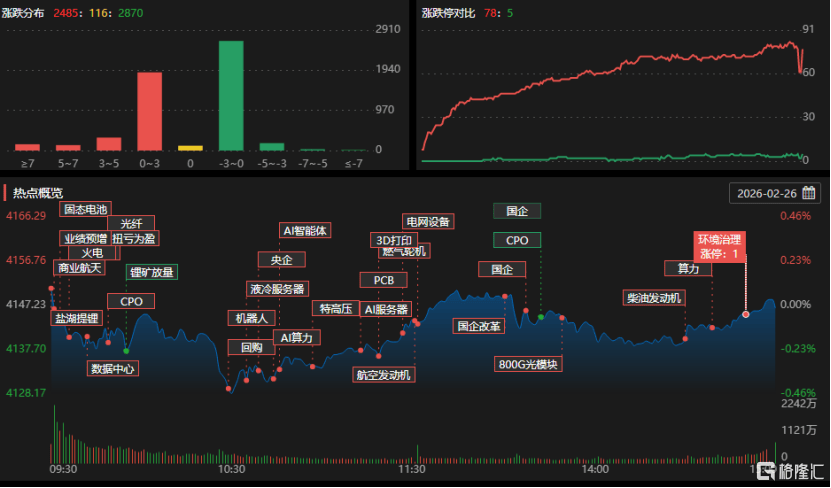
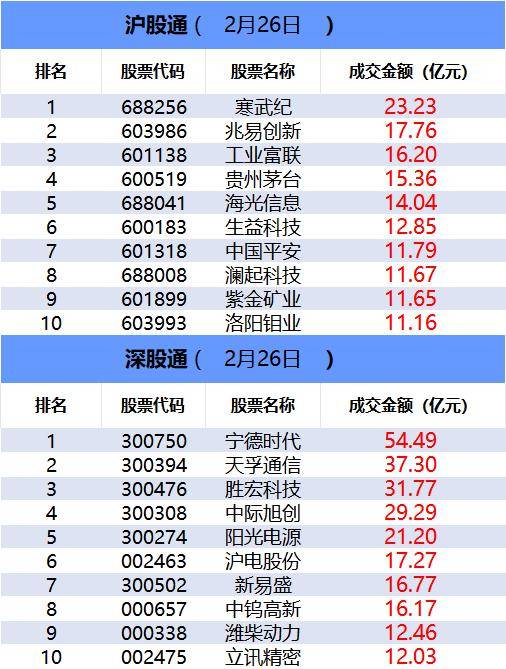
Group 1 - The core viewpoint of the news highlights significant trading activities in the stock market, particularly focusing on the strong performance of specific stocks like Hu Dian Co., which saw a surge in buying from various institutional investors and retail funds [1][13][14] - Hu Dian Co. experienced a strong limit-up, with three institutions purchasing 384 million and deep stock connect buying 737 million [1][13] - The top ten stocks by trading volume in the Shanghai Stock Connect included Han's Laser, Zhaoyi Innovation, and Industrial Fulian, indicating strong investor interest in these companies [3][4] Group 2 - The total trading volume for the Shanghai Stock Connect reached 145.06 billion, while the Shenzhen Stock Connect totaled 171.79 billion, reflecting robust market activity [2] - The electronic sector led the net inflow of funds, with a net inflow of 60.32 billion, while the non-ferrous metals sector faced the highest net outflow of 114.77 billion [5][6][7] - The top ten stocks with the highest net inflow included Hu Dian Co. and Shenghong Technology, while the highest net outflow was seen in stocks like Yangguang Electric and Ningde Times [8][9] Group 3 - The ETF trading volume was led by the A500 ETF Fund with a transaction amount of 10.70 billion, showing a slight increase from the previous trading day [10] - The top ETFs by transaction amount included the A500 ETF and the China-Korea Semiconductor ETF, with the latter experiencing a significant increase of 81.10% compared to the previous trading day [11] - The trading activity in ETFs indicates a growing interest in diversified investment products among investors [10][11] Group 4 - The four major index futures contracts saw a reduction in positions from both long and short sides, indicating a cautious market sentiment [12]
A股市场投资策略周报:春节消费温和复苏,市场呈现资金回流-20260226
BOHAI SECURITIES· 2026-02-26 09:25
投资策略 +-[Table_MainInfo]春节消费温和复苏,市场呈现资金回流 ――A 股市场投资策略周报 | 分析师: | 宋亦威 | 月 | SAC NO: S1150514080001 2026 | 26 | | | 年 | 日 | | 2 | | --- | --- | --- | --- | --- | --- | --- | --- | --- | --- | --- | | [Table_Analysis] 证券分析师 | | | | | [Table_Summary] 投资要点: | | | | | | | 宋亦威 | | | | | 市场回顾,节后 月 月 日),重要指数纷纷收涨; ⚫ 个交易日(2 24 日-2 26 | 3 | | | | | | 022-23861608 | | | | | 其中,上证综指收涨 1.58%,创业板指收涨 2.11%;风格层面,沪深 | | | | 300 | | | songyw@bhzq.com | | | | | 收涨 1.43%,中证 500 收涨 3.10%。成交方面有所放量,两市统计区间 | | | | | | | | | | | | 内成交 ...