新消费

Search documents
富达基金周文群:新消费整体估值偏高 对传统消费保持观望
Zhong Zheng Wang· 2025-08-05 13:53
Group 1 - The core viewpoint is that with the post-95 and post-00 generations becoming the main consumer force, there is a shift towards emotional value-driven demand, leading to rapid growth in service consumption and experience economy, particularly in sectors like trendy toys, health management, and cultural experiences [1] - From an investment perspective, new consumption overall is considered to have high valuations, necessitating a selective approach to stocks with valuation safety margins; traditional consumption is viewed with caution due to low valuations but lack of catalysts, requiring a wait for signals [1] - The investment process in new consumption companies has prompted new considerations, with a focus on the long-term trends in the IP industry and the international expansion of outstanding Chinese companies [1]
爆发!南向资金大举买入!年度净流入规模或超万亿港元
Zheng Quan Shi Bao· 2025-08-05 13:28
(原标题:爆发!南向资金大举买入!年度净流入规模或超万亿港元) 在港股市场"赚钱效应"推动下,南向资金今日再现强势流入。 8月5日,南向资金净买入港股234.25亿港元,为近一个月内第二次单日净流入突破200亿港元。这一数据不仅延续了年内南向资金持续加仓港股的 趋势,更凸显内地资金对港股核心资产的配置信心。 市场分析人士指出,港股短期经过震荡调整后,随着中美关系阶段性改善、美联储降息预期升温,港股市场再次吸引了内地资金关注。 净买入超230亿港元 在8月4日罕见净流出180.92亿港元后,南向资金8月5日恢复净买入。截至收盘,南向资金净买入港股的金额为234.25亿港元,年内南向资金净买入 港股金额达到8843.81亿港元,刷新历史纪录。 对于今日港股市场回流的原因,有分析人士指出,近期美联储降息预期显著回温,海外流动性持续好转,增强了内地资金对港股市场的信心。此 外,多家港股上市公司中期业绩表现较好,同样也吸引了内地资金的关注。 美国劳工部8月1日公布的数据显示,今年7月,美国非农业部门新增就业人数7.3万,低于预期,失业率小幅上升至4.2%。同时,5月和6月的新增 非农就业数据被大幅向下修正。其中,5月新 ...

还有能打的板块吗?
雪球· 2025-08-05 08:33
Group 1 - The article discusses the phenomenon of stock price movements where individual stocks can decline more than the overall index during a market downturn, highlighting the importance of statistical interpretation in market analysis [3][6] - It introduces the concept of price comparison effects among stocks, where the relative valuation of stocks leads to a cascading effect in price movements, causing some stocks to rise significantly while others lag behind [7][8] - The article emphasizes the cyclical nature of market trends, where sectors take turns leading the market, and how this can result in systematic adjustments in the overall market when most sectors reach their peak [9][8] Group 2 - The article identifies key sectors that have shown significant price movements since mid-April, including new consumption, gold, banking, military industry, innovative pharmaceuticals, overseas computing power, and domestic AI industry [11][12] - It details the performance and peak timings of various sectors, noting that gold was the first to support the market, followed by new consumption, which peaked between late May and early June [13][14][15] - The banking sector also saw early gains, with different types of banks peaking at various times from July 7 to July 11, indicating a pattern of internal rotation within the sector [17][18] Group 3 - The military industry has shown resilience due to various factors, including order fulfillment and military trade, with significant price movements observed in specific sub-sectors [19][20] - The overseas computing power supply chain has been robust, driven by strong fundamentals and significant growth, with no clear signs of a peak yet [20] - The innovative pharmaceutical sector has emerged as a strong performer, driven by changes in fundamentals and market dynamics, although it may be approaching a peak due to speculative trading [21][22] Group 4 - The article discusses the "anti-involution" sector, which includes both traditional and emerging industries, and how this sector's performance can signal market peaks [24][25] - It highlights the need for a high-activity sector to sustain market momentum, with the domestic AI industry being positioned as a potential driver for future market movements [28][30] - The AI industry is seen as a critical component for breaking the current market cycle, with its growth potential linked to advancements in AI applications across various sectors [29][30]

中信建投 8月A股策略展望
2025-08-05 03:20
Summary of Conference Call Notes Industry or Company Involved - The conference call focuses on the Chinese economy and the implications of recent government policies, particularly in the context of the A-share market and various sectors such as real estate, consumer goods, and technology. Core Points and Arguments 1. **Optimistic Economic Outlook**: The Politburo meeting expressed an optimistic view on the economic situation without mentioning increased external shocks or introducing strong stimulus policies. Emphasis was placed on urban renewal in real estate and the implementation of existing policies [1][3] 2. **Focus on Domestic Demand**: The policy shift aims to expand commodity consumption and cultivate new growth points in service consumption, alongside high-quality infrastructure projects to stimulate domestic demand [1][5] 3. **Cash Subsidies Over Price Subsidies**: The government is moving towards direct cash subsidies (e.g., childcare subsidies) to enhance consumer purchasing power, avoiding market distortions caused by price wars. This approach is expected to prevent distorted price perceptions in the long term [1][7][8] 4. **Policy Combination for Economic Recovery**: Attention is drawn to a combination of policies aimed at countering "involution" and promoting inflationary effects, which may boost prices and achieve re-inflation [1][9] 5. **Market Performance and Strategy**: The market may experience high-level fluctuations in the short term, with a recommendation to maintain a high position in investments, particularly in sectors like innovative pharmaceuticals, semiconductors, AI applications, and new consumer trends [1][10][11] 6. **Concerns in Downstream Industries**: Downstream sectors face uncertainties regarding the effectiveness of market-oriented measures for private enterprises, the alignment of demand-side policies, and the impact of rising upstream prices on costs [2][13][14] 7. **Supply-Side Reform Impact**: Supply-side reforms are expected to enhance production efficiency and economic quality, with a focus on upstream resource sectors such as photovoltaic materials, steel, fiberglass, and energy metals [1][12] 8. **Mid-term Involution Dynamics**: The phenomenon of "involution" is anticipated to recur in the mid-term, depending on the implementation of subsequent policies across various industries [2][15] 9. **Investment Recommendations**: Investors are advised to focus on upstream sectors, particularly those with volatile futures prices, while monitoring the rollout of policies related to "involution" for informed investment decisions [2][16] Other Important but Possibly Overlooked Content - The government is cautious about project approvals to improve the efficiency of fund usage, indicating a more prudent approach to fiscal policy [4] - The introduction of cash subsidies marks a significant shift in the government's approach to stimulating consumption, which could have lasting effects on consumer behavior and market dynamics [7][8] - The potential for a strong market response to the upcoming policies and the importance of aligning supply-side reforms with market needs are critical for future economic stability [12][15]

FZ 8月十大金股
2025-08-05 03:19
Summary of Conference Call Records Industry or Company Involved - A-shares market and various sectors including semiconductor, AI, OLED materials, biopharmaceuticals, and consumer goods Key Points and Arguments A-shares Market Outlook - The current downward risk in the A-shares market is considered low, supported by favorable statements from the political bureau meeting [1] - Historical price-performance ratio indicates a good position for investment despite recent gains in equity [1] Semiconductor Industry - Domestic chip manufacturing capabilities are improving, with significant advancements in AI-related chips [2] - The demand for domestic supply chains is increasing, leading to high processing rates for local manufacturers [2][3] OLED Materials - The penetration rate of OLED materials is increasing due to performance advantages over LCDs and new technologies addressing previous lifespan issues [9] - Domestic manufacturers are gaining market share as global OLED production capacity shifts to China [10] - Future growth is expected from domestic panel manufacturers expanding production and the introduction of new consumer electronics [11][12] Biopharmaceuticals - China National Pharmaceutical has made strategic acquisitions to enhance its pipeline, including a significant collaboration with a major pharmaceutical company [16][17] - Expected revenue growth from 2025 to 2027 is projected at 32.4 billion to 43.8 billion RMB, with substantial profit increases [18] Consumer Goods - The company "粉笔" (Fenbi) is positioned well in the online education sector, with plans to introduce AI-driven products to boost revenue [31][32] - "若与诚" (Ruoyucheng) is expanding its product lines in health and wellness, with expected revenue growth driven by new brand launches [33][34] Investment Recommendations - Various companies have been highlighted as "gold stocks" for August, including 中芯国际 (SMIC), 莱特光电 (Lite-On), and others, based on their growth potential and market positioning [3][8][12][29] Other Important but Possibly Overlooked Content - The overall economic environment is showing signs of recovery, which may positively impact various sectors [1] - The potential for new product launches in consumer electronics and the healthcare sector is significant, with expected high demand in the coming years [11][27] - The impact of geopolitical factors, such as tariffs, on market dynamics is acknowledged, particularly in the context of the U.S.-China trade relationship [25] This summary encapsulates the key insights from the conference call records, highlighting the optimistic outlook across various sectors and the strategic positioning of recommended companies.



【申万宏源策略】周度研究成果(7.25-8.3)
申万宏源研究· 2025-08-05 01:16
Core Viewpoint - The market is currently in a correction phase, returning to a volatile state, with the main structural breakthrough yet to be established. The market will digest the expected economic growth slowdown in the second half of 2025 and the policy focus on structural adjustments [4]. Group 1: Market Dynamics - The focus on self-sufficiency and defense industry presents a potential opportunity, with a "barbell strategy" (high dividend + micro-cap stocks) likely to see a rebound [4]. - The main catalyst for future upward movement is the trend against "involution," which is expected to improve the profitability of midstream manufacturing in the long term, although short-term momentum may face resistance [4]. Group 2: Sector Insights - The pharmaceutical and computer sectors (IT services, software development) are highlighted as key areas of interest [5]. - In the short term, consumer goods are expected to have a rebound potential, following the recent activity in Hong Kong's cyclical stocks, indicating a time window for revaluation of consumer goods [8]. - In the medium term, the probability of a reversal in the consumer goods sector is increasing, with the rise in consumer goods prices expected to solidify the current valuation of new consumption sectors [9]. Group 3: Policy and Economic Outlook - The recent meeting of the Central Committee of the Communist Party of China focused on the development of the 15th Five-Year Plan, emphasizing the need for a stable and active capital market [11]. - The policy mentions the attractiveness and inclusivity of the Chinese capital market, reflecting ongoing attention to its healthy development [12]. - Non-manufacturing PMI remains above the threshold but shows signs of marginal slowdown, with input prices performing better than sales prices [15].

七成投资者看好三季度A股 市场乐观情绪进一步酝酿——上海证券报·个人投资者2025年第三季度调查报告
Shang Hai Zheng Quan Bao· 2025-08-04 18:52
Core Viewpoint - The A-share market showed resilience in Q2, with nearly half of individual investors reporting profits, leading to increased optimism for Q3 [4][24]. Investor Performance - 48% of investors reported profits in Q2, an increase of 6 percentage points from the previous quarter [5]. - The majority of profitable investors had gains of 10% or less, accounting for 34% of respondents [5]. - The percentage of investors reporting losses decreased significantly to 20%, down 11 percentage points from the previous quarter [5]. Market Trends - A-share indices experienced a "V" shaped recovery after a significant drop in early April, with the Shanghai Composite Index recovering to above 3400 points by the end of Q2 [4][24]. - Investor sentiment shifted from cautious to optimistic, with 70% expecting the A-share market to rise in Q3, a 12 percentage point increase from the previous quarter [17][24]. Asset Allocation - There was a notable increase in the proportion of individual investors' securities account assets relative to their total financial assets, with 27% reporting an increase [8]. - 36% of investors plan to increase their allocation to equity assets, reflecting a growing confidence in the market [8]. Sector Preferences - Investors maintained a strong interest in technology growth stocks, with an average holding of 23.94%, significantly higher than other sectors [12]. - The cyclical sector saw increased attention, with a rise in average holdings to 20.21% in Q2 [12]. - New consumption concepts gained traction, with 55% of investors participating in the Hong Kong new consumption sector [15]. Future Outlook - 70% of investors believe the Shanghai Composite Index will close positively in Q3, with expectations for a trading range between 3400 and 3500 points [18][19]. - The liquidity outlook is improving, with 44% of investors expecting current liquidity levels to be maintained [20][21]. - 57% of investors anticipate continued growth in the Hong Kong market, with a significant portion willing to increase their investments [23].

食品饮料行业周报:白酒持续磨底,关注资金切换节奏-20250804
Huaxin Securities· 2025-08-04 14:31
Investment Rating - The report maintains a "Recommended" investment rating for the food and beverage industry [7] Core Insights - The liquor sector is showing signs of bottoming out, with increased catalysts for investment and improved cost-effectiveness in allocations. Factors include ongoing policy adjustments, low fund allocations in Q2 2025, and rising dividend yields from liquor companies [5][6] - The overall beverage market is experiencing a shift towards new consumption patterns, particularly in instant retail and tea beverage sectors, driven by efficiency and scale [6][7] - The report highlights a focus on key companies within the liquor sector, including Guizhou Moutai, Wuliangye, and Luzhou Laojiao, as well as flexible stocks like JiuGui Jiu and SheDe JiuYe [5][7] Summary by Sections Industry News - The liquor manufacturing industry's profit decreased by 2.1% year-on-year in the first half of the year [16] - The production of Renhuai liquor is expected to exceed 310,000 tons in 2024 [16] - Regulatory measures in Guiyang have been introduced to liquor companies [16] Company News - Guizhou Moutai has undergone personnel adjustments in its supervisory board [16] - SheDe JiuYe's board member resigned from his position [16] Key Company Feedback - The report emphasizes the importance of maintaining a diversified portfolio in the liquor sector, with a focus on companies that are actively engaging in market strategies and product differentiation [5][6] Industry Performance - The food and beverage sector has shown varied performance over the past month, with a slight increase of 0.2% [2] - The liquor sector is currently undergoing a destocking cycle, facing multiple pressures from pricing, demand, and policy [5] Key Data Trends - In 2024, the liquor industry is projected to generate revenue of 796.4 billion yuan, reflecting a year-on-year increase of 5.3% [35] - The cumulative production of liquor in 2024 is expected to be 4.145 million tons, down 7.72% year-on-year [35]




美国数据黑天鹅,会引发全球一轮调整吗?
格隆汇APP· 2025-08-04 09:25
Core Viewpoint - Recent US non-farm payroll data was disappointing, leading to a significant drop in US stocks, while Hong Kong and A-shares showed resilience with a strong recovery after initial declines [2] Group 1: Market Performance - The market opened lower but rebounded strongly, supported by banks and key stocks like SMIC, indicating a positive shift in market sentiment [2] - The military industry sector performed exceptionally well, driven by upcoming projects related to the new five-year plan [2] - The robotics sector, after a period of adjustment, is poised for growth, especially with the launch of the E-Town Robotics Consumption Festival in Beijing, which includes consumer subsidies [2] Group 2: New Consumption Trends - The new consumption sector, including pet food, trendy products, beauty care, and jewelry, showed positive performance after a prolonged adjustment period [3] - Cleaning appliances have reached new highs, marking a rare strong performance in consumer goods since July [3] - Companies like Ecovacs and Roborock have seen significant stock price increases, indicating potential opportunities in the new consumption space [4] Group 3: Future Outlook - Despite general market volatility, the overall performance remains positive, suggesting resilience in the face of external pressures [5] - The potential for interest rate cuts by the Federal Reserve could provide a boost to the market, with a focus on upcoming earnings reports and sectors that have seen prolonged adjustments [5] - Key areas to monitor include military, innovation drugs, robotics, and new consumption for potential investment opportunities [6]


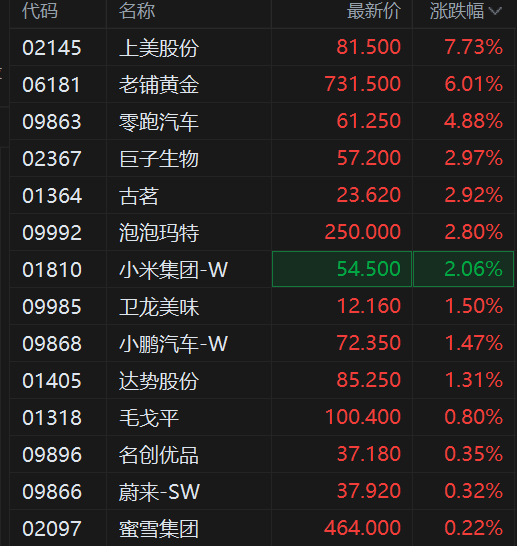
港股异动丨新消费概念股走高 上美股份涨近8% 泡泡玛特、巨子生物涨近3%
Ge Long Hui· 2025-08-04 03:41
| 代码 | 名称 | 最新价 | 涨跌幅 ▽ | | --- | --- | --- | --- | | 02145 | 下美股份 | 81.500 | 7.73% | | 06181 | 老铺黄金 | 731.500 | 6.01% | | 09863 | 零跑汽车 | 61.250 | 4.88% | | 02367 | 巨子生物 | 57.200 | 2.97% | | 01364 | 古茗 | 23.620 | 2.92% | | 09992 | 泡泡玛特 | 250.000 | 2.80% | | 01810 | 小米集团-W | 54.500 | 2.06% | | 09985 | 卫龙美味 | 12.160 | 1.50% | | 09868 | 小鹏汽车-W | 72.350 | 1.47% | | 01405 | 达势股份 | 85.250 | 1.31% | | 01318 | 毛戈平 | 100.400 | 0.80% | | 09896 | 名创优品 | 37.180 | 0.35% | | 09866 | 蔚来-SW | 37.920 | 0.32% | | 02097 | 蜜雪集 ...