
公用事业

Search documents
A 股 TTM&全动态估值全景扫描(20251220):A 股估值收缩,商贸零售行业领涨
Western Securities· 2025-12-20 14:30
Core Conclusions - The overall valuation of A-shares has contracted this week, with the retail trade sector leading the gains. The Ministry of Commerce recently held a meeting to promote the "Three New" (new consumption formats, new models, new scenarios) pilot work, providing policy support for industry recovery. The concept of "reward economy" has emerged, further boosting sentiment in the consumption sector. Currently, the overall PB (LF) of the retail trade sector is at the historical 37.0 percentile, indicating significant room for valuation improvement [1][8]. Valuation Overview - This week, the overall PE (TTM) of A-shares decreased from 21.74 times last week to 21.73 times this week, while the PB (LF) remained stable at 1.77 times [10]. - The main board's PE (TTM) increased from 17.46 times last week to 17.54 times this week, and the PB (LF) rose from 1.48 times to 1.49 times [17]. - The ChiNext's PE (TTM) fell from 72.27 times to 71.32 times, and the PB (LF) decreased from 4.27 times to 4.21 times [19]. - The Sci-Tech Innovation Board's PE (TTM) dropped from 210.87 times to 205.59 times, and the PB (LF) fell from 5.17 times to 5.04 times [25]. Relative Valuation Analysis - The relative PE (TTM) of computing power infrastructure, excluding operators/resource categories, decreased from 4.47 times last week to 4.28 times this week, while the relative PB (LF) fell from 4.66 times to 4.46 times [28]. - In terms of static PE (TTM), major industries such as discretionary consumption, consumer staples, midstream manufacturing, cyclical, and midstream materials have absolute and relative valuations above the historical median, with discretionary consumption and consumer staples exceeding the historical 90th percentile [32]. - From the perspective of PB (LF), industries like resources, TMT, cyclical, and midstream manufacturing have absolute and relative valuations above the historical median, while discretionary consumption, midstream materials, financial services, services, and consumer staples are below the historical median [34]. Dynamic Valuation Insights - Analyzing the full dynamic PE, industries such as discretionary consumption, midstream manufacturing, cyclical, and midstream materials have absolute and relative valuations above the historical median, with discretionary consumption exceeding the historical 90th percentile [41]. - The current comparison of odds (PB historical percentiles) and win rates (ROE historical percentiles) indicates that industries like agriculture, public utilities, and oil and petrochemicals exhibit characteristics of low valuation and high profitability [59]. - The comparison of odds (full dynamic PE) and win rates (25-26 consensus expected net profit compound growth rate) shows that industries such as building materials, power equipment, media, and defense industry possess both low valuations and high performance growth [62]. ERP and Yield Spread - The non-financial ERP of A-shares increased from 0.87% last week to 0.89% this week, while the equity-debt yield spread improved from -0.12% to -0.05% [63]. - The full dynamic ERP of key non-financial companies in A-shares rose from 2.77% to 2.80% this week [70].
浙江省上市企业ESG年度报告发布 勾勒可持续发展路线图
Sou Hu Cai Jing· 2025-12-20 10:54
Core Insights - The event "ESG: Responsibility for a Sustainable Future" was held in Hangzhou, Zhejiang, where the ESG information disclosure report for listed companies in Zhejiang was officially released [1] - The report indicates that Zhejiang has created a favorable environment for companies to implement ESG practices, aligning with the "Green Mountains and Clear Water are Gold and Silver Mountains" philosophy [1] Group 1: ESG Disclosure Overview - The report focuses on the ESG information disclosure status of 100 listed companies in Zhejiang, analyzing their ESG status, disclosure practices, existing issues, and recommendations [3] - As of November 20, 2025, 82 out of 100 sample companies have published ESG reports, with 47 from the Shanghai Stock Exchange and 35 from the Shenzhen Stock Exchange [3] - Hangzhou leads in the number of ESG reports disclosed, followed by Ningbo and Shaoxing [3] Group 2: ESG Ratings and Compliance - Nearly 70% of the 82 companies that published ESG reports received an A rating or above from Wind ESG, indicating good overall performance [3] - Among mandatory disclosure entities, 93.3% analyzed important issues, with high disclosure rates in environmental topics like "climate change," social issues like "employees," and governance topics like "stakeholder communication" [3] Group 3: Industry and Regional Disparities - The report highlights significant disparities in ESG report disclosure rates across 11 industries, with finance and energy sectors achieving full disclosure, while sectors like information technology and consumer discretionary only reached around 60% [5] - 12 companies have published ESG reports for 15 years or more, accounting for 14.6%, while the highest proportion, 54.9%, consists of companies that have published for less than 5 years, indicating that ESG reporting in Zhejiang is still in a growth phase [4] Group 4: Recommendations for Improvement - The report suggests enhancing ESG compliance supervision and accountability, including implementing responsibility guidelines for boards and decision-makers, and establishing cross-departmental teams for coordinated enforcement [5] - It recommends creating a gradient support system to address regional and industry imbalances, focusing on cities with higher disclosure rates like Hangzhou and Shaoxing as core leading areas [5] - Companies are encouraged to shift from short-term compliance thinking to a long-term value-oriented disclosure approach, integrating ESG disclosures into overall business development [6]

Germany removes dividend ban for Uniper, paving way for IPO
Reuters· 2025-12-19 18:27
Germany on Friday passed a law that will enable Uniper to resume dividend payments, removing one of the main hurdles to Berlin's plan to re-list the utility that was bailed out during Europe's energy crisis. ...

广安爱众12月19日现2笔大宗交易 总成交金额1000万元 溢价率为-10.71%
Xin Lang Cai Jing· 2025-12-19 10:15
炒股就看金麒麟分析师研报,权威,专业,及时,全面,助您挖掘潜力主题机会! 第1笔成交价格为4.00元,成交125.00万股,成交金额500.00万元,溢价率为-10.71%,买方营业部为中 国中金财富证券有限公司深圳爱国路证券营业部,卖方营业部为国元证券股份有限公司深圳深南大道中 国凤凰大厦证券营业部。 12月19日,广安爱众收涨1.13%,收盘价为4.48元,发生2笔大宗交易,合计成交量250万股,成交金额 1000万元。 第2笔成交价格为4.00元,成交125.00万股,成交金额500.00万元,溢价率为-10.71%,买方营业部为中 信证券华南股份有限公司东莞分公司,卖方营业部为国元证券股份有限公司深圳深南大道中国凤凰大厦 证券营业部。 进一步统计,近3个月内该股累计发生4笔大宗交易,合计成交金额为1706.5万元。该股近5个交易日累 计下跌1.97%,主力资金合计净流出2800.23万元。 责任编辑:小浪快报 ...

84只股涨停 最大封单资金5.53亿元
Zheng Quan Shi Bao Wang· 2025-12-19 08:23
| 600936 | 广西广电 | 4.30 | 6.76 | 2371.18 | 10196.07 | 传媒 | | --- | --- | --- | --- | --- | --- | --- | | 000566 | 海南海药 | 7.24 | 11.37 | 1408.12 | 10194.79 | 医药生物 | | 000639 | 西王食品 | 3.62 | 9.51 | 2733.39 | 9894.87 | 食品饮料 | | 002264 | 新华都 | 9.32 | 11.85 | 954.13 | 8892.49 | 传媒 | | 000417 | 合百集团 | 8.33 | 12.49 | 1018.83 | 8486.86 | 商贸零售 | | 002105 | 信隆健康 | 7.77 | 11.86 | 1080.45 | 8395.08 | 汽车 | | 002501 | 利源股份 | 2.39 | 5.22 | 3204.88 | 7659.66 | 有色金属 | | 600468 | 百利电气 | 7.14 | 6.14 | 1069.54 | 7636.52 | 电力设备 ...


港股“磨底”中静待反弹,港股通红利低波ETF基金(159118)早盘上涨,布局价值凸显
Mei Ri Jing Ji Xin Wen· 2025-12-19 03:25
Core Viewpoint - The Hong Kong stock market is experiencing a volatile upward trend, with the Hong Kong Stock Connect Low Volatility Dividend ETF (159118) rising approximately 0.72% during the session, driven by leading stocks such as Jiangxi Copper, Hang Lung Properties, China Telecom, and Cheung Kong Infrastructure Group [1] Group 1: Market Analysis - The three major indices in the Hong Kong stock market continue to show a volatile trend, with Huatai Securities indicating that the current market has limited downside potential but insufficient upward momentum, reflecting typical bottoming characteristics similar to those seen in November 2024 [1] - Historical experience suggests that after market sentiment reaches a bottom, there is often a rebound opportunity, which warrants early positioning by investors [1] Group 2: Future Outlook - Huatai Securities believes that if a consensus on RMB appreciation is formed, it will lead to changes in capital flow patterns, referencing the performance of European markets this year [1] - The market is overly concerned about the impact of currency appreciation and high export baselines; however, there is a possibility of unexpected resilience in exports in the first half of next year, given the moderate state of Sino-U.S. relations [1] Group 3: ETF Fund Characteristics - The Hong Kong Stock Connect Low Volatility Dividend ETF (159118) closely tracks the S&P Hong Kong Stock Connect Low Volatility Dividend Index (in HKD), favoring a large-cap value style [1] - The top three sectors represented in the ETF are real estate, utilities, and banking, with the top ten constituent stocks covering high-dividend targets across multiple industries [1] - The fund offers low fees (management and custody fees only 0.2%) and high efficiency (T+0 trading), allowing investors to easily access Hong Kong stocks, dividends, and low volatility [1]
密歇根州通过争议性协议 监管机构批准为甲骨文(ORCL.US)和OpenAI数据中心供电
Zhi Tong Cai Jing· 2025-12-19 03:04
Core Viewpoint - The Michigan regulatory agency has unanimously approved DTE Energy Co.'s request to provide power for a large-scale data center project planned by Oracle and OpenAI, despite public opposition [1][2]. Group 1: Project Details - DTE Energy's plan involves a $1.4 billion facility in Saline Township, which will require significant power supply [1]. - Oracle will cover most of the project's costs, including a minimum monthly fee and termination fees, as part of a financing deal worth approximately $14 billion [2]. - The data center is part of OpenAI's broader plan to build 8 gigawatts of capacity in the U.S., contributing to a total investment of over $450 billion in the next three years [2]. Group 2: Regulatory and Public Response - The Michigan Public Service Commission stated that the agreements protect the grid and the public, ensuring net financial benefits for DTE's other customers [1]. - The approval process has been contentious, with concerns raised about the potential for data centers to consume power at the expense of public services during emergencies [2]. - Public opposition was evident during the hearing, highlighting growing hostility towards data centers in certain regions of the U.S. [3].

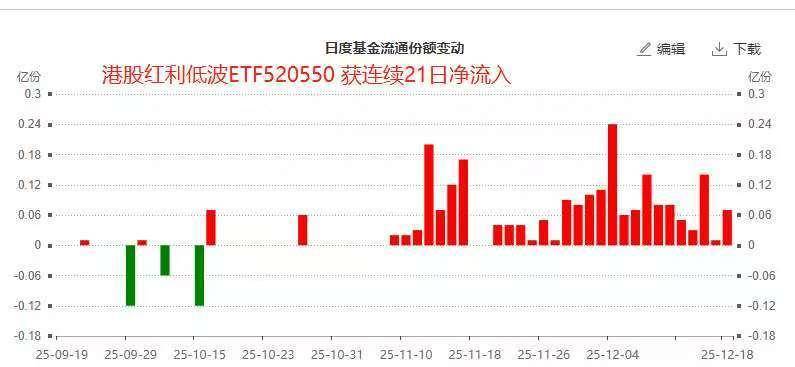
根本停不下来!港股红利低波ETF(520550)获连续21日增仓,股息率飙至近7%!
Sou Hu Cai Jing· 2025-12-19 02:45
Core Viewpoint - The Hong Kong dividend low-volatility ETF has attracted significant capital inflows, becoming a focal point for investors seeking stable returns in a volatile market environment [3][4]. Group 1: Fund Inflows - As of December 18, 2023, the Hong Kong dividend low-volatility ETF (code: 520550) has seen net inflows for 21 consecutive trading days, totaling approximately 190 million RMB [3][4]. - Year-to-date, the ETF has accumulated net inflows of nearly 1 billion RMB, indicating strong long-term investor confidence in this strategy [3][4]. Group 2: Dividend Yield and Valuation - The ETF's tracked index has a current dividend yield close to 7%, significantly higher than major mainland indices and leading among global markets [4]. - The high dividend yield is particularly attractive in the context of declining bank deposit rates and pressured returns from traditional investment products, making it a competitive option for conservative investors [4]. Group 3: Low Volatility Attributes - The low-volatility aspect of the strategy is crucial, as the ETF selects stocks with relatively low historical price volatility, resulting in an overall portfolio volatility that is significantly lower than the Hong Kong market average [5]. - In the current uncertain global economic climate, the demand for "safe" and "stable" investments has increased, making the dividend low-volatility strategy appealing to many investors [5]. Group 4: Market Outlook - The ongoing inflows into the Hong Kong dividend low-volatility ETF reflect a rational choice by market participants in light of the current macroeconomic environment, favoring assets with high growth certainty and consistent cash returns [6]. - The trend of declining risk-free interest rates enhances the attractiveness of dividend returns, suggesting a favorable outlook for dividend strategies in the medium to long term [6].
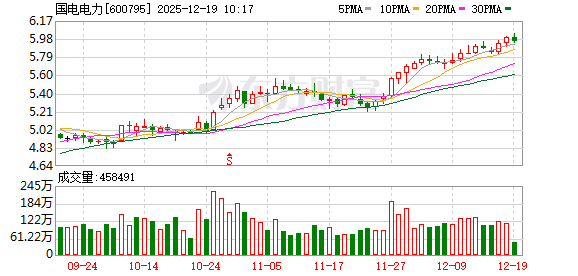
国电电力持续走强,股价再创新高
Zheng Quan Shi Bao Wang· 2025-12-19 02:16
两融数据显示,该股最新(12月18日)两融余额为8.02亿元,其中,融资余额为7.92亿元,近10日减少 8634.17万元,环比下降9.83%。 公司发布的三季报数据显示,前三季度公司共实现营业收入1252.05亿元,同比下降6.47%,实现净利润 67.77亿元,同比下降26.27%,基本每股收益为0.3800元,加权平均净资产收益率11.50%。(数据宝) (文章来源:证券时报网) 国电电力股价再创历史新高,该股近期呈不断突破新高之势,近一个月累计有10个交易日股价刷新历史 纪录。截至09:40,该股目前上涨0.33%,股价报6.01元,成交1867.76万股,成交金额1.12亿元,换手率 0.10%,该股最新A股总市值达1071.92亿元,该股A股流通市值1071.92亿元。 证券时报·数据宝统计显示,国电电力所属的公用事业行业,目前整体涨幅为0.18%,行业内,目前股价 上涨的有91只,涨幅居前的有胜通能源、中泰股份、ST金鸿等,涨幅分别为10.02%、5.34%、5.17%。 股价下跌的有21只,跌幅居前的有梅雁吉祥、美能能源、大连热电等,跌幅分别为1.93%、1.88%、 0.87%。 ...

港股中期交易窗口打开,聚焦分红可持续性强、盈利稳定的优质标的
Mei Ri Jing Ji Xin Wen· 2025-12-19 02:08
Core Viewpoint - The Hong Kong stock market is experiencing a mid-term adjustment, with quality assets becoming more attractive due to improved safety margins and sustained net inflows from southbound capital [1] Group 1: Market Performance - The Hong Kong Stock Connect Low Volatility Dividend ETF (159118) has seen a slight increase of approximately 0.3% [1] - After a one-sided rise in September, the market has undergone a period of adjustment since October [1] Group 2: Investment Strategy - Multiple factors are contributing to the opening of a mid-term trading window in the Hong Kong market, including market adjustments enhancing safety margins and improvements in macro fundamentals [1] - Investors are advised to focus on high-quality stocks with strong dividend sustainability and stable earnings, particularly in growth sectors that have been deeply adjusted due to style shifts [1] Group 3: ETF Characteristics - The Hong Kong Stock Connect Low Volatility Dividend ETF (159118) closely tracks the S&P Hong Kong Stock Connect Low Volatility Dividend Index, which has a strong historical performance and leans towards large-cap value style [1] - The top three industries represented in the index are real estate, utilities, and banking, with the top ten constituent stocks covering high-dividend targets across multiple sectors [1] - The ETF offers low fees (management and custody fees only 0.2%) and high efficiency (T+0 trading), facilitating easy access to Hong Kong stocks, dividends, and low volatility [1]