
原油

Search documents
能源化工期权:能源化工期权策略早报-20260109
Wu Kuang Qi Huo· 2026-01-09 04:22
Report Summary 1. Report Industry Investment Rating No information provided in the content. 2. Core Viewpoints - The energy - chemical sector is divided into energy, alcohols, polyolefins, rubber, polyesters, alkalis, and others [8]. - For each sector, options strategies and suggestions are provided for selected varieties [8]. - Options strategy reports are written for each option variety based on underlying market analysis, option factor research, and option strategy suggestions [8]. 3. Summary by Related Catalogs 3.1 Underlying Futures Market Overview - Various option varieties' underlying contracts are presented, including details such as the latest price, change, percentage change, trading volume, volume change, open interest, and open interest change [3]. 3.2 Option Factor - Volume and Open Interest PCR - The volume and open interest PCR for different option varieties are given, along with their changes. These PCR indicators are used to describe the strength of the option - underlying market and the timing of market turning points [4]. 3.3 Option Factor - Pressure and Support Levels - The pressure and support levels for each option variety are provided, along with the offset values, maximum call and put open interests [5]. 3.4 Option Factor - Implied Volatility - Implied volatility data for different option varieties are presented, including at - the - money implied volatility, weighted implied volatility, its change, annual average, call and put implied volatility, and the difference between implied and historical volatility [6]. 3.5 Strategy and Suggestions 3.5.1 Energy - related Options (Crude Oil and LPG) - **Fundamentals**: For crude oil, the US military raid on Maduro has not damaged domestic oil and gas facilities; the rift between Saudi - UAE on the Yemen issue has not affected OPEC + coordination. NNPC aims to increase production. For LPG, the supply has no new increment, and chemical demand supports the price [7][9]. - **Market Analysis**: Crude oil has shown a weak - biased market trend over time. LPG has an oscillating and downward - biased market [7][9]. - **Option Factor Research**: Crude oil's implied volatility is below the average, and the open interest PCR indicates a weak market. LPG's implied volatility is around the average, and the open interest PCR also shows a weak market [7][9]. - **Option Strategies**: For both crude oil and LPG, there are no directional strategies. Volatility strategies involve selling a combination of call and put options, and spot long - hedging strategies involve constructing long collar strategies [7][9]. 3.5.2 Alcohol - related Options (Methanol and Ethylene Glycol) - **Fundamentals**: For methanol, imports from Venezuela in 2025 - 2026 and the supply - demand situation are considered. For ethylene glycol, the port inventory situation is presented [9][10]. - **Market Analysis**: Methanol shows an oversold rebound trend, while ethylene glycol shows a weak - biased trend [9][10]. - **Option Factor Research**: Methanol's implied volatility is around the historical average, and the open interest PCR indicates a weak market. Ethylene glycol's implied volatility is above the average, and the open interest PCR shows strong short - side power [9][10]. - **Option Strategies**: There are no directional strategies. Volatility strategies involve selling a combination of call and put options for methanol and short - selling volatility for ethylene glycol. Spot long - hedging strategies involve constructing long collar strategies [9][10]. 3.5.3 Olefin - related Options (PVC) - **Fundamentals**: The production capacity utilization rate of PVC is presented, with attention to future maintenance efforts [10]. - **Market Analysis**: PVC has shown a downward trend and then a rebound [10]. - **Option Factor Research**: PVC's implied volatility has decreased to below the average, and the open interest PCR indicates a continued weak trend [10]. - **Option Strategies**: A bull spread strategy for call options is constructed for directional gain, and spot long - hedging strategies involve holding spot long + buying at - the - money put options + selling out - of - the - money call options [10]. 3.5.4 Rubber - related Options (Rubber) - **Fundamentals**: The inventory and production data of natural and synthetic rubber are provided [11]. - **Market Analysis**: Rubber has shown a recovery trend [11]. - **Option Factor Research**: Rubber's implied volatility is approaching the average, and the open interest PCR indicates a weak market [11]. - **Option Strategies**: There are no directional strategies. Volatility strategies involve selling a combination of call and put options, and there is no spot hedging strategy [11]. 3.5.5 Polyester - related Options (PTA) - **Fundamentals**: The PTA market's start - up rate and the operation of production facilities are presented [11]. - **Market Analysis**: PTA has shown an oversold rebound and short - term strong trend [11]. - **Option Factor Research**: PTA's implied volatility is at a relatively low level, and the open interest PCR indicates a strong market [11]. - **Option Strategies**: There are no directional strategies. Volatility strategies involve selling a combination of call and put options, and there is no spot hedging strategy [11]. 3.5.6 Alkali - related Options (Caustic Soda and Soda Ash) - **Fundamentals**: For caustic soda, the capacity utilization rate of sample enterprises is given. For soda ash, the domestic effective production capacity is presented [12]. - **Market Analysis**: Caustic soda has shown a weak - biased trend, and soda ash has shown a low - level weak oscillation [12]. - **Option Factor Research**: Caustic soda's implied volatility is at a high level, and the open interest PCR indicates a weak market. Soda ash's implied volatility is at a relatively high historical level, and the open interest PCR indicates a short - biased market [12]. - **Option Strategies**: For caustic soda, a bear spread strategy is constructed for directional gain, and a spot collar hedging strategy is used. For soda ash, volatility strategies involve short - selling volatility, and spot long - hedging strategies involve constructing long collar strategies [12]. 3.5.7 Other Options (Urea) - **Fundamentals**: The daily production data of urea are provided [13]. - **Market Analysis**: Urea has shown a short - term weak trend [13]. - **Option Factor Research**: Urea's implied volatility is at a low level, and the open interest PCR indicates strong short - side pressure [13]. - **Option Strategies**: There are no directional strategies. Volatility strategies involve selling a combination of call and put options with a long - biased delta, and spot hedging strategies involve holding spot long + buying at - the - money put options + selling out - of - the - money call options [13].
贵金属早报-20260109
Yong An Qi Huo· 2026-01-09 01:44
Price Performance - London Gold's latest price is 4429.35, with a change of -8.65 [1] - London Silver's latest price is 75.21, with a change of -3.78 [1] - London Platinum's latest price is 2298.00, with a change of -64.00 [1] - London Palladium's latest price is 1711.00, with a change of -62.00 [1] - WTI Crude's latest price is 57.76, with a change of 1.77 [1] - LME Copper's latest price is 12820.00, with a change of -300.50 [1] - The latest value of the US Dollar Index is 98.86, with a change of 0.12 [1] - The latest exchange - rate of Euro against US Dollar is 1.17, with a change of -0.00 [1] - The latest exchange - rate of British Pound against US Dollar is 1.34, with a change of -0.00 [1] - The latest exchange - rate of US Dollar against Japanese Yen is 156.87, with a change of 0.09 [1] Trading Data - COMEX Silver inventory's latest value is 13762.65, with a change of -101.33 [1] - SHFE Silver inventory's latest value is 637.65, with a change of 84.22 [1] - Gold ETF持仓's latest value is 1067.13, with no change [1] - Silver ETF持仓's latest value is 16215.43, with a change of 115.60 [1] - The latest value of the Shanghai Gold Exchange's silver inventory is not provided, and there is no change in the gold deferred - fee payment direction and a change of 0.00 in the silver deferred - fee payment direction [1]
能源化工日报-20260109
Wu Kuang Qi Huo· 2026-01-09 01:00
Report Industry Investment Rating There is no information provided in the report regarding the industry investment rating. Core Viewpoints - For crude oil, although the geopolitical premium has disappeared and OPEC's production increase is minimal with supply not yet surging, oil prices should not be overly shorted in the short - term. A range strategy of buying low and selling high is maintained, but it is recommended to wait and see for now to observe OPEC's export price - support intention [3]. - For methanol, the current valuation is low, and the outlook for next year is marginally improving with limited downside. Due to the recent geopolitical instability in Iran, there is a feasibility of buying on dips [6]. - For urea, the current situation of the internal - external price difference has opened the import window, and with the expectation of increased production at the end of January, there will be bearish fundamentals, so it is advisable to take profits on rallies [8]. - For rubber, the stock market and commodities mostly rose, and the technical analysis of rubber prices is bullish but shows signs of weakness. There are different views from the long and short sides. The short - term trading strategy is neutral, with a short - selling strategy if it falls below 16,000. It is also recommended to partially build a position by buying the NR main contract and shorting the RU2609 [10][11][14]. - For PVC, the overall fundamentals are poor with strong supply and weak demand in the domestic market. In the short - term, electricity prices are expected to support PVC at the cost end, while in the medium - term, a strategy of shorting on rallies is recommended before significant production cuts in the industry [16][17]. - For pure benzene and styrene, the non - integrated profit of styrene is neutral to low with large upward repair space. It is advisable to go long on the non - integrated profit of styrene before the first quarter of next year [20]. - For polyethylene, OPEC + plans to suspend production growth in Q1 2026, and the crude oil price may have bottomed. It is recommended to go long on the LL5 - 9 spread on dips [23]. - For polypropylene, under the background of weak supply and demand with high inventory pressure, the futures price may bottom out when the oversupply situation changes in Q1 next year [26]. - For PX, it is expected to maintain a slight inventory build - up before the maintenance season. There are medium - term opportunities to go long on dips [29]. - For PTA, it is expected to enter the Spring Festival inventory build - up stage after short - term inventory drawdown. There are medium - term opportunities to go long on dips [31]. - For ethylene glycol, the overall load is still high, and the port inventory build - up cycle will continue. In the medium - term, there is an expectation of further profit compression and load reduction. It is necessary to beware of rebound risks in the short - term due to the tense situation in Iran [33]. Summary by Related Catalogs Crude Oil - **Market Information**: The main INE crude oil futures closed down 8.60 yuan/barrel, a 2.02% decline, at 416.20 yuan/barrel. High - sulfur fuel oil rose 1.00 yuan/ton, a 0.04% increase, to 2458.00 yuan/ton, and low - sulfur fuel oil rose 33.00 yuan/ton, a 1.14% increase, to 2929.00 yuan/ton. The U.S. EIA weekly data showed that commercial crude oil inventories decreased by 3.83 million barrels to 419.06 million barrels, a 0.91% decrease; SPR increased by 0.25 million barrels to 413.46 million barrels, a 0.06% increase; gasoline inventories increased by 7.70 million barrels to 242.04 million barrels, a 3.29% increase; diesel inventories increased by 5.59 million barrels to 129.27 million barrels, a 4.52% increase; fuel oil inventories decreased by 0.06 million barrels to 22.98 million barrels, a 0.27% decrease; and aviation kerosene inventories increased by 0.05 million barrels to 44.03 million barrels, a 0.11% increase [2]. - **Strategy**: Maintain a range strategy of buying low and selling high, but wait and see for now [3]. Methanol - **Market Information**: Regional spot prices in Jiangsu changed by 10 yuan/ton, Shandong by 0 yuan/ton, Henan by - 15 yuan/ton, Hebei by 0 yuan/ton, and Inner Mongolia by - 2.5 yuan/ton. The main futures contract decreased by 36 yuan/ton to 2231 yuan/ton, and the MTO profit was 127 yuan [5]. - **Strategy**: Buy on dips [6]. Urea - **Market Information**: Regional spot prices in Shandong, Hebei, Hubei, and Jiangsu increased by 10 yuan/ton, while those in Henan and Shanxi remained unchanged. The overall basis was - 36 yuan/ton. The main futures contract decreased by 14 yuan/ton to 1776 yuan/ton [7]. - **Strategy**: Take profits on rallies [8]. Rubber - **Market Information**: The stock market and commodities mostly rose, and the technical analysis of rubber prices is bullish but shows signs of weakness. There are different views from the long and short sides. The tire开工率 has marginally deteriorated. As of December 25, 2025, the operating rate of all - steel tires in Shandong was 62.20%, 2.46 percentage points lower than the previous week and 0.02 percentage points lower than the same period last year. The operating rate of semi - steel tires was 73.74%, 0.98 percentage points higher than the previous week but 5.05 percentage points lower than the same period last year. The social inventory of natural rubber in China was 118.2 tons as of December 21, 2025, a 2.5% increase from the previous month [10][11][12]. - **Strategy**: Adopt a neutral short - term trading strategy, or wait and see. Short if it falls below 16,000. Partially build a position by buying the NR main contract and shorting the RU2609 [14]. PVC - **Market Information**: The PVC05 contract rose 53 yuan to 4972 yuan. The spot price of Changzhou SG - 5 was 4650 yuan/ton, a decrease of 50 yuan/ton. The basis was - 255 yuan/ton, an increase of 17 yuan/ton. The 5 - 9 spread was - 137 yuan/ton, a decrease of 2 yuan/ton. The overall operating rate of PVC was 78.6%, a 1.4% increase from the previous period, with the calcium - carbide method at 78.4% (a 0.1% decrease) and the ethylene method at 79.3% (a 5% increase). The overall downstream operating rate was 44.5%, a 0.9% decrease. Factory inventory was 30.9 tons (an increase of 0.3 tons), and social inventory was 106.3 tons (an increase of 0.3 tons) [15]. - **Strategy**: Short on rallies in the medium - term before significant production cuts in the industry [17]. Pure Benzene & Styrene - **Market Information**: The spot price of pure benzene in East China was 5320 yuan/ton, unchanged. The closing price of the active contract was 5442 yuan/ton, unchanged. The basis was - 122 yuan/ton, an increase of 22 yuan/ton. The spot price of styrene was 6925 yuan/ton, an increase of 25 yuan/ton. The closing price of the active contract was 6807 yuan/ton, a decrease of 21 yuan/ton. The basis was 118 yuan/ton, an increase of 46 yuan/ton. The BZN spread was 138.25 yuan/ton, an increase of 4.5 yuan/ton. The profit of non - integrated EB plants was - 99.3 yuan/ton, a decrease of 25 yuan/ton. The EB spread between the first and second contracts was 69 yuan/ton, a decrease of 19 yuan/ton. The upstream operating rate was 70.7%, a 1.57% increase. The inventory at Jiangsu ports was 13.23 tons, a decrease of 0.65 tons. The weighted operating rate of the three S products was 42.24%, a 1.77% increase [19]. - **Strategy**: Go long on the non - integrated profit of styrene before the first quarter of next year [20]. Polyethylene - **Market Information**: The closing price of the main contract was 6628 yuan/ton, a decrease of 14 yuan/ton. The spot price was 6525 yuan/ton, unchanged. The basis was - 103 yuan/ton, an increase of 14 yuan/ton. The upstream operating rate was 83.39%, a 0.04% increase. The production enterprise inventory was 39.54 tons, a 2.47 - ton increase, and the trader inventory was 2.93 tons, a 0.17 - ton increase. The average downstream operating rate was 40.8%, a 0.35% decrease. The LL5 - 9 spread was - 37 yuan/ton, an 8 - yuan increase [22]. - **Strategy**: Go long on the LL5 - 9 spread on dips [23]. Polypropylene - **Market Information**: The closing price of the main contract was 6484 yuan/ton, a decrease of 2 yuan/ton. The spot price was 6340 yuan/ton, unchanged. The basis was - 144 yuan/ton, an increase of 2 yuan/ton. The upstream operating rate was 73.85%, a 1.03% decrease. The production enterprise inventory was 46.77 tons, a 2.3 - ton decrease, the trader inventory was 20.47 tons, a 2.75 - ton increase, and the port inventory was 7.11 tons, a 0.48 - ton increase. The average downstream operating rate was 52.76%, a 0.48% decrease. The LL - PP spread was 144 yuan/ton, a 12 - yuan decrease [24][25]. - **Strategy**: Wait for the oversupply situation to change in Q1 next year for the price to bottom out [26]. PX - **Market Information**: The PX03 contract decreased by 50 yuan to 7286 yuan. The PX CFR price decreased by 14 dollars to 886 dollars. The basis was 1 yuan (an increase of 6 yuan), and the 3 - 5 spread was - 42 yuan (unchanged). The Chinese PX operating rate was 90.9%, a 0.3% increase, and the Asian operating rate was 81.2%, a 0.3% increase. A 820,000 - ton overseas plant in Kuwait was under maintenance, and the load of FCFC in Taiwan, China increased. The PTA operating rate was 78.2%, a 0.1% increase. In December, South Korea exported 433,000 tons of PX to China, a 42,000 - ton increase year - on - year. In November, the inventory was 4.02 million tons, a 50,000 - ton decrease from the previous month. The PXN was 367 dollars (a 2 - dollar decrease), the South Korean PX - MX was 147 dollars (a 7 - dollar decrease), and the naphtha crack spread was 90 dollars (a 1 - dollar decrease) [28]. - **Strategy**: Look for medium - term opportunities to go long on dips [29]. PTA - **Market Information**: The PTA05 contract remained unchanged at 5150 yuan. The East China spot price decreased by 30 yuan to 5070 yuan. The basis was - 48 yuan/ton, a 7 - yuan decrease. The 5 - 9 spread was 60 yuan/ton, a 16 - yuan decrease. The PTA operating rate was 78.2%, a 0.1% increase. The downstream operating rate was 90.8%, unchanged. Some plants were under maintenance or restarted. The social inventory (excluding credit warrants) was 203 tons as of January 4, a 25,000 - ton decrease from the previous period. The spot processing fee of PTA increased by 43 yuan to 367 yuan, and the processing fee on the futures market increased by 14 yuan to 384 yuan [30]. - **Strategy**: Look for medium - term opportunities to go long on dips, paying attention to the rhythm [31]. Ethylene Glycol - **Market Information**: The EG05 contract rose 41 yuan to 3879 yuan. The East China spot price decreased by 2 yuan to 3717 yuan. The basis was - 143 yuan/ton, a 4 - yuan decrease. The 5 - 9 spread was - 91 yuan/ton, unchanged. The ethylene glycol operating rate was 73.9%, a 0.2% increase, with the syngas - based method at 78.6% (a 2.8% increase) and the ethylene - based method at 71.3% (a 1.2% decrease). Some plants were under maintenance or planned to start production. The import arrival forecast was 178,000 tons, and the departure from East China ports on January 7 was 12,600 tons. The port inventory was 72.5 tons, a 5000 - ton decrease from the previous period. The profit of naphtha - based production was - 756 yuan, that of domestic ethylene - based production was - 892 yuan, and that of coal - based production was 188 yuan. The ethylene price remained unchanged at 745 dollars, and the price of Yulin pit - mouth steam coal decreased to 540 yuan [32]. - **Strategy**: Be cautious of short - term rebound risks due to the tense situation in Iran. Expect further valuation compression in the medium - term without further production cuts in China [33].
告别“唯美”时代 加拿大原油加速奔向全球
Xin Lang Cai Jing· 2026-01-08 14:51
Core Viewpoint - Canadian commodity exports experienced growth for the second consecutive month in October, although the growth rate slowed due to a decline in crude oil and asphalt shipments, primarily influenced by price drops and refinery shutdowns in the U.S. [1] Group 1: Export Performance - Despite the slowdown, exports to countries outside the U.S. saw significant growth [1] - Energy remains a core export for Canada, with the majority directed to the U.S., but crude oil exports to other regions are on the rise [1] Group 2: Statistical Insights - Data from Statistics Canada indicates that in the first ten months of 2025, the share of crude oil exports to countries outside the U.S. reached 8.3%, compared to only 4.4% in the same period of 2024 [1]
原油情绪共振 加元走势偏强
Jin Tou Wang· 2026-01-08 13:57
Group 1 - The USD/CAD exchange rate continues to rise, driven by market concerns over potential Venezuelan oil returning to the market, which could intensify competition for North American oil supplies, thereby putting pressure on the Canadian dollar [1] - Despite signs of improvement in Canadian economic data, the USD remains stable ahead of key U.S. employment data, supporting a short-term strong trend for USD/CAD [1] - The core driver of the exchange rate's upward movement is the market's reassessment of the global oil supply landscape, particularly after the U.S. signaled a potential restart of Venezuelan oil imports, raising concerns about increased global oil supply and competition for Canadian oil [1] Group 2 - Canada's latest Purchasing Managers' Index (PMI) has shown a significant improvement, returning to the expansion zone, indicating a notable recovery in domestic business activity [2] - The market is cautiously awaiting Canada's trade balance data to further assess the impact of external demand on the economy [2] - The overall performance of the USD remains stable, with the U.S. economy showing some resilience, although weak employment indicators are leading to a cautious market stance ahead of key data releases [2] Group 3 - Technically, the USD/CAD exchange rate is in a bullish trend, consistently trading above key short- and medium-term moving averages, with strong buying momentum evident [2] - The recent price action has confirmed sustained buying interest, with the RSI indicator in a strong zone, suggesting that upward potential has not yet been fully realized [2] - Key resistance and support levels are identified, with a potential breakthrough of resistance opening new upward movement, while failure to hold support could halt the short-term bullish trend [2]
大类资产配置月报:攻防兼备,择机布局-20260108
Guo Yuan Qi Huo· 2026-01-08 13:12
Report Industry Investment Rating No relevant content provided. Core Viewpoints of the Report - In 2026, the equity market is expected to start a new upward wave in Q1, with a long - position overweight strategy for the stock index. The bond market may continue its weak performance at the beginning of 2026 but could have a rebound after the Spring Festival, with a short - position hedge before the Spring Festival and a long - position underweight after. Commodities should be structurally allocated, with long - position overweight on precious metals, non - ferrous metals, and new energy commodities, long - position standard allocation (timing) on black building materials and agricultural products, and short - position standard allocation on crude oil [4]. Summary by Relevant Catalogs 1. Review of the Performance of Major Asset Classes - **Equity Market**: In December 2025, the A - share market oscillated upward, switching back to the growth - oriented style. Most primary industry indices rose, with national defense, communications, non - ferrous metals, non - bank finance, and machinery leading the monthly gains [8][10]. - **Bond Market**: The performance of short - and long - term bonds diverged. Short - term Treasury yields declined while long - term yields increased, and the Treasury term spread widened significantly. By December 31, 2025, the 2 - year and 5 - year Treasury yields dropped to 1.3605% and 1.3830% respectively, while the 10 - year and 30 - year yields rose to 1.8473% and 2.2674% [13]. - **Commodities**: The prices of domestic commodity futures were differentiated, with precious metals leading the gains. As of December 28, 2025, the precious metals index soared 14.38%, the metal index rose 6.18%, the industrial products index increased 1.44%, and the agricultural products index slightly declined 0.59% [17]. 2. Outlook and Analysis of Major Asset Classes - **Macroeconomic Aspect**: Abroad, the probability of further interest rate cuts by the Fed may decrease. Domestically, the probability of interest rate cuts in Q1 2026 is low, but a reserve requirement ratio cut is still expected [19][28]. - **Equity Assets**: In the short - to - medium term, the cross - year market has started, and the equity market is expected to start a new upward wave in Q1 2026. In the long - term, the policy and liquidity environment in 2026 are favorable to the market [31][32]. - **Bond Assets**: The bond market may continue its weak performance at the beginning of 2026, with the upper limit of the 10 - year Treasury yield before the Spring Festival likely between 1.90% - 1.95%. After the Spring Festival, there may be an oversold rebound opportunity [35][36]. - **Commodities**: The differentiation pattern of commodities will continue. Crude oil may remain weak after a short - term rebound. Industrial metals may face supply - demand imbalance, and agricultural product prices may fluctuate more due to various factors. Precious metals may experience significant short - term fluctuations but maintain an upward long - term trend [37][38]. 3. Allocation Strategies for Major Asset Classes - **Domestic Stock Index**: In 2026, the equity market should be strategically allocated, with a long - position overweight in January. Focus on industries such as the AI industry chain, leading companies going global, industries with improved supply - demand relationships, and the industrialization of cutting - edge technologies [40]. - **Commodities**: Increase the weight of commodities in the asset allocation. Overweight precious metals, non - ferrous metals, and new energy commodities; standard - allocate black building materials and agricultural products (timing); and short - allocate crude oil [41][42]. - **Treasury Bonds**: Hedge with short positions before the Spring Festival and underweight long positions after the Spring Festival. The bond market will remain volatile in 2026 and should be under - allocated [43].
百利好晚盘分析:宽松预期降温 金价恐迎回调
Sou Hu Cai Jing· 2026-01-08 09:40
Gold Market - Geopolitical tensions are easing, with Ukraine's President Zelensky expressing hope for an end to the conflict in the first half of the year, which may put pressure on gold prices [2] - The recent ADP employment data showed an increase of 41,000 jobs in December, below the market expectation of 47,000, indicating potential volatility in gold prices ahead of the upcoming non-farm payroll data [2] - Analyst Chen Yu from Bailihau believes that the significant rise in gold prices at the end of last year was driven by expectations of Federal Reserve easing and challenges to its independence, but warns of potential price corrections in the short term [2] - Technical analysis indicates a bearish trend, with prices breaking below the 20-day moving average, suggesting a likelihood of continued weakness [2] Oil Market - The oil market remains in a state of oversupply, with the U.S. continuing to source oil from Venezuela, which is expected to provide an indefinite supply of 50 million barrels [3] - Economic data from the U.S. shows a weak job market and declining inflation, which may negatively impact oil demand [3] - Political tensions are easing, with reduced risks of supply disruptions from the Russia-Ukraine conflict and Israel signaling no immediate action against Iran [4] - Technical indicators show a bearish trend, with prices remaining below the 20-day and 62-day moving averages, suggesting continued pressure on oil prices [4] U.S. Dollar Index - The U.S. dollar index is expected to rebound in early January due to previous market expectations of Federal Reserve easing and political interventions affecting the Fed's independence [5] - The likelihood of a rate cut by the Federal Reserve in January is low, with a probability of 11.6% for a 25 basis point cut and 88.4% for maintaining current rates, indicating stability in the dollar index [6] - Technical analysis shows a bullish trend, with the index maintaining above the 20-day moving average and potential for upward movement if it breaks above the 62-day moving average [6] Nikkei 225 - The Nikkei 225 index has shown signs of weakness, with recent trading days closing lower, indicating potential further downside risk [7] - Despite the recent downturn, the index remains above the 20-day moving average, suggesting that a bearish outlook may be premature [7] Copper Market - The copper market has experienced a decline, with recent trading days closing lower and forming a bearish engulfing pattern, indicating potential further downside risk [8] - The 20-day moving average continues to trend upward, suggesting that the market may be more inclined towards a correction rather than a reversal [8] Market Overview - U.S. Treasury advisor Lavorgna suggests that the Federal Reserve should continue to cut rates [9] - The United Nations reports that global economic growth is expected to slow to 2.7% by 2026, down from 2.8% in 2025 [9] - President Trump states that Venezuela's oil revenue will only be used to purchase U.S.-made products [9] Upcoming Data/Events - Key upcoming data includes the Challenger job cuts report and initial jobless claims for the week ending January 3 [10]


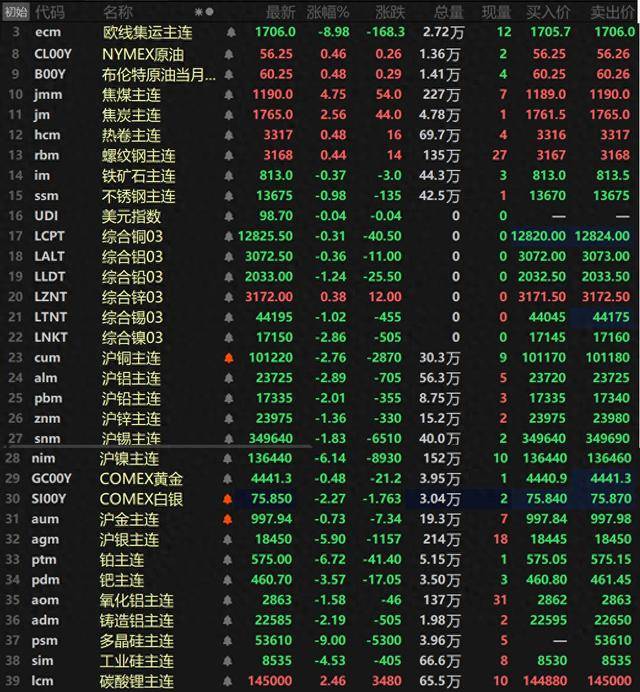
美元下跌 金属集体下挫 多晶硅跌停 沪镍跌超6% 碳酸锂涨逾2%
Sou Hu Cai Jing· 2026-01-08 09:26
Metal Market - Domestic base metals collectively declined, with all falling over 1%. Nickel led the drop with a 6.14% decrease, while copper, aluminum, and lead fell over 2% with copper down 2.76%, aluminum down 2.89%, and lead down 2.01% [1] - Lithium carbonate rose by 2.46%, while industrial silicon fell by 4.53%. Polycrystalline silicon hit a limit down with a 9% drop, priced at 53,610 yuan/ton [1][4] - In the black metal sector, stainless steel fell by 0.98% and iron ore by 0.37%, while other varieties saw slight increases, with rebar and hot-rolled coil both rising under 1% [1] - Precious metals saw declines, with COMEX gold down 0.48% and silver down 2.27%. Domestic gold fell by 0.73% and silver by 5.9% [1][2] Macro Environment - The central bank conducted a 99 billion yuan reverse repurchase operation today, with a bid amount of 99 billion yuan and a fixed interest rate of 1.40%, unchanged from previous operations [5] - The U.S. dollar index decreased by 0.04% to 98.70, with recent employment data indicating a drop in job vacancies, raising expectations for further interest rate cuts by the Federal Reserve [8][9] Oil Market - Both domestic oil prices increased, with U.S. oil rising by 0.46% and Brent oil by 0.48%. The decline in U.S. crude oil inventories exceeded expectations, supporting oil prices [10]
贵金属早报-20260108
Yong An Qi Huo· 2026-01-08 02:34
Group 1: Price Performance - London platinum's latest price is 2362.00 with a change of 116.00; London palladium's latest price is 1773.00 with a change of 51.00; LME copper's latest price is 13120.50 with a change of -251.50 [3] - The latest value of the US dollar index is 98.74 with a change of 0.14; the latest value of euro - US dollar exchange rate is 1.17 with a change of - 0.00; the latest value of pound - US dollar exchange rate is 1.35 with a change of - 0.00; the latest value of US dollar - Japanese yen exchange rate is 156.78 with a change of 0.11 [3] Group 2: Trading Data - COMEX silver's latest inventory is 13863.98 with a change of -108.05; SHFE silver's latest inventory is 553.43 with a change of -28.01 [4] - Gold ETF's latest holding is 1067.13 with no change; silver ETF's latest holding is 16099.83 with a change of -18.33 [4] - The deferred fee payment direction of SGE gold's latest data is 1 with a change of -1.00; the deferred fee payment direction of SGE silver's latest data is 2 with no change [4]
能源化策略日报:委内瑞拉原油供应将逐步正常拖累油价,塑料反弹打开进?套利窗-20260108
Zhong Xin Qi Huo· 2026-01-08 01:43
Report Industry Investment Rating No relevant content provided. Core Views of the Report - The energy and chemical market is disturbed by geopolitical risks, and the chemical industry as a whole continues to fluctuate. The Venezuelan situation affects the supply of crude oil, and the market prices of various energy and chemical products show different trends under multiple factors such as supply - demand, cost, and geopolitics [1][3]. - The trading logic of the chemical market is disturbed by multiple favorable factors, and the strength - weakness relationship between varieties has changed significantly. The rebound of polyolefins has opened the import arbitrage window for polyethylene, and the current rebound may overdraw the future maintenance benefits of the industry [2]. Summary by Variety Crude Oil - **View**: Geopolitical factors continuously disturb, and oil prices continue to fluctuate. The supply of Venezuelan crude oil is expected to gradually normalize, and the global crude oil supply pressure continues. However, geopolitical prospects in Russia - Ukraine, Iran, and Venezuela are the core factors guiding the crude oil supply expectation. Oil prices will continue to fluctuate under the balance of supply surplus and frequent geopolitical disturbances [1][8]. - **Main Logic**: EIA data shows that the US commercial crude oil inventory decreased in the week of January 2, and the weekly production estimate decreased slightly. The refinery operating rate remained high, and the total inventory of crude oil and petroleum products increased seasonally. If the US - Venezuelan crude oil trade volume increases and sanctions are reduced, the supply of Venezuela may recover slightly this year [8]. - **Outlook**: Geopolitical premium fluctuates, and it is regarded as short - term fluctuation [8]. Asphalt - **View**: The US is dealing with the sanctioned Venezuelan crude oil, and the asphalt futures price fluctuates. - **Main Logic**: OPEC+ will suspend production increase in the first quarter. Venezuela is expected to transfer 30 - 50 million barrels of oil to the US. The interruption expectation of Venezuelan crude oil exports is gradually alleviated, and the asphalt raw material supply interruption expectation is also relieved. The asphalt cracking spread is under pressure. The asphalt production in Hainan has increased significantly, and the inventory pressure is still large. The asphalt is overvalued compared with fuel oil [9]. - **Outlook**: The absolute price of asphalt is overvalued [9]. High - Sulfur Fuel Oil - **View**: The Venezuelan situation is controllable, and the fuel oil futures price drops. - **Main Logic**: OPEC+ will suspend production increase in the first quarter, and the supply of heavy oil will surge. The energy crisis in Iraq may lead to the resumption of fuel - oil power generation. However, the high - sulfur fuel oil demand is suppressed by the high - level floating storage in the Asia - Pacific region, and the demand for fuel - oil power generation in the Middle East is gradually replaced by natural gas and photovoltaics [9]. - **Outlook**: Supply and demand are weak [9]. Low - Sulfur Fuel Oil - **View**: The low - sulfur fuel oil futures price fluctuates and declines. - **Main Logic**: It is affected by the decline in shipping demand, green energy substitution, and high - sulfur substitution. The export tax - refund rate of low - sulfur fuel oil has an advantage, and it is expected to face the trend of increased supply and decreased demand. Currently, the valuation is low and it will fluctuate with crude oil [11]. - **Outlook**: It is affected by green fuel substitution and the lack of high - sulfur substitution demand space, but the current valuation is low and it follows the fluctuation of crude oil [11]. Methanol - **View**: The inventory accumulation along the coast slows down, and methanol is expected to be stable and slightly strong under the expectation of inventory reduction. - **Main Logic**: The domestic supply is abundant, and the demand is rational. The port inventory is in an accumulation state, but the growth rate has slowed down, indicating that the reduction of imports is beneficial. However, the current MTO profit is not good, and the operation of some projects needs attention [29]. - **Outlook**: It is regarded as short - term stable and slightly strong [29]. Urea - **View**: The new order transactions push up the price close to the pressure level, and urea is regarded as fluctuating. - **Main Logic**: The supply side has high daily production and operation rate to meet previous orders. The demand side is cautious about high - price goods. The inventory is flat, and the sustainability of new order transactions near the price of 1800 yuan/ton needs attention [30]. - **Outlook**: It is regarded as short - term fluctuation [30]. Ethylene Glycol (MEG) - **View**: The general rise of the coal - chemical industry boosts the atmosphere, but the increase is limited due to fundamental pressure. - **Main Logic**: The coal price rises, and the coal - chemical industry is supported by cost. However, the ethylene glycol's own inventory accumulation cycle is difficult to reverse, so the rebound space is limited [21][22]. - **Outlook**: The short - term price will fluctuate within the range, and the long - term inventory accumulation pressure is still large, with an operation range of [3700 - 3900] [22]. PX - **View**: The sector sentiment is warm, and the downstream demand still has support, so it maintains range consolidation. - **Main Logic**: The international oil price is weak during the day, and the cost support is insufficient. However, the overall rise of downstream PTA is strong, which limits the decline of PX. The supply - demand variables are limited, and the price is expected to fluctuate within a high - level range [13]. - **Outlook**: The short - term price is expected to fluctuate within a high - level range, and the positive - spread logic is maintained [13]. PTA - **View**: The cost guidance is limited, but the enthusiastic sentiment of chemical products supports the price to be firm. - **Main Logic**: The international oil price is average during the day, and the cost support is insufficient. However, the domestic chemical product sector sentiment is high. The demand is expected to weaken, but the overall sentiment is warm, and the social inventory is continuously decreasing. The overall supply - demand is in a tight pattern, and the spot market will fluctuate within a range [14]. - **Outlook**: The price will fluctuate and consolidate with the cost. The TA05 contract can be bought on dips in the medium - term, and short - sold in the range of 5200 - 5300. The TA05 - 09 can be positively spread on dips [15]. Short - Fiber - **View**: The cost provides certain support, but the demand sustainability is insufficient, and the profit is under pressure. - **Main Logic**: The upstream polyester raw materials fluctuate without a clear direction. The downstream demand is continuously insufficient, and some terminal enterprises may enter the holiday state after the middle of the month. The chemical product sentiment is warm, and the short - fiber price is expected to fluctuate and consolidate [25][26]. - **Outlook**: The short - fiber price will fluctuate with the upstream, and the processing fee is slightly under pressure [26]. Bottle - Chip - **View**: More devices are under maintenance in January, and the basis is firm. - **Main Logic**: The commodity market rises as a whole, and the cost support is acceptable. However, the downstream terminal replenishment willingness is not high, which restricts the increase. It is expected that the market center of polyester bottle - chips will fluctuate and adjust [27]. - **Outlook**: The absolute value fluctuates with the raw material, and the support for the processing fee increases [27]. Propylene (PL) - **View**: There is an expectation of PDH maintenance, and PL rises slightly. - **Main Logic**: The expectation of PDH maintenance boosts the price. The enthusiasm of market participants has increased, and the enterprise inventory is low. The powder profit has been slightly repaired, but the downstream demand in the off - season has limited support [36]. - **Outlook**: PL fluctuates in the short term [36]. PP - **View**: The coal price indirectly boosts, but the basis support is limited, and PP rises cautiously. - **Main Logic**: The oil price fluctuates, and the actual reduction in Venezuelan crude oil exports is uncertain. The coal price rebounds in the short term, which indirectly boosts PP. It is the off - season for PP downstream, and the trading volume has decreased after the futures price rebound. The short - term maintenance has increased [35]. - **Outlook**: PP fluctuates in the short term [35]. LLDPE - **View**: The downstream trading volume has decreased, and the upward space of LLDPE is limited. - **Main Logic**: The oil price fluctuates, and the supply of crude oil is disturbed in the short term. The futures price rebounds slightly under the repair of macro - expectations, but the spot is weak, and the basis is weak. It is the off - season for plastic demand, and the demand support is limited [34]. - **Outlook**: LLDPE fluctuates in the short term [34]. PVC - **View**: There are frequent supply disturbances, and PVC is cautiously optimistic. - **Main Logic**: Geopolitical disturbances may boost the sentiment of commodity bulls. From a domestic perspective, the marginal device operation rate has increased slightly, and the profit repair may increase the supply elasticity. From an overseas perspective, some PVC production capacity has withdrawn from the market. The downstream is in the off - season, and the export orders are average [39]. - **Outlook**: Supported by factors such as "anti - involution", spring maintenance expectations, and overseas device disturbances, PVC runs strongly. If the sentiment fades, the adjustment pressure on the disk will increase [39]. Caustic Soda - **View**: The market sentiment is positive, and caustic soda is driven up. - **Main Logic**: Geopolitical disturbances may boost the sentiment of commodity bulls. The expected increase in the electricity cost of restricted - capacity caustic soda in Shaanxi boosts the market sentiment. The alumina marginal device profit is poor, and the demand for caustic soda has marginal support. The upstream production is stable, and the caustic soda cost is expected to increase [41]. - **Outlook**: The disk may fluctuate. The support comes from positive market sentiment and the expectation of cost increase, while the pressure comes from high inventory and pessimistic supply - demand expectations [41].