
有色金属

Search documents
沪铜日报:震荡承压-20260306
Guan Tong Qi Huo· 2026-03-06 11:18
【冠通期货研究报告】 沪铜日报:震荡承压 发布日期:2026 年 3 月 6 日 【行情分析】 沪铜今日低开高走,日内收跌。美国上周初请失业金人数 21.3 万,低于预期且裁员 数大降。2 月 SMM 中国电解铜产量环比减少 3.69 万吨,降幅为 3.13%,同比上升 7.96%,比预期值低 0.11 万吨。预计 3 月产量环比增长 5.28 万吨,同比上升 6.51%,由 于 1 月份检修企业多在 3 月复产,且新投产冶炼厂有增产,预计 3 月份产量可能创历史 新高。由于铜精矿方面趋于短缺,故国内对于废铜需求量预计有增多,而国内政策扰动 废铜产业链,随着需求量的增长,废铜供给缺口预计靠海外进口弥补。铜价连续上行, 下游终端高价抵触情绪严重,铜材端对需求的弱化,目前行业淡季叠加高铜价,预计下 游铜材表现继续承压为主。综合来看,国内两会政策释放的积极信号托底乏力,美联储 降息时间预期推迟,美元近日呈现走强趋势,基本面拖累叠加宏观干扰,沪铜稳中偏弱 格局运行。 资料来源:同花顺期货通(日线图表) 【期现行情】 期货方面:沪铜低开高走,日内收跌。 现货方面:今日华东现货升贴水-70 元/吨,华南现货升贴水-70 ...
有色日报:有色震荡偏弱-20260306
Bao Cheng Qi Huo· 2026-03-06 10:09
1. Report Industry Investment Rating - No relevant content provided 2. Core Views - **Copper**: Today, the main contract of Shanghai copper slightly declined, and the trading volume decreased, indicating that the market has become more cautious. The spot discount remained stable, and the downstream inventory - building demand was limited. The high global copper inventory on the LME and the strong US dollar index continued to suppress short - term prices. Although the policies of the Two Sessions in China stabilized expectations, the manufacturing PMI in February dropped to 49.0, and the demand recovery needs further verification. Recently, Shanghai copper may maintain a volatile pattern [6] - **Aluminum**: Today, the main contract of Shanghai aluminum slightly declined, and the trading volume decreased, indicating a cooling market sentiment. The continuous decline of LME aluminum inventory supported long - term prices. However, the US dollar index rose to around 99, and the trading of supply disruptions in the Middle East eased, leading to a weak short - term trend. The downstream resumption of work was average, and the terminal demand did not increase significantly. The market may enter a volatile adjustment [7] 3. Summary by Related Catalogs Copper - related Charts - **Chart 1**: Copper basis [9][10] - **Chart 2**: Copper monthly spread [17] - **Chart 3**: SHFE warehouse receipts [11] - **Chart 4**: LME inventory [15] - **Chart 5**: COMEX inventory [13] - **Chart 6**: London copper premium/discount [18] Aluminum - related Charts - **Chart 7**: Aluminum basis [19][21] - **Chart 8**: Aluminum monthly spread [22] - **Chart 9**: SHFE warehouse receipts daily report [24] - **Chart 10**: Shanghai - London ratio [24] - **Chart 11**: LME inventory [24] - **Chart 12**: London aluminum premium/discount [26]
有色金属行业双周报(2026、02、20-2026、03、05):有色金属高位震荡,静待二季度供需验证-20260306
Dongguan Securities· 2026-03-06 09:26
Investment Rating - The report maintains a "Market Weight" rating for the non-ferrous metals industry, indicating that the industry index is expected to perform within ±10% of the market index over the next six months [67]. Core Insights - The non-ferrous metals industry has experienced a high level of volatility, with a recent increase of 5.64% over the past two weeks, outperforming the CSI 300 index by 5.91 percentage points, ranking 5th among 31 industries [2][11]. - The report highlights that the rare earth sector is expected to see a second growth peak in demand due to humanoid robots, while supply-side constraints persist [4][63]. - Tungsten prices have surged over 500% since early 2025, leading to cautious investment recommendations due to potential negative feedback on downstream alloy demand [4][63]. - Precious metals are currently facing downward pressure due to geopolitical tensions and inflation concerns, but gold remains a significant asset for long-term investment [4][64]. - Industrial metals are anticipated to stabilize as traditional consumption peaks approach, with prices expected to recover gradually [4][64]. Summary by Sections Market Review - As of March 5, 2026, the non-ferrous metals industry has seen a year-to-date increase of 20.50%, outperforming the CSI 300 index by 20.12 percentage points [11]. - The small metals sector has risen by 10.44%, precious metals by 8.09%, industrial metals by 5.10%, new metal materials by 3.07%, and energy metals by 1.00% over the past two weeks [11][16]. Price Analysis - As of March 5, 2026, key industrial metal prices are as follows: - LME Copper: $12,859.00/ton - LME Aluminum: $3,292.50/ton - LME Lead: $1,943.50/ton - LME Zinc: $3,230.00/ton - LME Nickel: $17,215.00/ton - LME Tin: $49,405.00/ton [22][64]. Industry News - The report notes significant developments in the rare earth sector, including a recent price recovery and anticipated demand growth driven by technological advancements [4][63]. - The discovery of over 150 million tons of rare earth minerals in the Dominican Republic could position the country as a key supplier in the global market [60][61]. Weekly Insights - The report suggests monitoring companies such as Northern Rare Earth (600111) for potential investment opportunities due to expected demand growth in the rare earth sector [4][65]. - Western Mining (601168) and Luoyang Molybdenum (603993) are also highlighted for their strong performance and growth potential in the industrial metals sector [4][65].



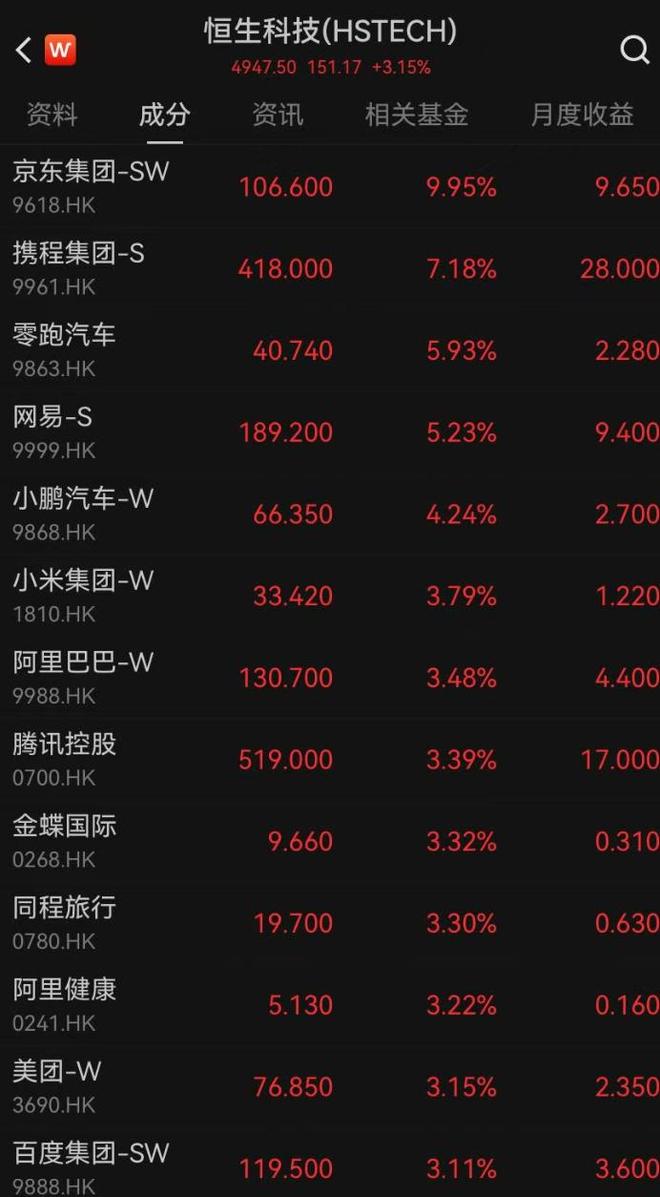
港股大涨!互联网龙头股价飙升,京东大涨10%,携程涨超7%,腾讯、阿里涨超3%,京东物流暴涨23%|港股收盘
Mei Ri Jing Ji Xin Wen· 2026-03-06 09:12
Market Performance - The Hong Kong stock market experienced a significant increase, with the Hang Seng Index rising by 1.72% and the Hang Seng Tech Index increasing by 3.15% [1] - Major internet companies saw substantial gains, including JD.com up by 10%, Trip.com up by 7%, and NetEase up by 5% [1] Individual Stock Movements - JD Logistics surged by 23%, indicating strong market interest [3] - Other notable performers included Tencent Holdings and Alibaba, both rising over 3% [1][2] Sector Performance - The healthcare, software, and food and beverage sectors experienced notable increases, while the metals and steel sectors saw declines [5][6] - Specific sector indices showed significant growth, with the Hong Kong healthcare index up by 3.34% and the software services index up by 2.85% [6]


若美伊冲突长期化,对全球资产有何影响?
李迅雷金融与投资· 2026-03-06 07:09
Core Viewpoint - The article discusses the implications of the recent US-Israel military actions against Iran, highlighting the potential for prolonged conflict and its impact on global geopolitical dynamics and asset pricing. Group 1: Reasons for Prolonged Conflict - The current military actions represent a shift in US strategy from targeting Iran's nuclear capabilities to regime change, indicating a fundamental change in the nature of the conflict [1]. - The timing of the military strikes coincided with negotiations, eliminating any potential for diplomatic resolution and escalating the conflict into a civilizational clash [2]. - Unlike Syria and Libya, Iran's regime is supported by a strong military foundation, making rapid regime change unlikely [3]. Group 2: Iran's Military Capabilities - Iran has developed a self-sufficient defense industry due to decades of sanctions, making it difficult for external forces to dismantle its military capabilities [4]. - The cost-effectiveness of Iran's military assets, such as drones, allows it to sustain prolonged conflict at a lower financial burden compared to its adversaries [4]. Group 3: Political Dynamics in the US - The Trump administration faces internal pressures regarding the legitimacy of military actions without Congressional approval, complicating the conflict's management [5]. - There is a growing divide within Trump's support base regarding the military actions, with some allies opposing the conflict as contrary to "America First" principles [5]. Group 4: Global Economic Implications - The conflict is expected to reshape global economic models, with a potential shift in how national power is assessed, moving away from traditional economic indicators to military and strategic capabilities [10][25]. - China's strategic position is likely to strengthen as it remains militarily unengaged while being a major manufacturing power, similar to the US during World War II [11]. Group 5: Asset Pricing Impact - The conflict has already led to significant volatility in energy prices, with Brent crude oil experiencing sharp increases due to supply fears [13]. - Global stock markets have reacted negatively, particularly in regions heavily reliant on energy imports, with notable declines in indices such as Japan's Nikkei and South Korea's KOSPI [15]. - Gold prices have shown unusual behavior, initially rising but then experiencing a pullback due to liquidity issues and market dynamics [20][21]. Group 6: Investment Recommendations - There is an anticipated increase in demand for resources and energy infrastructure, suggesting a favorable outlook for commodities like copper and rare earths [27]. - The military and technological sectors, particularly AI and drone technology, are expected to see growth as the conflict continues [28]. - Hong Kong's position as a financial hub may be re-evaluated, with potential for valuation recovery as it serves as a bridge between Chinese manufacturing and global capital [28].

拥抱顺周期系列1:顺周期的上涨或刚开始
Huachuang Securities· 2026-03-06 06:28
Market Overview - The cyclical market is perceived to be strong, but concerns about high valuations exist; however, from a 5-year perspective, the cyclical rally may just be beginning[3] - From 2021 to 2025, the domestic real estate cycle was declining, and the PPI continued to bottom out, leading to a bear market in cyclical industries[6] - The overall cumulative increase of the Wind All A index from September 2021 to September 2025 was 11%, while construction materials fell by 36%, steel by 35%, and basic chemicals by 21%[6] Valuation Insights - The overall valuation of cyclical industries is not expensive, with current valuations around the 50% percentile of the past 20 years; for example, steel is at 1.3x PB (60% percentile) and basic chemicals at 2.6x PB (56% percentile)[8] - In a bull market environment at 4100 points on the Shanghai Composite, it is challenging to find absolutely cheap quality stocks[8] Macro Fundamentals - The performance recovery of cyclical industries is expected as PPI year-on-year growth is anticipated to turn positive, which typically leads to profit growth and ROE recovery[9] - As of January 2026, PPI was still in a negative growth range at -1.4%, with cyclical sector ROE around 8% and profit growth near 0%[9] Institutional Behavior - Institutional investors have just begun to increase their positions in cyclical sectors, with current allocations still low; for instance, as of Q4 2025, the allocation to non-ferrous metals was 8%[12] - The allocation to basic chemicals was 3%, and to construction materials was only 0.7%[12] Supply-Side Dynamics - The supply-side constraints have led to a long-cycle dividend, with capital expenditures in cyclical industries declining over the past five years, resulting in tight supply conditions[14] - For example, capital expenditure to depreciation ratios for coal remained at 1-1.5, while for steel it dropped from 1.2 to 0.8[18] Historical Context - Historical comparisons indicate that the current cyclical rally has not yet ended; previous cyclical rallies lasted around 400-500 trading days, while the current rally has only lasted 164 trading days since July 2025[24] - The last cyclical downturn saw significant increases in commodity prices, with the CRB index showing a maximum increase of over 200% during previous cycles[19]
铜冠金源期货商品日报-20260306
Tong Guan Jin Yuan Qi Huo· 2026-03-06 02:57
1. Report Industry Investment Rating No relevant content provided. 2. Core Viewpoints of the Report - Overseas, the escalation of military actions between the US, Israel, and Iran may last for months, leading to increased uncertainties in the energy and shipping markets. Rising oil prices strengthen inflation expectations, causing the market to postpone the expected timing of the Fed's first interest rate cut to September and expect only one cut this year. In the domestic market, the Two Sessions set the GDP target for 2026 at 4.5% - 5%, and A - shares are expected to maintain a volatile recovery in the short term [2][3]. - For precious metals, the adjustment is not over yet, with the gold price trend remaining stronger than the silver price, and the gold - silver ratio continuing to correct upwards [5]. - Copper prices are expected to maintain high - level volatility in the short term due to factors such as the impact of the US - Iran conflict on inflation and the tight supply pattern [6][7]. - Aluminum prices are expected to remain high and fluctuate widely in the short term, with geopolitical risks being the core driving factor [8][9]. - Alumina is expected to have a short - term preference for oscillation, but there is still significant upward pressure in the long term [10]. - Cast aluminum is expected to oscillate at a high level, with cost support and market sentiment being easily affected by news [11]. - Zinc prices are expected to maintain high - level oscillation, with macro factors being the main driver and high inventory still exerting pressure [12]. - Lead prices are expected to maintain low - level wide - range oscillation due to high inventory and limited demand improvement [14]. - Tin prices are expected to maintain high - level adjustment, with the market focusing on inflation and the supply improvement expectation increasing [15]. - Nickel prices are expected to remain oscillating, with the cost - end support weakening and the global nickel supply - demand structure shifting to a tight balance [16][17]. - Steel prices are expected to show an oscillating trend, with production remaining stable, apparent demand recovering, and inventory continuing to accumulate [19]. - Iron ore prices are expected to oscillate and stabilize, with supply and demand both affected by factors such as the Two Sessions and steel mill production restrictions [20]. - Coking coal and coke prices are expected to oscillate in the short term, with the profitability of coking enterprises turning positive and the market affected by factors such as steel mill production and policy support [21]. - Soybean meal and rapeseed meal prices are expected to oscillate, with the US soybean export increasing and the South American harvest gradually materializing [22][23]. - Palm oil prices are expected to oscillate strongly in the short term, supported by rising oil prices and expected inventory decline [24]. 3. Summary by Relevant Catalogs 3.1 Macro - Overseas: The military actions between the US, Israel, and Iran have escalated, with Iran refusing to negotiate and claiming the ability to counter - attack. The Asian energy market has entered an emergency state, and rising oil prices have strengthened inflation expectations, causing the market to postpone the expected timing of the Fed's first interest rate cut to September and expect only one cut this year. The US stock market closed down, the US dollar index oscillated around 99, the 10 - year US Treasury bond yield rose to 4.13%, gold, silver, and copper closed down, and oil prices rose by more than 3%. Attention is paid to the US February non - farm payroll report [2]. - Domestic: The Two Sessions set the GDP target for 2026 at 4.5% - 5%, the inflation target at 2%, the budget fiscal deficit at 5.89 trillion yuan (with a deficit rate of 4%), the local special bond quota at 4.4 trillion yuan, and issued 1.6 trillion yuan in special treasury bonds. The policy focuses on expanding domestic demand, cultivating new drivers, and developing technology, while maintaining a moderately loose monetary environment. A - shares are expected to maintain a volatile recovery in the short term [3]. 3.2 Precious Metals - On Thursday, international precious metal futures prices declined. The COMEX gold futures fell 0.81% to $5093.30 per ounce, and the COMEX silver futures fell 0.80% to $82.52 per ounce. The Fed's hawkish signals, inflation pressure, and strong employment data have strengthened the expectation of no interest rate cut, putting pressure on precious metal prices. The conflict between the US and Iran has intensified, increasing concerns about energy supply and inflation, and reducing the possibility of interest rate cuts. The market expects the Fed to keep interest rates unchanged at the March 18 policy meeting. The CME has lowered the margin for gold and silver. The adjustment of precious metals is not over yet, and the gold - silver ratio will continue to correct upwards. Investors are closely watching the US February employment report [4][5]. 3.3 Copper - On Thursday, the main contract of Shanghai copper continued to oscillate, and LME copper adjusted to around $12,800 to seek support. The domestic spot market for electrolytic copper improved, and the LME inventory rose to 261,000 tons, while the COMEX inventory remained at 600,000 tons. The US - Iran conflict has led to a rise in oil prices, increasing inflation expectations and possibly delaying the Fed's interest rate cut, which has cooled market risk appetite and put pressure on the metal market. The domestic government work report focuses on cultivating new - quality productive forces. The copper supply pattern remains tight, and the inventory accumulation rate has slowed down. Copper prices are expected to maintain high - level volatility in the short term [6][7]. 3.4 Aluminum - On Thursday, the main contract of Shanghai aluminum closed at 24,815 yuan per ton, up 1.31%, and the LME closed at $3,292.5 per ton, down 1.29%. The electrolytic aluminum ingot inventory increased by 72,000 tons to 1.229 million tons, and the aluminum rod inventory in the main domestic consumption areas increased by 5,500 tons to 403,500 tons. The core driving factor for aluminum prices is geopolitical risks, and the repeated news has intensified market fluctuations. The passage of the Strait of Hormuz remains uncertain, and the risk of supply interruption has not been eliminated. Aluminum prices are expected to remain high and fluctuate widely in the short term [8][9]. 3.5 Alumina - On Thursday, the main contract of alumina futures closed at 2,800 yuan per ton, up 0.18%. The national average spot price of alumina rose by 5 yuan to 2,673 yuan per ton, with a discount of 100 yuan per ton. The increase in the cost expectation driven by the limit - up of caustic soda futures and the reduction in supply due to the production cut of an alumina plant in Guizhou have led to a short - term preference for oscillation. However, there is still significant upward pressure in the long term due to large new and potential复产 capacities [10]. 3.6 Cast Aluminum - On Thursday, the main contract of cast aluminum alloy futures closed at 23,420 yuan per ton, up 1.23%. The cost support is significant, and casting aluminum enterprises have a strong willingness to raise prices. However, the market sentiment is easily affected by news due to the unclear situation in the Middle East. Cast aluminum is expected to oscillate at a high level [11]. 3.7 Zinc - On Thursday, the main contract of Shanghai zinc first rose and then fell during the day and continued to decline at night, and LME zinc closed down. The market supply increased, and downstream demand was weak, with the inventory continuing to accumulate. Rising oil prices have affected the Fed's interest rate cut expectation, and the US dollar is strong, which suppresses zinc prices. However, the cost support is still strong, and the policy is positive. Zinc prices are expected to maintain high - level oscillation [12]. 3.8 Lead - On Thursday, the main contract of Shanghai lead oscillated horizontally during the day and declined at night, and LME lead closed down. Due to equipment maintenance and policy control, the resumption of some secondary lead smelters has been postponed to April, and the supply pressure has been relieved. However, the downstream battery factories and dealers have high inventory, and the demand for replenishment is weak. The social inventory remains at a high level, and lead prices are expected to maintain low - level wide - range oscillation [14]. 3.9 Tin - On Thursday, the main contract of Shanghai tin dived in the afternoon, stabilized at the end of the session, and oscillated narrowly at night, and LME tin oscillated. The concern about the obstruction of the Strait of Hormuz has eased, and the US Treasury will announce measures to deal with rising energy prices. The supply improvement expectation has increased, and the support from the supply side has weakened. However, the decline in futures prices has increased the downstream replenishment expectation, limiting the adjustment space of futures prices. Tin prices are expected to maintain high - level adjustment [15]. 3.10 Nickel - On Thursday, the main contract of Shanghai nickel maintained oscillation, and LME nickel adjusted to around 17,300 to seek support. The global energy crisis concern has cooled down in the short term, and the risk - aversion sentiment has declined. Although the Philippines is in the rainy season, the nickel ore export has not decreased significantly. Considering the supply increase after the rainy season, the upward trend of nickel ore prices may not be sustainable. The cost - end support has weakened, and the global nickel supply - demand structure will shift to a tight balance. Nickel prices are expected to remain oscillating [16][17]. 3.11 Steel (Screw and Coil) - On Thursday, steel futures oscillated. The spot market trading volume was 60,000 tons. The supply of the five major steel products increased slightly, the total inventory increased by 5.7%, and the consumption of building materials increased by 90.8%. The Two Sessions are in line with expectations, and the macro - policy is positive. However, the real estate market is still at risk, and the terminal expectation is moderate. Steel production remains stable, the apparent demand recovers, and the inventory continues to accumulate. Steel prices are expected to show an oscillating trend [19]. 3.12 Iron Ore - On Thursday, iron ore futures oscillated. The port spot trading volume was 720,000 tons. The supply from overseas increased slightly, and the arrival decreased. The inventory pressure is still large. The macro - expectation has landed, and the steel mills in the north are under production restrictions, so the demand is limited. Iron ore prices are expected to oscillate and stabilize [20]. 3.13 Coking Coal and Coke - On Thursday, coking coal and coke futures oscillated. The profitability of coking enterprises has turned positive, and the production has remained stable. However, the inventory pressure of coking enterprises has increased, and there is an expectation of price cuts for coke. The coal production in the origin has returned to normal, and the supply of coking coal is loose. The demand from steel mills in Tangshan and other places is limited, and they mainly consume inventory. Coking coal and coke prices are expected to oscillate in the short term [21]. 3.14 Soybean Meal and Rapeseed Meal - On Thursday, the soybean meal 05 contract rose 0.28% to 2,843 yuan per ton, and the rapeseed meal 05 contract rose 0.13% to 2,318 yuan per ton. The US soybean export increased by 383,500 tons this week. The production estimates of soybeans in South America have been adjusted slightly, and the supply and export are increasing. The import cost of soybeans supports the domestic market, but the upward space is limited. Soybean meal and rapeseed meal prices are expected to oscillate [22][23]. 3.15 Palm Oil - On Thursday, the palm oil 05 contract rose 1.28% to 9,070 yuan per ton. The rise in oil prices has led to an increase in diesel prices, and the palm oil price is at a discount compared to diesel. The threat of interrupted vegetable oil transportation through the Middle East route has supported the palm oil price. The market expects the inventory of Malaysian palm oil to continue to decline at the end of February, and India may increase palm oil purchases. Palm oil prices are expected to oscillate strongly in the short term [24].
铜:现货贴水收窄,限制价格回落
Guo Tai Jun An Qi Huo· 2026-03-06 02:56
2026 年 03 月 06 日 | | | 昨日收盘价 | 日涨幅 | 昨日夜盘收盘价 | 夜盘涨幅 | | --- | --- | --- | --- | --- | --- | | | 沪铜主力合约 | 101,080 | -0.57% | 100980 | -0.10% | | | 伦铜3M电子盘 | 12,859 | -1.29% | - | - | | | | 昨日成交 | 较前日变动 | 昨日持仓 | 较前日变动 | | 期 货 | 沪铜指数 | 270,654 | -54,409 | 585,448 | 13,044 | | | 伦铜3M电子盘 | 27,857 | 3,005 | 305,000 | -953 | | | | 昨日期货库存 | 较前日变动 | 注销仓单比 | 较前日变动 | | | 沪铜 | 303,632 | 1,157 | - | - | | | 伦铜 | 282,200 | 20,675 | 5.20% | -0.45% | | | | | 昨日价差 | 前日价差 | 较前日变动 | | | LME铜升贴水 保税区仓单升水 | | -19.03 46 | -43.95 ...
湘财证券晨会纪要-20260306
Xiangcai Securities· 2026-03-06 02:51
Financial Engineering - As of February 28, 2026, there are 13,817 existing funds in the market, an increase of 95 funds compared to the previous month. The total net asset value of funds is 37.23 trillion yuan, which is an increase of 9.7 billion yuan, indicating a slight growth in the fund market size [2] - In February 2026, the returns of value, balanced, and growth fund indices were 1.00%, 1.40%, and 0.72% respectively, with balanced funds outperforming growth funds, showing a certain degree of performance divergence among different styles of funds [2] ETF Market Tracking - As of February 28, 2026, there are 1,446 ETFs in the Shanghai and Shenzhen markets, an increase of 16 from the previous period. The total asset management scale is 5.39 trillion yuan, a decrease of 73.79 billion yuan, while the total shares amount to 33.4 trillion, an increase of 60.17 billion shares [3] - In February, the median return of stock ETFs was 0.70%, while cross-border ETFs had the lowest median return of -3.30%. Bond ETFs had a median return of 0.21%, outperforming commodity ETFs [3] - Cross-border ETFs exhibited the highest internal deviation in February, while stock and commodity ETFs had internal deviations of 3.18% and 0.89% respectively. Bond ETFs had the lowest internal deviation at 0.11% [3] ETF Strategy Tracking - The industry ETF rotation strategy focused on steel, coal, and non-ferrous metals in February 2026, achieving a cumulative return of 6.17%, significantly outperforming the cumulative return of the CSI 300 index at 0.09%, resulting in an excess return of 6.08%. Year-to-date, the strategy's cumulative return is 71.82%, compared to the CSI 300's 21.67%, yielding an excess return of 50.15% [4] - The PB-ROE framework's industry ETF rotation strategy focused on non-ferrous metals, transportation, and utilities in February 2026, with a cumulative return of 4.25%, again outperforming the CSI 300 index's 0.09% return, leading to an excess return of 4.16%. Year-to-date, this strategy's cumulative return is 34.51%, compared to the CSI 300's 21.67%, resulting in an excess return of 12.84% [4] Investment Recommendations - For March 2026, there is a positive outlook on the non-ferrous metals, steel, and coal industries, with corresponding ETFs recommended for these sectors. Additionally, based on the PB-ROE situation and supplementary indicators, the ETF rotation strategy suggests focusing on the communication, agriculture, forestry, animal husbandry, and coal industries, with corresponding ETFs recommended for these sectors as well [5]
有色套利早报-20260306
Yong An Qi Huo· 2026-03-06 02:38
Report Industry Investment Rating - Not provided Core View - The report presents cross - market, cross - period, spot - futures, and cross - variety arbitrage tracking data for various non - ferrous metals including copper, zinc, aluminum, nickel, lead, and tin on March 6, 2026 [1][3] Summary by Relevant Catalogs Cross - Market Arbitrage Tracking - **Copper**: Spot price in China is 101490, LME price is 12941, and the ratio is 7.82; March price in China is 101230, LME price is 12986, and the ratio is 7.85. The equilibrium ratio for spot import is 7.85 with a profit of - 1074.42, and the profit for spot export is - 739.10 [1] - **Zinc**: Spot price in China is 24710, LME price is 3285, and the ratio is 7.52; March price in China is 24570, LME price is 3313, and the ratio is 5.08. The equilibrium ratio for spot import is 8.25 with a profit of - 2375.80 [1] - **Aluminum**: Spot price in China is 25120, LME price is 3355, and the ratio is 7.49; March price in China is 24890, LME price is 3358, and the ratio is 7.55. The equilibrium ratio for spot import is 8.31 with a profit of - 2750.22 [1] - **Nickel**: Spot price in China is 135200, LME price is 17079, and the ratio is 7.92. The equilibrium ratio for spot import is 7.99 with a profit of - 1303.61 [1] - **Lead**: Spot price in China is 16675, LME price is 1905, and the ratio is 8.73; March price in China is 16800, LME price is 1949, and the ratio is 12.73. The equilibrium ratio for spot import is 8.51 with a profit of 418.22 [3] Cross - Period Arbitrage Tracking - **Copper**: The spreads between the next month, March, April, May and the spot month are - 330, - 180, - 120, - 90 respectively, and the theoretical spreads are 609, 1116, 1632, 2148 respectively [3] - **Zinc**: The spreads between the next month, March, April, May and the spot month are 120, 170, 215, 235 respectively, and the theoretical spreads are 225, 356, 487, 618 respectively [3] - **Aluminum**: The spreads between the next month, March, April, May and the spot month are 135, 210, 245, 290 respectively, and the theoretical spreads are 234, 370, 505, 641 respectively [3] - **Lead**: The spreads between the next month, March, April, May and the spot month are 20, 45, 80, 115 respectively, and the theoretical spreads are 209, 314, 418, 523 respectively [3] - **Nickel**: The spreads between the next month, March, April, May and the spot month are - 960, - 460, - 280, - 90 respectively [3] - **Tin**: The spread between the 5 - month and 1 - month is - 520, and the theoretical spread is 8032 [3] Spot - Futures Arbitrage Tracking - **Copper**: The spreads between the current - month contract, next - month contract and the spot are - 35, - 365 respectively, and the theoretical spreads are 247, 758 respectively [3] - **Zinc**: The spreads between the current - month contract, next - month contract and the spot are - 310, - 190 respectively, and the theoretical spreads are 86, 229 (also mentioned with theoretical spreads of 56, 224) [3] - **Lead**: The spreads between the current - month contract, next - month contract and the spot are 80, 100 respectively, and the theoretical spreads are 121, 233 respectively [3] Cross - Variety Arbitrage Tracking - The ratios of copper/zinc, copper/aluminum, copper/lead, aluminum/zinc, aluminum/lead, lead/zinc in Shanghai (three - continuous) are 4.12, 4.07, 6.03, 1.01, 1.48, 0.68 respectively, and in London (three - continuous) are 4.00, 3.91, 6.65, 1.02, 1.70, 0.60 respectively [3]