白银

Search documents
时至年末,回顾今年的投资,聊聊复盘与应对
Sou Hu Cai Jing· 2025-11-13 01:26
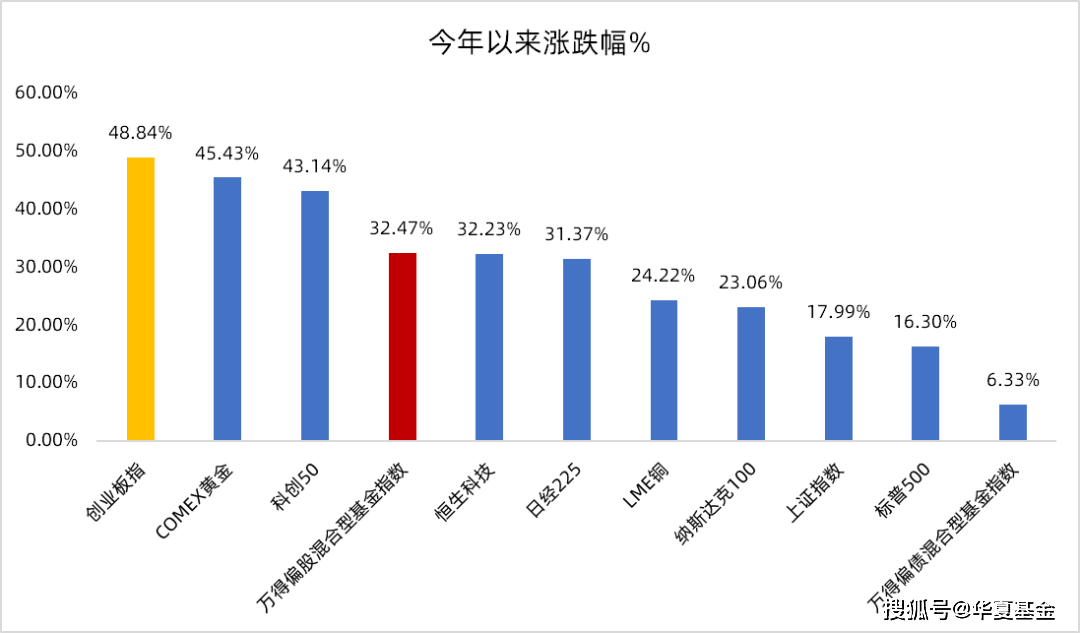
Core Insights - The year 2025 has been marked by significant market movements, with the Shanghai Composite Index reaching a nearly ten-year high, validating earlier bullish predictions [1] - Key themes for 2025 include the impact of Trump's new policies, domestic policy responses, and the challenges of asset allocation in a low-interest-rate environment [1] - The A-share market has seen a surge in investor participation, with nearly 250 million investors, indicating a robust market environment [2] Market Performance - A-shares and Hong Kong stocks have performed well, driven by sectors like AI and innovative pharmaceuticals, with the ChiNext Index outperforming gold [3] - Among 31 primary industries, 30 have reported positive returns, with a stark contrast between the leading materials sector and the declining food and beverage sector, showing an 80% difference [4] - Various fund types have achieved positive returns, with equity and mixed funds averaging 29.97% and 26.17% returns respectively [7] Fund Performance - Commodity funds have seen unprecedented gains, with returns nearing 40%, while QDII funds have also performed well with a 26.46% increase [8] - FOF funds have benefited from diversified asset allocation, achieving an average return of 15.84%, marking one of the best years historically [8] - Bond funds have lagged, with an average return of only 2.13%, although convertible bond funds have performed better, exceeding 20% returns [8] Investment Trends - The concept of "slow bull" has gained traction, with expectations for a sustainable market rally over the next two to three years, supported by technological innovation and policy backing [16] - Investors are increasingly favoring low-volatility products, with a focus on absolute returns and diversified strategies [14] - The market is characterized by alternating sentiments of fear and greed, with a need for disciplined investment approaches amidst volatility [12][19]

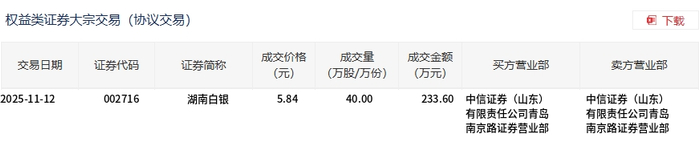
湖南白银今日大宗交易折价成交40万股,成交额233.6万元
Xin Lang Cai Jing· 2025-11-12 09:02
Core Insights - On November 12, Hunan Silver conducted a block trade of 400,000 shares, with a transaction value of 2.336 million yuan, accounting for 0.34% of the total transaction volume for the day [1][2] - The transaction price was 5.84 yuan, representing a discount of 9.32% compared to the market closing price of 6.44 yuan [1] Summary by Category Transaction Details - Transaction Date: November 12, 2025 [2] - Security Code: 002716 [2] - Security Name: Hunan Silver [2] - Transaction Price: 5.84 yuan [2] - Transaction Volume: 400,000 shares [2] - Transaction Amount: 2.336 million yuan [2] - Buyer Brokerage: CITIC Securities (Shandong) [2] - Seller Brokerage: CITIC Securities (Shandong) [2]

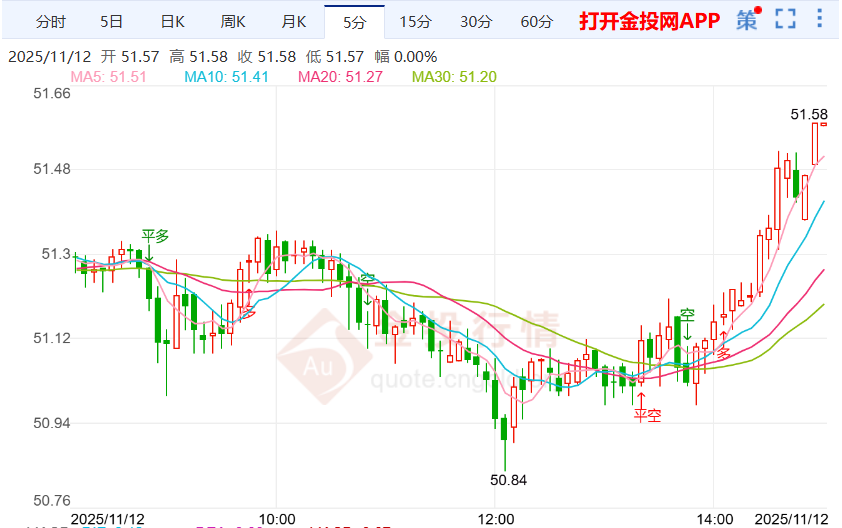
北约讨论援乌议题国际白银高涨
Jin Tou Wang· 2025-11-12 07:53
Group 1 - International silver is currently trading above $51.43, with an opening price of $51.15 and a current price of $51.56, reflecting a 0.73% increase [1] - The highest price reached today is $51.59, while the lowest was $50.84, indicating a short-term bullish trend in the silver market [1] - The silver market is expected to continue its upward trajectory, with a target of $52 in the near term and a maximum target of $53 for the week [4] Group 2 - NATO Secretary General Jens Stoltenberg met with Ukrainian Deputy Prime Minister Taras Kachka to discuss Ukraine's progress in reforms and defense needs [3] - Kachka emphasized the importance of NATO's recommendations for Ukraine's security and defense reforms by 2026 [3] - The EU remains the largest financial supporter of Ukraine, which heavily relies on external aid due to significant defense spending impacting social and humanitarian expenditures [3]
金价突破4040美元,费率成本最低的黄金股ETF涨近2%,黄金ETF华夏7连“吸金”
Ge Long Hui· 2025-11-10 02:35
Group 1 - The core viewpoint of the articles highlights a significant rise in the precious metals sector, with spot gold surpassing $4040 per ounce and a notable increase in gold and silver ETFs [1][2] - The People's Bank of China increased its gold reserves by 30,000 ounces at the end of October, marking the 12th consecutive month of gold accumulation [2] - Weak economic indicators from the U.S., including a surge in layoffs and declining consumer confidence, have heightened the appeal of precious metals as safe-haven assets, leading to increased expectations for a Federal Reserve rate cut in December [2] Group 2 - Domestic gold ETF holdings in China saw an increase of 79.02 tons in the first three quarters of 2025, representing a year-on-year growth of 164.03% [2] - State Street Global Advisors raised its most optimistic gold price forecast to $4100-$4500 per ounce, suggesting that despite potential overbought conditions, gold remains underrepresented in investment portfolios [2] - The gold stock ETF (159562) rose by 1.92%, while the Huaxia Gold ETF (518850) increased by 0.87%, with the latter attracting a net inflow of 2.3 billion yuan over the past 20 days [3]
中信建投:中长期依然看多黄金
Di Yi Cai Jing· 2025-11-10 00:16
Group 1 - The sentiment index for A-shares and Hong Kong stocks is declining from high levels, with a decrease in the VIX for the Shanghai 50, CSI 300, CSI 500, and CSI 1000 [1] - Current institutional focus is on the defense and military industry, while attention in the telecommunications sector has decreased from high levels [1] - There has been an increase in institutional interest in the "oil and petrochemicals," "coal," "steel," "retail," and "non-bank financial" sectors over the past week [1] Group 2 - Many industries are currently at the threshold of triggering congestion indicators, including liquidity, constituent stock diffusion, and constituent stock consistency [1] - The relative returns for electric power and utilities, basic chemicals, electric equipment and new energy, electronics, and computers are expected to be favorable by November 2025 [1] - The VIX for gold, silver, copper, and crude oil has decreased, with a long-term bullish outlook on gold [1]

日度策略参考-20251107
Guo Mao Qi Huo· 2025-11-07 06:35
Report Industry Investment Rating No relevant content provided. Core Viewpoints of the Report - The current macro - level is in a relatively vacuum period, A - shares lack a clear upward main line, market trading volume remains low, and the stock index continues to fluctuate, accumulating momentum for the next round of upward movement. Meanwhile, with policy support and abundant macro - liquidity, there is still strong support below the stock index [1]. Summary by Related Catalogs Macro Finance - **Treasury Bonds**: Asset shortage and weak economy are beneficial to bond futures, but the central bank has recently warned of interest - rate risks, suppressing the upward space, showing an oscillating trend [1]. - **Copper**: The tight pattern of US dollar liquidity has eased, market risk appetite has recovered, and copper prices have stopped falling [1]. - **Aluminum**: Recently, the industrial - side driving force is limited, and the macro - level benefits have been digested, so aluminum prices are oscillating [1]. - **Alumina**: With still a small profit in production, domestic alumina production capacity is continuously released, and both production and inventory are increasing, putting pressure on the spot price. Recently, attention should be paid to the cost support [1]. - **Zinc**: The US government shutdown has reached the longest historical record, and market risk - aversion sentiment has increased. The LME zinc inventory has been continuously decreasing, and the short - squeeze movement has driven zinc prices higher. However, considering the domestic oversupply, caution is needed when chasing high prices [1]. Non - ferrous Metals - **Nickel**: The better - than - expected US ADP data has alleviated concerns about the US economic recession, but the expectation of the Fed's interest - rate cut has been suppressed, and market risk appetite has fluctuated. Indonesia has recently restricted the approval of nickel - related smelting projects again, but the approved projects are not affected. In the fourth quarter, attention should be paid to the approval of nickel - ore quotas in 2026. Nickel prices may oscillate in the short term, and high inventory pressure should be watched out for. It is recommended to trade within a short - term range, and the long - term surplus pattern of primary nickel will continue [1]. - **Stainless Steel**: The better - than - expected US ADP data has alleviated concerns about the US economic recession, but the expectation of the Fed's interest - rate cut has been suppressed, and market risk appetite has fluctuated. Indonesia has restricted the approval of nickel - related smelting projects again, but the approved projects are not affected. In the fourth quarter, attention should be paid to the progress of the approval of Indonesian nickel - ore quotas, and the premium at the ore end is currently stable. The price of raw - material ferronickel has weakened slightly, the social inventory of stainless steel has decreased slightly, and the steel mills' production plan for October is stable. Macro - sentiment is fluctuating, steel mills have recently lifted price limits, and stainless - steel futures are oscillating at the bottom. It is recommended to trade short - term and look for opportunities to sell on rallies [1]. - **Tin**: Recently, the positive macro - sentiment has been digested. Considering that the raw - material end of tin has not recovered and the new - quality demand is expected to be good, it is still recommended to pay attention to the opportunity of going long on dips in the long - term [1]. Precious Metals and New Energy - **Precious Metals (Gold and Silver)**: Judges of the high - court generally question the legitimacy of tariffs, increasing market uncertainty and supporting precious - metal prices. However, the resilience of US economic data has disrupted the interest - rate cut expectation. Precious metals are expected to oscillate within a range in the short term [1]. - **Industrial Silicon**: The production capacity in the northwest is continuously resuming, the start - up in the southwest is weaker than in previous years, and the impact of the dry season is weakened [1]. - **Polysilicon**: In the long - term, there is an expectation of production - capacity reduction. In the fourth quarter, the terminal installation will increase marginally. The anti - involution policy has not been implemented for a long time, and market sentiment has faded [1]. - **Lithium Carbonate**: The traditional peak season for new - energy vehicles is approaching, the energy - storage demand is strong, but the hedging pressure is large [1]. Ferrous Metals - **Rebar**: There are concerns about the potential weakening of industrial demand in the off - season. After the macro - sentiment is realized, attention should be paid to the upward pressure. It is advisable to participate in the out - of - the - money accumulative put option strategy [1]. - **Hot - Rolled Coil**: The off - season effect of the industry is not obvious, but the industrial structure is still loose. Similarly, attention should be paid to the upward pressure on prices after the macro - sentiment is realized [1]. - **Iron Ore**: Near - month production is restricted, but the commodity sentiment is good, and there is still an upward opportunity for far - month contracts [1]. - **Sulfur**: The direct demand is good, and there is cost support, but the supply is high, inventory is accumulating, and the sector is under pressure, with limited price rebound space [1]. - **Coke and Coking Coal**: Coking coal is struggling near the previous high, repeatedly testing the support. The high point of the coke futures price has included the expectation of five rounds of price increases, but the actual three - round price increase has been delayed, and the game is intense. Based on the tight supply, coke and coking coal are relatively strong, but considering the weakening of steel prices and the potential weakening of steel demand in November, the futures prices of coke and coking coal are likely to return to the oscillating range after a false breakout. In the short - term, it is advisable to wait and see, and in the long - term, it is still advisable to go long at low prices. Industrial customers can consider selling hedging [1]. Agricultural Products - **Palm Oil**: In the short term, palm oil still faces the dual pressures of seasonal production increase and weak exports. However, starting from November, Malaysia enters the traditional production - reduction cycle. If export data improve significantly, it may trigger a staged rebound [1]. - **Soybean Oil**: According to the China - US negotiation agreement, China will purchase 12 million tons of US soybeans in the next two months, which may bring a loose expectation for soybean oil in the fourth quarter, and the rebound momentum is insufficient. The actual impact needs to be observed [1]. - **Rapeseed Oil**: The meeting between Chinese and Canadian leaders has brought the expectation of Sino - Canadian relaxation, and the bumper harvest of Canadian rapeseed has put pressure on the futures price [1]. - **Cotton**: Although the production capacity in Xinjiang is expanding, the production capacity in the inland may decrease marginally. At the same time, due to the thinning of spinning profits in Xinjiang, the operating rate may also be affected. The contradiction between the expansion of Xinjiang's production capacity and the reduction of spinning profits makes the cotton demand in the new year highly uncertain. The current futures price has fully priced in the selling pressure of new crops, and the downward space is limited, but under the background of a record - high production of new crops, the basis and futures price may continue to be under pressure [1]. - **Sugar**: Typhoons before and after the National Day have had an adverse impact on the sugar - cane harvest and production in South China. There is a seasonal upward impetus for sugar prices in the short term. In the medium - term, considering the good growth of sugar cane this year, the rebound space after the new - sugar listing is expected to be limited [1]. - **Soybeans and Soybean Meal**: The domestic soybean purchase and crushing profit is poor, and the domestic futures price is undervalued. With the expectation of China's purchase of US soybeans, the import cost of US soybeans is expected to rise, and the domestic futures price is expected to rebound in the short term to repair the crushing profit. However, the current loose supply of domestic soybean - meal spot and the expected loose global soybean supply in the long - term limit the rebound height [1]. - **Paper Pulp**: The current trading logic of paper pulp is related to the trading of old warehouse receipts for the November contract. With weak downstream demand, the futures price is under great pressure. It is recommended to conduct a reverse spread between the November and January contracts [1]. - **Log**: The fundamentals of logs have declined, but the spot price is firm. After a sharp decline in the futures price, the risk - return ratio of short - selling is low. It is recommended to wait and see [1]. - **Live Pigs**: In the past half - month, the spot price has risen alternately in the north and south due to secondary fattening, frozen - product storage, and reluctance to sell, which has postponed the production capacity. There is still pressure on the November slaughter. In the short term, the futures price is at the same level as the spot price, and the futures price will follow the spot price to stabilize and then weaken [1]. Energy and Chemicals - **Crude Oil**: OPEC+ plans to continue a small - scale production increase in December, the short - term geopolitical speculation has cooled down, and the suspension of some China - US trade - tariff policies has eased market sentiment [1]. - **Fuel Oil**: Similar to crude oil, the short - term supply - demand contradiction is not prominent, and it follows the trend of crude oil. The demand for the 14th Five - Year Plan construction rush is likely to be falsified, and the supply of Venezuelan crude oil is sufficient. The profit of asphalt is high [1]. - **Natural Rubber**: There is strong support from raw - material costs, the mid - stream inventory is continuously decreasing, and the commodity - market atmosphere is positive [1]. - **BR Rubber**: The decline of crude - oil prices has reduced the cost support of butadiene, and the supply of synthetic rubber is loose. High - production and high - inventory have not suppressed the price, and the mainstream supply price has been continuously reduced [1]. - **PTA**: Gasoline profit and low benzene price support PX. The gasoline cracking price has risen above $15, prompting refineries to increase gasoline production and reduce the feed of aromatic - hydrocarbon units. Overseas device failures and the decline of the operating load of some domestic reforming units, as well as the rotation inspection of large domestic PTA devices, have led to a decline in domestic PTA production [1]. - **Ethylene Glycol**: The decline of crude - oil prices has led to a decline in ethylene - glycol prices, while the rise of coal prices has slightly strengthened the cost support of domestic ethylene glycol. The "Golden September and Silver October" of the polyester industry is coming to an end, and the domestic demand has not significantly declined [1]. - **Short - Fiber**: Gasoline profit and low benzene price support PX. The rebound of PTA prices has strengthened the basis of short - fiber. Short - fiber prices continue to fluctuate closely with costs [1]. - **Styrene**: The Asian benzene price is still weak, the operating rates of STDP and reforming units have declined, the arbitrage window from Northeast Asia to the US is still closed, the profit of domestic styrene has decreased, the number of styrene - device overhauls has gradually increased, and crude - oil prices have continued to fall [1]. - **Urea**: The export sentiment has eased slightly, and the limited domestic demand restricts the upward space. There is support from anti - involution and cost - end factors [1]. - **PE**: Under high - supply, the inventory pressure is large, the intensity of overhauls has weakened, and the downstream demand is slowly increasing, but the peak season is not prosperous [1]. - **PP**: The support from overhauls is limited, and the new - device production has increased the supply pressure. The downstream improvement is less than expected, and the futures price has returned to the fundamentals, showing a weak - oscillating trend [1]. - **PVC**: The overhauls have decreased compared with the previous period, and the new production capacity has been released, increasing the supply pressure. The rise of coal prices has strengthened the cost support of PVC [1]. - **Caustic Soda**: Many alumina projects in Guangxi are planned to be put into production, the subsequent concentration of overhauls will decrease, the high - concentration caustic soda is at a negative premium, the absolute price is low, and the near - month warehouse receipts are limited, so there is a risk of short - squeeze [1]. - **LPG**: The international oil - gas fundamentals are continuously loose, the CP/FEI prices have weakened, the valuation of the domestic LPG futures price has been repaired, and the domestic spot fundamentals are stable due to short - term cooling and chemical rigid demand [1]. Others - **Container Shipping (European Route)**: The positive macro - sentiment has been gradually digested, the expectation of price increases in the peak season has been priced in advance, and the shipping capacity supply in November is relatively loose [1].
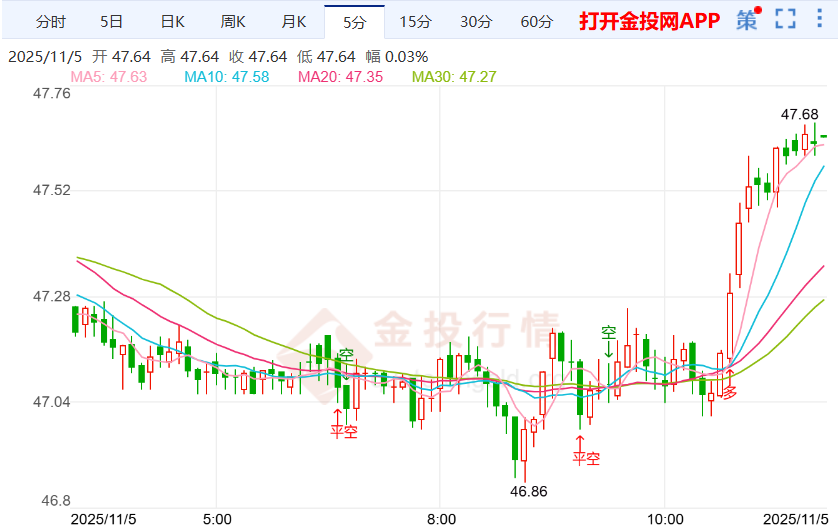
美联储降息预期降温国际银反弹
Jin Tou Wang· 2025-11-05 05:21
Group 1 - International silver is currently trading above $47.52, with a recent opening at $47.17 and a current price of $47.64, reflecting a 1.08% increase [1] - The highest price reached today was $47.68, while the lowest was $46.86, indicating a short-term bullish trend for silver [1] Group 2 - Recent comments from Federal Reserve officials, including Chairman Powell, suggest a more hawkish stance, indicating that a rate cut in December is not guaranteed [3] - Market expectations for a rate cut in December are approximately 65%, which has strengthened the dollar and limited the gains of non-yielding assets like silver [3] - The ongoing budget impasse in Washington has led to a government shutdown that has lasted six weeks, potentially delaying key economic indicators and increasing macroeconomic uncertainty [3] Group 3 - Investors are closely monitoring geopolitical tensions and trade issues, which have sustained demand for safe-haven assets [3] - Ukrainian President Zelensky announced plans to establish arms export and joint production offices in Berlin and Copenhagen to raise funds for domestic weapon production [3] - Silver prices may attempt to rebound around the $47 mark, with potential for a strong rally if it stabilizes above $48, targeting a high of $49.5 [3]
期货市场交易指引:2025年11月05日-20251105
Chang Jiang Qi Huo· 2025-11-05 03:16
1. Report Industry Investment Ratings - **Macro - Finance**: Index futures are bullish in the medium - long term with a strategy of buying on dips; Treasury bonds are expected to move sideways [1][6] - **Black Building Materials**: Coking coal and rebar are for range trading; Glass is recommended for selling call options [1][8][9] - **Non - ferrous Metals**: Copper is advised to close long positions at high levels or engage in range short - term trading; Aluminum is recommended to buy on dips; Nickel suggests waiting and seeing or shorting on rallies; Tin, gold, and silver are for range trading [1][12][13] - **Energy and Chemicals**: PVC, caustic soda, styrene, rubber, urea, methanol, and polyolefins are expected to move sideways. Soda ash 01 contract follows a short - selling mindset [1][23][24][34] - **Cotton and Textile Industry Chain**: Cotton and cotton yarn are expected to move sideways; PTA is in low - level oscillation; Apples and jujubes are in weak oscillation [1][37][38] - **Agriculture and Animal Husbandry**: Pigs and eggs face pressure in rebounds; Corn is in a bottom - building oscillation; Soybean meal rebounds from a low level; Oils are in weak oscillation [1][41][48][49] 2. Core Views - The market is in a vacuum period of performance, events, and policies after the Sino - US trade negotiation, third - quarter reports, and the Fourth Plenary Session, so it will oscillate to wait for new changes at the end of the year [6] - The main trading line of Treasury bonds is not over, but the market is observing the scale and scope of the central bank's Treasury bond trading, so it is expected to move sideways [6] - The coal market has tight supply and demand, and prices are rising steadily. The supply of coking coal may be affected by the resumption of production in coal mines, and the price of rebar is expected to have limited downside space due to low valuation [8] - The supply of glass is high, demand is weak, and the overall supply - demand pattern is poor, so it is recommended to sell call options [10] - The short - term supply - demand situation of copper has limited support for prices, and it is expected to oscillate at a high level. The supply of aluminum may face adjustments, and it is recommended to take profit on long positions at high levels [12][14] - The supply of nickel may be more abundant in the medium - long term, and it is recommended to wait and see or short on rallies. The supply of tin is expected to improve, and it is recommended for range trading [18][20] - Precious metals are supported by interest - rate cut expectations and safe - haven needs, but are in a short - term adjustment state, and are recommended for range trading [20][22] - The supply - demand of PVC is still weak, and it is expected to oscillate. The supply of caustic soda is affected by alumina, and it is expected to oscillate weakly [23][25] - The cost of benzene ethylene is under pressure, and the overall chemical fundamentals are weak, so it is expected to oscillate. The cost support of rubber is insufficient, and it is expected to oscillate [26][28] - The supply of urea decreases, demand increases, and the price is expected to rise slightly. The supply of methanol is tight in some areas, and the port inventory pressure is high, so it is expected to oscillate [29][31] - The supply of polyolefins has new production capacity, and demand is mainly for rigid needs, so PE is expected to oscillate, and PP is expected to oscillate weakly [33] - The supply of soda ash is excessive, and it is recommended to maintain a short - selling mindset for the 01 contract [36] - The supply - demand of cotton and cotton yarn is expected to be stable, and it is expected to oscillate. The supply of PTA is in a state of inventory accumulation, and it is in low - level oscillation [37][38] - The quality of apples has declined, and consumption is weak, so the price is expected to decline. The price of jujubes is expected to decline [38][40] - The supply of pigs is large in the first half of next year, and prices face pressure. The supply of eggs is still large in the medium - long term, and prices face pressure [41][44] - The supply of corn is sufficient in the short term, and demand is weak, so it is in a bottom - building oscillation. The price of soybean meal is supported by cost and is expected to rebound [47][48] - Oils are under pressure in the short term but have support factors, and are expected to oscillate widely [54] 3. Summary by Directory 3.1 Macro - Finance - **Index Futures**: A - shares and Hong Kong stocks are generally down. The market lacks catalysts and is expected to oscillate. It is bullish in the medium - long term and recommended to buy on dips [6] - **Treasury Bonds**: Treasury bond futures have mixed performance. The market is observing the central bank's operations, and it is recommended to maintain a balanced allocation and expect sideways movement [6] 3.2 Black Building Materials - **Double - Coking Coal**: The coal market has tight supply and demand, and prices are rising. It is necessary to pay attention to the resumption of production in coal mines [8] - **Rebar**: The price has fallen, but the low valuation limits the downside space. It is recommended to buy on dips for the RB2601 contract and focus on the range of 3000 - 3200 [8] - **Glass**: The supply is high, demand is weak, and the overall supply - demand pattern is poor. It is recommended to sell the 01 contract out - of - the - money call options and hold them until expiration [10] 3.3 Non - ferrous Metals - **Copper**: The price has reached a new high and then declined. The short - term supply - demand has limited support, and it is expected to oscillate at a high level. The recommended operating range of the main Shanghai copper contract is 85000 - 89000 [12][13] - **Aluminum**: The price of bauxite is under pressure, and the supply of electrolytic aluminum may face adjustments. It is recommended to take profit on long positions at high levels [14] - **Nickel**: The supply may be more abundant in the medium - long term, and it is recommended to wait and see or short on rallies [18] - **Tin**: The supply is expected to improve, and it is recommended for range trading, with the reference range of the Shanghai tin 12 contract being 275,000 - 295,000 yuan/ton [20] - **Silver and Gold**: They are supported by interest - rate cut expectations and safe - haven needs, are in a short - term adjustment state, and are recommended for range trading. The reference range of the Shanghai silver 12 contract is 10700 - 11600, and that of the Shanghai gold 12 contract is 890 - 940 [20][22] 3.4 Energy and Chemicals - **PVC**: The supply is high, demand is weak, and it is expected to oscillate. The 01 contract is temporarily concerned about the range of 4600 - 4800 [23] - **Caustic Soda**: The supply is affected by alumina, and it is expected to oscillate weakly. The 01 contract is temporarily concerned about the pressure at 2400 [24] - **Benzene Ethylene**: The cost is under pressure, and the overall chemical fundamentals are weak. It is expected to oscillate, and the range of 6300 - 6700 is concerned [26] - **Rubber**: The cost support is insufficient, and it is expected to oscillate. The support at 15000 is concerned [28] - **Urea**: The supply decreases, demand increases, and the price is expected to rise slightly. The 01 contract range is 1600 - 1700 [29][30] - **Methanol**: The supply is tight in some areas, and the port inventory pressure is high. It is expected to oscillate, and the 01 contract range is 2230 - 2330 [31][32] - **Polyolefins**: The supply has new production capacity, and demand is mainly for rigid needs. PE is expected to oscillate, paying attention to the support at 6900, and PP is expected to oscillate weakly, paying attention to the support at 6600 [33] - **Soda Ash**: The supply is excessive, and it is recommended to maintain a short - selling mindset for the 01 contract [36] 3.5 Cotton and Textile Industry Chain - **Cotton and Cotton Yarn**: The supply - demand is expected to be stable, and it is expected to oscillate [37] - **PTA**: The price is in low - level oscillation, and the supply is in a state of inventory accumulation. The concerned range is 4400 - 4700 [38] - **Apples and Jujubes**: The quality of apples has declined, consumption is weak, and the price is expected to decline. The price of jujubes is also expected to decline [38][40] 3.6 Agriculture and Animal Husbandry - **Pigs**: The 01 contract is under pressure due to postponed supply, and it is recommended to take profit on short positions gradually. The 03 and 05 contracts have large supply and weak demand in the first half of next year, and it is recommended to hold short positions. The 07 and 09 contracts should be carefully bottom - fishing [41] - **Eggs**: The 12 contract has a large premium over the spot, and it is recommended to short on rallies lightly. The 01 contract oscillates in the range of 3250 - 3400 [43][44] - **Corn**: The short - term supply is sufficient, and demand is weak. It is in a bottom - building oscillation, and the 01 contract oscillates in the range of 2050 - 2170. It is recommended to pay attention to the 3 - 5 positive spread [45][46][47] - **Soybean Meal**: It rebounds from a low level. The M2601 contract can take profit on a small scale at high levels and hold after a pullback. Spot enterprises can fix the basis from November to January at low points [48][49] - **Oils**: They are in a high - level adjustment, with palm oil being weak and soybean oil being strong. The 01 contracts of soybean, palm, and rapeseed oil should pay attention to the support levels of 7900 - 8000, 8450 - 8500, and 9250 - 9350 respectively, and not chase short. It is recommended to pay attention to the strategy of the narrowing spread of rapeseed - soybean 01 and the widening spread of soybean - palm 01 [49][54]
白银投资惊现剪刀差!期货大涨股票大跌,背后暗藏什么玄机?
Sou Hu Cai Jing· 2025-11-04 18:29
Market Overview - On November 4, 2025, the silver market exhibited a rare divergence, with domestic silver T D prices rising to 11,426 CNY per kilogram, an increase of 44 CNY or 0.39%, while A-share silver concept stocks fell sharply, with the sector index dropping by 1.92% [1][3][4]. Market Dynamics - The divergence between the futures and stock markets is becoming a new norm in the precious metals market, as evidenced by the contrasting movements on the same day. The silver T D contract opened at 11,410 CNY, briefly dipped to a low of 11,211 CNY, and then rebounded to a high of 11,445 CNY in the afternoon [4][6]. - A-share silver stocks, such as Hunan Silver and Silver Nonferrous, saw declines of 1.24% and 1.33%, respectively, underperforming the broader market, which only saw a slight drop of 0.2% [4][6]. Fund Flows - On the same day, CMX silver futures saw a 15% increase in trading volume compared to the previous day, with an additional 8,000 contracts in open interest, indicating a rising demand for silver from international funds, likely influenced by expectations of a Federal Reserve rate cut [7][9]. - Conversely, the stock market experienced capital outflows, with investors showing reduced willingness to allocate funds to silver stocks, reflecting concerns over the performance of silver industry chain companies [9][12]. Industry Insights - The divergence between silver futures and stocks highlights issues in the price transmission mechanism within the industry chain. While rising futures prices can enhance product pricing for silver mining companies, the third-quarter earnings forecasts for Hunan Silver and Silver Nonferrous indicated a slowdown in net profit growth to 5% and 3%, respectively, below market expectations [10][11]. - The processing segment faces significant profit pressure, as rising raw material prices for recycled silver have increased production costs, while weak end-demand hampers the ability to pass these costs onto downstream customers [10][11]. Macro Factors - The divergence in the silver market is influenced by macroeconomic conditions, including a 0.3% decline in the U.S. dollar index, which supports non-dollar assets like silver. The anticipated Federal Reserve rate cuts are shifting capital preferences across markets [12][14]. - Geopolitical risks, such as tensions in the Middle East, have increased demand for safe-haven assets like silver, although the A-share market has not benefited from this influx of capital due to overall weakness [14][15].

加油且慢!重大利好:全球石油过剩,油价或将迎来大幅下调!
Sou Hu Cai Jing· 2025-11-03 18:38
Group 1 - The report predicts that Brent crude oil prices will average $68 per barrel in 2025 and may drop to $60 in 2026, which would be cheaper than five years ago [1][3] - Global oil inventories are expected to be 65% higher in 2025 compared to the peak in 2020, leading to stagnant oil demand due to the rise of electric and hybrid vehicles [3] - A decrease in oil prices is expected to ease inflationary pressures, with food prices projected to drop by 6.1% in 2025, benefiting consumers in developing countries [3] Group 2 - Fertilizer prices are projected to surge by 21% in 2025, increasing agricultural costs and squeezing farmers' profits [3][5] - Precious metals are expected to perform well, with gold prices projected to rise by 42% in 2025 and an additional 5% in 2026, while silver is expected to increase by 34% [3][5] - The World Bank advises countries to invest in technology and improve market transparency to withstand price fluctuations, indicating a need for proactive economic strategies [5]