非银金融

Search documents
机构资金买入力量有望增强
Xinda Securities· 2025-12-28 02:12
Group 1 - The core conclusion indicates that the buying power of institutional funds is expected to strengthen, with the Shanghai Composite Index achieving an "eight consecutive days of gains" and market trading volume recovering [2][8] - Positive factors catalyzing the year-end market rally include the rebound of US tech stocks, appreciation of the RMB, rising prices of non-ferrous metals (gold, silver, copper), and various themes in commercial aerospace [2][8] - The report emphasizes that the key factor driving the index to break through the upper range of the consolidation zone is the influx of incremental funds, particularly the gradual increase in institutional buying power [2][8] Group 2 - The appreciation of the RMB is beneficial for the return of overseas funds, with the RMB appreciating nearly 4% against the USD in 2025, and the offshore RMB/USD exchange rate breaking the "7" mark [9] - The report notes that the recent acceleration of inflows into stock ETFs indicates a significant increase in the net inflow scale of ETFs related to the CSI A500, suggesting that institutional funds are accelerating their layout [12][14] - The private equity fund management scale increased significantly by 1.04 trillion RMB in October 2025, reaching 7.0076 trillion RMB, and continued to rise to 7.0383 trillion RMB in November, indicating a potential important source of incremental funds for the market [14][15] Group 3 - The report highlights that there are currently no signs of accelerated inflows from resident incremental funds, but there is optimism for a seasonal surge in Q1, particularly in years when the Spring Festival is later [17][25] - The report suggests that the tactical foundation of the bull market remains solid, with the potential for a resonance between profit improvement and fund inflows [30][31] - The report recommends increasing allocations to value sectors and suggests that the technology sector typically shows significant excess returns during the spring market [36][37]
沪指八连阳成交放大 融资余额创历史新高
Zheng Quan Shi Bao· 2025-12-26 22:49
Group 1 - The A-share market continues to strengthen, with the Shanghai Composite Index rising for eight consecutive days, marking a significant trend similar to the one observed in April near the 3000-point level [1] - The total trading volume for the week reached 9.83 trillion yuan, the highest in nearly six weeks, with a daily trading volume surpassing 2 trillion yuan on Friday [1] - Margin financing saw a significant increase, with a net purchase of over 41.3 billion yuan, the highest in 11 weeks, bringing the financing balance to a historical high of 2.53 trillion yuan [1] Group 2 - The electronics sector received over 10.7 billion yuan in net financing, while the communication sector saw over 7.1 billion yuan, and the power equipment sector gained over 6.7 billion yuan in net financing [1] - Major sectors such as defense, machinery, and basic chemicals also experienced substantial net inflows, with power equipment receiving over 49.2 billion yuan and electronics over 47.1 billion yuan [1] - Only the banking and coal sectors experienced slight net outflows, indicating a strong preference for growth sectors [1] Group 3 - Looking ahead, the market is expected to follow a "cross-year market" pattern, with large-cap stocks leading the way, followed by small-cap stocks, as historical trends suggest [2] - The technology sector is anticipated to remain a key focus, with expectations of significant returns, while commodities are showing signs of a bullish trend [2] - The aerospace equipment sector has seen a remarkable increase, with the index rising 18.25% this week and 83.85% year-to-date, indicating strong investor interest [2] Group 4 - Recent developments in the aerospace sector include the launch of the Commercial Space Industry Alliance Innovation Fund and the successful launch of the Long March 8 rocket, which is expected to drive rapid expansion in the industry [3] - The upcoming measures to support the G60 Science and Technology Corridor in the Yangtze River Delta are set to take effect from January 1, 2026, further boosting the aerospace sector [3] - The commercial rocket sector is projected to undergo a transformation by 2026, marking a significant shift towards reusable rockets in China [3]
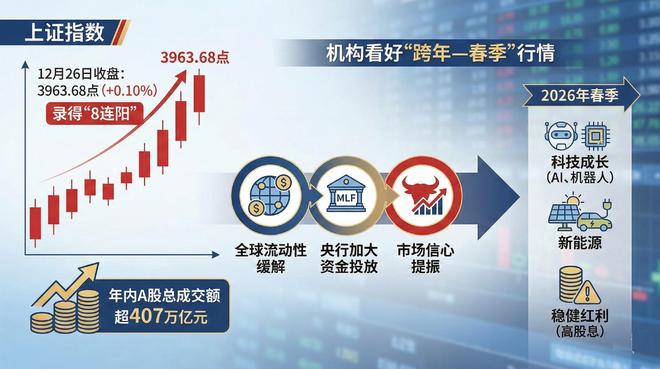
沪指录得“8连阳” 机构看好“跨年—春季”行情
Zhong Guo Jing Ying Bao· 2025-12-26 14:22
Core Viewpoint - The A-share market is experiencing a sustained upward trend, with the Shanghai Composite Index achieving an 8-day consecutive rise, attributed to multiple favorable factors both domestically and internationally [2][3]. Group 1: Market Performance - As of December 26, the Shanghai Composite Index closed at 3963.68 points, up 0.10%, marking the longest consecutive rise of the year since December 17 [2]. - The total trading volume of the A-share market exceeded 407 trillion yuan, setting a new annual record as of December 23 [3]. Group 2: Monetary Policy and Liquidity - The People's Bank of China (PBOC) announced a 400 billion yuan operation of one-year Medium-term Lending Facility (MLF) to maintain reasonable liquidity in the banking system, resulting in a net injection of 100 billion yuan for December [3]. - The PBOC's actions are aimed at stabilizing the funding environment, with a focus on maintaining a relatively stable and ample liquidity state [3]. Group 3: Seasonal Market Trends - The "cross-year-spring" market phenomenon is characterized by seasonal trends in the A-share market, often occurring from December to February, driven by improved liquidity, favorable policies, and increased risk appetite [4]. - Historical data indicates that significant market movements typically begin in December and are influenced by multiple factors rather than just calendar effects [4]. Group 4: Investment Opportunities - Analysts suggest that the current market environment is conducive to structural opportunities in the technology sector, particularly in AI applications and cyclical sectors like chemicals and non-ferrous metals [7]. - The central economic work conference emphasized innovation and the development of new growth drivers, which may further support investment in technology and related sectors [7]. Group 5: Future Market Outlook - The market is expected to see a rotation among sectors, with technology stocks likely to remain a key investment focus in 2026, alongside sectors such as new energy, consumption, and military [7]. - Investors are advised to pay close attention to industry cycles and market sentiment to optimize asset allocation in the evolving market landscape [7].

【26日资金路线图】有色金属板块净流入逾183亿元居首 龙虎榜机构抢筹多股
证券时报· 2025-12-26 10:48
Market Overview - The A-share market showed mixed performance on December 26, with the Shanghai Composite Index closing at 3963.68 points, up 0.1%, and the Shenzhen Component Index at 13603.89 points, up 0.54% [1] - Total market turnover reached 21812.64 billion, an increase of 2372.04 billion compared to the previous trading day [1] Capital Flow - The main capital in the A-share market experienced a net outflow of 242.43 billion, with an opening net outflow of 96.61 billion and a closing net outflow of 6.56 billion [2] - The CSI 300 index saw a net outflow of 54.39 billion, while the ChiNext index had a net outflow of 133.96 billion and the STAR Market a net outflow of 20.89 billion [4] Sector Performance - The non-ferrous metals sector led with a net inflow of 183.35 billion, showing a rise of 2.35% [6][7] - Other sectors with net inflows included non-bank financials (40.67 billion) and electric power equipment (16.91 billion) [7] - The electronics sector faced the largest net outflow at -173.32 billion, followed by machinery equipment at -86.84 billion and pharmaceuticals at -39.51 billion [7] Notable Stocks - Yangguang Electric Power saw the highest net inflow of 23.72 billion [8] - Institutional buying was noted in several stocks, including Aerospace Development with a net purchase of 481.76 million [11][12]

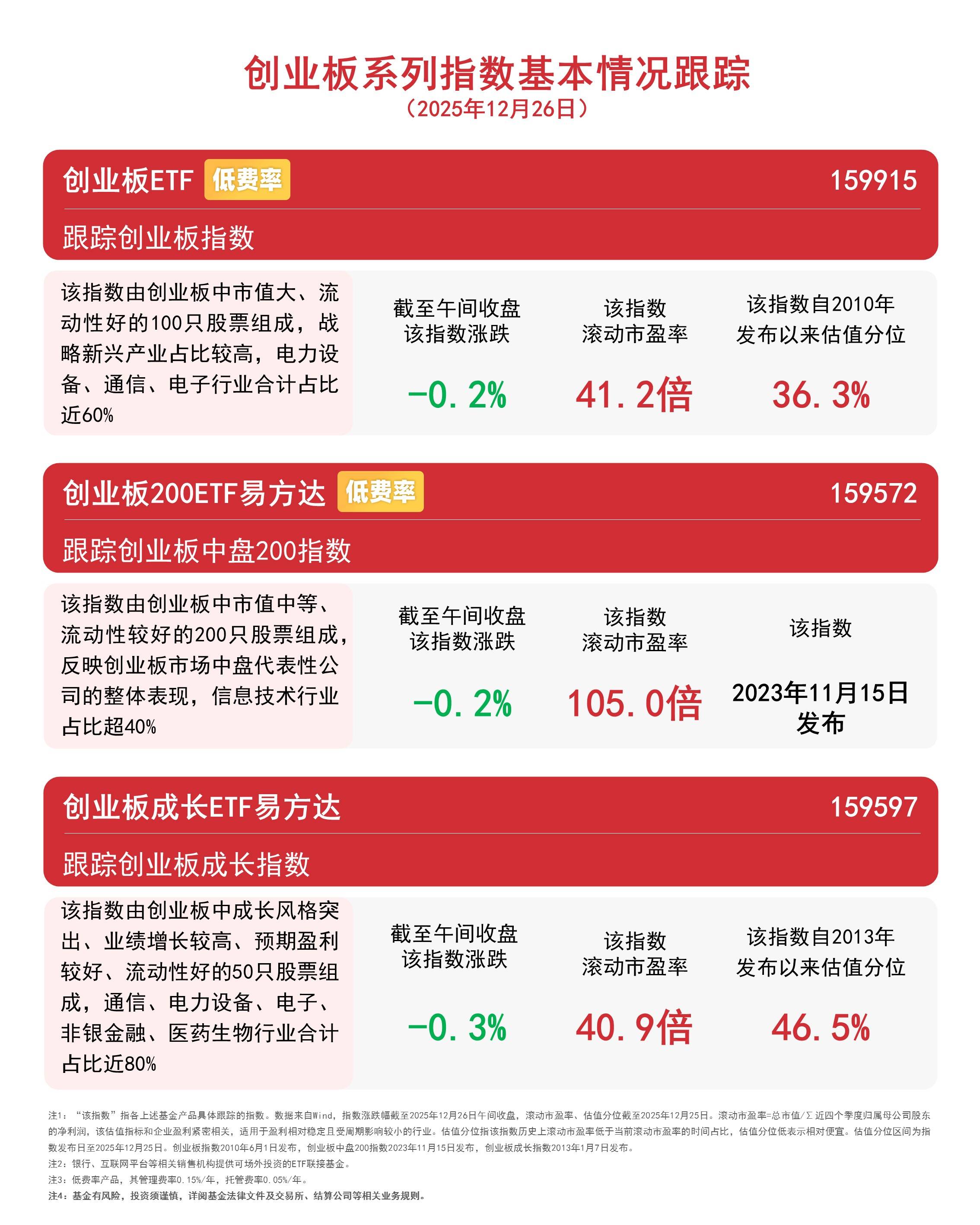
创业板系列指数小幅回踩,关注创业板ETF(159915)、创业板200ETF易方达(159572)等产品投资机遇
Sou Hu Cai Jing· 2025-12-26 05:06
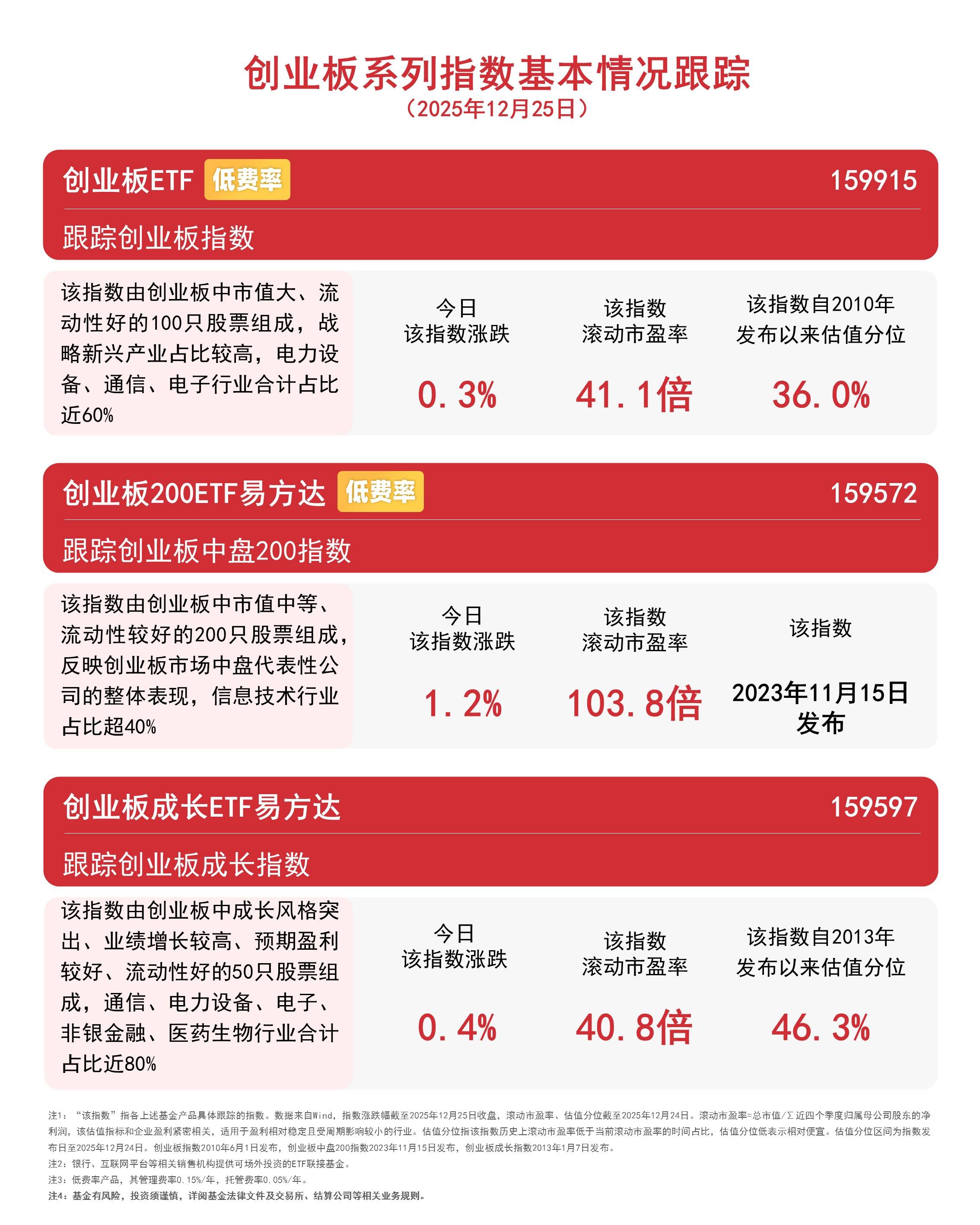
Group 1 - The ChiNext Index and ChiNext Mid-Cap 200 Index both declined by 0.2%, while the ChiNext Growth Index fell by 0.3% as of the midday close [1] - Huazhong Securities' report indicates that price improvements will boost nominal GDP, leading to a continuous recovery in corporate profits, which will serve as a strong fundamental support for the market [1] - It is estimated that the overall profit growth rate for the A-share market will increase from 8.2% in 2025 to 10.3% in 2026, with the profit growth rate excluding financials reaching 7.7% [1] Group 2 - The ChiNext is expected to benefit from a new round of industrial cycles, with a projected profit growth rate of 31.7% in 2026 [1] - The ChiNext Growth ETF tracks the ChiNext Growth Index, which consists of 50 stocks characterized by growth style, high performance, good profit expectations, and strong liquidity, with the information technology sector accounting for over 40% [3] - The communication, power equipment, electronics, non-bank financials, and pharmaceutical sectors collectively account for nearly 80% of the ChiNext Growth Index [3]

浙商证券浙商早知道-20251226
ZHESHANG SECURITIES· 2025-12-25 23:30
证券研究报告 | 浙商早知道 报告日期:2025 年 12 月 26 日 浙商早知道 2025 年 12 月 26 日 市场总览 重要观点 http://www.stocke.com.cn 1/4 请务必阅读正文之后的免责条款部分 大势:周四上证指数上涨 0.47%,沪深 300 上涨 0.18%,科创 50 下跌 0.23%,中证 1000 上涨 0.97%,创业板指上 0.30%,恒生指数上涨 0.17%。 行业:周四表现最好的行业分别是国防军工(+2.91%)、轻工制造(+1.59%)、机械设备(+1.51%)、汽车(+1.46%)、 非银金融(+1.08%),表现最差的行业分别是综合(-1.12%)、有色金属(-0.77%)、商贸零售(-0.47%)、煤炭(-0.24%)、 通信(-0.18%)。 资金:周四沪深两市总成交额为 19245 亿元,南下资金净流出 11.75 亿港元。 【浙商大制造中观策略 邱世梁/王华君/周向昉】机械设备 年度行业策略报告:可控核聚变:招标提速,设备先行 ——20251224 【浙商大消费中观策略 钟烨晨】酒店餐饮 年度行业策略报告:2026 年餐饮行业风险排雷手册—— ...
A股市场大势研判:沪指七连阳
Dongguan Securities· 2025-12-25 23:30
Market Performance - The Shanghai Composite Index closed at 3959.62, up by 0.47% with an increase of 18.67 points [2] - The Shenzhen Component Index closed at 13531.41, up by 0.33% with an increase of 44.99 points [2] - The CSI 300 Index closed at 4642.54, up by 0.18% with an increase of 8.48 points [2] - The ChiNext Index closed at 3239.34, up by 0.30% with an increase of 9.77 points [2] - The STAR 50 Index closed at 1349.06, down by 0.23% with a decrease of 3.07 points [2] Sector Rankings - The top five sectors by growth include Defense and Military Industry (2.91%), Light Industry Manufacturing (1.59%), Machinery Equipment (1.51%), Automotive (1.46%), and Non-Bank Financials (1.08%) [3] - The bottom five sectors by decline include Comprehensive (-1.12%), Nonferrous Metals (-0.77%), Retail (-0.47%), Coal (-0.24%), and Banking (-0.18%) [3] Market Outlook - The market showed a collective rise with the Shanghai Composite Index achieving seven consecutive days of gains [4] - The People's Bank of China emphasized the continuation of a moderately loose monetary policy and the importance of maintaining capital market stability [5] - The trading volume in the Shanghai and Shenzhen markets reached 1.92 trillion, an increase of 443 billion from the previous trading day [5] - The offshore RMB against the USD broke the 7.0 mark for the first time since September 2024, which is expected to enhance the attractiveness of RMB assets [5] - Key sectors to focus on include dividends, TMT (Technology, Media, and Telecommunications), and consumer sectors [5]
【25日资金路线图】国防军工板块净流入逾61亿元居首 龙虎榜机构抢筹多股
Zheng Quan Shi Bao· 2025-12-25 13:33
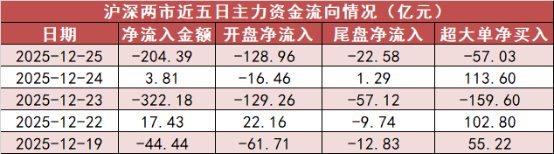
Market Overview - The A-share market experienced an overall increase on December 25, with the Shanghai Composite Index closing at 3959.62 points, up 0.47%, the Shenzhen Component Index at 13531.41 points, up 0.33%, and the ChiNext Index at 3239.34 points, up 0.3% [1] - The total trading volume in the A-share market reached 19440.6 billion yuan, an increase of 466.79 billion yuan compared to the previous trading day [1] Capital Flow - The main capital in the A-share market saw a net outflow of 204.39 billion yuan for the day, with an opening net outflow of 128.96 billion yuan and a closing net outflow of 22.58 billion yuan [2] - The CSI 300 index recorded a net outflow of 79.88 billion yuan, while the ChiNext saw a net outflow of 51.51 billion yuan and the STAR Market a net outflow of 16.01 billion yuan [4] Sector Performance - The defense and military industry led the sectors with a net inflow of 61.72 billion yuan, followed by machinery equipment with 60.79 billion yuan and the automotive sector with 39.51 billion yuan [6][7] - The electronic sector experienced the largest net outflow of 81.47 billion yuan, followed by retail with 50.64 billion yuan and telecommunications with 44.44 billion yuan [7] Individual Stocks - Goldwind Technology saw the highest net inflow of 8.29 billion yuan among individual stocks [8] - Institutions actively participated in several stocks, with Hainan Development showing a net institutional buy of 288.69 million yuan, while Tianji Co. had a net institutional sell of 21.35 million yuan [10][11]
风险月报 | 权益市场风险偏好温和修复,多维度指标分化持续缓和
中泰证券资管· 2025-12-25 11:32
Core Viewpoint - The overall market risk preference is showing a mild recovery, with the risk scoring system indicating a slight improvement in the stock market, while the bond market remains cautious due to weak economic data and credit risk concerns in the real estate sector [2][5]. Market Risk Assessment - The risk score for the CSI 300 index is 54.89, up from 52.77 last month, indicating a moderate recovery in market risk preference [2]. - The valuation of the CSI 300 has slightly increased to 61.54 from 60.68, remaining in a mid-high range over the past six months, with significant valuation differentiation across sectors [2]. - The market expectation score has decreased to 50.00 from 52.00, reflecting resilient external demand but a notable slowdown in internal demand [2]. Market Sentiment - Market sentiment has improved to 50.69 from 45.24, moving from a "depressed" to a "neutral" range, although sentiment indicators show significant differentiation [3]. - Margin financing scores have surged from historical lows to highs, indicating a recovery in sentiment, while public fund issuance remains stable at high levels [3]. Economic Indicators - Consumer Price Index (CPI) rose by 0.7%, the highest increase since March 2024, while core CPI increased by 1.2% [9]. - Industrial production value increased by 4.8%, with significant growth in equipment manufacturing and high-tech industries [9]. - Fixed asset investment decreased by 2.6% year-on-year, but excluding real estate development, it shows a growth of 0.8% [9]. Liquidity and Monetary Policy - The social financing scale increased by 8.5% year-on-year, with broad money (M2) growing by 8.0%, indicating a moderately loose monetary policy [11]. - The central bank has maintained a stable monetary policy, with the ten-year government bond yield around 1.85% and the thirty-year bond around 2.25%, reflecting a bear steepening trend in the bond market [11][12]. Investment Focus - In a structured market, sectors with high valuation and strong earnings certainty are emphasized, while those with high valuations but weak fundamentals are viewed with caution [3]. - The focus is on quality targets within a manageable risk range, prioritizing earnings realization and cash flow stability [3].

创业板指午后反弹,收获4连阳,创业板ETF(159915)助力布局创新型企业盈利修复机遇
Sou Hu Cai Jing· 2025-12-25 11:24
Group 1 - The ChiNext Mid-Cap 200 Index rose by 1.2%, the ChiNext Growth Index increased by 0.4%, and the ChiNext Index gained 0.3%, marking a four-day winning streak [1] - Huashan Securities reports that price improvements will boost nominal GDP, leading to a sustained recovery in corporate profits, which will serve as a strong fundamental support for the market [1] - It is estimated that the overall profit growth rate for the entire A-share market will increase from 8.2% in 2025 to 10.3% in 2026, with the profit growth rate excluding financials reaching 7.7% [1] Group 2 - The ChiNext and Sci-Tech Innovation Board are expected to benefit from a new industrial cycle, maintaining high growth rates, with the ChiNext's profit growth rate projected to reach 31.7% in 2026 [1] - The ChiNext Growth ETF tracks the ChiNext Growth Index, which consists of 50 stocks characterized by strong growth, good profit expectations, and high liquidity, with the information technology sector accounting for over 40% [3] - The combined weight of the telecommunications, power equipment, electronics, non-bank financials, and pharmaceutical sectors in the ChiNext Growth Index is nearly 80% [3]