
科技

Search documents
新基金密集发行 2026投资风向浮现
Xin Lang Cai Jing· 2026-01-11 21:22
Group 1 - In the first trading week of 2026, a total of 46 new funds were launched, with equity funds dominating the market, including 16 mixed equity funds and 10 passive index funds [2][4] - The popularity of equity products can be traced back to 2025, where over 1500 new funds were issued, totaling more than 1.1 trillion units, with a significant focus on equity products [4][5] - The trend of increasing issuance of equity funds is evident, with a notable growth in stock and mixed funds compared to previous years, reflecting a sustained demand for equity assets amid improving market conditions [6][7] Group 2 - The "technology boom" remains a key investment theme, with a strong preference for technology sectors such as AI, quantum communication, and advanced manufacturing, which are expected to continue driving investment in 2026 [6][7] - Multiple fund companies emphasize the importance of technology as a long-term investment focus, highlighting sectors like semiconductors, consumer electronics, and innovative energy solutions [6][7] - The AI application sector is anticipated to become a significant investment focus in 2026, with a shift towards commercialized applications across various industries [7]
从中长期视角看中国经济前景依然光明
Xin Lang Cai Jing· 2026-01-11 20:19
Core Viewpoint - The Chinese economy faces both strategic opportunities and risks during the 14th Five-Year Plan period, with a long-term positive trend remaining intact despite short-term challenges [4]. Group 1: Economic Challenges and Opportunities - Current economic pressures stem from cyclical factors due to insufficient demand, external environment impacts, and structural factors leading to a decline in traditional growth drivers [4]. - Structural factors include the diminishing returns from traditional growth drivers such as reform dividends, globalization, demographic advantages, and industrialization, which contribute to a lower potential growth rate [4]. Group 2: New Growth Drivers - New growth drivers can be cultivated through deepening reforms and structural transformations, which are essential for high-quality economic development [4]. - Key new growth drivers identified include: - **Technological Innovation**: The rise of market-oriented technological innovations from small and medium-sized enterprises, particularly in regions like Hangzhou, is expected to become a new growth engine [4]. - **Deep Urbanization**: The integration of urban clusters such as the Yangtze River Delta and the Greater Bay Area can significantly boost GDP growth, with a 1% increase in urbanization rate potentially leading to a 1.8% GDP growth [5]. - **Consumption Upgrade**: Improving consumption rates and quality through reforms in income distribution and fiscal policies can drive economic growth [5]. - **Structural Reform Dividends**: Continued structural reforms, including state-owned enterprise reforms and market unification, can release economic vitality and promote growth [5]. - **Quality of Labor**: The transition towards higher-quality labor, particularly in technology sectors, presents a cost advantage that can enhance productivity [6][7]. Group 3: Growth Projections - While growth rates may not reach the optimistic 8% forecasted by some, achieving a growth rate of 5%-6% during the 14th and 15th Five-Year Plans is feasible if new growth drivers are effectively stimulated [8]. - The goal of reaching a per capita GDP of around $20,000 by 2035 requires an average annual growth rate of approximately 4.72% from 2020 to 2035 [8]. Group 4: Modern Industrial System - Constructing a modern industrial system is crucial for transforming growth drivers, with a focus on optimizing traditional industries and fostering strategic emerging industries [9]. - The integration of innovation with industry and the digital economy with the real economy is essential for developing a modern industrial framework [9]. Group 5: Role of Institutional Innovation - Institutional innovation is necessary to support technological advancements and provide effective protection for intellectual property, which is vital for the integration of innovation and industry [10]. - Comprehensive reforms to establish a high-level socialist market economy are critical for driving high-quality development [10].

深圳消费“四大奇观”,这座城市如此热辣滚烫
Sou Hu Cai Jing· 2026-01-11 15:01
Core Insights - The article highlights the emergence of seven major cities in China, referred to as the "Seven Heroes of Consumption," each with a retail sales total exceeding 1 trillion yuan, including Shanghai, Chongqing, Beijing, Guangzhou, Shenzhen, Chengdu, and Suzhou [1] - Shenzhen is identified as a rising star in the consumption landscape, achieving a retail sales total of 938.18 billion yuan in the first 11 months of the year, with a year-on-year growth of 2.8%, positioning it as a significant player in the "trillion yuan consumption club" [1] Group 1: Shopping Centers - Shenzhen is experiencing a boom in large shopping centers, with numerous openings each month, showcasing its status as a shopping paradise [3] - Major shopping centers like Shenzhen Bay MixC Phase II and K11 ECOAST are part of a growing list, indicating strong consumer demand and confidence in the city's consumption potential [3] - The occupancy rate of commercial projects by China Resources exceeds 97%, with rental income increasing by 17%, reflecting a robust demand-supply cycle in the retail sector [3] Group 2: First Store Economy - Shenzhen is becoming a hub for the "first store economy," with 461 new first stores opening in 2024 and an expected 1,200 in 2025, making it a leader in the Greater Bay Area [5] - New commercial developments are expected to have over 50% of their offerings as first stores, indicating a strong appetite for new brands among consumers [5] - The presence of international brands like Rihanna's FENTY BEAUTY and other flagship stores highlights Shenzhen's appeal as a launchpad for new retail concepts [5] Group 3: Technology Consumption - Shenzhen is evolving into a center for "technology consumption," with a rapid adoption of innovative tech products, outpacing the national average by 3-6 months [9] - The city has seen significant sales in tech categories, with over 360 billion yuan in sales driven by a trade-in program covering various product categories, including over 176 billion yuan in automotive sales [9] - The penetration rate of new energy vehicles in Shenzhen is over 80%, leading the nation in this segment [9] Group 4: Cultural and Recreational Integration - The integration of culture, commerce, and tourism is thriving in Shenzhen, with attractions like the world's largest physical bookstore and indoor ski resorts drawing both locals and tourists [7] - The city's diverse consumption landscape reflects a blend of high-energy and tranquil experiences, appealing to a wide range of consumer preferences [12] - Shenzhen's unique natural scenery and urban design contribute to a vibrant consumer environment, connecting shopping districts with parks and cultural venues [12] Group 5: Consumer Trends - Shenzhen's consumers are characterized by a blend of technology-driven "self-indulgent consumption" and a focus on quality and value [14] - The city is noted for its youthful and dynamic consumer base, which is expected to play a crucial role in driving future consumption growth in China [14] - As China emphasizes expanding domestic demand and promoting consumption, Shenzhen's young population is poised to become a significant force in the consumer market [14]

但斌、王庆最新发声:从“924”到现在肯定是个牛市
Di Yi Cai Jing Zi Xun· 2026-01-11 13:13
Market Overview - The A-share market has entered a new phase in 2026, with the Shanghai Composite Index reaching 4120.43 points and total trading volume exceeding 30 trillion yuan [2] - Analysts believe that the market is in a bull phase since the "924" rally, with a focus on improving the quality of listed companies and their competitive advantages [2][6] Investor Sentiment - There has been a shift in investor risk appetite since the "924" rally, leading to a recovery in market sentiment [4] - Analysts predict that undervalued value stocks will be further revalued as investor sentiment stabilizes [4][5] Sector Performance - Growth stocks, particularly in the technology sector, have shown performance since the "924" rally, with a notable revaluation of these stocks [3][4] - The market is currently characterized by structural opportunities, especially in sectors driven by AI and technological advancements [4] International Investor Interest - International investors are increasingly participating in Chinese assets, with a shift in sentiment following profitable investments [7][8] - Morgan Stanley has upgraded its rating on Chinese stocks from neutral to overweight, indicating a belief in a slow bull market [8][9] Future Outlook - The market is expected to continue benefiting from technological advancements and improved competitive environments across various industries [8] - Analysts emphasize the importance of enhancing company quality and profitability to sustain long-term market growth [6]

大转变,“囤积商品”的时代来临了!
华尔街见闻· 2026-01-11 12:21
Core Viewpoint - The commodity market is undergoing a profound paradigm shift due to escalating geopolitical tensions and the restructuring of global supply chains, moving from a "just-in-time" model to a "just-in-case" inventory accumulation strategy [1][2]. Group 1: Supply Chain Transformation - Major economies are transitioning from a reliance on minimal commercial inventories to large-scale strategic reserves to mitigate risks from potential wars, shipping disruptions, or geopolitical blockades [2]. - This shift is driven by an extreme desire for security, reshaping the supply-demand dynamics of various commodities, particularly energy and strategic metals [3][4]. Group 2: Price Volatility and Investment Opportunities - Prices of critical military metals like tungsten and cobalt have experienced significant volatility, with projected price increases of 229% and 120% respectively by 2025 [5][15]. - The new trading narrative for investors includes a focus on gold as a hedge against credit risk and a bullish outlook on metals driven by national security demands, especially as defense budgets rise significantly [6][15]. Group 3: Geopolitical Implications - The low-trust global environment has shifted priorities from efficiency to survival, with countries now prioritizing physical ownership of commodities [9]. - The U.S. is reinforcing its energy security, with strategic actions reflecting a long-term focus on resource control to ensure absolute security [12][13]. Group 4: Gold and De-dollarization - The global de-dollarization process is fundamentally changing the pricing logic of gold, with central banks accelerating their shift from dollar reserves to gold [16]. - If the top 50 central banks increase their gold reserves by just 1%, it could potentially raise gold prices by approximately $1,000 [17]. Group 5: Market Implications - The macro narrative shift presents direct investment implications, with recommendations for investors to focus on capital market opportunities related to defense stocks and commodity ETFs [18]. - Mining stocks, particularly gold mining companies, are also positioned to benefit, as evidenced by record profits across tracked gold miners [20].

报告:下周看好军工板块的投资者比例大幅提高,环比提升6个百分点
Zheng Quan Shi Bao Wang· 2026-01-11 11:09
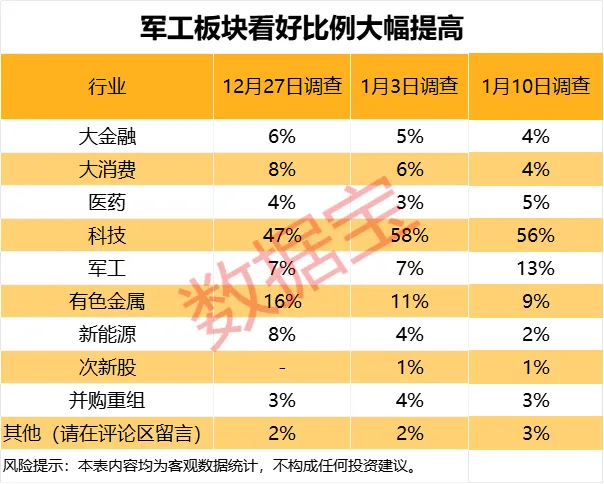
Group 1 - The overall profit effect among investors is positive, with 88% reporting profits, and 55% of those making profits within 10% [1] - Approximately 3% of investors are currently in cash, while about 46% are fully invested or using margin, indicating a slight increase in investment positions [1] - 29% of investors chose to increase their positions this week, a 6 percentage point increase from the previous week, reflecting optimism towards the market [1] Group 2 - The A-share market continues to rise, with investor confidence recovering, although the Shanghai Composite Index is at a near ten-year high, leading to some skepticism about the upward momentum [1] - 43% of investors believe the market will "rise and break through 4200 points" next week, while 46% expect "sideways fluctuations" [1][3] - Only 7% of investors are bearish, predicting the market will "fall below 4000 points" [1][3] Group 3 - The proportion of investors optimistic about the military industry has significantly increased, rising by 6 percentage points [2] - In the latest survey, the technology sector remains the most favored, with 56% of investors expressing confidence [2] - Other sectors such as large finance, large consumption, and new energy have seen a decline in investor optimism [2]
CMF展望2026年经济 多维度向好可期
Sou Hu Cai Jing· 2026-01-11 09:33
Economic Outlook for 2026 - The report anticipates a "gradual warming" of the Chinese economy in 2026, with GDP growth expected to rebound seasonally, and actual GDP growth projected to be in the range of 4.5% to 5% for the year, approaching the upper limit [1] - Nominal GDP growth is expected to show a more significant rebound, with the macro and micro "temperature difference" gradually disappearing [1] Price Trends - Consumer Price Index (CPI) is expected to gradually rise to a moderate range, while the decline in Producer Price Index (PPI) is expected to narrow, alleviating negative effects related to prices [1] Consumption Sector - The consumption market is projected to operate steadily in 2026, with a recovery in dining consumption, emergence of new consumption formats driven by AI and robotics, and growth in service consumption being the main drivers of consumption growth, with total retail sales of consumer goods expected to return to a growth rate of around 4% [2] Investment Sector - Investment is expected to stabilize, with infrastructure investment recovering first and a significant reduction in the decline of real estate investment; a notable structural optimization combining "investment in physical assets" and "investment in people" (such as education and healthcare) is anticipated [2] Foreign Trade and Employment - Foreign trade is expected to remain at a high level, with a moderate appreciation of the RMB exchange rate, overall employment stability, synchronized growth in residents' income, a "soft landing" in the real estate market, and an estimated annual stock market increase of about 10% [2] Expert Insights - Experts emphasize the importance of stabilizing prices as a core policy for 2026, aiming to bring CPI closer to a target of 2%, while controlling real estate supply and stabilizing housing prices to avoid negative impacts on consumption and investment [2] - The real estate market is currently experiencing a "decline in both volume and price," and further price adjustments are needed to convert potential demand into effective demand [3] - The long-term trend of RMB appreciation is seen as a necessary step for China to transition to a high-income country, with policies needing to accommodate this trend [3] - Balancing "technological self-reliance" with "improving livelihoods" is crucial, focusing on breakthroughs in AI and advanced manufacturing while enhancing social security for vulnerable groups [3]
【陇上评论】为高质量发展夯实基础
Xin Lang Cai Jing· 2026-01-11 01:43
Core Viewpoint - The article emphasizes the strategic deployment of the "Five Strengths" initiative in Gansu, particularly highlighting the newly added "Strong Foundation" action as essential for addressing deep-rooted issues and ensuring long-term development in the region [1][2]. Summary by Sections Strong Foundation Action - The "Strong Foundation" action aims to address Gansu's developmental challenges, including insufficient development and imbalanced industrial growth between urban and rural areas [1]. - It targets systemic and fundamental issues related to high-quality development, such as weak foundational research, inadequate resource support, and the need for an improved business environment [1][3]. Role of Strong Foundation - The "Strong Foundation" serves as both a "ballast" and a "connector" within the "Five Strengths" framework, providing essential support for technological innovation and industrial upgrades [2]. - It facilitates the flow of resources and collaboration between county-level and provincial initiatives, creating a conducive environment for high-quality development [2]. Multi-Dimensional System Engineering - The "Strong Foundation" encompasses both hard infrastructure (transportation, water conservancy, energy) and soft infrastructure (institutional frameworks, talent aggregation, innovation ecosystems) [3]. - The initiative requires a systematic approach to balance traditional and new infrastructure development, ensuring a comprehensive and efficient modern infrastructure system [3]. - Emphasis is placed on project management, optimizing approval processes, and enhancing financing channels to ensure effective project implementation [3].
银行、科技双双分化,中概股大跳水,黄金再拉升
Ge Long Hui· 2026-01-10 14:16
Market Overview - The three major indices closed higher, with the Dow Jones up 0.48%, the Nasdaq up 0.81%, and the S&P 500 up 0.65% [1] Banking Sector - The banking sector showed mixed performance, with Citigroup, Goldman Sachs, Morgan Stanley, U.S. Bancorp, and Alliance West Bank experiencing slight gains, while Bank of America, JPMorgan Chase, and Zions Bancorporation saw minor declines [3] Technology Sector - The technology sector exhibited increased divergence, highlighted by Intel's significant rise of 10.8% and Tesla's increase of 2.11%. Other major companies like Apple, Google, Microsoft, and META had modest gains, while Qualcomm fell by 2.25% and Netflix dropped by 1.3% [3] Chinese Concept Stocks - Chinese concept stocks opened lower and maintained a downward trend throughout the day, with the China Golden Dragon index down 1.3%. Notable declines included Xpeng Motors down 2.44% and Alibaba down 2.27%, while Baidu rose by 1.61% and Bilibili increased by 1.85% [3] Gold Market - COMEX gold experienced narrow fluctuations before a significant increase, closing up 0.68% at $4518.4 per ounce, with intraday lows of $4461.8 and highs of $4527 [3]
囤积商品的时代来临了
Hua Er Jie Jian Wen· 2026-01-10 11:48
Core Insights - The commodity market is undergoing a significant paradigm shift due to escalating geopolitical tensions and global supply chain restructuring, moving from a "just-in-time" model to a "just-in-case" stockpiling approach [1][2] - Countries are increasingly building strategic reserves to mitigate risks associated with potential wars, shipping disruptions, or geopolitical blockades, leading to a reconfiguration of supply and demand across various commodities [1][4] Group 1: Commodity Trends - Energy and strategic metals are becoming focal points for stockpiling, with countries potentially amassing around 1.4 billion barrels of oil, sufficient to sustain supply for hundreds of days, far exceeding the 90-day international norm [1][3] - The prices of critical military metals such as tungsten and cobalt have experienced significant volatility, with projected price increases of 229% and 120% respectively by 2025 [1][5] Group 2: Investment Implications - The shift in commodity dynamics suggests new trading themes for investors, particularly around "de-dollarization" and the demand for metals driven by national security needs [2][6] - Central banks are accelerating their gold purchases as a hedge against credit risk, with the share of the dollar in global foreign exchange reserves dropping to 56.92%, prompting a shift in gold's pricing logic [6] Group 3: Market Opportunities - Investors are advised to focus on capital market opportunities related to this macro narrative, such as European defense stocks and commodity ETFs, as funds are increasingly flowing into "hard assets" [7] - Gold mining stocks are also positioned to benefit, with all tracked gold miners achieving record profits at current gold prices, indicating a strong market for gold as a value storage asset [7]