AI应用

Search documents
机构策略:科技和周期的双轮驱动主线或仍将延续
Zheng Quan Shi Bao Wang· 2025-12-09 00:59
Group 1 - The core viewpoint emphasizes the importance of aligning A-share market investments with the "14th Five-Year Plan" policy guidance, focusing on opportunities arising from global monetary easing and industrial upgrades [1] - Three main investment themes are identified: 1) Technology innovation led by artificial intelligence; 2) Digital transformation of traditional industries through "AI+"; 3) Value recovery through investment in human capital to boost consumption [1] - The dual drivers of technology and cyclical industries are expected to continue, with relative profitability and economic advantages in technology likely to persist amid a global tech cycle [1] Group 2 - External demand for Chinese exports may face pressure due to tariff disturbances, low global economic growth, and stricter regulations on transshipment trade, but structural advantages in Chinese manufacturing are expected to support stable growth in exports [2] - Four incremental opportunities for external demand in 2026 are identified: 1) Structural support from the "re-industrialization" demand in emerging markets; 2) Gradual realization of competitive advantages in Chinese manufacturing; 3) Domestic industrial and value chain upgrades driven by overseas expansion; 4) Growth potential in service trade under focused policies [2]
跨年行情有望徐徐展开
Mei Ri Jing Ji Xin Wen· 2025-12-08 03:35
Group 1 - CITIC Securities reports that a turning point in inventory has been observed since mid-November, with expectations for LME copper prices to accelerate towards $12,000 per ton by the end of the year due to interest rate cuts and domestic production reductions [1] - Looking ahead to next year, the dual narrative of "U.S. copper hoarding" and "domestic production cuts" is expected to resonate, potentially widening the supply gap by 60%, with $12,000 becoming a new starting point for copper prices [1] - A comprehensive recommendation for allocation in the copper sector has been made [1] Group 2 - Cinda Securities indicates that the foundation for a bull market remains solid, with the current market's low trading volume not being a negative signal, as historical patterns show that low volume often coincides with good buying opportunities during bull markets [2] - The report suggests that the end of the year may serve as a window for positioning ahead of a cross-year market rally, as adjustments typically occur before such rallies [2] - Huaxi Securities anticipates an influx of new capital into the A-share market at the year's end, driven by factors such as potential interest rate cuts by the Federal Reserve and favorable currency conditions for foreign investment in Chinese assets [3] - The report highlights sectors to focus on, including high-growth areas supported by industrial policy, such as innovative pharmaceuticals and AI applications, as well as non-ferrous metals benefiting from improved overseas liquidity [3]


A股分析师前瞻:多路增量资金入市可期,“春躁”预热行情或提前
Xuan Gu Bao· 2025-12-07 13:26
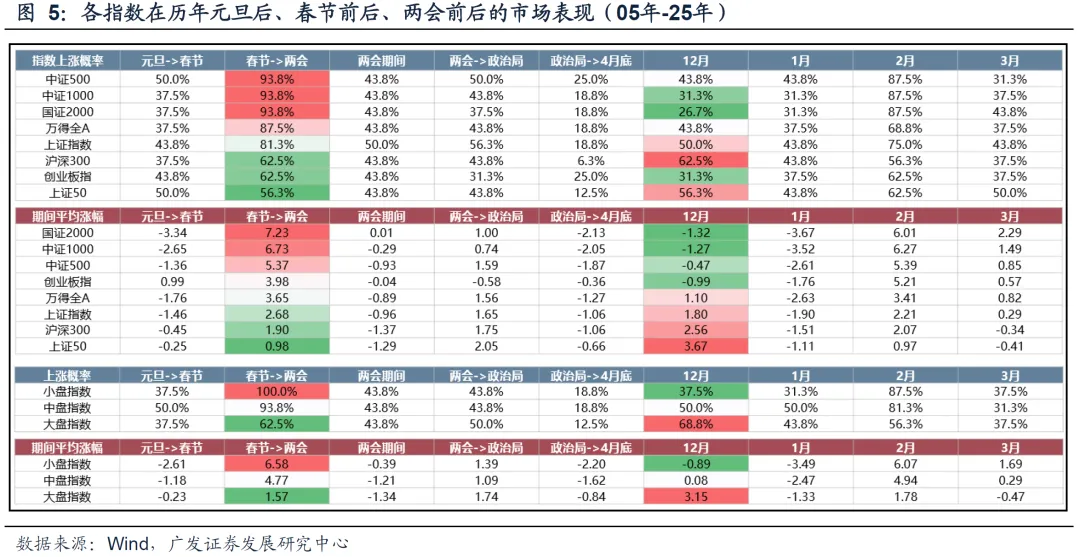
本周各家券商策略普遍提及岁末年初的历史行情表现情况,整体看好春季躁动提前。 广发策略刘晨明团队复盘了岁末年初的指数及风格历史表现情况,可总结为: 11月:对机构最不利的一个月已经过去,11月份市场涨跌和基本面关联度最弱,主题活跃、轮动加快。 12月:过去20年,指数在12月涨跌各半,不过基本面定价的有效性较11月增强;风格方面,大盘优于小盘,红利占优,金融板块涨幅居前,港 股红利也迎来一年中日历效应最强的时段。 1月:指数在1月的上涨概率仅43%,小盘股上涨概率仅31%,主要受年报预告压制风险偏好影响。 春节前后、2月:一年当中风险偏好最高的区间,小盘股胜率超过90%,成长风格、电子/计算机/非银等行业的平均涨幅最高。 今年来看,截止11月下旬,主线板块的调整时间、调整空间都已较为充分,近期已出现不同程度的反弹、或不再下跌,12月可纳入观察区间。26年的春季 躁动大概率不会缺席,做好积极布局准备(缺席的原因不外乎政策及外部冲击、流动性冲击、盈利下行,今年上述因素展望都较为温和)。 中银策略王君团队指出,"春躁"预热行情有望提前开启。下周起,美联储12月降息预期即将落地,当前市场对于12月降息的预期比较一致,需 ...

周末要闻及周策略丨多重政策护航,跨年行情要来了?
Sou Hu Cai Jing· 2025-12-07 12:56
Group 1 - The National Healthcare Security Administration and the Ministry of Human Resources and Social Security have issued new drug directories for basic medical insurance and commercial health insurance, adding 114 new drugs, including 50 innovative drugs [1] - The China Securities Regulatory Commission has set clear requirements for market value management, cash dividends, and share buybacks to enhance the investment value of listed companies and increase investor returns [1] - The Financial Regulatory Administration has adjusted the risk factors for insurance companies' stock investments, aiming to cultivate and expand patient capital [1] Group 2 - The A-share market has shown a recovery, with major indices closing in the green, and the Shanghai Composite Index surpassing 3900 points [2] - Recent financial regulatory policies are expected to provide significant short-term support to the market, including differentiated supervision for quality institutions and the relaxation of capital and leverage restrictions [2] - Historical data indicates that the period from mid-December to mid-January is typically a key observation window for year-end market trends, coinciding with the release of annual policies and seasonal liquidity easing [2] Group 3 - In terms of sector allocation, the brokerage sector may benefit from regulatory policy optimization, while high-dividend stocks in banking, electricity, and home appliances remain attractive [3] - Growth sectors such as AI applications, robotics, and innovative pharmaceuticals are expected to have recovery potential if the spring market rally starts early [3] Group 4 - Upcoming IPOs include companies like Nabai Chuan, Yuxun Co., and Yuanchuang Co., with a focus on sectors such as new energy vehicle thermal management and optical communication [9]
财信证券宏观策略周报(12.8-12.12):指数震荡企稳,逐步低吸科技方向-20251207
Caixin Securities· 2025-12-07 10:56
Group 1 - The report indicates that the A-share market is currently experiencing a low-level oscillation, with initial signs of stabilization as major indices' moving averages converge, awaiting a new trend in the market [4][7][16] - It is anticipated that a new buying window will open around mid-December, driven by institutional funds repositioning for the next year, the Central Economic Work Conference, and the expected interest rate cuts by the Federal Reserve [4][16] - The long-term outlook suggests a "slow bull" market for A-shares in 2026, supported by improved corporate performance, increased household savings entering the market, and a favorable global liquidity environment [4][7] Group 2 - The report highlights the potential for significant growth in the commercial aerospace sector, with the market expected to exceed 2.5 trillion yuan this year, driven by favorable policies and the establishment of dedicated regulatory bodies [11] - There is a focus on strategic minor metals and industrial metals, with expectations for a rebound in prices as the price gap between precious metals and these metals continues to widen [9][10] - The report emphasizes the importance of the AI application sector and domestic AI computing capabilities, which are expected to benefit from policy support and market trends [17][18] Group 3 - The real estate market is showing signs of divergence, with new home prices increasing while second-hand home prices continue to decline, affecting consumer sentiment [8] - The report notes that the financial sector is undergoing a transformation towards high-quality development, with regulatory changes expected to inject significant liquidity into the market [12] - The anticipated interest rate cuts by the Federal Reserve are expected to positively impact sectors such as non-ferrous metals and innovative pharmaceuticals [18]
开源证券:本轮春季躁动的共性&个性
Xin Lang Cai Jing· 2025-12-07 09:07
Core Viewpoint - The article discusses the reasons behind the seasonal market rally known as "spring excitement," emphasizing its historical significance and the factors contributing to its occurrence [1][2][4]. Group 1: Significance of Spring Rally - The spring rally serves as a market response to economic expectations and policy directions for the coming year, allowing investors to position themselves for the main themes of the year [1][8]. - It provides a favorable opportunity for institutions to adjust their portfolios, especially after year-end assessment pressures ease [1][8]. - The rally reflects seasonal liquidity improvements, driven by capital inflows around the Spring Festival and heightened policy expectations [1][8]. Group 2: Core Causes of Spring Rally - The three main causes of the spring rally include: 1. Concentrated release of policy expectations [1][8]. 2. Seasonal changes in liquidity, including a narrowing M1-M2 gap and strong credit issuance at the beginning of the year [1][8]. 3. An earnings vacuum period that allows institutions to adjust their holdings [1][8]. Group 3: Factors Influencing Rally Intensity - Historical analysis indicates that a strong spring rally typically requires one or a combination of the following conditions: 1. Short-term macroeconomic data (e.g., PMI, social financing, industrial value-added) significantly exceeding expectations, signaling economic stabilization or recovery [2][8]. 2. Overall corporate profitability entering an upward trajectory, with positive annual and quarterly earnings forecasts, free from major external disruptions [2][8]. 3. Clearly accommodative monetary policy, characterized by rising M1 growth, declining short-term interest rates, and enhanced credit pulses, providing ample liquidity support for high-elasticity assets [2][8]. Group 4: Changes in Funding Ecology - The current market sees two significant changes in funding ecology that may contribute to a stable increase in China's securitization rate: 1. The weakening of real estate investment attributes, with the equity market becoming a new primary venue for household assets [2][9]. 2. Indirect movement of household funds into the market, resulting in a continuous and stable influx of new capital [2][9]. Group 5: Investment Strategy - The investment strategy suggests a dual focus on technology and cyclical sectors, highlighting: 1. The dual driving forces of technology and cyclical opportunities, with cyclical prospects becoming more prominent amid anti-involution trends [4][11]. 2. Continued long-term advantages for technology sectors [4][11]. 3. Identification of opportunities in recently undervalued growth sectors such as military, media (gaming), AI applications, Hong Kong internet, and power equipment [4][11]. Group 6: Sector Allocation Recommendations - Recommendations for sector allocation include: 1. Internal recovery and high-low cuts within technology: military, media (gaming), AI applications, Hong Kong internet, batteries, and core AI hardware [5][12]. 2. Benefits from PPI improvement and broad anti-involution: solar energy, chemicals, steel, non-ferrous metals, electricity, and machinery [5][12]. 3. Long-term core holdings: stable dividends, gold, and optimized high-dividend stocks [5][12].
投资策略专题:本轮春季躁动的共性、个性
KAIYUAN SECURITIES· 2025-12-07 07:15
Group 1: Commonality of Spring Rally - The spring rally signifies the market's early response to economic expectations and policy directions for the coming year, allowing investors to position themselves for the main themes of the year [12][13] - The three core drivers of the spring rally include concentrated policy expectations, seasonal liquidity changes, and the performance vacuum during the earnings reporting period [16][20] - Strong spring rallies typically occur when macroeconomic data significantly exceeds expectations, overall corporate earnings enter an upward trajectory, and monetary policy is notably accommodative [21][20] Group 2: Changes in Funding Ecology Behind the Index Bull Market - The weakening of real estate investment attributes has led to the equity market becoming the new main stage for residents' assets, with a structural migration of funds from real estate to stocks and funds [23][24] - Residents' funds are indirectly entering the market, bringing stable incremental capital, with a shift from high-yield financial products to new categories such as fixed income+, secondary bond funds, and higher-risk bank wealth management products [25][26] Group 3: Investment Strategy - Technology and Cyclical Sectors - The market correction is seen as a temporary pause, with an emphasis on early positioning for the spring rally, focusing on both technology and cyclical sectors as dual drivers [29][30] - Specific sectors showing potential include military industry, media (gaming), AI applications, Hong Kong internet, and power equipment, with core technology blue chips expected to recover [29][30]
深演智能,二度递表港交所
Zhong Guo Zheng Quan Bao· 2025-12-04 08:16
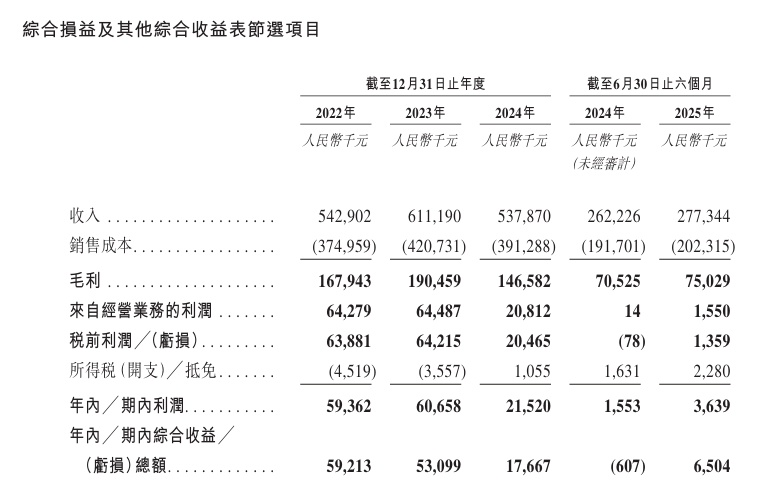
Core Viewpoint - 深演智能科技股份有限公司 has submitted its listing application to the Hong Kong Stock Exchange for the second time, focusing on AI applications in marketing and sales, amidst a competitive and rapidly changing market [1][2]. Group 1: Company Overview - 深演智能 is a decision-making AI technology company that emphasizes AI applications in marketing and sales scenarios, ranking first in China's marketing and sales decision-making AI application market with a market share of 2.6% as of 2024 [2][3]. - The company has developed a product matrix centered around two flagship platforms, AlphaDesk and AlphaData, with the latest addition being Deep Agent [3]. Group 2: Financial Performance - The company's revenue figures for the years 2022 to 2025 (first half) are approximately 543 million, 611 million, 538 million, and 277 million RMB respectively, with net profits of about 59 million, 61 million, 22 million, and 3.6 million RMB for the same periods [3][4]. - The revenue from the top five clients accounted for 51.1%, 50.2%, 54.6%, and 70.2% of total revenue in 2022, 2023, 2024, and the first half of 2025 respectively, indicating a high dependency on a limited client base [5]. Group 3: Market Competition - The market in which 深演智能 operates is described as highly competitive and rapidly changing, with significant risks if the company fails to compete effectively against existing or emerging competitors [6][7]. - Competitors may have advantages such as longer operating histories, stronger brand recognition, and better financial, technical, and marketing resources, which could lead to price pressures and reduced profit margins for 深演智能 [7].
A股市场2026年投资策略—角逐定价权,迈入低波市
2025-12-04 04:47
Summary of Key Points from the Conference Call Industry Overview - The A-share market is transitioning from domestic-focused companies to global multinational corporations, indicating a shift from an emerging market to a mature market. This transformation is expected to enhance pricing power for Chinese companies in the global value chain during the "14th Five-Year Plan" period [4][5][6]. Core Insights 1. **Global Exposure of A-Share Companies**: - The overseas business exposure of A-share companies has significantly increased, with the share of overseas revenue for the top 30 manufacturing companies rising from 7% in 2005 to 45% in 2025H1. This high exposure contributes 39% of profits and 35% of market capitalization for the entire A-share non-financial sector [5][19][20]. - The correlation between A-share companies' performance and domestic economic indicators is decreasing, indicating a shift towards global economic cycles [5][23]. 2. **Impact of US-China Relations**: - The dynamics of US-China relations are crucial for market trends, with two key events in 2026 (the signing of a trade agreement and the US midterm elections) expected to segment the market into three phases: pre-agreement, post-agreement to midterm elections, and post-midterm elections [6][35]. 3. **Market Liquidity and Investment Trends**: - The influx of capital is primarily from absolute return-focused funds, leading to a long-term decline in market volatility. Traditional subjective long-only funds are seeing limited net inflows compared to tool-based products [7][9][11]. - The shift towards tool-based investment products, such as thematic ETFs, is evident, with significant net inflows into these products compared to broad-based ETFs [9][20]. Industry Configuration 1. **Manufacturing Sector Upgrades**: - The traditional manufacturing sector is focusing on upgrading quality and converting market share advantages into pricing power. The goal is to increase the profit share of Chinese manufacturing in the global market [12][19]. - Key sectors to watch include non-ferrous metals, chemicals, and new energy [12]. 2. **Chinese Enterprises Going Global**: - The trend of Chinese companies expanding overseas is expected to continue, with significant potential for profit growth in sectors like machinery, innovative pharmaceuticals, and electric equipment [13][19]. - The current overseas penetration rates for various sectors indicate that many industries are still in the early stages of international expansion [13]. 3. **AI and Technology Sector**: - The continuation of the technology market is dependent on new applications that broaden the commercial landscape for AI. The market is currently anxious about the sustainability of AI investments [14][19]. - Key sectors include semiconductors, computing power, and AI applications, which are expected to drive future growth [14]. 4. **Consumer Sector Opportunities**: - The consumer sector is currently underperforming relative to external demand, but there is potential for recovery driven by policy changes and macroeconomic shifts [14][19]. Risk Factors - Potential risks include escalating tensions in technology, trade, and finance between the US and China, domestic policy effectiveness, macroeconomic liquidity tightening, and geopolitical conflicts [14][19]. Investment Strategy for 2026 - Four key investment portfolios have been proposed for 2026: - **Manufacturing Upgrade 30**: Focused on traditional manufacturing leaders with significant market share advantages. - **Chinese Enterprises Going Global 30**: Targeting companies with strong global competitiveness. - **China AI 35**: Concentrating on firms in the semiconductor and AI application sectors. - **New Consumption 15**: Emphasizing companies with strong brands and service-oriented consumer offerings [14][19]. This comprehensive analysis highlights the evolving landscape of the A-share market, driven by global exposure, US-China relations, and sector-specific trends, while also addressing potential risks and strategic investment opportunities.
抄底?
第一财经· 2025-12-03 12:21
Core Viewpoint - The market is experiencing a correction phase, with a notable shift in capital allocation towards low-volatility sectors, while retail investors are engaging in structural bottom-fishing strategies [6][8]. Market Performance - The three major indices have all fallen below the 5-day moving average, indicating a bearish trend, with 1,442 stocks rising and 3,872 stocks declining [4]. - The trading volume in the two markets reached 6.6 trillion, reflecting a 4.80% increase, suggesting a significant adjustment in capital allocation rather than a mass withdrawal [6]. Capital Flow - There was a net outflow of 8.696 billion from institutional funds, while retail investors showed a net inflow [7]. - Institutions are cautiously positioning themselves in low-volatility sectors such as coal and non-ferrous metals, while remaining watchful on growth sectors like lithium batteries and AI applications [8]. Investor Sentiment - Retail investor sentiment stands at 75.85%, indicating a relatively optimistic outlook despite the market's downturn [9]. - The average position held by investors is 70.18%, with 32.31% increasing their positions and 14.53% reducing them [12][18].