
医疗保健

Search documents
分化加剧!金融周期承压,科技消费成市场新主线!
Sou Hu Cai Jing· 2025-07-16 05:30
Group 1 - The current market is in a period of policy dividend release and industrial transformation, with significant characteristics of volume fluctuations and hot topic rotations [1][3] - Short-term focus can be on the film and entertainment sector (performance catalysts + summer consumption), AI computing power industry chain (chip supply recovery + domestic substitution), innovative pharmaceuticals (optimized collection policies), and robotics themes for trading opportunities [1][3] - The A-share communication industry leads with a 1.76% increase, driven by Nvidia's resumption of H20 chip supply to China and rising expectations for domestic computing power industry chain [2][3] Group 2 - The A-share market shows mixed performance, with the Shanghai Composite Index slightly down by 0.13% to 3500.62 points, while the Shenzhen Component, ChiNext Index, and STAR Market Index show increases of 0.11%, 0.36%, and 0.39% respectively [2] - The Hong Kong stock market remains stable, with the Hang Seng Index up by 0.28% to 24658.55 points, and the Hang Seng Technology Index rising by 0.61% to 5464.40 points, indicating a focus on technology and healthcare sectors [2][3] - The durable consumer goods index dropped by 5.38%, reflecting market caution regarding consumer profit-taking pressures and the recovery strength of the real estate chain [3] Group 3 - Mid-term recommendations suggest focusing on the pan-technology sector, capturing AI-driven computing power, applications, and data elements as the main line [3] - New consumption sectors should pay attention to domestic brands catering to Generation Z needs, interactive entertainment, and smart home products [3] - Investors are advised to be cautious of traditional cyclical industry fluctuations and high valuation risks, prioritizing targets with clear industrial logic, strong policy support, and solid performance backing [3]
关税阴影下的美股财报季:期权市场押注个股波动飙升 医疗股恐成“风暴眼”
智通财经网· 2025-07-15 05:58
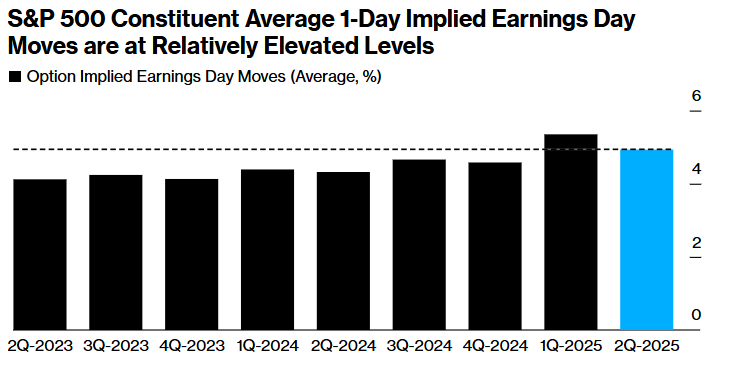
Core Viewpoint - The upcoming earnings season is expected to be significantly influenced by tariff-related uncertainties, leading to increased volatility in stock prices, particularly in the healthcare sector [1][4]. Group 1: Earnings Season and Market Reactions - The options market indicates that the volatility of S&P 500 companies on earnings announcement days will be greater compared to recent quarters, with healthcare showing the highest potential for significant fluctuations [1]. - 73% of S&P 500 companies are expected to report earnings before the new deadline for a trade agreement with the U.S., contributing to ongoing uncertainty [4]. - Analysts have noted that the volatility in stock prices on earnings announcement days has been increasing in both the U.S. and Europe, particularly for consumer and healthcare companies [4]. Group 2: Sector-Specific Insights - The healthcare sector is anticipated to experience notably higher volatility due to threats from high tariffs and recent cuts to Medicaid funding [4]. - In the second quarter of 2025, the expected earnings growth rates for various sectors are as follows: Information Technology (6.3%), Consumer Discretionary (5.9%), Communication Services (5.5%), Financials (3.8%), Health Care (5.6%), and others [5]. Group 3: Market Trends and Strategies - The current market conditions are slightly below neutral, which may favor a potential market rally during the earnings season, with stocks typically rising in about 75% of the time during this period [5]. - The volatility of individual stocks remains stable despite a general upward trend in the market, with traders anticipating larger individual stock movements during the earnings season [8]. - Goldman Sachs predicts that the volatility on earnings days could be 3.5 times higher than on non-earnings days, compared to a previous ratio of 2.5 times [10].

20cm速递|双创板块上行,科创创业ETF(588360)涨超2%,机构表示科技金融支持力度加大
Mei Ri Jing Ji Xin Wen· 2025-07-15 04:32
Group 1 - The core viewpoint is that capital market reforms will enhance mechanisms supporting the development of technology growth enterprises, with a focus on sectors like biomedicine, artificial intelligence, commercial aerospace, and low-altitude economy [1] - Reforms in the Sci-Tech Innovation Board and the Growth Enterprise Market, such as the establishment of a growth layer, the resumption of listing standards for unprofitable companies, and the introduction of a third set of standards for the Growth Enterprise Market, will significantly increase market support for technology companies, creating more investment opportunities in these fields [1] - The Sci-Tech Innovation and Entrepreneurship ETF (588360) tracks the Sci-Tech Innovation and Entrepreneurship 50 Index (931643), which is composed of 50 strategic emerging industry listed companies selected from the Sci-Tech Innovation Board and the Growth Enterprise Market, focusing on high-growth sectors like information technology and healthcare [1] Group 2 - The index constituents generally have a large average market capitalization and maintain a dynamic optimization of constituent structure through a quarterly adjustment mechanism, reflecting the overall performance of leading companies in China's Sci-Tech and Growth Enterprise sectors [1]

恒生医疗ETF(513060)盘中涨超1%,冲击3连涨,机构看好创新药BD催化延续
Xin Lang Cai Jing· 2025-07-15 03:26
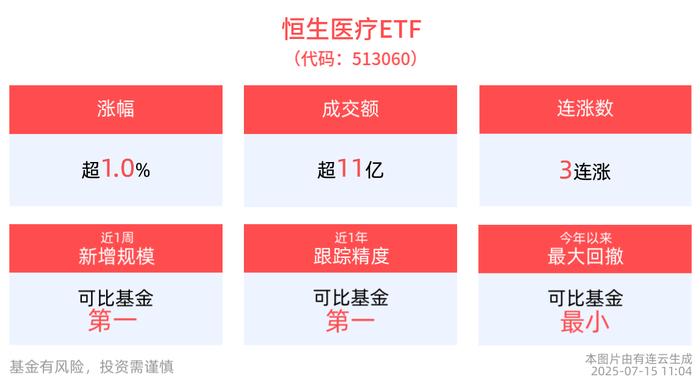
Group 1 - The Hang Seng Healthcare Index (HSHCI) increased by 0.87% as of July 15, 2025, with notable gains from stocks such as Health Road (02587) up 9.58% and BeiGene (06160) up 5.18% [3] - The Hang Seng Healthcare ETF (513060) has seen a 1.01% rise, marking its third consecutive increase, with a latest price of 0.6 yuan [3] - The ETF's trading volume was active, with a turnover of 1.151 billion yuan and a turnover rate of 13.96% [3] Group 2 - The adjustment of the 2025 National Basic Medical Insurance and commercial health insurance drug catalogues officially started on July 11, 2025, with results expected to be announced between October and November 2025 [4] - In the first half of 2025, China's innovative drug license-out transactions reached nearly 66 billion USD, surpassing the total for 2024, indicating strong interest from multinational pharmaceutical companies [4] - Key transaction categories include Antibody-Drug Conjugates (ADC) and bispecific antibodies, with expectations for continued activity in the second half of 2025 [4] Group 3 - The Hang Seng Healthcare ETF's size grew by 196 million yuan over the past week, ranking it in the top third among comparable funds [5] - The ETF's net value has increased by 19.77% over the past two years, with a maximum monthly return of 28.34% since inception [5] - The ETF's Sharpe ratio for the past year is 2.02, indicating strong risk-adjusted returns [5] Group 4 - The management fee for the Hang Seng Healthcare ETF is 0.50%, and the custody fee is 0.15% [6] - The ETF's tracking error over the past year is 0.060%, the highest tracking precision among comparable funds [6] - The latest price-to-earnings ratio (PE-TTM) for the index tracked by the ETF is 28.79, indicating a valuation lower than 87.88% of the time over the past three years [6] Group 5 - The top ten weighted stocks in the Hang Seng Healthcare Index account for 58.84% of the index, including companies like Innovent Biologics (01801) and WuXi Biologics (02269) [6]
“杭州六小龙”两位创始人成香港特首智囊!
新浪财经· 2025-07-14 00:16
Group 1 - The article discusses the first meeting of the new Chief Executive's Advisory Group in Hong Kong, which took place from July 9 to 11, 2023, focusing on the Chief Executive's Policy Address and overall development of Hong Kong [1][2] - The new members of the Advisory Group include Dr. Zhu Min, former Vice President of the International Monetary Fund, and founders of two tech companies from Hangzhou, indicating a shift towards a younger and more tech-focused representation [2][6] - The meetings emphasized Hong Kong's unique advantages as an international financial center and its role as a gateway for mainland companies to go public [2][9] Group 2 - The Advisory Group is structured into three main themes: high-quality and sustainable economic development, innovation and entrepreneurship, and regional and global collaboration [9] - The article highlights the recent increase in IPO activities in Hong Kong, with 42 IPOs completed in the first half of 2025, raising over 1,070 million HKD, marking a 22% increase compared to the previous year [10] - There is a growing interest from companies in Southeast Asia and the Middle East to list in Hong Kong, reflecting the positive market sentiment and effective promotional efforts [11][12]

【海外点评】德、英股市创历史新高,特朗普升级贸易攻势
Sou Hu Cai Jing· 2025-07-13 11:13
Group 1: Global Market Performance - The MSCI Global Stock Index decreased by 0.34%, while the Bloomberg Global Commodity Index fell by 0.42%, the Bloomberg Global Aggregate Bond Index dropped by 0.89%, and the FTSE EPRA/NAREIT Global REITs Index declined by 0.90% [1] - Emerging markets outperformed developed markets, with only the Chinese stock market rising among the BRICS nations; the Shanghai Composite Index increased by 0.82% and the Hang Seng Index rose by 0.93% [1] - In developed markets, the European STOXX Index rose by 1.15%, with Germany's DAX Index up by 1.97% and France's CAC40 Index up by 1.73%, while U.S. indices fell, with the S&P 500 down by 0.31% [1] Group 2: Commodity Market Insights - Brent crude oil futures rose by 3.02% to $70.36 per barrel, while WTI crude oil futures increased by 2.16% to $68.45 per barrel [4] - Industrial metals showed mixed performance; aluminum prices increased by 0.50%, while copper prices fell by 2.07% [2] - Gold prices rose by 0.55% to $3,355.59 per ounce, and silver prices increased by 4.02% [2] Group 3: Bond Market Developments - U.S. Treasury yields saw a slight increase, with the 10-year yield rising by 6.4 basis points to 4.411% [2] - European countries also experienced rising yields, with the UK's 10-year yield up by 3.6 basis points to 4.620% [2] - The U.S. dollar index rose by 0.69% to 97.853, while the Japanese yen depreciated by over 2% against the dollar [2] Group 4: Economic Data and Trends - U.S. initial jobless claims were reported at 227,000, slightly below expectations, while continuing claims rose to 1.965 million [3] - The Federal Reserve's June meeting minutes indicated a divergence in views on interest rate adjustments, with some members favoring rate cuts while others expressed concerns about persistent inflation [3] - The Eurozone's retail sales increased by 1.8% year-on-year, surpassing expectations [3] Group 5: REITs and Real Estate Market - The global REITs market saw a decline, with the STOXX Global 1800 REITs Index down by 1.03% [10] - U.S. REITs showed varied performance across sectors, with hotel REITs outperforming expectations [10] - The outlook for REITs remains mixed, with healthcare REITs showing consistent growth while retail REITs face volatility [10] Group 6: Investment Opportunities - Investors are advised to monitor oil price fluctuations due to geopolitical risks and OPEC+ production increases [7] - The ongoing geopolitical tensions in the Middle East may enhance gold's safe-haven appeal, prompting investors to consider gold price trends [9] - The potential for further monetary easing by central banks could create long-term investment opportunities in REITs [10]
失业率意外下降,低薪兼职成常态,加拿大就业市场的背后真相
Sou Hu Cai Jing· 2025-07-12 02:59
Core Insights - Canada's unemployment rate unexpectedly decreased to 6.9% in June, despite various economic challenges, driven primarily by job growth in wholesale and retail trade, healthcare, and social assistance sectors [1][3] - The addition of 83,100 jobs, mostly part-time, has injected some vitality into the labor market, but raises concerns about job quality and income stability [1][3] Employment Quality Concerns - The average wage growth for long-term employees has slowed to 3.2%, indicating potential underlying issues in the Canadian job market [3][5] - The prevalence of part-time positions suggests a decline in job quality, leading to income instability and limited career advancement opportunities, particularly affecting groups that require stable, high-income jobs [3][5] Manufacturing Sector Challenges - The manufacturing sector continues to face significant pressure from tariffs and international trade issues, which hampers overall employment growth [3][7] - Trade tensions between the U.S. and Canada remain unresolved, contributing to a challenging environment for Canadian manufacturing [3][7] Healthcare and Retail Sector Dynamics - Job growth in healthcare and social assistance is a positive sign, but the low wage levels and prevalence of low-skilled positions raise questions about long-term economic benefits [5][7] - The increase in employment within the wholesale and retail trade sectors may reflect consumer responses to economic conditions, but the sustainability of this growth is uncertain due to the rise of e-commerce and AI [5][7] Macroeconomic Context - The decline in unemployment does not mask the underlying issues within the Canadian job market, which is influenced by external factors rather than internal economic growth [7] - Future employment trends will be shaped by global economic uncertainties, changes in international trade relations, and domestic policy adjustments [7]

高盛策略转向均衡配置:软件服务与媒体娱乐成增长核心,材料板块逆势受宠
Zhi Tong Cai Jing· 2025-07-11 01:52
Core Insights - Goldman Sachs' investment strategy team has made significant adjustments to the U.S. sector allocation model, recommending a more balanced sector allocation strategy for investors [1] - The updated sector model indicates that an equal-weight sector allocation portfolio has a significantly higher probability of achieving over 5% excess returns compared to an equal-weight S&P 500 index over the next six months [1] Sector Recommendations - The software and services, as well as media and entertainment sectors, continue to hold their previous overweight ratings, while the new materials sector has been included in the core recommendations for the first time [1] - The consumer staples sector has been removed from the priority allocation list [1] - The report emphasizes that the current U.S. stock market exhibits an overly optimistic outlook on the economic prospects, with both downside risks and upside potential present in the actual economic performance [1] Investment Strategy - The strategy report suggests avoiding significant bias towards cyclical or defensive sectors, advocating for a balanced investment portfolio that can withstand market fluctuations [1] - In terms of specific sector selection, software and services (long-term growth expectation of 14%) and media and entertainment (long-term growth expectation of 14%) stand out due to their robust growth prospects, particularly in a moderately growing economy [1] - Defensive sectors such as utilities and real estate are favored due to the expectation of a slight decline in bond yields [1] - Among cyclical sectors, the materials sector is viewed as having a better allocation advantage compared to the energy sector, primarily based on expectations of falling oil prices [1] Adjustments and Market Outlook - The industrial sector has been downgraded due to its overall valuation being at historical highs, with the model indicating the lowest likelihood of achieving significant excess returns over the next six months [2] - Although the consumer staples and healthcare sectors are not explicitly bearish, their allocation priority has been slightly lowered compared to the model's baseline recommendations [2] - The adjustments reflect Goldman Sachs' neutral judgment on the market environment, acknowledging the reasonableness of current market optimism while diversifying allocations to hedge against potential risks [2] - The strategy team highlights that in the context of economic growth uncertainty, sectors that combine growth potential with reasonable valuations will exhibit greater investment resilience, while excessive bets on a single direction may face dual volatility risks [2]
“大而美”法案削减医疗补助,美国经济会好吗
2 1 Shi Ji Jing Ji Bao Dao· 2025-07-10 12:30
Core Viewpoint - The "Big and Beautiful" tax and spending bill passed by the U.S. House of Representatives may not yield the optimistic outcomes that Republicans envision, particularly regarding its impact on social safety nets and the economy [1][5]. Summary by Sections Tax and Spending Changes - The bill extends tax cuts for corporations and individuals initiated during Trump's first term in 2017, including tax exemptions for certain tip and overtime income, while also lowering corporate taxes [2]. - It represents a significant shift in U.S. spending priorities, with major cuts to social security programs like Medicaid and SNAP, and increased funding for tax cuts, defense, and immigration enforcement [2]. Impact on Social Safety Nets - The bill imposes stricter eligibility requirements for Medicaid, requiring individuals aged 19-64 to work at least 80 hours per month to qualify for insurance, which could severely limit access for many low-income individuals [3]. - The reduction in Medicaid funding and support for low-income families may lead to a diminished safety net, adversely affecting those who rely on these programs for basic healthcare and food assistance [3][4]. Economic Implications - The Congressional Budget Office estimates that the bill will increase the national debt by $3.3 trillion over the next decade, exacerbating the federal government's financial situation [5]. - There are concerns that tax cuts may not lead to immediate investment growth, as manufacturing jobs continue to decline and hiring in retail and services remains sluggish [5]. Societal Consequences - The reduction in social safety net spending could potentially lead to increased crime rates and a decline in birth rates, with the U.S. experiencing its lowest birth rate since 1979 [6]. - The bill reflects a traditional Republican economic policy approach, but its long-term effects on the economy and society may be profound and divisive [6].
投资策略专题:经济信心提升下,次新股扬帆起航
KAIYUAN SECURITIES· 2025-07-10 08:45
Group 1 - The current trend of newly listed stocks has re-emerged since September 2024, with the Wind New Stock Index showing a significant upward trend after a period of relative stability [2][12][15] - Fund holdings in newly listed stocks are relatively low, indicating a potential for significant future increases as funds have been under-allocated in this sector [14][15] - The performance of newly listed stocks is closely correlated with improvements in China's economic outlook, particularly in relation to the United States [20][21] Group 2 - Newly listed stocks benefit from the "era dividend" associated with current IPOs, reflecting strong growth potential and alignment with new economic policies [3][24] - The newly listed stock index is characterized by a diverse industry distribution, reducing exposure to risks associated with any single sector [24][27] Group 3 - The existing Wind New Stock Index lacks the characteristics of a truly investable index due to high turnover and frequent rebalancing [28][29] - A new index, the Open Source New Stock Index, has been developed to better capture the "era dividend" by including stocks listed for less than six years, thus stabilizing the index and enhancing its investment significance [30][31] Group 4 - The Open Source Strategy Selected New Stock Strategy has been constructed by integrating financial and technical indicators, achieving a cumulative return of 980.32% since April 2010, with an annualized return of 16.89% [5][36][41] - The performance of the new stock financial portfolio has significantly outperformed benchmarks, demonstrating its effectiveness in generating alpha [38][41]