
券商

Search documents
2026年格隆汇“下注中国”十大核心资产之东方财富
Ge Long Hui· 2026-01-04 10:55
Core Viewpoint - Dongfang Caifu (300059.SZ) has been selected as a core asset in the financial sector, reflecting its strong performance and growth potential in the upcoming market environment [1] Industry Overview - The brokerage sector is entering a favorable growth cycle, driven by government policies aimed at stabilizing growth and the stock market, with a projected ROE of 8.61% for 2026, representing a 24% increase from 2025 [4] - The average daily trading volume in A-shares is expected to stabilize at 1.5 trillion yuan in 2025, with margin financing balances exceeding 2.5 trillion yuan, indicating a "healthy bull market" [1] Company Analysis - Dongfang Caifu has established a unique ecosystem combining "Dongfang Caifu Network + Tian Tian Fund + Securities," enhanced by AI technology, positioning it as a core asset with both beta and alpha advantages [1] - In the first three quarters of 2025, Dongfang Caifu reported revenue of 11.589 billion yuan, a year-on-year increase of 58.67%, and a net profit of 9.097 billion yuan, nearing the total for 2024 [1] Business Drivers - The brokerage business is expected to benefit from a bull market, with increased trading volumes leading to higher commission revenues [7] - The wealth management sector is expanding as Chinese residents shift asset allocation from deposits to funds and stocks, with Dongfang Caifu poised to capture more market share [7] - The integration of AI technology is enhancing service efficiency, with significant improvements in customer service response rates and user retention [7] Competitive Advantages - Dongfang Caifu's competitive edge lies in its "traffic + license + technology" model, creating a robust moat that is difficult for competitors to replicate [9] - The company has a comprehensive licensing structure, allowing it to meet diverse financial needs and enhance user stickiness [10] - Significant investment in technology has resulted in high profit margins and operational efficiency, with a gross margin of 69% and a net margin of 81.2% in 2025 [11] Financial Performance - The financial performance of Dongfang Caifu is strong, with a net asset of 72 billion yuan and a debt-to-asset ratio of 76.63%, indicating a solid financial position [19] - The dynamic PE ratio is 28.81, which is lower than the average PE of traditional brokerages at around 20, suggesting a favorable valuation relative to growth prospects [22] Growth Projections - Revenue from brokerage services is expected to exceed 8 billion yuan, with margin interest income reaching 4.5 billion yuan, and fund distribution income projected to hit 2 billion yuan in 2026 [22] - The AI and data services segment is anticipated to experience explosive growth, transitioning from a supplementary role to a core growth driver [16]



七年两度挂牌,国联民生决意退出中海基金
Sou Hu Cai Jing· 2026-01-04 10:02
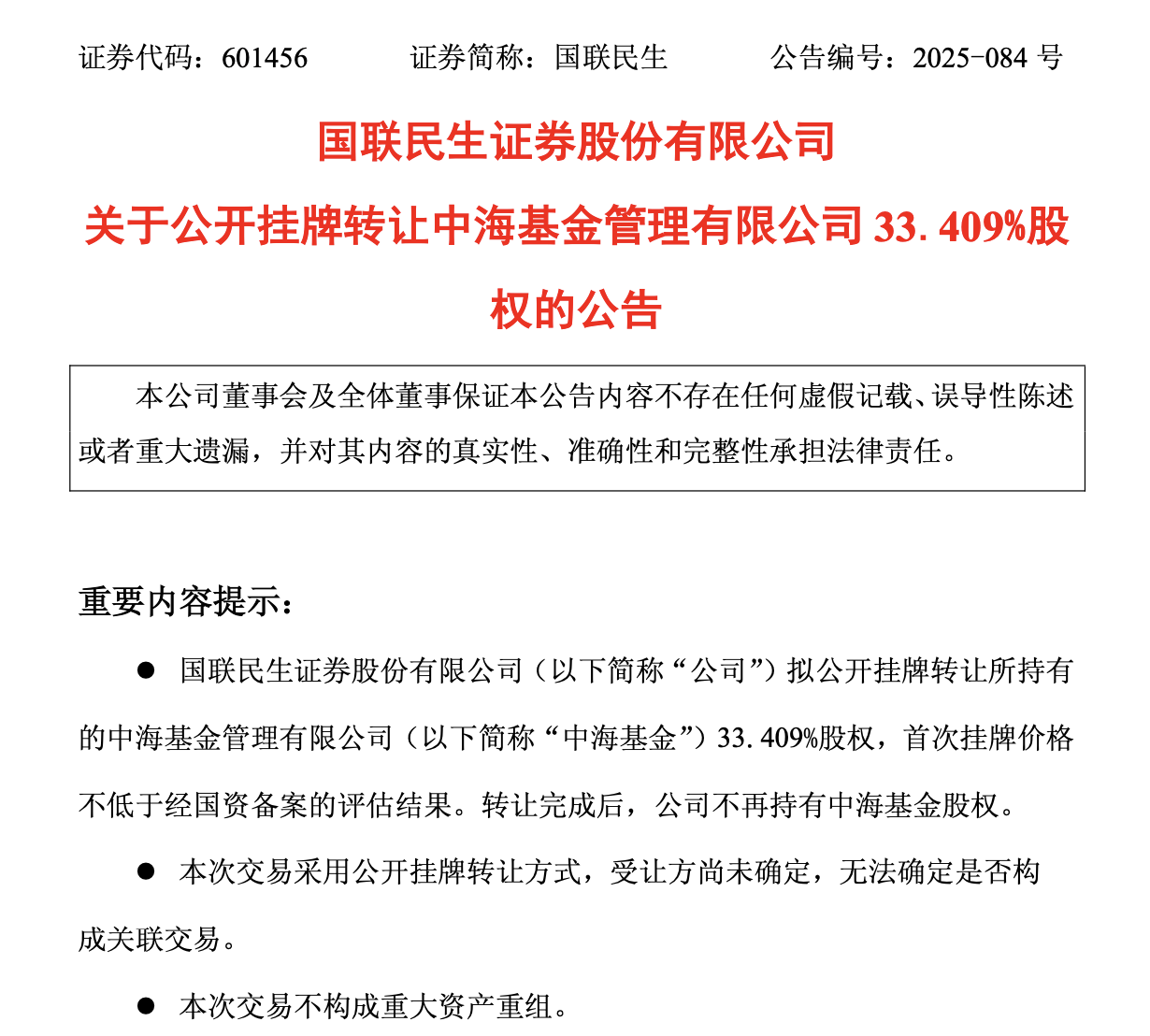
2025年12月30日,国联民生(601456)发布公告,拟公开挂牌转让所持中海基金33.409%股权,首次挂牌价格不低于经国资备案的评估结果,按中联资产评 估集团的市场法评估,这部分股权价值约1.53亿元。 而国联证券作为中海基金的创始股东,其持股比例从最初的49%降至33.41%,经历了从控股到参股的角色转变。 七年前,国联证券曾试图彻底退出中海基金,2018年2月,国联证券曾挂牌转让中海基金33.41%股权,挂牌底价2.14亿元。公开资料显示,2014-2017年上半 年,国联证券从中海基金获得的分红相当可观;并且当时正处于券商资管向主动管理转型的大背景下,国联证券选择退出的举动令人费解。时代周报报道, 据中海基金内部人员表示,国联证券在公司的存在感较低,与之对应的是大股东中海信托对于公司的发展给予了较多支持,公司的文化也与大股东颇为接 近,而国联证券作为第二大股东某种意义上更类似于财务投资者的角色。但最终这起转让并没有成功。 两年后,国联证券态度突变,又计划从法国洛希尔银行收购25%股权,意图重获控制权。根据2020年9月的计划,收购价格为1.15亿元,若交易完成,国联 证券将持股58.41%,成为控 ...

中信证券:人心思涨环境下 开年后A股市场或震荡向上
智通财经网· 2026-01-04 09:41
Core Viewpoint - The report from CITIC Securities indicates that the biggest expected divergence in 2026 will stem from the balance between external and internal demand, with a trend towards imposing tariffs on external demand and subsidizing internal demand, marking an important beginning this year [1][7]. Market Overview - The market is expected to experience a higher probability of upward movement after the New Year, given the relatively low funding enthusiasm at the end of last year and the prevailing sentiment of wanting to see market growth [1][8]. - The overall market sentiment is currently restrained, with many investors waiting for the right entry point, suggesting limited potential for significant market corrections in the absence of major unexpected risks [8]. Investment Strategy - The company recommends adopting a mindset focused on "earning performance money rather than expecting valuation money" for mid-term investments, favoring sectors with lower heat and concentration but increasing attention and catalysts, such as chemicals, engineering machinery, electric power equipment, and new energy [1][10]. - There is a cautious approach towards high prosperity and high heat sectors that have seen stagnant stock prices, while new industry themes like commercial aerospace are expected to continue to evolve and warrant ongoing attention [1][10]. Performance Analysis - In 2025, the median return for actively managed public funds tracked by CITIC Securities was 28.2%, ranking third over the past decade, with a significant disparity in returns between the top and bottom deciles [2]. - The overall performance of the A-share and Hong Kong stock markets in 2025 can be divided into five phases, with notable fluctuations driven by external factors such as tariff impacts and AI application narratives [3][4]. Structural Market Dynamics - The significant money in the structural bull market in 2025 primarily came from the correction of expected divergences and performance growth, particularly in the context of external and internal demand dynamics [4]. - The report highlights that the market's perception of external demand has shifted from optimism to caution, with geopolitical factors influencing expectations throughout the year [7]. Future Outlook - The anticipated structural adjustments in trade policies, including increased tariffs and stricter export controls, indicate a shift in China's approach to external trade, aiming to balance external and internal demand [7]. - The report emphasizes that the market may struggle to quickly price in these significant structural changes, which could serve as both a source of expected divergence and potential performance growth [7].

非银金融行业周报:看好券商和保险开门红行情,公募销售费新规落地-20260104
KAIYUAN SECURITIES· 2026-01-04 09:14
非银金融 2026 年 01 月 04 日 投资评级:看好(维持) 行业走势图 数据来源:聚源 -10% 0% 10% 19% 29% 2025-01 2025-05 2025-09 非银金融 沪深300 相关研究报告 《保险公司资负管理办法发布,明确 监 管 指 标 和 阈 值 — 行 业 周 报 》 -2025.12.21 《美联储降息利好券商海外业务,新 规规范基金销售 — 行 业 周 报 》 -2025.12.14 《券商杠杆上限有望松绑,险企调降 风 险 因 子 释 放 资 金 — 行 业 周 报 》 -2025.12.7 看好券商和保险开门红行情,公募销售费新规落地 ——行业周报 | 高超(分析师) | 卢崑(分析师) | 张恩琦(联系人) | | --- | --- | --- | | gaochao1@kysec.cn | lukun@kysec.cn | zhangenqi@kysec.cn | | 证书编号:S0790520050001 | 证书编号:S0790524040002 | 证书编号:S0790125080012 | 周观点:看好券商和保险开门红行情,公募销售费新规落地 元旦假期 ...
申万宏源:上证综指连续阳线后,春季行情仍有纵深
Xin Lang Cai Jing· 2026-01-04 08:47
Group 1 - The December 2025 PMI shows a significant month-on-month improvement, reinforcing the absence of downward risks for the spring season [1][5] - The favorable economic conditions are supported by the late timing of the 2026 Spring Festival, which has led to a pre-emptive increase in export orders [1][5] - The spring season is expected to provide a continuous window for risk appetite, with key events such as the February pre-Spring Festival rebound and the March Two Sessions potentially enhancing policy catalysts [1][5] Group 2 - The economic and industrial variables are slow-moving, while capital supply and demand are fast-moving, a characteristic that may become more pronounced in the spring market [1][5] - The A500 ETF has entered a stable phase, and the influx of new capital at the beginning of the year is expected to coincide with a recovery in foreign investment activity due to the appreciation of the RMB [1][5] - The A-share market is anticipated to have a positive start, with widespread profit-making effects likely to emerge [1][5] Group 3 - The conditions for a comprehensive bull market in 2026 are gradually being established, with a dynamic development process underway [2][6] - The market's previous skepticism regarding foreign capital inflows is shifting, as the recent appreciation of the RMB enhances the competitiveness of Chinese manufacturing, potentially accelerating foreign capital return [2][6] - The second half of 2026 is expected to witness a bull market driven by various positive factors, including cyclical improvements in fundamentals and increased asset allocation towards equities by residents [2][6] Group 4 - The spring market structure remains unchanged, with higher elasticity in thematic trading opportunities, particularly in AI computing chains and cyclical sectors [3][7] - The thematic rotation includes industrial themes (commercial aerospace, robotics, nuclear fusion), capital themes (A500, insurance, foreign capital return), and policy themes (service consumption, Hainan) [3][7] - The investment focus is on sectors with Alpha logic, while cyclical sectors are recommended only for those with strong fundamentals [3][7]

华金证券:节后春季行情进行中 聚焦成长
Xin Lang Cai Jing· 2026-01-04 08:42
Group 1 - The short-term performance of A-shares after the New Year is mainly influenced by policies, external events, liquidity, and overseas market trends [1][6] - Since 2010, in 16 years, the Shanghai Composite Index has risen in 11 instances during the 10 trading days before the holiday and has shown similar patterns after the holiday [1][6] - Positive policies and external events are core influencing factors for post-holiday A-share performance, with examples including the resolution of the "fiscal cliff" in the US in January 2013 and the easing of US-China trade tensions in early 2019 [1][6] Group 2 - Current observations suggest that the A-share spring market is ongoing, with potential for a strong but volatile performance post-New Year [1][6] - There is a likelihood of further positive policy implementation after the holiday, including the rollout of guidelines for equipment updates and trade-in policies, as well as local government meetings to stimulate consumption [1][6] Group 3 - External risks post-holiday are expected to be limited, with a high probability of a Federal Reserve rate cut in January and stable US-China relations, although tensions with Japan may persist [2][7] - Liquidity is anticipated to further loosen, with potential for accelerated capital inflow into the stock market [2][7] Group 4 - The economic recovery remains weak, with industrial profits continuing to decline, but there is potential for recovery in certain sectors, particularly in technology and cyclical industries [2][7] - Historical trends indicate that industries driven by upward policies and trends before the holiday are likely to maintain their strength afterward [3][8] Group 5 - Recommendations for post-holiday investment include focusing on technology, certain cyclical sectors, and consumer industries, with specific mention of machinery, military, new energy, media, computing, electronics, telecommunications, and pharmaceuticals [4][9] - Current PEG ratios for growth sectors like power equipment and media are relatively low, indicating potential for investment [4][9]
浙商证券:看多马年春节 短线两手准备
Xin Lang Cai Jing· 2026-01-04 08:42
Core Viewpoint - The market experienced narrow fluctuations before the New Year, with most broad indices slightly declining. Looking ahead, the rise of Hong Kong stocks and the A50 index during the New Year period suggests a high probability of a "good start" for A-shares after the holiday. However, the sustainability of the three driving factors behind the recent A-share rally (A500 ETF volume and price increase, strong performance of optical modules, and booming commercial aerospace) remains uncertain post-holiday, necessitating a dual-preparation strategy in the short term. From a mid-term perspective, the market is expected to rise further before March [1][4][10]. Market Overview - The major indices showed slight declines before the New Year, with a narrow range of fluctuations observed [7]. - Sector performance indicated strength in petrochemicals and commercial aerospace, while robotics and soft technology sectors also saw gains [7]. - Market sentiment improved with a rise in trading volume in Shanghai and Shenzhen, although stock index futures contracts were generally at a discount [7]. - Fund flows showed an increase in margin trading balances, with the securities ETF experiencing the highest net inflow [7]. Market Attribution - The Ministry of Finance announced a continuation of a more proactive fiscal policy for 2026 [9]. - The official release of the 2026 national subsidy plan was noted [9]. - A reduction in the value-added tax rate from 5% to 3% for individuals selling homes purchased for less than two years was implemented [9]. - The China Securities Regulatory Commission issued new regulations on the management of sales expenses for publicly raised securities investment funds [9]. Investment Strategy - Based on the outlook for the Year of the Horse, the recommendation is to maintain current holdings and avoid chasing prices, especially for those that have seen significant gains this year. If a situation similar to the "golden pit" of early 2025 arises, it is advised to increase allocations at lower prices [5][11]. - Sector focus should be on high-tech sectors that have recently undergone sufficient adjustments, such as the Hang Seng Technology and Sci-Tech 50 indices [5][11]. - Industry attention should be directed towards the brokerage sector, which has shown significant lag and market share expansion, as well as robotics-related machinery and automotive sectors, AI application-related media and computing sectors, and sectors benefiting from the Spring Festival retail surge, including electronics and chemicals [5][11]. - Individual stock selection should prioritize low-priced, lagging stocks within the aforementioned sectors and industries [5][11].

A股策略周报:一年之计在于春-20260104
GUOTAI HAITONG SECURITIES· 2026-01-04 07:28
Group 1 - The A-share market is expected to welcome a "spring opening red" due to the resonance of policy expectations, liquidity, and fundamentals, with a focus on technology, non-bank financials, and consumption [2][4] - The Shanghai Composite Index closed at 3968.84 points in 2025, with an annual increase of 18.41%, confirming the strategic judgment of Guotai Junan [8][4] - The market is anticipated to stabilize at important levels, driven by factors such as the upcoming announcement of the new Federal Reserve chair, expectations of U.S. interest rate cuts in 2026, and increased liquidity from A500 ETF inflows [8][4][5] Group 2 - The report highlights a new trend of price signals indicating an economic upturn, with demand improving in sectors like chemicals and new energy, while supply is contracting [21][4] - The technology sector is expected to benefit from global chip technology breakthroughs and a continued trend of rising storage prices, with domestic computing infrastructure shortages likely accelerating localization [25][4] - Non-bank financials are projected to benefit from increased wealth management demand and capital market reforms, with recommendations for insurance and brokerage firms [41][4] Group 3 - The report emphasizes the importance of cyclical stocks in the context of expanding domestic demand and stable real estate policies, recommending sectors such as tourism services and consumer goods [25][4] - The AI application sector is highlighted as a key growth area, with significant developments in robotics and commercial aerospace, indicating strong investment potential [25][4] - The report notes that the insurance sector is expected to see improved profitability due to increased equity allocations and favorable market conditions [41][4]
定期报告:节后春季行情进行中聚焦成长
Huajin Securities· 2026-01-04 02:01
1. Report Industry Investment Rating No relevant content provided. 2. Core Viewpoints of the Report - This year after the New Year's Day, the A - share spring market is underway and may be volatile and bullish, affected by factors such as policy implementation, liquidity, and the performance of the Hong Kong stock market [1][4][7]. - After the holiday, technology growth and some cyclical industries may be relatively dominant, with continuous upward industrial trends and policy support [1][26]. - After the holiday, it is recommended to continue to allocate industries such as technology, some cyclical and consumer sectors on dips [1][38][46]. 3. Summary by Relevant Catalogs 3.1 Post - holiday Spring Market is Underway 3.1.1 Factors Affecting Post - holiday A - share Movement - Since 2010, in 11 out of 16 years, the Shanghai Composite Index showed the same upward or downward trend in the 10 trading days before and after the holiday. The post - holiday short - term market performance is affected by policies, external events, liquidity, and the performance of the Hong Kong stock market [1][4]. - Positive policies and external events may lead to a short - term rise in the post - holiday A - shares, while tight policies or negative external events may result in weak performance. Liquidity also plays a key role, and the performance of the Hong Kong stock market during the holiday has a certain impact on the post - holiday A - shares [4]. 3.1.2 This Year's A - share Spring Market is Underway and May be Volatile and Bullish - Positive policies may continue to be implemented after the holiday, and external risks may be limited. The "two new" policies are accelerating implementation, local two - sessions may be held intensively, and consumption - stimulating policies may be introduced. Externally, the Fed may cut interest rates in January, Sino - US relations may remain stable, and geopolitical conflicts may ease [7][8]. - Post - holiday short - term liquidity may be further relaxed. Overseas, the Fed is likely to cut interest rates, and the RMB exchange rate may be strong. Domestically, the central bank may cut interest rates and reserve requirements. Also, stock market funds may accelerate inflow [9]. - The Hong Kong stock market performed strongly during the New Year's Day holiday, which may boost the post - holiday A - shares. The correlation coefficient between the Hong Kong stock market's rise and fall during the New Year's Day holiday and the Shanghai Composite Index's rise and fall in the 10 trading days after the holiday is about 0.5 [18][19]. - The post - holiday economy and corporate profits are still in weak recovery. The economy is in a weak recovery state, and corporate profits may continue to recover, although the industrial enterprise profits in November continued to decline [21]. 3.2 Industry Allocation: Focus on Growth after the Holiday 3.2.1 Technology Growth and Some Cyclical Industries May be Relatively Dominant after New Year's Day - Historically, policy and industrial trends drive pre - holiday strong industries to maintain their strength after the holiday. Pre - holiday leading industries may switch due to high sentiment or market adjustments. Industries with continuous strength around the New Year's Day usually have a relatively low historical quantile of trading volume [26]. - This year, the industrial trends of technology growth and some cyclical industries may continue to rise after the holiday. The pre - holiday leading cyclical industries have neutral - low sentiment, while the technology growth industries have high sentiment [26]. 3.2.2 Currently, the PEG of Electric Power, Media, and Automobile is Low - Among the primary growth industries, the predicted PEG of electric power equipment, media, and automobile is relatively low, at 0.64, 0.86, and 1.13 respectively. The historical quantiles of trading volume of medicine, computer, media, and automobile are low [40]. - Among the secondary growth industries, the sentiment of traditional Chinese medicine, biological products, automobile services, and chemical pharmaceuticals is low. The predicted PEG of nautical equipment, games, commercial vehicles, and wind power equipment is relatively low [44]. 3.2.3 After the Holiday, it is Recommended to Continue to Allocate Industries such as Technology, Some Cyclical and Consumer Sectors on Dips - It is recommended to allocate industries with upward policy and industrial trends, such as machinery (robotics), military (commercial aerospace), electric power (nuclear fusion, energy storage), media (AI applications, games), computer (AI applications, satellite Internet), electronics (semiconductors, AI hardware), communication (AI hardware), and medicine (innovative drugs) on dips [46]. - In the short term, it is recommended to allocate sectors that may make up for lost ground and have potentially improved fundamentals, such as securities and consumer sectors (food, retail, social services) on dips [56].
A股市场运行周报第74期:看多马年春节,短线两手准备-20260103
ZHESHANG SECURITIES· 2026-01-03 13:44
Core Viewpoints - The report is optimistic about the A-share market post-New Year, anticipating a "good start" after the holiday due to the rise in Hong Kong stocks and the A50 index [1][2][50] - There is uncertainty regarding the sustainability of the three driving factors behind the recent A-share rally: the A500 ETF's volume and price increase, the strength of optical modules, and the booming commercial aerospace sector [1][2][50] - The mid-term outlook suggests that the market may continue to rise before March, with a general recommendation to be bullish and proactive in investments [1][2][50] Market Overview - The market experienced narrow fluctuations before the New Year, with most broad indices slightly declining; the Shanghai Composite Index rose by 0.13%, while the CSI 300 and SSE 50 fell by 0.59% and 0.47% respectively [10][48] - The A500 ETF's share increased by only 1.58 billion shares in the last three days before the holiday, a significant drop from the previous week [10][48] - The overall market sentiment indicated a tendency to "rest and prepare for the next battle," as reflected in the low volatility before the holiday [10][48] Sector Observations - The report highlights strong performance in the petrochemical and commercial aerospace sectors, with the oil and petrochemical sector rising by 3.92% and the commercial aerospace sector increasing by 3.05% [13][49] - The report notes a resurgence in interest in robotics and AI applications, with automotive and machinery sectors rising by 1.44% and 1.32% respectively, while consumer sectors like food and beverage saw declines [13][49] Fund Flow Analysis - The latest margin trading balance reached 2.54 trillion yuan, an increase of 0.47% from the previous week, indicating a positive trend in fund inflow [26][48] - The report indicates that the securities ETF saw the highest net inflow of 13.1 billion yuan, while the electronic ETF experienced the largest outflow of 8.9 billion yuan [26][48] Valuation Insights - The dynamic valuation model shows that the current market indices have seen an increase in valuation levels, with the Shanghai Composite Index's PE-TTM at 16.59, placing it in the 91.99 percentile [40][42] - The Shenzhen Component Index's PE-TTM is at 31.24, in the 77.52 percentile, indicating a generally elevated valuation across major indices [40][42]