
啤酒

Search documents
燕京啤酒:2025年度业绩预告
Zheng Quan Ri Bao· 2026-01-20 13:36
Group 1 - The company, Yanjing Beer, announced an expected net profit attributable to shareholders for the year 2025 ranging from 1.58352 billion to 1.74187 billion yuan, indicating a growth of 50.00% to 65.00% compared to the previous year [2]


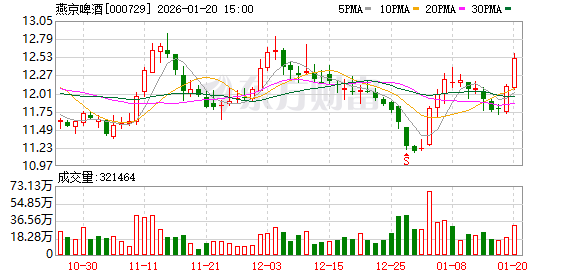
燕京啤酒(000729.SZ)发预增,预计2025年度归母净利润15.84亿元至17.42亿元,同比增长50%-65%
智通财经网· 2026-01-20 12:49
Core Viewpoint - Yanjing Beer (000729.SZ) has disclosed its earnings forecast for the year 2025, projecting a significant increase in net profit attributable to shareholders, indicating strong growth potential for the company [1] Financial Performance - The company expects net profit attributable to shareholders to be between 1.584 billion yuan and 1.742 billion yuan, representing a year-on-year growth of 50% to 65% [1] - The net profit after deducting non-recurring gains and losses is projected to be between 1.457 billion yuan and 1.561 billion yuan, reflecting a year-on-year increase of 40% to 50% [1]
爆款续命后,金星啤酒火速IPO:家族套现超3亿,欠缴员工公积金
Feng Huang Wang Cai Jing· 2026-01-20 12:49
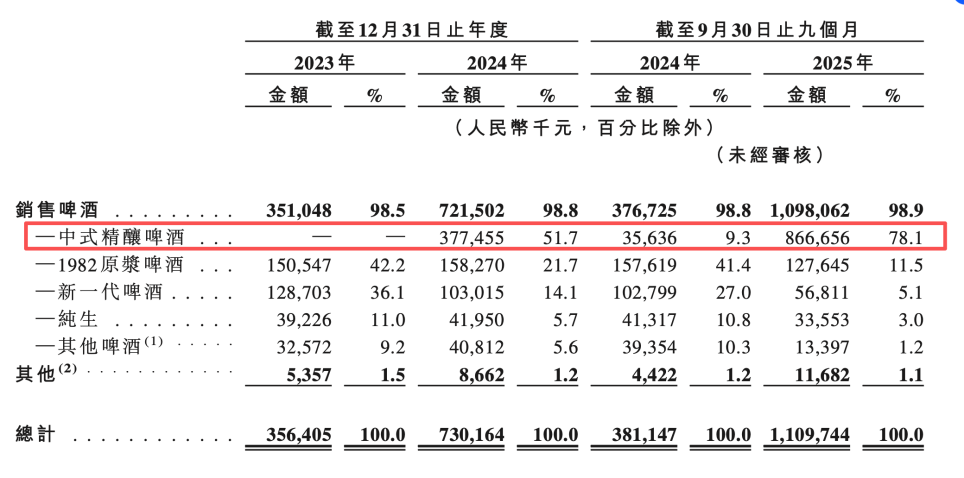
Core Viewpoint - Jinxing Beer has submitted its prospectus to the Hong Kong Stock Exchange, experiencing a significant turnaround driven by its popular product "Maojian Tea Beer," which has led to rapid revenue growth and a strong push for an IPO [1][2]. Financial Performance - Revenue for Jinxing Beer in 2023, 2024, and the first nine months of 2025 was 356 million, 730 million, and 1.1 billion RMB respectively, with net profits soaring from 12.2 million to 305 million RMB, marking a 924% increase in 2024 [1][3]. - Gross margins improved significantly, with figures of 27.3%, 37.8%, and 47% for the respective years, while net margins rose from 3.4% to 27.5% [1][6]. - Operating cash flow transitioned from a negative 60 million RMB in 2023 to a positive 360 million RMB in 2024 [1]. Product Dependency - The "Maojian Tea Beer" product line has become a major revenue contributor, accounting for 51.7% of total revenue in its launch year and increasing to 78.1% by the first nine months of 2025 [2][3]. - This heavy reliance on a single product raises concerns about revenue volatility in the face of market competition and changing consumer preferences [2]. Market Competition - The success of Jinxing Beer in the craft beer segment has attracted major competitors, including traditional beer giants and cross-industry players, leading to an increasingly competitive market landscape [2]. Corporate Governance - Jinxing Beer is a family-controlled business, with the Zhang family holding approximately 99.99% of the shares, indicating a high concentration of control [3]. - The company has faced scrutiny over its governance practices, including significant cash dividends distributed to major shareholders, raising concerns about the protection of minority shareholders' interests [4]. Financial Management Issues - The company has reported overdue social insurance and housing fund payments totaling 21.9 million RMB from 2023 to the first three quarters of 2025, although it claims to have rectified the social insurance issues [5]. - There have been irregularities in financial controls, such as allowing distributors to make payments through third-party accounts, which constituted a significant portion of cash receipts in previous years [5]. Debt Levels - Jinxing Beer had an extremely high debt-to-asset ratio of 2250% in 2023, which improved to 98.7% in 2024 and further decreased to 11.1% by the first nine months of 2025, indicating a significant reduction in financial leverage [5][6].
燕京啤酒发预增,预计2025年度归母净利润15.84亿元至17.42亿元,同比增长50%-65%
Zhi Tong Cai Jing· 2026-01-20 12:48
Core Viewpoint - Yanjing Beer (000729.SZ) has disclosed its earnings forecast for the year 2025, projecting a significant increase in net profit attributed to shareholders, indicating strong growth potential in the company's financial performance [1] Financial Performance - The company expects net profit attributable to shareholders to be between 1.584 billion and 1.742 billion yuan, representing a year-on-year growth of 50% to 65% [1] - The net profit after deducting non-recurring gains and losses is projected to be between 1.457 billion and 1.561 billion yuan, reflecting a year-on-year increase of 40% to 50% [1]
爆款续命后,金星啤酒火速IPO:家族套现超3亿,欠缴员工公积金
凤凰网财经· 2026-01-20 12:44
Core Viewpoint - Jin Xing Beer has submitted its prospectus to the Hong Kong Stock Exchange, showcasing a significant turnaround driven by its popular product "Maojian Tea Beer," which has led to rapid revenue growth and a strong push for an IPO [1][9]. Financial Performance - Revenue figures for Jin Xing Beer are as follows: 2023 revenue was 356 million RMB, projected to reach 730 million RMB in 2024, and 1.1 billion RMB in the first nine months of 2025. Net profit surged from 12.2 million RMB in 2023 to 125 million RMB in 2024, and further to 305 million RMB in 2025 [1][10]. - Gross margins improved significantly, with 27.3% in 2023, 37.8% in 2024, and 47% in 2025. Net margins also increased from 3.4% in 2023 to 27.5% in 2025 [1][10]. - Operating cash flow transitioned from a negative 60 million RMB in 2023 to a positive 360 million RMB in 2024 [1]. Product Dependency - The "Maojian Tea Beer" product line has become a major revenue driver, contributing 51.7% of total revenue in 2024 and increasing to 78.1% in the first nine months of 2025. This heavy reliance on a single product poses risks if its popularity wanes or competition intensifies [2][4]. Market Competition - The success of the Chinese craft beer market has attracted major players like China Resources, Tsingtao, and Yanjing, as well as cross-industry companies such as Mixue Ice City and Hema, indicating a future of intensified competition [4]. Corporate Governance - Jin Xing Beer is a family-controlled business, with Zhang Tieshan and Zhang Feng holding approximately 99.99% of the shares, leading to concerns about governance and minority shareholder protection [6][7]. - The company has faced issues with unpaid employee social insurance and housing funds, totaling 21.9 million RMB from 2023 to the first three quarters of 2025, raising questions about its financial practices [8]. Dividend Policy - Following its revenue growth, Jin Xing Beer distributed significant cash dividends totaling 329 million RMB, which accounted for about 80% of its net profits for 2024 and 2025, primarily benefiting the controlling shareholders [7]. Debt Levels - The company's debt levels were alarming, with an asset-liability ratio of 2250% in 2023, which improved to 98.7% in 2024 and further reduced to 11.1% in the first nine months of 2025, indicating a significant recovery [9][10].

青岛啤酒(600600.SH):子公司财务公司拟合理利用自有资金进行固定收益类投资业务
Ge Long Hui A P P· 2026-01-20 12:38
Core Viewpoint - Qingdao Beer (600600.SH) aims to enhance capital utilization efficiency and increase cash asset returns by utilizing its wholly-owned subsidiary's financial company for fixed-income investment, ensuring daily operational needs and fund safety are maintained [1] Group 1 - The financial company will engage in fixed-income investment activities with a maximum balance of RMB 4.34 billion, not exceeding 70% of the financial company's net capital [1] - The funds within this limit can be used on a rolling basis [1]

青岛啤酒:子公司财务公司拟合理利用自有资金进行固定收益类投资业务
Ge Long Hui· 2026-01-20 12:22
Core Viewpoint - Qingdao Beer (600600.SH) aims to enhance capital utilization efficiency and increase cash asset returns by utilizing its wholly-owned subsidiary's financial company for fixed-income investment, ensuring daily operational needs and fund safety are met [1] Group 1 - The financial company will engage in fixed-income investment activities with a maximum balance of RMB 4.34 billion, not exceeding 70% of the financial company's net capital [1] - The funds within this limit can be used on a rolling basis [1]
燕京啤酒:2025年净利润同比预增50%-65%
Di Yi Cai Jing· 2026-01-20 12:13
Core Viewpoint - The announcement from Yanjing Beer indicates a significant expected increase in net profit for the fiscal year 2025, reflecting the company's strategic focus on product innovation and brand development [1] Group 1: Financial Performance - Yanjing Beer projects a net profit attributable to shareholders of 1.58352 billion to 1.74187 billion yuan for the fiscal year 2025, representing a growth of 50% to 65% compared to the previous year [1] - The increase in net profit is partly due to the recognition of land reserve payments from a subsidiary, which is expected to add approximately 132 million yuan to the net profit attributable to shareholders [1] Group 2: Strategic Initiatives - The company is committed to advancing its "big product" strategy, focusing on enhancing product strength, brand power, and channel capabilities [1] - Yanjing Beer is actively exploring innovative paths and deepening its management system to support brand modernization, including youth-oriented, fashionable, and premium positioning [1] - The implementation of a tiered market development strategy is part of the company's efforts to sustain growth, with Yanjing U8 continuing to show a steady growth trend [1]
燕京啤酒2025年预计归母净利提升超五成
Bei Jing Shang Bao· 2026-01-20 12:12
Core Viewpoint - Beijing Yanjing Beer Co., Ltd. forecasts a net profit attributable to shareholders of 1.584 billion to 1.742 billion yuan for the year 2025, representing a year-on-year increase of 50% to 65% compared to 1.056 billion yuan in the previous year [1] Financial Performance - The expected net profit range for 2025 is between 1.584 billion yuan and 1.742 billion yuan [1] - This projection indicates a significant growth of 50% to 65% compared to the net profit of 1.056 billion yuan from the previous year [1]
1月20日晚间公告 | 利欧股份核查完成复牌;璞泰来等多家公司年报业绩大增
Xuan Gu Bao· 2026-01-20 12:10
Suspension and Resumption - Liao Co., Ltd. has completed the verification and resumed trading [1] - Kailong High-Tech is planning to acquire control of Jinwangda, resulting in stock suspension [2] External Investment and Daily Operations - Baili Tianheng's application for the marketing of iza-bren for the treatment of recurrent or metastatic esophageal squamous cell carcinoma has been accepted and included in the priority review list, marking the first global application for an EGFR×HER3 dual antibody ADC [3] - Huadian Technology has signed a contract worth 374 million yuan for the first phase of a 1 million kilowatt wind-solar hydrogen production project in Inner Mongolia [4] - Jinma Amusement plans to raise no more than 1.05 billion yuan through a private placement for projects related to cultural tourism robots, IP empowerment, and park construction and operation [4] - Zhenyu Technology anticipates a significant increase in orders from the robotics sector by Q4 2025, particularly for dexterous hand components and assemblies [4] Performance Changes - Putailai expects a net profit of 2.3 billion to 2.4 billion yuan in 2025, representing a year-on-year growth of 93.18% to 101.58%, driven by significant increases in wet diaphragm and coating processing business volumes [5] - Hikvision anticipates a net profit of 14.188 billion yuan in 2025, an 18% increase year-on-year [6] - Chipbond expects a net profit of 275 million to 295 million yuan in 2025, reflecting a growth of 71.13% to 83.58% due to breakthroughs in high-end PCB and semiconductor fields [6] - Allwinner Technology forecasts a net profit of 251 million to 295 million yuan in 2025, a growth of 50.53% to 76.92% driven by increased market demand and new product launches [6] - Yanjing Beer projects a net profit of 1.58352 billion to 1.74187 billion yuan in 2025, a growth of 50% to 65% year-on-year [7] - Zhongshi Technology expects a net profit of 330 million to 370 million yuan in 2025, a growth of 63.86% to 83.73% due to increased shipments of thermal materials and components [7] - Yutong Optical anticipates a net profit of 240 million to 280 million yuan in 2025, a growth of 30.75% to 52.54% driven by increased business volume in various optical components [7] - Tonghuashun expects a net profit of 2.735 billion to 3.282 billion yuan in 2025, reflecting a growth of 50% to 80% due to increased activity in the domestic capital market [7] - Tongfu Microelectronics projects a net profit of 1.1 billion to 1.35 billion yuan in 2025, a growth of 62.34% to 99.24% driven by structural growth in the global semiconductor industry [8] - Northeast Securities anticipates a net profit of 1.477 billion yuan in 2025, a growth of 69.06% due to increased investment and wealth management income [8]
