
债券

Search documents
固收-2026年度策略-时光倒流
2025-12-31 16:02
Summary of Key Points from Conference Call Industry Overview - The discussion primarily revolves around the Chinese economy and its comparison with Japan, emphasizing that the economic conditions and corporate investments in China are distinct from Japan's past experiences [1][3] - The focus is on the structural performance of the Chinese market, particularly in the TMT (Technology, Media, and Telecommunications) sector, which is becoming increasingly significant [1][6] Core Insights and Arguments - High-quality development is emphasized, prioritizing sustainability over reliance on infrastructure and real estate, which have diminished in importance for A-shares [1][5] - The correlation between memory prices and A-shares is highlighted, with a reported correlation of 0.76, indicating that memory prices are more relevant for investment decisions than real estate prices [6][7] - The contribution of real estate to GDP is declining, with its impact now less significant than that of some software and information sectors [8] - The relationship between housing prices and interest rates is unstable, with historical examples showing varying trends [9] - Consumer behavior is affected by real estate market fluctuations, but this impact varies significantly across different regions [10] - Export data is crucial for asset pricing, but over-reliance on it can lead to misjudgments, as seen in past economic cycles [11] Important but Overlooked Content - The global inflation transmission mechanism indicates a reversal of long-term deflation expectations in China, challenging previous assumptions about the economy [12] - Anticipated monetary policy adjustments for 2026 include a potential rate cut and reserve requirement ratio reduction, but significant credit expansion is unlikely [13] - The bond market faces challenges such as spread issues and changing commercial models, with a forecasted 10-year government bond yield range of 1.7% to 2.1% for 2026 [2][18] - Investment opportunities for 2026 include timing for government bond purchases, EVE indicator management, and changes in fiscal debt structure, with an overall increase in risk appetite due to rising stock proportions in financial products [19]
外资行美债&汇率2026展望汇总
2025-12-31 16:02
Summary of Key Points from the Conference Call Records Industry Overview - The conference call records focus on the U.S. Treasury market and interest rate outlook for 2026, with insights from various financial institutions including Barclays, HSBC, Morgan Stanley, Deutsche Bank, and Bank of America Merrill Lynch. Core Insights and Arguments U.S. Treasury Market Outlook 1. **Yield Curve Dynamics**: - Barclays predicts a steepening of the yield curve, with 2-year yields expected to drop to 3.1% and 30-year yields remaining around 4.7%, resulting in a 2s30s spread of 160 basis points [6][10]. - HSBC anticipates a bear steepening of the yield curve, projecting a 10-year yield of 4.30% by the end of 2026 [15][19]. - Morgan Stanley suggests that the Fed's rate cuts may be less than market expectations, with a forecast of only 50 basis points of cuts [25][26]. 2. **Federal Reserve Policy**: - The new leadership at the Federal Reserve is expected to adopt a more dovish stance, potentially lowering rates below neutral levels [6][7]. - The Fed is projected to end quantitative tightening (QT) and begin purchasing T-bills to maintain adequate reserves, with an estimated purchase of $330 billion in T-bills in 2026 [10][31]. 3. **Fiscal Deficit and Inflation**: - The fiscal deficit is expected to remain around 6% of GDP, approximately $1.9 trillion, with inflation projected to stabilize around 2% [6][10][25]. - Concerns about inflation resurgence due to fiscal expansion and tariff impacts are highlighted, with core PCE inflation expected to remain above 2% [41][48]. Supply and Demand Dynamics 1. **Net Supply Projections**: - A significant reduction in net supply of U.S. Treasuries is anticipated, with a decrease of approximately $470 billion to $1.2 trillion in 2026 [6][58]. - Investment-grade corporate bonds are expected to see an increase in net supply, driven by mergers and acquisitions [58]. 2. **Market Demand**: - Bank demand for mid-term Treasuries is expected to rebound due to regulatory changes [9]. - Continuous inflows into bond funds are supporting demand, particularly for MBS, which are favored due to their attractive spreads [58][62]. Investment Recommendations 1. **Asset Recommendations**: - Barclays recommends going long on 2-year Treasuries to capitalize on anticipated rate cuts [10]. - HSBC suggests positioning in the belly of the curve (5-year Treasuries) for lower structural risk and positive carry [21]. - Deutsche Bank advises a cautious approach to long-dated Treasuries, predicting underperformance relative to swaps [39]. 2. **Strategic Themes**: - "Carry is king" is emphasized as a core investment strategy, focusing on high-yield bonds and leveraged loans due to their attractive coupon rates in a stable interest rate environment [41][47]. - The potential for a bear steepening of the yield curve is noted, with strategies to exploit this dynamic [21][47]. Other Important Insights - The reports highlight a complex economic landscape characterized by resilient growth, sticky inflation, and the dual risks of fiscal deterioration and inflation rebound [7][17]. - The impact of AI-driven capital expenditures and fiscal stimulus from legislation like the One Big Beautiful Bill Act (OBBBA) is noted as a potential growth driver [41][48]. - The need for caution regarding economic recession risks and policy uncertainties is emphasized, particularly in relation to tariffs and Fed independence [26][37]. This summary encapsulates the key points from the conference call records, providing a comprehensive overview of the U.S. Treasury market outlook and associated investment strategies for 2026.
【立方债市通】郑州两家AAA主体拟发债47亿/2026年土储专项债发行启动/机构研判明年城投信用趋势
Sou Hu Cai Jing· 2025-12-31 12:46
Key Points - The bond market issued over 70,000 billion yuan in November 2025, with various categories including government bonds, local government bonds, financial bonds, corporate credit bonds, asset-backed securities, and interbank certificates of deposit [1] - The Ministry of Finance announced the bond issuance plan for the first quarter of 2026, which includes key term government bonds, short-term government bonds, ultra-long general government bonds, and savings bonds [2] - The central bank conducted a 7-day reverse repurchase operation of 5,288 billion yuan, resulting in a net injection of 5,028 billion yuan [4] - Qingdao initiated the issuance of special bonds for land reserves in 2026, with total financing for land reserve special bonds in 2025 reaching 5,602.71 billion yuan [6] - Beijing, Shandong, Xinjiang, and Hubei announced plans to issue a total of 3,895.21 billion yuan in local government bonds in the first quarter of 2026 [6] - The Zhengzhou Transportation Development Investment Group plans to issue 1 billion yuan in green corporate bonds, which has been approved by the Shanghai Stock Exchange [10] - The Zhengzhou Urban Development Group plans to issue 3.7 billion yuan in corporate bonds, which has been accepted by the Shanghai Stock Exchange [11] - The New Xiang High-tech Investment Group plans to issue 300 million yuan in rural revitalization corporate bonds, which has been approved by the Shenzhen Stock Exchange [13] - The Henan Urban and Rural Comprehensive Investment Company plans to issue 2 billion yuan in bonds to support small and micro enterprises, which has been accepted by the Shenzhen Stock Exchange [17] - The credit rating of Shaanxi Tourism Group has been upgraded from AA+ to AAA, with a stable outlook [19] - The credit quality of local government financing platforms is expected to remain stable in 2025, with a focus on debt replacement and risk mitigation [22] - The refinancing environment for local government financing platforms is expected to remain tight in 2026, with strict controls on new financing [23] - The transformation of local government financing platforms is essential, with mergers and acquisitions expected to continue [24] - New policies targeting the management and resolution of operating debts of platform companies are anticipated in 2027 [25]


2025年债市复盘系列之一:再见2025:利率债复盘
Huachuang Securities· 2025-12-31 12:04
1. Report Industry Investment Rating There is no information provided regarding the industry investment rating in the given documents. 2. Core View of the Report In 2025, the bond market ended two consecutive years of rapid decline and entered a low - level oscillation. Due to the over - pursuit of interest rate cut expectations and capital gain games at the end of 2024, which over - exhausted the market's upward potential, the yield at the beginning of 2025 was at the annual low. Although the tariff disturbances in early April provided temporary support to the bond market, in the second half of the year, along with the repair of the stock - bond ratio and regulatory disturbances in the fund market, the bond market gradually adjusted, with the adjustment intensifying towards the end of the year and a significant increase in the ultra - long end. Driven by three main lines of central bank policy regulation, tariff games, and the stock - bond seesaw, the yield showed an "N - shaped" trend, and the ultra - long - term spread broke out of the low - level oscillation range, with the 30 - 10y Treasury term spread returning to the level of the second half of 2022 [5][8]. 3. Summary by Directory 3.1 Annual Summary: Fast Bull Pause, Low - Level Balance - In 2025, the bond market shifted from a fast - bull market to a low - level balance. The yield started at a low point due to the over - speculation at the end of 2024. Throughout the year, it was affected by central bank policies, tariff games, and the stock - bond seesaw, showing an "N - shaped" trend [5][8]. - From January to March, the central bank tightened funds, causing the yield to rise to the annual high of 1.90%. From April to June, tariff disturbances and growth - stabilizing policies led to a narrow - range oscillation around 1.65%. From July to September, the stock - bond seesaw and regulatory new rules triggered an upward adjustment in yield. From October to the end of the year, factors such as tightened fund regulation, weakened monetary easing expectations, and supply - demand pressure in the ultra - long end led to a significant upward adjustment in the bond market [9]. 3.2 Stage Review: Central Bank → Tariff → Stock - Bond Seesaw, Yield "N - shaped" Trend 3.2.1 First Stage: Continuation of the Late - 2024 Rush - Ahead Market, Bond Market Reached the Annual Low - From late November 2024 to early January 2025, the reduction of non - bank inter - bank deposits in late November 2024 removed interest rate blockages, and the monetary policy turned "moderately loose". With the year - end rush - ahead by institutions, the yield of the 10 - year Treasury active bond dropped below 1.6% to 1.59% in early January 2025 [5][12]. 3.2.2 Second Stage: Central Bank's Tightening of Funds Broke the Interest Rate Downward Inertia, Bond Market Corrected to the Annual High - From early January to the end of March 2025, the central bank tightened funds to address long - term interest rate risks and "fund idling". The bond market returned to a positive carry situation, and the 10 - year Treasury yield rose from 1.60% to the annual high of 1.89%. After the tax period and at the end of the quarter, with the central bank's active liquidity injection, the bond market stabilized and recovered to around 1.80% [13][18]. 3.2.3 Third Stage: Tariff Friction and Growth - Stabilizing Policy Game, Yield Declined and Then Turned to Oscillation - From April to June 2025, the "reciprocal tariff" imposed by the US on China in early April and the subsequent domestic growth - stabilizing policies led to a rapid decline in yield, which then entered a narrow - range oscillation around 1.65%. In May, after the implementation of policies such as interest rate cuts and reserve requirement ratio cuts, the bond market showed a "buy - the - rumor, sell - the - news" pattern, and the yield oscillated upwards. In June, with the central bank's release of a "loose money" signal and other factors, the yield dropped slightly to 1.65% [2][19]. 3.2.4 Fourth Stage: "Anti - Involution" and Regulatory New Rules Triggered Adjustment Pressure, Stock - Bond Seesaw Effect Prominent - From July to September 2025, after the weakening of external disturbances in July, the "anti - involution" policy made the stock - bond seesaw effect prominent, and the news of new fund sales rules increased the concern of bond fund redemptions. The bond market entered a period of headwinds, with the yield rising significantly and the curve steepening [25]. 3.2.5 Fifth Stage: The Year - End Consensus Expectation Was Broken, Bond Market Oscillated Weakly - From October to December 2025, after the escalation of tariff frictions in October, concerns about fund regulation led to preventive redemptions of bond funds by institutional investors. The central bank's bond - buying scale was lower than expected, and risk events in the real estate market and supply - demand pressure in the ultra - long end led to a significant upward adjustment in the bond market, with the 30 - year Treasury leading the decline and the curve steepening [30].
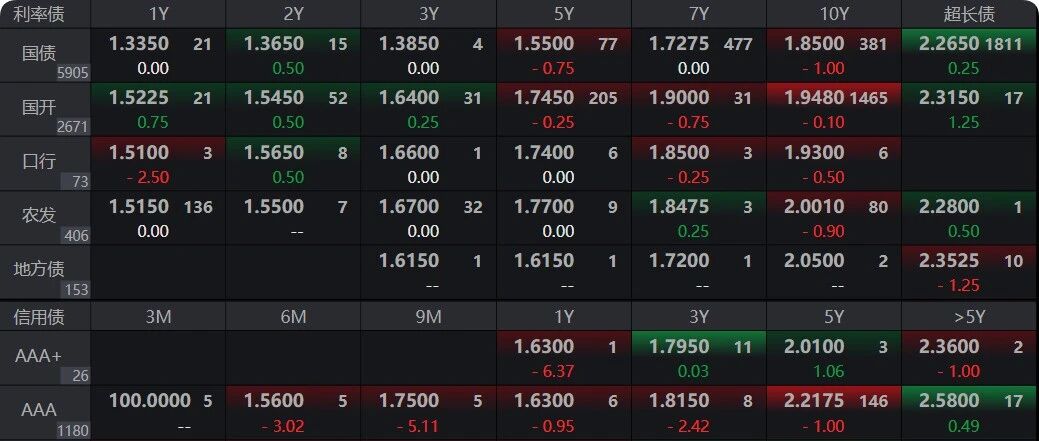
【笔记20251231— 蓄势2025,突破2026】
债券笔记· 2025-12-31 10:50
Core Viewpoint - The article discusses the current financial market conditions, highlighting the balanced and slightly loose liquidity environment, the unexpected rise in PMI, and the short-term nature of the bond market adjustments, leading to mixed performance in the stock and bond markets [2][4]. Group 1: Market Conditions - The central bank conducted a 7-day reverse repurchase operation of 528.8 billion yuan, with a net injection of 502.8 billion yuan after 26 billion yuan of reverse repos matured [2]. - The liquidity environment is described as balanced and slightly loose, with the DR001 rate around 1.33% and DR007 at approximately 1.98% [2]. - The stock market experienced slight gains, with the December PMI exceeding expectations, while bond market sentiment was initially positive before fluctuating [4]. Group 2: Bond Market Insights - The 10-year government bond yield opened at 1.86%, dipping to a low of 1.8475% before rebounding to 1.85% later in the day [4]. - The article notes that the bond market's adjustment is viewed as a short-term phenomenon by most industry insiders, as reported by the Financial Times [4]. - The 10-year government bond futures recorded their first annual decline since 2017, indicating significant market shifts [4]. Group 3: Year-End Performance - The US dollar index recorded its largest annual decline in eight years, paving the way for a strong performance in global commodities and stock markets, with gold and silver achieving historic gains [4]. - The Shanghai Composite Index rose by 18.4%, marking its largest annual increase in six years, while the bond market faced challenges [4]. - The article humorously attributes the bond market's predictions to a deputy governor, who forecasted a significant drop in bond prices with a yield increase of 30 basis points [4].
2025收官日,美股指期货集体下挫,科技股承压,金银齐跌,现货白银跌近6%,原油小幅走高
Hua Er Jie Jian Wen· 2025-12-31 10:45
Market Overview - On the last trading day of 2025, US stock index futures collectively declined, with technology stocks under pressure in pre-market trading [1] - The market experienced light trading due to holiday factors, with European stocks showing mixed results [2] - Major global exchanges shortened trading hours, with Japan, South Korea, and Germany closed, and France and the UK closing early [1] Key Market Movements - The Dow futures fell by 0.15%, S&P 500 futures dropped by 0.26%, and Nasdaq futures decreased by nearly 0.4% [1][4] - The 10-year US Treasury yield decreased by 1 basis point to 4.11% [3] - The US dollar remained stable, while the euro and yen both fell by 0.1% against the dollar [3] Commodity and Cryptocurrency Performance - Spot silver plummeted over 5.4% to $72 per ounce, with a significant drop of nearly 7% at one point [3][4] - Spot gold decreased by 0.2% to $4,329 per ounce, while WTI crude oil rose by 0.3% to $58.1 per barrel [3] - Bitcoin increased by 0.3% to $88,476.81, and Ethereum rose by 0.2% to $2,971.16 [3] Analyst Insights - Market dynamics are influenced more by divergence than direction as the year-end approaches, which has somewhat suppressed risk appetite [1] - Investment portfolio adjustments may be occurring as fund managers seek to align their holdings with benchmark indices after a strong year [3]

央行:11月债券市场共发行各类债券70179.3亿元
智通财经网· 2025-12-31 10:33
Group 1: Bond Market Issuance - In November, the bond market issued a total of 70,179.3 billion yuan across various types of bonds, including 10,444.2 billion yuan in government bonds, 9,126.9 billion yuan in local government bonds, 11,955.0 billion yuan in financial bonds, 13,948.8 billion yuan in corporate credit bonds, 327.2 billion yuan in credit asset-backed securities, and 24,009.2 billion yuan in interbank certificates of deposit [2][3] - As of the end of November, the total custody balance of the bond market reached 196.3 trillion yuan, with 173.0 trillion yuan in the interbank market and 23.2 trillion yuan in the exchange market [2][3] Group 2: Bond Market Trading Activity - In November, the interbank bond market recorded a total transaction volume of 30.5 trillion yuan, with an average daily transaction of 1.5 trillion yuan, reflecting a year-on-year increase of 7.6% and a month-on-month increase of 3.2% [3] - The exchange bond market had a transaction volume of 3.8 trillion yuan, with an average daily transaction of 188.7 billion yuan [3] Group 3: Foreign Participation in Bond Market - As of the end of November, the custody balance of foreign institutions in the Chinese bond market was 3.6 trillion yuan, accounting for 1.9% of the total custody balance [4] - Foreign institutions held 2.0 trillion yuan in government bonds, representing 56.2% of their total holdings [4] Group 4: Money Market Activity - In November, the interbank lending market recorded a transaction volume of 7.4 trillion yuan, a year-on-year decrease of 17.3% but a month-on-month increase of 9.6% [5] - The weighted average interest rate for interbank lending was 1.42%, up by 2.5 basis points month-on-month [5] Group 5: Commercial Paper Market - In November, the acceptance amount of commercial bills was 4.0 trillion yuan, with a discount amount of 3.1 trillion yuan [6] - Small and micro enterprises accounted for 93.5% of all bill issuers, with a total bill issuance amount of 3.0 trillion yuan [6] Group 6: Stock Market Performance - At the end of November, the Shanghai Composite Index closed at 3,888.6 points, down 66.2 points or 1.7% from the previous month [7] - The Shenzhen Component Index closed at 12,984.1 points, down 394.1 points or 2.9% from the previous month [7] Group 7: Holder Structure in Interbank Bond Market - As of the end of November, there were 3,987 institutional members in the interbank bond market, all of which were financial institutions [8] - The top 50 investors in corporate credit bonds held 53.4% of the total holdings, primarily concentrated among state-owned commercial banks, public funds, and insurance financial institutions [8]
央行:11月,债券市场共发行各类债券70179.3亿元
Sou Hu Cai Jing· 2025-12-31 10:18
Group 1: Bond Market Issuance - In November, the bond market issued a total of 70,179.3 billion yuan across various types of bonds, including 10,444.2 billion yuan in government bonds, 9,126.9 billion yuan in local government bonds, 11,955.0 billion yuan in financial bonds, 13,948.8 billion yuan in corporate credit bonds, 327.2 billion yuan in credit asset-backed securities, and 24,009.2 billion yuan in interbank certificates of deposit [1] Group 2: Bond Market Operation - In November, the interbank bond market had a total transaction volume of 30.5 trillion yuan, with an average daily transaction of 1.5 trillion yuan, reflecting a year-on-year increase of 7.6% and a month-on-month increase of 3.2% [2] - The exchange bond market recorded a transaction volume of 3.8 trillion yuan, with an average daily transaction of 188.7 billion yuan [2] Group 3: Foreign Participation in Bond Market - As of the end of November, the custody balance of foreign institutions in the Chinese bond market was 3.6 trillion yuan, accounting for 1.9% of the total custody balance [3] - Foreign institutions held 2.0 trillion yuan in government bonds, representing 56.2% of their total holdings [3] Group 4: Money Market Operation - In November, the interbank lending market had a transaction volume of 7.4 trillion yuan, a year-on-year decrease of 17.3% but a month-on-month increase of 9.6% [4] - The weighted average interest rate for interbank lending was 1.42%, up by 2.5 basis points month-on-month [4] Group 5: Bill Market Operation - In November, the acceptance amount of commercial bills was 4.0 trillion yuan, while the discount amount was 3.1 trillion yuan [5] - Small and micro enterprises accounted for 93.5% of all bill issuers, with a total bill issuance amount of 3.0 trillion yuan [5] Group 6: Stock Market Operation - By the end of November, the Shanghai Composite Index closed at 3,888.6 points, a decrease of 66.2 points or 1.7% [6] - The average daily trading volume in the Shanghai market was 808.05 billion yuan, reflecting a month-on-month decrease of 16.0% [6] Group 7: Holder Structure in Interbank Bond Market - As of the end of November, there were 3,987 institutional members in the interbank bond market, all of which were financial institutions [7] - The top 50 investors in corporate credit bonds held 53.4% of the total bonds, primarily concentrated among state-owned commercial banks, public funds, and insurance institutions [8]
央行:11月份债券市场共发行各类债券70179.3亿元
Zheng Quan Shi Bao Wang· 2025-12-31 09:56
Core Insights - The central point of the article is the performance of the bond market in November 2025, highlighting the total issuance and custody balances of various types of bonds [1] Group 1: Bond Issuance - In November, the total issuance of various bonds reached 70,179.3 billion yuan [1] - Government bonds issued amounted to 10,444.2 billion yuan, while local government bonds totaled 9,126.9 billion yuan [1] - Financial bonds issued were 11,955.0 billion yuan, and corporate credit bonds reached 13,948.8 billion yuan [1] - Credit asset-backed securities issued were 327.2 billion yuan, and interbank certificates of deposit issuance was 24,009.2 billion yuan [1] Group 2: Bond Custody Balances - As of the end of November, the total custody balance of the bond market was 196.3 trillion yuan [1] - The interbank market custody balance was 173.0 trillion yuan, while the exchange market custody balance was 23.2 trillion yuan [1] - By bond type, the custody balances were as follows: government bonds at 40.1 trillion yuan, local government bonds at 54.3 trillion yuan, financial bonds at 44.6 trillion yuan, corporate credit bonds at 34.8 trillion yuan, credit asset-backed securities at 1.0 trillion yuan, and interbank certificates of deposit at 20.3 trillion yuan [1] - The custody balance of commercial bank counter bonds was 2,740.7 billion yuan [1]
欧元区国债收益率反弹 欧元窄幅波动静候美联储纪要
Xin Lang Cai Jing· 2025-12-31 09:31
Group 1 - Eurozone government bond yields have slightly risen amid thin holiday trading, while the euro has experienced a minor decline [1] - The market is awaiting the release of the Federal Reserve's December meeting minutes at 19:00 GMT for insights on potential U.S. interest rate cuts in 2026 [1] - The euro has dropped by 0.15% to 1.1775 USD, influenced by a stronger dollar [1] Group 2 - Eurozone bond yields have rebounded, partially recovering from previous declines, with Spain's harmonized inflation rate easing slightly from 3.2% in November to 3.0% in December, supporting bond market performance [1] - The yield on Germany's 10-year government bonds increased by 2.5 basis points to 2.853%, while Spain's equivalent yield rose by 3.3 basis points to 3.283% [1]